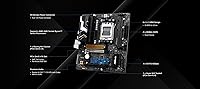
Overview

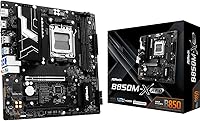
The ASRock B850M-X R2.0 Micro-ATX Motherboard arrived in mid-2025 as a well-timed option for builders ready to commit to AMD's AM5 platform without spending flagship money. The B850 chipset sits comfortably between entry-level B650 and the pricier X870 — capable enough for most Ryzen builds, without the premium overhead you may never actually use. This budget AM5 motherboard has already earned a spot near the top of Amazon's Computer Motherboards bestseller list, which reflects genuine demand rather than clever marketing. That said, it is designed for mainstream use. Don't walk in expecting an extreme overclocking platform; this is a practical board built squarely around real-world value.
Features & Benefits

The B850M-X R2.0 packs a 6+1+1 Dr.MOS power design that handles Ryzen 7000 and 9000 series chips reliably through everyday workloads, though builders pairing it with a high-TDP Ryzen 9 should keep expectations grounded — this isn't built for extreme sustained loads. Memory support reaches 8200+ MHz in overclocked mode across two DDR5 slots running dual-channel by default, which is genuinely fast for this price tier. Storage flexibility stands out: a PCIe 5.0 M.2 slot, a Gen4 M.2 slot, and four SATA ports give you room to grow without an immediate upgrade. Wired networking runs at 2.5G, and BIOS Flashback lets you update firmware without a compatible CPU installed — useful when a new Ryzen generation drops before a BIOS update ships.

Best For

This Micro-ATX AM5 board makes the most sense for builders putting together compact, cost-conscious systems around a Ryzen 7000 or 9000 processor. If your case is Micro-ATX or smaller and you want a platform that will still feel current in a few years, this hits the right notes. It's also a natural fit for home office machines where solid wired ethernet matters more than built-in wireless — just know there's no Wi-Fi here; that's the WiFi variant's job. Upgraders coming from AM4 who want DDR5 and PCIe 5.0 without jumping to a premium chipset will find it appealing. And if you're planning to drop in a future Ryzen CPU, BIOS Flashback makes the initial setup significantly less stressful.

User Feedback

With 97 ratings averaging 4.4 out of 5 stars, the B850M-X R2.0 has built a solid early reputation — though the review pool is still relatively small for a board released mid-2025, so treat the score as encouraging rather than definitive. Buyers consistently highlight how painless the installation is and praise the BIOS interface for being approachable, even for first-time builders. DDR5 stability out of the box comes up repeatedly as a positive. On the flip side, the two-DIMM limit frustrates upgraders wanting four slots, and the absence of Wi-Fi catches some buyers off guard. A few users running demanding Ryzen 9 chips note the power delivery headroom is tighter than they'd prefer. Overall, most buyers feel it punches well for what it costs.

Pros

  • B850 chipset hits a practical sweet spot — more capable than B650 without the X870 price jump.
  • PCIe 5.0 x16 slot and a Gen5 M.2 slot keep the build relevant for next-generation GPUs and SSDs.
  • BIOS Flashback lets you update firmware without a working CPU installed, which simplifies new-platform builds considerably.
  • DDR5 speeds up to 8200+ MHz in OC mode deliver genuinely fast memory performance for the price tier.
  • Two M.2 slots plus four SATA ports offer more storage flexibility than most boards in this class.
  • The B850M-X R2.0 supports the full Ryzen 7000, 8000, and 9000 lineup, giving you CPU upgrade options down the road.
  • 2.5G LAN is a meaningful step up from standard gigabit, especially for NAS users or heavy local file transfers.
  • Micro-ATX form factor works across a wide range of cases without the footprint of a full ATX board.
  • Early buyer reviews consistently highlight a smooth installation experience and an approachable BIOS interface.
  • DDR5 runs stably out of the box for most users, with little to no manual tuning required at stock settings.

Cons

  • Only two DIMM slots limits memory configuration options — no room for a four-stick setup.
  • No onboard Wi-Fi on this SKU; buyers who skim the listing may not catch the distinction until the build is underway.
  • Power delivery headroom is tighter than ideal when running high-TDP Ryzen 9 processors under sustained loads.
  • The review pool is still relatively small for a mid-2025 release, so long-term reliability data is limited.
  • No Thunderbolt connectivity, which rules it out for creators relying on high-bandwidth external peripherals.
  • USB options are functional but not particularly generous — demanding multi-device setups may feel constrained at the rear.
  • Budget-tier VRM cooling means thermal performance under extreme workloads is less predictable than on pricier boards.
  • No integrated graphics output support, so a discrete GPU or APU is required to get a display signal.

Ratings

Our AI rating system analyzed verified global buyer reviews for the ASRock B850M-X R2.0 Micro-ATX Motherboard, actively filtering out incentivized, bot-generated, and unverified feedback to surface what real builders actually experienced. Scores reflect a balanced synthesis of both praise and frustration — nothing is rounded up to make the board look better than it is. Where users consistently flagged trade-offs, those pain points are reflected directly in the numbers below.

Value for Money
88%
Buyers repeatedly note that getting PCIe 5.0, dual M.2 slots, and 2.5G LAN at this price tier is genuinely hard to beat. For builders assembling a compact Ryzen 9000 system on a constrained budget, the feature-to-cost ratio lands well above most direct competitors.
A handful of buyers feel the lack of onboard Wi-Fi slightly undercuts the value proposition, since adding a wireless adapter pushes the effective cost closer to the WiFi variant anyway. Those who needed Wi-Fi from day one felt they should have spent a little more upfront.
Installation Experience
91%
First-time builders consistently describe the physical installation as refreshingly straightforward — clear labeling, logical component placement, and a well-organized I/O area reduce the usual new-build guesswork. The included quick-start documentation covers the essentials without being overwhelming.
A small number of reviewers flagged that the M.2 retention screw locations are fiddly on the Gen5 slot, requiring a steady hand and the right screwdriver size. Nothing unusual for the form factor, but worth noting for builders with limited dexterity.
BIOS Usability
83%
The EZ Mode interface is clean and covers boot order, fan control, and XMP/EXPO memory enablement in a way that does not intimidate newer builders. Experienced users praise the Advanced Mode for exposing enough tuning options to tweak memory subtimings and voltage without unnecessary complexity.
Some users report that the initial factory BIOS on early units required an update before DDR5 kits would POST at their rated speeds, which is manageable but adds a setup step beginners may not anticipate. The BIOS aesthetics also feel dated compared to premium competitors.
DDR5 Memory Stability
86%
The majority of buyers report that DDR5 kits running at 6000 MHz to 6400 MHz lock in and run stable immediately after enabling XMP or EXPO in BIOS, with no manual intervention needed. Even kits rated for higher speeds generally trained correctly within one or two reboots.
Pushing beyond 7200 MHz required more manual tuning for several users, and a subset of reviewers found that certain memory kits not on ASRock's QVL struggled to maintain stability at advertised speeds without voltage adjustments. The two-slot limitation also means there is no fallback configuration if a kit is problematic.
Power Delivery & VRM
67%
33%
For Ryzen 7 and mid-range Ryzen 9 chips running within their stock power limits, the 6+1+1 Dr.MOS stage delivers clean, stable voltage with no thermal complaints reported from mainstream use cases. Home office builds and gaming rigs with sensible TDP headroom are well within its comfort zone.
Users pairing the board with top-end Ryzen 9 processors and running sustained all-core workloads — rendering, encoding, simulation — note that VRM temperatures climb noticeably under prolonged stress. The power phase count is adequate for mainstream use but clearly not engineered with enthusiast-class sustained loads in mind.
Storage Flexibility
89%
Having a Gen5 M.2 slot, a Gen4 M.2 slot, and four SATA ports on a budget Micro-ATX board is genuinely uncommon, and buyers building media servers or multi-drive gaming rigs appreciate having room to grow without needing an add-in card. Both M.2 slots can be populated simultaneously without lane conflicts.
The SATA and M.2 ports share no bandwidth under typical configurations, but buyers running all slots fully populated reported needing to verify BIOS settings to confirm nothing was inadvertently disabled. Documentation on slot priority behavior could be clearer in the manual.
Networking Performance
84%
The Realtek 2.5G LAN delivers noticeably faster local network transfers than standard gigabit, which home NAS users and those on multi-gig ISP plans appreciate immediately. Latency during online gaming also tested consistently low across user reports, with no widespread driver stability complaints.
The complete absence of Wi-Fi on this SKU is the primary frustration, and it catches some buyers off guard if they did not read the listing carefully. For anyone in a room without an ethernet run, the board effectively requires additional spend to get wireless connectivity.
PCIe 5.0 Readiness
87%
Having a full PCIe 5.0 x16 slot positions the B850M-X R2.0 well for next-generation GPU drops, and current high-end GPUs run at full bandwidth without any de-rating. The Gen5 M.2 slot pairs well for users who want the fastest available NVMe storage alongside a modern GPU.
At the time of writing, PCIe 5.0 GPUs are not yet widely available at consumer price points, so this feature is largely future-facing. Some buyers feel they are paying a small premium for headroom they may not realistically use for a year or more.
BIOS Flashback
92%
Builders who purchased a Ryzen 9000 series CPU with an older BIOS on the board praise this feature heavily — being able to flash firmware without any installed components removes a common first-build obstacle entirely. The process is well-documented by ASRock and works reliably according to multiple user reports.
The feature requires a specific USB port on the rear I/O and a correctly formatted drive, and a few users initially used the wrong port or file naming convention, causing confusion. Clear labeling on the port itself helps, but the setup process is not entirely foolproof for absolute beginners.
Thermal Management
71%
29%
For mainstream Ryzen builds with reasonable ambient temperatures, the board's heatsinks keep chipset and VRM temperatures well within safe operating ranges under mixed workloads. Builders running the board in well-ventilated Micro-ATX cases report no thermal throttling or stability issues during everyday use.
In compact cases with restricted airflow, VRM temperatures under sustained all-core loads rise more quickly than on boards with larger or heatpipe-linked heatsinks. Builders planning to use high-TDP Ryzen 9 chips in a tight enclosure should factor in active case airflow as a non-negotiable.
USB Connectivity
72%
28%
The inclusion of both front-panel and rear USB 3.2 Gen1 Type-C ports is appreciated by builders using modern cases and peripherals, and the USB 2.0 headers remain useful for wireless keyboard or mouse dongles and RGB controllers. Coverage is solid for a board in this class.
The rear USB port count is modest compared to mid-range competitors, and the absence of USB 3.2 Gen2x2 or Thunderbolt limits high-speed external storage options. Content creators or users juggling multiple fast external drives may find the bandwidth ceiling frustrating over time.
Build Quality & Materials
78%
22%
The PCB feels solid and well-populated, with no reported flex issues during installation and component placement that suggests reasonable manufacturing quality control. Heatsink retention is firm, and the I/O backplate is pre-installed, which is a small but welcome convenience during assembly.
At this price point, the board uses a more basic PCB layer count than premium alternatives, and the visual finish is functional rather than distinctive — builders who care about aesthetics may find the overall look underwhelming inside a windowed case. No RGB lighting is present on this SKU.
Fan & Cooling Headers
74%
26%
The board includes multiple fan headers with PWM control, which is enough for a standard Micro-ATX build with a CPU cooler and one or two case fans. BIOS fan curve customization is available and functional, letting users tune noise levels for office environments.
The total number of fan headers is limited compared to boards targeting enthusiast cooling setups, and users building larger cooling arrays with multiple radiator fans may need a splitter or external fan hub. Header placement is also less accessible in some Micro-ATX cases due to the board's compact dimensions.
Long-Term Reliability
69%
31%
Early buyers report no widespread hardware failures or premature component issues, and ASRock has a reasonable track record for BIOS support continuity on recent platforms. The board appears stable in day-to-day operation across the review window available so far.
As a product released in mid-2025, the review pool is still relatively small and does not yet reflect multi-year ownership experience. Confidence in long-term durability will grow as the sample size increases; for now, drawing firm conclusions about longevity from the current data would be premature.

Suitable for:

The ASRock B850M-X R2.0 Micro-ATX Motherboard is an excellent match for builders who want a capable, modern AMD platform without pushing into premium price territory. If you're planning a compact desktop around a Ryzen 7000 or 9000 series processor and your case is Micro-ATX or smaller, this board slots in naturally without forcing any awkward compromises. It's particularly well-suited to home office and productivity builds where a reliable 2.5G wired connection matters more than built-in wireless — the ethernet performance here is solid, and skipping Wi-Fi hardware keeps costs down. Upgraders coming from AM4 will appreciate landing on a platform with genuine DDR5 support and a PCIe 5.0 slot, giving the build room to grow as storage and GPU technology advances. DIY builders who anticipate future CPU swaps will find BIOS Flashback genuinely useful, since it lets you update firmware before a compatible processor is even installed.
Not suitable for:

Enthusiast builders chasing peak overclocking performance should look elsewhere — the ASRock B850M-X R2.0 Micro-ATX Motherboard carries a 6+1+1 power phase design that handles mainstream Ryzen loads well but runs closer to its limits when paired with high-TDP Ryzen 9 chips under sustained, demanding workloads. Anyone planning to install four memory sticks will hit an immediate wall, since the board only supports two DIMM slots, capping memory configuration flexibility even though the total capacity ceiling is generous. Wireless connectivity is a non-starter here — there is no onboard Wi-Fi on this SKU, so if your desk isn't near an ethernet drop, you'll want to budget for a separate adapter or step up to the WiFi variant instead. Full-tower ATX builders obviously won't be mounting this in a standard large chassis without a trade-off in fit and aesthetics. And if you need bleeding-edge VRM headroom for content creation rigs running a Ryzen 9 at full tilt for hours, a higher-tier board is the more honest recommendation.
Specifications

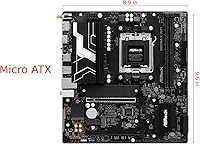
  • Form Factor: Micro-ATX layout measuring 11.54 x 10.71 x 2.52 inches, compatible with Micro-ATX and larger standard cases.
  • CPU Socket: AMD Socket AM5, supporting Ryzen 7000, 8000, and 9000 series processors.
  • Chipset: AMD B850 chipset, positioned between the entry-level B650 and the premium X870 for mid-range builds.
  • Memory Slots: Two DDR5 DIMM slots supporting dual-channel configurations with a maximum capacity of 128 GB.
  • Memory Speed: Native DDR5 support with overclocked profiles reaching 8200+ MHz via XMP or EXPO profiles.
  • PCIe Slot: One full-length PCIe 5.0 x16 slot for discrete graphics cards compatible with next-generation GPUs.
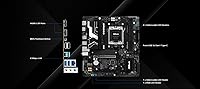
  • M.2 Storage: Two M.2 slots: one Blazing Gen5x4 for cutting-edge NVMe SSDs, and one Hyper Gen4x4 for mainstream high-speed drives.
  • SATA Ports: Four SATA3 ports for connecting traditional SSDs, HDDs, or optical drives at up to 6 Gb/s.
  • Wired LAN: Realtek 2.5 Gigabit ethernet controller for wired networking speeds well above standard gigabit.
  • Wireless: No onboard Wi-Fi or Bluetooth on this SKU; wireless connectivity requires a separate adapter or selecting the WiFi variant.
  • USB Ports: Rear and front-panel USB options include USB 3.2 Gen1 Type-C, multiple USB 3.2 Gen1 Type-A, and USB 2.0 ports.
  • Power Design: 6+1+1 phase Dr.MOS power architecture providing stable VCore delivery for mainstream Ryzen processors.
  • BIOS Flashback: Dedicated BIOS Flashback button allows firmware updates using only a USB drive and power connection, with no CPU or RAM required.
  • Weight: Board weighs 2.57 pounds, typical for a populated Micro-ATX design with heatsinks and I/O shielding.
  • OS Support: Officially supports Windows 10 and Windows 11 with full driver availability from ASRock.
  • Battery: Requires one CR2032 coin cell battery for CMOS real-time clock, included in the retail package.
  • Release Date: First made available in July 2025, aligning with broader Ryzen 9000 series platform adoption.

Related Reviews

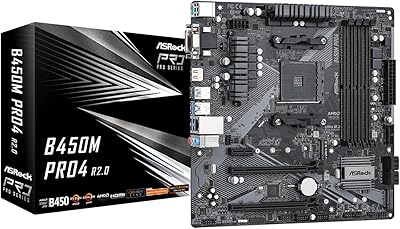
ASRock B450M PRO4 R2.0 Micro ATX Motherboard
74%
88%
Value for Money
79%
CPU Compatibility
86%
Ease of Installation
74%
BIOS & Software
83%
Long-term Reliability
More
ASRock A520M Pro4 Micro ATX Motherboard
83%
92%
Value for Money
89%
Processor Compatibility
86%
Performance Stability
84%
Build Quality
88%
Ease of Setup
More
ASRock 970M Pro3 Micro ATX Motherboard
74%
88%
Value for Money
91%
Compatibility & CPU Support
86%
Ease of Installation
61%
BIOS Usability
54%
Overclocking Headroom
More
ASRock B550M-HDV Micro-ATX Motherboard
76%
91%
Value for Money
88%
CPU Compatibility
86%
Ease of Setup
89%
Stability & Reliability
58%
VRM & Power Delivery
More
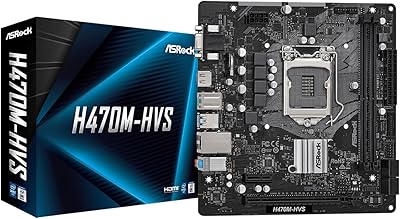
ASRock H470M-HVS Micro-ATX Motherboard
69%
83%
Value for Money
91%
CPU Compatibility
78%
BIOS Experience
47%
Storage Options
53%
Connectivity & USB
More
ASRock A620M-HDVM.2 Micro-ATX AM5 Motherboard
85%
89%
Value for Money
93%
Performance with Ryzen 7000 CPUs
85%
Ease of Setup and BIOS
88%
Build Quality and Durability
90%
Compatibility with DDR5
More
ASRock B550 Phantom Gaming 4 ATX Motherboard
79%
93%
Value for Money
91%
CPU Compatibility
84%
Storage Flexibility
89%
BIOS Experience
78%
Power Delivery
More
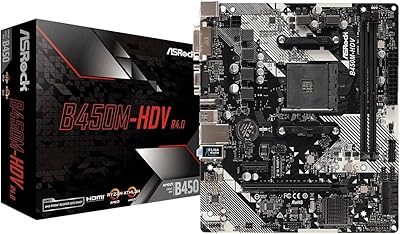
ASRock B450M-HDV R4.0 Motherboard
83%
91%
Value for Money
87%
Performance
89%
Ease of Installation
65%
RAM Compatibility and Overclocking
84%
Build Quality
More
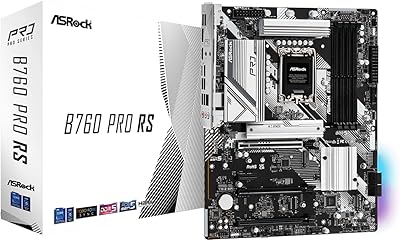
ASRock B760 Pro RS ATX Motherboard
80%
83%
Value for Money
88%
Feature Set
91%
CPU Compatibility
74%
Memory Performance
76%
VRM & Power Delivery
More
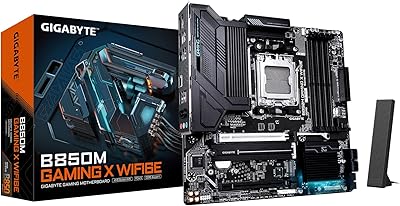
GIGABYTE B850M Gaming X WiFi 6E
81%
88%
Value for Money
91%
Installation & Build Experience
84%
BIOS Usability
67%
VRM & Thermal Performance
82%
DDR5 Compatibility
More

FAQ

No, this specific SKU does not include onboard Wi-Fi or Bluetooth. If wireless connectivity is important to your build, you'll want to look at the B850M-X WiFi R2.0 variant instead, which adds Wi-Fi 6E and Bluetooth. Alternatively, a PCIe or USB Wi-Fi adapter will work fine in a pinch.

Unfortunately, no. The AM5 socket is not backward compatible with AM4 processors, so Ryzen 5000 and older chips won't physically fit. The ASRock B850M-X R2.0 Micro-ATX Motherboard supports Ryzen 7000, 8000, and 9000 series CPUs only.

Technically yes, but with some caveats. The 6+1+1 power phase design handles mainstream Ryzen loads without issue, but under prolonged, intensive workloads with a high-TDP Ryzen 9, the VRM runs closer to its limits. For occasional heavy tasks it should be fine, but if sustained all-day rendering is your primary use case, a board with a beefier power delivery stage would be a more comfortable long-term choice.

It lets you update the motherboard's firmware using just a USB flash drive and a power connection — no CPU, RAM, or GPU required. This matters a lot if you buy a newer Ryzen processor that isn't yet supported by the factory BIOS. Instead of being stuck, you can flash the updated firmware before installing anything else, then proceed with the build normally. It's a genuinely useful safety net for new-platform builds.

You get two M.2 slots total. The primary slot (Blazing Gen5x4) supports the fastest current NVMe drives, while the secondary slot (Hyper Gen4x4) is still very quick by any practical measure. Both can be populated simultaneously, and you also have four SATA ports for additional drives, so storage expansion options are solid for this price tier.

It supports DDR5 overclocking up to 8200+ MHz with compatible kits using XMP or EXPO profiles. For most builders, loading an XMP preset in BIOS is all it takes to unlock your memory's rated speed. That said, pushing extreme manual overclocks at the very top of the DDR5 range is better suited to a premium X870 board; the B850M-X R2.0 is solid for enthusiast OC levels, not bleeding-edge tuning.

Yes. The board has a dedicated PCIe 5.0 x16 slot for your GPU and a separate Blazing M.2 Gen5x4 slot for a PCIe 5.0 SSD, so both can run simultaneously without bandwidth sharing. This is one of the practical advantages of the B850 chipset at this price point.

Yes, Micro-ATX boards are compatible with standard mid-tower, full-tower, and Micro-ATX cases — as long as the case lists Micro-ATX support, this board will mount normally. It's physically smaller than ATX, so you'll have fewer mounting points but no clearance issues in a properly sized case.

Early buyer feedback consistently calls it approachable. ASRock's BIOS has an EZ Mode for beginners that covers the basics clearly, and an Advanced Mode for those who want to dig into memory timings or fan curves. It's not the most polished interface in the industry, but it's functional and well-organized enough that most first-time builders get through setup without major confusion.

Always start with two sticks in matched pairs if your budget allows. Since this board only has two DIMM slots, using two identical sticks automatically enables dual-channel mode, which gives noticeably better memory bandwidth versus a single-channel setup. Check ASRock's QVL (Qualified Vendor List) for memory kits that have been tested and confirmed compatible with the board.

Where to Buy