Overview

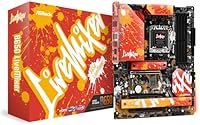
The ASRock B650 LiveMixer AM5 Motherboard sits in a comfortable middle ground within AMD's AM5 lineup — not a stripped-down entry option, but well short of X670E flagship pricing. What distinguishes the LiveMixer from a crowd of generic B650 boards is its audio-forward identity: the LIVEMIXER branding signals a deliberate focus on sound, backed by Nahimic software and a Realtek ALC897 codec. Released in late 2022, this B650 board has built up a real-world track record that gives buyers meaningful context. At its price tier, it competes credibly against alternatives, but whether it wins that comparison depends on what your build demands most — storage, audio, or raw expandability.

Features & Benefits

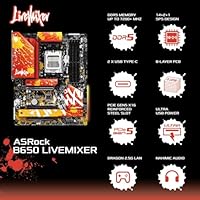
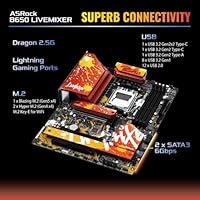
The 14+2+1 phase power design is one of the more practical strengths here — more power phases mean the board distributes electrical load more evenly, which translates to better stability when a Ryzen 7000 chip is under sustained load. Storage is a genuine highlight: a PCIe Gen5 x4 M.2 slot offers next-generation NVMe throughput that most B650 boards skip, alongside two Gen4 M.2 slots. Four DDR5 DIMM slots reach up to 128 GB at 6400 MHz overclocked — tangible breathing room for video editors and heavy multitaskers. The onboard 7.1-channel audio, powered by Nahimic, is better than baseline for a motherboard, though it won't replace a dedicated sound card. HDMI and DisplayPort outputs add display flexibility for Ryzen builds using integrated graphics.

Best For

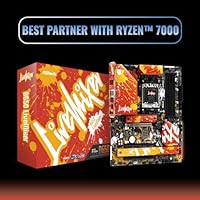
This B650 board makes the most sense for builders making the jump to AM5 who want solid DDR5 performance without paying X670E chipset prices. Pair it with a mid-range or high-end Ryzen 7000 processor and a Gen5 NVMe drive, and you're squeezing genuine value out of the platform. Content creators and streamers will appreciate the multi-slot M.2 expandability and the above-average onboard audio. That said, there are real trade-offs worth knowing upfront: only two SATA3 ports make this a poor fit for builds that rely on multiple hard drives. Wi-Fi is absent out of the box — adding a Key-E wireless module separately is an easy-to-miss extra purchase that catches some buyers off guard.

User Feedback

With a 4.2 out of 5 rating across roughly 52 reviews, the LiveMixer has earned a reasonably positive early reputation — though that sample size is modest, so treat it as a directional indicator rather than a settled verdict. Early buyers frequently highlight straightforward BIOS navigation and reliable DDR5 compatibility, with several noting the audio performance holds up well in daily use. On the critical side, the limited SATA port count draws consistent complaints from users expecting more legacy storage flexibility. Several reviewers also flagged missing Wi-Fi as an unwelcome surprise — it needs to be sourced and added separately. BIOS update experiences have been mixed, and memory tuning on DDR5 can involve a steeper learning curve than expected.

Pros

  • PCIe Gen5 x4 M.2 slot delivers next-level NVMe speeds that most B650 boards do not offer.
  • Three M.2 slots total give content creators and power users meaningful storage flexibility.
  • The 14+2+1 phase power setup keeps Ryzen 7000 chips stable even under sustained workloads.
  • DDR5 support up to 6400 MHz with four DIMM slots accommodates up to 128 GB of RAM.
  • Nahimic audio integration makes onboard sound noticeably better than bare-minimum B650 alternatives.
  • Three PCIe 4.0 x16 slots allow for capture cards, multi-GPU, or other expansion without compromise.
  • BIOS setup is straightforward, according to early buyers — a real time-saver for first-time AM5 builders.
  • Onboard HDMI and DisplayPort outputs are handy for Ryzen builds using integrated graphics.
  • The ATX form factor fits standard cases and leaves room for proper cable management.

Cons

  • No Wi-Fi included — a wireless Key-E module must be purchased and installed separately.
  • Only two SATA3 ports makes this a poor fit for any build relying on multiple traditional drives.
  • The Realtek ALC897 audio codec, while decent, is not a substitute for a dedicated sound card.
  • With only around 52 ratings, long-term reliability data is still limited compared to more established boards.
  • BIOS firmware update experiences have been inconsistent, which can be a concern on the AM5 platform.
  • DDR5 memory tuning has a steeper learning curve than DDR4, and not all kits behave predictably at rated speeds.
  • Four USB 2.0 rear ports feel dated given the price point — faster rear USB options are limited.
  • Buyers upgrading from older platforms will need to budget for a full DDR5 memory kit, adding to total cost.

Ratings

The scores below reflect an AI-driven analysis of verified global user reviews for the ASRock B650 LiveMixer AM5 Motherboard, with spam, bot-submitted, and incentivized feedback actively filtered out before scoring. Each category is weighted against real-world buyer experiences — not spec sheets — so both standout strengths and genuine frustrations are represented as honestly as possible. Given the current review sample size, these ratings should be read as an informed early consensus rather than a final verdict.

Value for Money
78%
22%
Buyers building a Ryzen 7000 system on a realistic budget consistently note that this B650 board punches above its price tier, particularly because of the PCIe Gen5 M.2 slot — a feature usually reserved for pricier boards. For the features offered, most users feel the pricing is justified.
A few buyers feel the value proposition weakens once they factor in the cost of a separate Wi-Fi module, which should arguably be included at this price point. Without wireless, the real out-of-pocket cost is higher than the sticker suggests.
Build Quality
83%
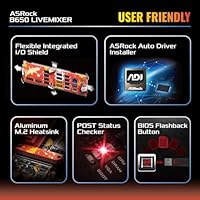
Users regularly comment on the solid, no-flex feel of the PCB and the quality of the M.2 heatsink covers. The board installs cleanly into standard ATX cases without the alignment issues that occasionally plague cheaper alternatives in this chipset class.
A handful of users noted that the rear I/O shield feel is less premium than the board itself, and the overall aesthetic is somewhat plain compared to RGB-heavy competitors — though that is largely a cosmetic observation rather than a functional concern.
DDR5 Compatibility
81%
19%
Early buyers report that DDR5 kits from major brands initialize correctly on the first boot more often than expected for an AM5 board, and EXPO and XMP profiles are generally recognized without manual intervention. Running memory at 6000 MHz is consistently described as stable and predictable.
Pushing kits to the upper 6400 MHz OC ceiling requires patience and sometimes manual BIOS tuning — a process that less experienced builders find frustrating. Not every DDR5 kit behaves identically, and compatibility can vary more than the spec sheet implies.
Storage Expandability
86%
Three M.2 slots — including one Gen5 — give content creators and power users exceptional NVMe flexibility for a B650 board. Builders using this board for video editing workstations report that having dedicated slots for an OS drive, a scratch drive, and a media archive drive is genuinely practical.
The two SATA3 ports are a recurring complaint for users coming from older platforms with larger drive collections. Anyone relying on four or more hard drives or SATA SSDs will need to add a SATA expansion card, adding cost and complexity.
Onboard Audio
74%
26%
Streamers and casual content creators find the Nahimic-enhanced 7.1-channel audio noticeably better than what most motherboards at this tier offer. Background noise floor is low, and the Nahimic software adds useful spatial audio processing that works well for gaming headsets and monitor speakers alike.
The Realtek ALC897 codec has a ceiling, and users doing serious audio production quickly hit it — fine detail retrieval and dynamic range fall short of even a budget dedicated sound card. It is better than average for a motherboard, but audiophiles should not use it as a reason to skip an external audio interface.
BIOS Experience
77%
23%
First-time AM5 builders frequently mention that the BIOS layout is logical and easy to navigate, with clear labeling for memory profiles and boot priority settings. Finding XMP and EXPO options is straightforward, which reduces frustration during initial setup.
BIOS update experiences have been inconsistent — some users report smooth updates via ASRock's Instant Flash, while others encountered boot issues requiring a CMOS reset to recover. Firmware support cadence is also slower than some competing brands.
Power Delivery
84%
The 14+2+1 phase configuration handles Ryzen 7000 CPUs confidently under sustained multi-threaded workloads like video rendering and 3D modeling, with temperatures on the VRM heatsink staying manageable in well-ventilated cases. Users pairing this board with upper-mid-range Ryzen chips report no throttling.
Enthusiasts pushing flagship Ryzen 7000X3D chips with aggressive PBO settings have noted that the VRM runs warmer than expected in smaller or poorly ventilated cases. This is unlikely to be a problem for typical builds, but thermal headroom is not limitless.
PCIe Expandability
79%
21%
Three PCIe 4.0 x16 slots give streamers and creators practical room to run a discrete GPU alongside a capture card and a networking card simultaneously, without slot conflicts. This level of expansion is uncommon at the B650 price tier.
The primary GPU slot runs at PCIe 4.0, not Gen5, which may feel like a missed opportunity given the Gen5 M.2 support elsewhere on the board. In practice this has no measurable impact on current GPU performance, but it is worth noting for forward-looking buyers.
Wireless Connectivity
41%
59%
The Key-E slot is correctly positioned and physically easy to access, meaning adding a Wi-Fi module later is not a complicated process for anyone comfortable working inside a PC case.
No Wi-Fi module is included, and many buyers discover this only after unboxing — a genuine pain point at this price tier where wireless is increasingly expected out of the box. Buyers who need wireless connectivity immediately face an additional purchase before their build is functional.
USB Connectivity
58%
42%
The four rear USB 2.0 ports cover basic peripheral connections like keyboards, mice, and USB dongles without issue, and internal headers offer additional front-panel flexibility for most standard ATX cases.
Four USB 2.0 rear ports feel underspecced for a board at this price — users moving from modern productivity workstations frequently notice the absence of more USB 3.2 Gen2 or Type-C ports on the rear I/O, requiring hubs or add-in cards for high-speed peripherals.
Video Output
71%
29%
Having both HDMI and DisplayPort on the rear I/O is a genuine convenience for users running Ryzen 7000G integrated graphics, enabling dual-monitor setups without a discrete GPU — useful for compact office builds or budget-conscious secondary workstations.
The video output options are irrelevant for users pairing this board with a discrete graphics card, as display output will run through the GPU instead. Buyers using non-G Ryzen 7000 chips should not expect any output from these ports at all.
Thermal Management
76%
24%
The M.2 heatsink on the Gen5 Flaming M.2 slot does a reasonable job keeping NVMe temperatures in check during sustained sequential reads and writes — a real concern with fast Gen5 drives that generate notable heat.
The two Gen4 M.2 slots have more modest cooling, and users running high-performance Gen4 drives in all three slots simultaneously may see thermal throttling during extended workloads. Active airflow across the board mitigates this but does not eliminate it entirely.
Installation Experience
82%
18%
The manual is clear, component labeling on the board itself is legible, and the physical layout avoids the cramped slot positioning that complicates builds on some competing ATX boards. Most users describe the installation as smooth and logically sequenced.
A few buyers found that the included accessories — particularly SATA cables — felt sparse for a board in this price range. Nothing critical is missing, but the unboxing experience does not feel as premium as the board's positioning might suggest.
Long-Term Reliability
69%
31%
The boards that have been in continuous use since 2022 show no widespread pattern of early hardware failures in the available feedback, which is encouraging for a platform that launched with some initial DDR5 teething issues across the industry.
The review pool of around 52 ratings is too small to draw confident conclusions about long-term durability. BIOS firmware consistency remains an open question, and buyers should monitor ASRock community forums for any recurring issues that emerge over time.

Suitable for:

The ASRock B650 LiveMixer AM5 Motherboard is a strong match for PC builders who want a capable, well-rounded AM5 platform without stretching into X670E territory. It particularly rewards users pairing it with a mid-to-high-end Ryzen 7000 processor and a PCIe Gen5 NVMe drive, where the board's storage headroom and power delivery get genuinely exercised. Content creators — video editors, podcasters, streamers — will find the multi-slot M.2 configuration and Nahimic-enhanced audio more useful than what most competing B650 boards offer at a similar price. Builders who rely primarily on fast NVMe storage rather than banks of hard drives will work comfortably within its two SATA port limit. It also suits users who want onboard display output as a backup or primary option when running AMD integrated graphics.

Not suitable for:

Buyers expecting built-in Wi-Fi will run into an immediate frustration — the ASRock B650 LiveMixer AM5 Motherboard ships without a wireless module, and adding one requires sourcing and installing a separate Key-E card, which is easy to overlook at checkout. Anyone building a storage-heavy system with multiple hard drives or SSDs in a SATA configuration will hit a hard ceiling fast with only two SATA3 ports. This board is also not the right call for audiophiles expecting studio-grade onboard sound — the Realtek ALC897 codec is above average for a motherboard but has a clear ceiling, and serious listening setups will still need a dedicated audio solution. Users on tight budgets hoping to extract extreme overclocking performance may also find better value elsewhere, as the B650 chipset has inherent limitations compared to X670E in that regard.

Specifications

  • Chipset: Built on the AMD B650 chipset, supporting the full Ryzen 7000 series processor lineup on the AM5 platform.
  • CPU Socket: Uses the AMD AM5 (LGA1718) socket, compatible exclusively with Ryzen 7000 series processors.
  • Form Factor: Standard ATX form factor measuring 12.01 x 9.61 inches, fitting the vast majority of mid-tower and full-tower cases.
  • Memory Slots: Four DDR5 DIMM slots supporting up to 128 GB of total system RAM with a maximum overclocked speed of 6400 MHz.
  • Power Phases: Delivers a 14+2+1 Smart Power Stage configuration for stable, evenly distributed power to the CPU under sustained load.
  • M.2 Storage: Includes one PCIe Gen5 x4 M.2 slot and two PCIe Gen4 x4 M.2 slots for a total of three NVMe storage positions.
  • SATA Ports: Provides two SATA3 ports for legacy hard drive or SATA SSD connections — a limited count for multi-drive builds.
  • PCIe Expansion: Three PCIe 4.0 x16 slots allow for discrete graphics cards, capture cards, or other full-length expansion devices.
  • Audio: Onboard 7.1-channel HD audio powered by a Realtek ALC897 codec, supplemented by Nahimic Audio software processing.
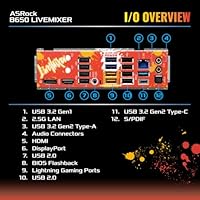
  • Video Output: Rear I/O includes one HDMI port and one DisplayPort, enabling display connectivity when using AMD integrated graphics.
  • USB Ports: Four USB 2.0 ports are available on the rear I/O panel for peripherals and legacy device connections.
  • Wi-Fi: A Key-E M.2 slot is present for a wireless adapter, but no Wi-Fi module is included in the box.
  • Weight: The board weighs 4.4 pounds, typical for a fully equipped ATX motherboard at this feature level.
  • Platform: Officially supported on Windows, consistent with AMD's driver and software ecosystem for the AM5 platform.
  • Release Date: First made available in October 2022, giving this board over two years of real-world deployment and BIOS refinement history.

Related Reviews
ASRock B850 LiveMixer WiFi Motherboard
79%
88%
VRM & Power Delivery
86%
Memory Compatibility
91%
PCIe 5.0 & M.2 Storage
84%
BIOS Experience
79%
WiFi 7 Performance
More
ASUS TUF Gaming B650-Plus WiFi ATX Motherboard
81%
91%
Out-of-Box Stability
88%
BIOS Experience
89%
Power Delivery
71%
DDR5 Memory Compatibility
86%
Networking Performance
More
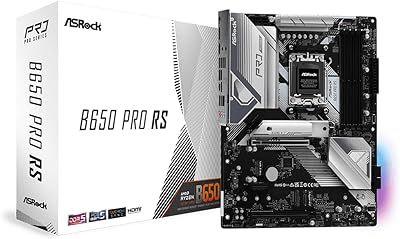
ASRock B650 PRO RS ATX Motherboard
74%
88%
Value for Money
83%
Build Quality
84%
BIOS Experience
86%
Installation & Setup
71%
CPU Power Delivery
More
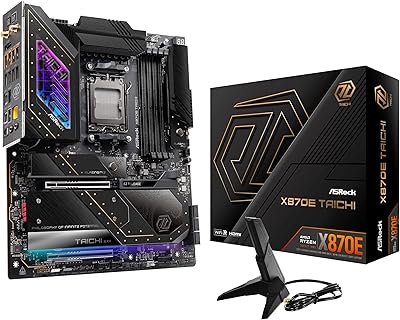
ASRock X870E Taichi AM5 Motherboard
85%
91%
Performance
88%
Build Quality
89%
Overclocking Capability
87%
Cooling System
84%
Installation Ease
More
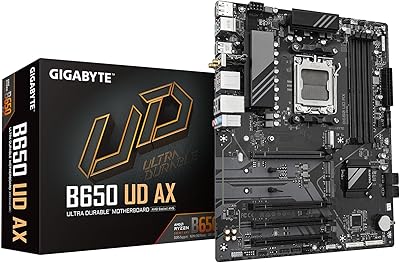
GIGABYTE B650 UD AX ATX Motherboard
79%
84%
Value for Money
81%
Build Quality
78%
BIOS Experience
72%
DDR5 Compatibility
67%
VRM Performance
More
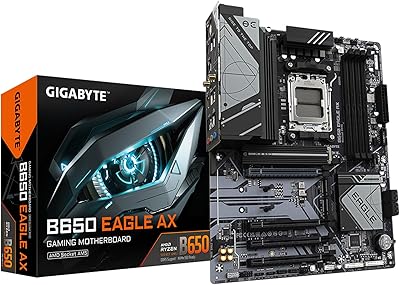
GIGABYTE B650 Eagle AX
86%
91%
Value for Money
94%
Storage Performance
88%
Thermal Management
87%
Wireless Connectivity
83%
BIOS and Software
More
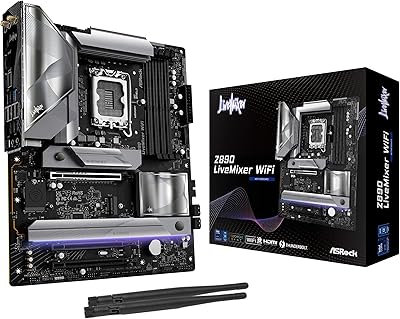
ASRock Z890 LiveMixer WiFi ATX Motherboard
75%
91%
Connectivity & I/O
88%
WiFi 7 Performance
54%
BIOS Experience
83%
CPU Power Delivery
78%
DDR5 Memory Support
More
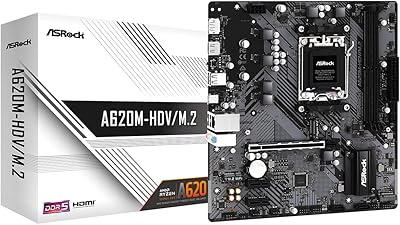
ASRock A620M-HDVM.2 Micro-ATX AM5 Motherboard
85%
89%
Value for Money
93%
Performance with Ryzen 7000 CPUs
85%
Ease of Setup and BIOS
88%
Build Quality and Durability
90%
Compatibility with DDR5
More
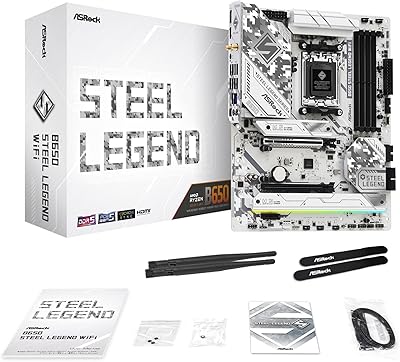
ASRock B650 Steel Legend WiFi 6E ATX Motherboard
87%
91%
Performance
89%
Stability
88%
Overclocking Capability
92%
WiFi 6E Connectivity
85%
Ease of Installation
More
ASRock H610M-HVS Micro ATX Motherboard
72%
83%
Value for Money
74%
Build Quality
78%
CPU Compatibility
77%
BIOS Experience
71%
Memory Support
More

FAQ

No, it does not. The LiveMixer has a Key-E M.2 slot on the board that can accept a Wi-Fi module, but nothing is included in the box. If wireless connectivity is important to you, budget for a compatible Key-E adapter separately — it is an easy detail to miss before checkout.

This board supports the AMD Ryzen 7000 series processors on the AM5 socket. It is not compatible with older Ryzen 5000 or earlier chips, as those use the AM4 socket. Always verify your CPU model against ASRock's official compatibility list before buying.

No — the ASRock B650 LiveMixer AM5 Motherboard uses DDR5 memory exclusively. DDR4 is physically and electrically incompatible with AM5 boards, so you will need to purchase new DDR5 kits if you are upgrading from an older platform.

You get three M.2 NVMe slots — one Gen5 and two Gen4 — plus two SATA3 ports. That is a maximum of five storage devices, which is solid for most builds. Just be aware that if you rely heavily on traditional hard drives or SATA SSDs, two ports is a meaningful limitation.

For most users, yes — the Realtek ALC897 with Nahimic software produces noticeably cleaner output than bare-minimum motherboard audio. It handles gaming, streaming, and casual listening well. That said, if you are doing professional audio work or critical mixing, a dedicated sound card or USB audio interface will still outperform it.

Early buyers generally report that the BIOS is intuitive and well-organized, which is reassuring for builders new to AM5. DDR5 memory tuning can take some trial and error — especially if you are pushing XMP or EXPO profiles close to 6400 MHz — but the initial boot and basic setup process is considered accessible.

The primary x16 slot runs at PCIe 4.0, not Gen5. The Gen5 support on this board is limited to the dedicated M.2 storage slot. If you plan to install a PCIe Gen5 GPU, this board will run it at Gen4 speeds, which for current graphics cards has no meaningful real-world performance difference.

The board officially supports DDR5 up to 6400 MHz with overclocking. Reaching that ceiling depends on your specific memory kit and CPU's memory controller tolerance. A DDR5-6000 kit is often the sweet spot for AM5 builds in terms of stability and performance gains without excessive tuning effort.

Yes, but only if your Ryzen 7000 processor includes integrated graphics — not all Ryzen 7000 CPUs do. Models in the Ryzen 7000G series have integrated graphics; standard non-G Ryzen 7000 chips do not. Check your CPU's specifications before counting on the onboard video outputs.

The available feedback is reasonably positive, with a 4.2 out of 5 rating, but the review pool sits at around 52 ratings — that is not a large sample. Most reported issues center on BIOS update experiences and DDR5 compatibility quirks rather than hardware failures. It is worth monitoring community forums for firmware update notes if you buy this board.

Where to Buy