Overview

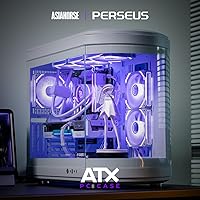
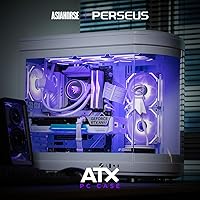
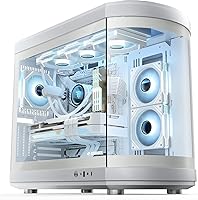
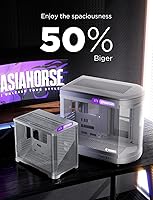
The AsiaHorse Perseus Mid-Tower ATX PC Case arrived on the market in mid-2024 with a clear ambition: give builders a head-turning showpiece without forcing them to choose between looks and airflow. Where most mid-towers stick to rectangular slabs of tempered glass, this aquarium-style case wraps the front and sides in a 180° elliptical glass panel that genuinely stops people mid-scroll. It sits price-wise between no-frills budget enclosures and the kind of boutique cases that cost as much as a GPU — a deliberate sweet spot. The dual-chamber interior keeps power supply cables and messy runs hidden behind a divider, so what you see through that sweeping glass is all build, no clutter.
Features & Benefits

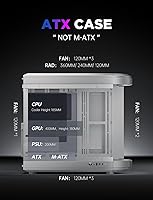
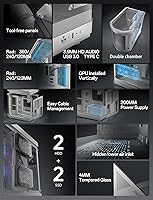
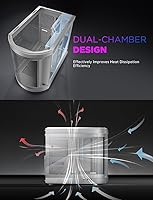
The panoramic oval glass is the obvious showstopper, but the engineering underneath earns its place too. The dual-chamber design routes PSU bulk and wiring behind a solid divider, which means the visible side of the build stays presentation-ready. Cooling flexibility is genuinely broad — the chassis can accept up to nine fans in total, and the top supports a full 360mm radiator, making a high-performance AIO a realistic option without stepping up to a full tower. GPU clearance is generous enough to handle even the longest RTX 40-series cards, and vertical GPU mounting is supported if you want the card on display. The front I/O includes a Type-C port at 10Gbps, though only one USB-A 3.0 slot accompanies it, which feels a touch conservative.

Best For

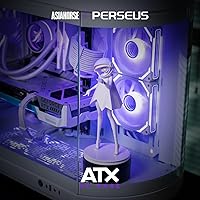
This aquarium-style case is built for a specific kind of builder — one who wants their rig to look as good as it performs. The open interior and sweeping glass make it a natural fit for anyone showcasing custom water-cooling loops or high-end air coolers up to 185mm tall. Collectors will appreciate that the bottom chamber doubles as a display area for small figurines or memorabilia, which is a genuinely unusual feature at this price tier. It also suits builders who plan to run a powerful GPU without worrying about clearance, and those who prefer room to grow — storage supports two 3.5-inch drives and two 2.5-inch SSDs. If you just want a plain, understated box, this is not your case.

User Feedback

With around 84 ratings and a 4.3-star average, early reception to the Perseus mid-tower is encouraging — but it is still a small sample, so treat these impressions as early-adopter signals rather than settled verdicts. Buyers consistently praise the build quality and glass, noting that the tempered panels feel solid and the overall construction holds up well at this price point. The recurring friction involves liquid cooling: when a radiator and thick fans combined exceed 52mm, installation requires a specific sequencing — motherboard and CPU power cables must go in before the radiator. It is manageable, but not intuitive. A 200mm PSU length cap also caught some builders off guard, so compatibility checks are worth doing before purchasing.

Pros

  • The 180° elliptical panoramic glass transforms how your components look, offering visibility that standard side-window cases cannot replicate.
  • Dual-chamber design keeps PSU cables and routing completely hidden, so the showcase side of the build always looks clean.
  • Top-mounted 360mm radiator support lets you run a high-end AIO without moving to a larger full-tower chassis.
  • Generous GPU clearance comfortably accommodates the longest RTX 40-series cards, including thick triple-fan models.
  • Vertical GPU mounting is supported, giving builders the option to make the graphics card a visual centerpiece.
  • Up to nine fan positions provide serious thermal flexibility for anyone who wants comprehensive airflow coverage.
  • The front Type-C port operates at 10Gbps — genuinely useful for fast external drives and modern peripherals.
  • SPCC steel construction feels solid, and the tempered glass panels are thick enough that they don't flex under normal handling.
  • The bottom interior chamber doubles as a display shelf for collectibles, which is a rare and crowd-pleasing design touch.
  • This aquarium-style case supports ATX, Micro-ATX, and ITX motherboards, making it flexible across a range of build configurations.

Cons

  • A strict 200mm PSU length cap rules out many popular high-wattage power supplies — verify compatibility before committing.
  • Installing a thick AIO radiator requires a precise build sequence; deviating from it can make cable routing nearly impossible.
  • Only one USB-A 3.0 port on the front panel feels sparse for anyone who plugs in multiple peripherals regularly.
  • Side radiator support tops out at 240mm, so builders wanting dual large-format liquid cooling loops will hit a dead end.
  • The oval silhouette is polarizing — builders who prefer minimalist, understated cases will likely find this chassis too bold.
  • With fewer than 100 ratings at the time of writing, long-term durability and reliability remain genuinely unproven.
  • The product listing shows a clearly erroneous shipping weight, which makes it difficult to plan for freight or delivery logistics.
  • Cable management in the hidden PSU chamber may feel tight for builders using large, fully modular cable sets.
  • The case is relatively new to market, meaning community resources like build guides and compatibility reports are still limited.

Ratings

The scores below reflect an AI-driven analysis of verified buyer reviews for the AsiaHorse Perseus Mid-Tower ATX PC Case, collected globally and filtered to remove incentivized, bot-generated, and low-quality feedback. Every category is scored to reflect both what early owners genuinely love and where real friction points exist, so you get an honest picture of what it is like to actually live with this chassis. Strengths and trade-offs are weighted equally — nothing is softened to protect the rating.

Aesthetic Design
94%
The 180° elliptical glass window is the kind of design detail that makes people stop and ask what case that is. Early buyers consistently describe the bullet-head aquarium silhouette as unlike anything else in the mid-tower segment, and the ARGB lighting interacting with the curved glass creates a display effect that rectangular cases simply cannot replicate.
The polarizing oval shape means this case is not for everyone — builders who prefer understated, minimal designs will find it too theatrical for a standard office or desk setup. The aesthetic also commits you fully to a visible, showcase-style build; if you later want a clean, cable-hidden look from the outside, the all-glass wraparound leaves no hiding place.
Component Visibility
91%
The 180° panoramic glass delivers a level of component visibility that standard side-window designs cannot approach — your GPU, motherboard, and cooling all become part of the display rather than hidden inside a box. The dual-chamber layout amplifies this further by keeping wiring and PSU bulk entirely out of the visible zone, so the glass-facing interior always looks intentional.
The all-glass wraparound design means dust accumulation on the interior surfaces is immediately visible and more noticeable than in cases with smaller windows. Builders who are not meticulous about cable routing and component cleanliness may find the fishbowl effect more exposing than flattering.
Build Quality
83%
The SPCC steel frame feels solid under hand pressure and does not flex the way budget chassis often do, and the tempered glass panels have enough thickness that they inspire genuine confidence during installation and panel swapping. Buyers at this price tier frequently note that the overall fit and finish punches above expectations.
Given that the case is still relatively new with a limited number of real-world owners, long-term durability data — particularly for the glass hinges and panel mounts under repeated use — remains an open question. A handful of early buyers also flagged minor panel alignment inconsistencies out of the box, suggesting quality control is solid but not flawless.
GPU Compatibility
86%
The generous internal dimensions mean builders can slot in flagship dual and triple-fan GPUs without worrying about length or height clearance — even the most physically imposing RTX 40-series cards fit without modification. Vertical GPU mounting support adds a display option for builders who want the graphics card to face the panoramic glass as a visual centerpiece.
The 180mm height ceiling for GPUs is on the tighter side and could become relevant if future GPU generations push card dimensions further. Vertical mounting also requires sourcing a compatible riser cable separately, which is an extra step and added cost that buyers sometimes discover only after unboxing.
Interior Spaciousness
82%
18%
The interior is genuinely roomy for a mid-tower, comfortably accommodating a full-size ATX motherboard alongside a lengthy GPU, a tall CPU tower cooler, and an AIO radiator simultaneously without requiring component compromises. The bottom display chamber also creates usable space that doubles as a creative showcase area, which no conventional mid-tower offers.
The dual-chamber design, while visually effective, does mean that some of the overall case volume is dedicated to the PSU and cable compartment rather than usable component space, which can make working inside the rear section feel confined. PSU units longer than 200mm simply will not fit, cutting off a meaningful portion of the market.
Airflow & Cooling
78%
22%
Nine potential fan positions give builders serious flexibility to configure push-pull setups or zone-specific airflow without running out of mounting slots, and the top panel's 360mm radiator support means high-end AIO cooling is genuinely achievable at mid-tower dimensions. The dual-chamber design also helps by keeping PSU heat generation physically isolated from the main component area.
No fans are included in the box, which means real-world cooling performance depends entirely on what the buyer installs — an important consideration for total build cost. The elliptical glass enclosure also does not promote front air intake as directly as a mesh-front case would, so buyers chasing maximum airflow efficiency may find a trade-off here.
Value for Money
76%
24%
For builders who genuinely want a showpiece mid-tower with panoramic glass and dual-chamber organization, the asking price represents reasonable value compared to boutique cases that cost significantly more for similar aesthetics. The inclusion of vertical GPU mounting support and multiple fan and radiator positions means there are no immediately obvious feature compromises at this price point.
Buyers who simply need a functional mid-tower without display aspirations will find the premium hard to justify — there are more airflow-optimized cases in the same price range that outperform this aquarium-style case on thermal benchmarks. The lack of included fans also means the real cost of a complete, well-cooled build is notably higher than the case price alone suggests.
Storage Options
73%
27%
Having two 3.5-inch HDD bays alongside two 2.5-inch SSD mounting points covers the storage needs of the majority of current gaming and creative workstation builds, and the rear chamber placement keeps drives out of sight. Builders who primarily rely on M.2 NVMe drives mounted directly to the motherboard will find this entirely adequate for a high-performance setup.
Four drive bays in total is not a generous allocation for heavy media production builders or content creators who work with large local storage arrays. There is also no dedicated front-accessible drive bay or toolless installation mechanism mentioned, which would have been a convenient addition for users who swap drives frequently.
Cable Management
71%
29%
The dual-chamber layout is genuinely effective at keeping the main build area looking clean — the PSU and all primary cable runs are routed behind a physical divider, so the glass-facing side remains uncluttered by design. Builders who take their time report a satisfying end result where virtually no wiring is visible from the front or sides.
Working inside the hidden PSU compartment can be frustrating, especially with large modular power supplies whose cable sets are thick and stiff. Builders using bulkier premium PSUs report needing extra patience to tuck cables neatly into the limited rear space, and cable management routing options feel somewhat constrained compared to cases designed with dedicated management channels.
Assembly Experience
69%
31%
The logical dual-chamber layout gives the build process a clear structure once you understand it — PSU and cables go in the back, components go in the front, and the separation keeps each workspace relatively organized. Builders who plan their component order in advance and read the manual report a smooth, satisfying experience overall.
The AIO installation sequence is the most common frustration cited by early owners — if the radiator plus fans exceed 52mm in depth, cables must be routed before the radiator is installed, and reversing this order mid-build is genuinely aggravating. First-time builders may also find the unconventional case shape slightly disorienting compared to standard rectangular chassis with more predictable layouts.
AIO & Liquid Cooling Support
67%
33%
The top panel's capacity for a full 360mm radiator is a meaningful advantage — it means builders planning a high-end liquid cooling loop do not need to upsize to a full tower just to get adequate radiator real estate. A secondary 240mm radiator position on the side panel also adds flexibility for dual-radiator configurations.
The real friction comes when your radiator and fans together exceed 52mm in combined thickness — at that point, installation requires routing motherboard power cables and completing most wiring before the radiator can go in, otherwise access becomes physically blocked. This sequencing requirement has tripped up multiple buyers and is the single most cited installation complaint in early reviews.
Front I/O Usability
62%
38%
The Type-C port running at 10Gbps is a legitimately useful addition that aligns with modern peripherals, external SSDs, and current-gen device cables — it is the kind of port that a good number of last-generation cases lack entirely. Its placement is accessible and the connector feels sturdy based on early user reports.
One USB-A 3.0 port is the entire Type-A offering on the front panel, which feels notably sparse when most competing cases provide two or more. Builders who routinely use front-panel ports for keyboards, mice, or USB drives during setup will find themselves reaching for the rear motherboard ports far more often than expected.
PSU Compatibility
58%
42%
The dedicated rear PSU chamber keeps power supply noise and heat physically separated from the main component zone, which is a genuine thermal and organizational benefit. Standard ATX power supplies that fall within the 200mm length threshold fit cleanly without requiring any adapters or workarounds.
The 200mm PSU length ceiling is the most frequently flagged compatibility concern from real buyers — many popular high-wattage and premium modular units exceed this limit, and there is no workaround once the compartment will not close. Discovering this incompatibility after purchase is a genuinely frustrating experience that a quick spec check before buying can entirely prevent.
Noise Dampening
54%
46%
The wide fan support across multiple positions means buyers can optimize for quiet operation by choosing high-quality, low-RPM fans that balance airflow and noise — the chassis gives you the fan slots to make that possible. The physical separation of the PSU in its own chamber also means PSU fan noise is partially isolated from the main listening zone.
There are no acoustic dampening panels anywhere in the chassis — the design prioritizes airflow and visual openness over noise reduction, which is a deliberate trade-off but one that limits this aquarium-style case in quieter office or bedroom settings. Builders who use loud fans or high-RPM configurations will find sound transmission from the case is noticeable at close range.

Suitable for:

The AsiaHorse Perseus Mid-Tower ATX PC Case is purpose-built for builders who treat their PC as a display piece as much as a performance machine. If your setup lives in a living room, a streaming desk, or anywhere guests will see it, the 180° elliptical glass and bullet-head silhouette make an immediate impression that standard rectangular cases simply cannot match. Enthusiasts planning a 360mm AIO build will find real value here — the top radiator clearance is generous enough for serious liquid cooling without needing to step up to a full tower. Collectors and hobbyists get an unexpected bonus in the bottom chamber, which doubles as a display shelf for figurines or memorabilia sitting right alongside the components. The dual-chamber layout rewards builders who care about cable discipline, since PSU bulk and routing clutter are kept entirely out of the visible zone. Anyone who builds iteratively and wants room to later upgrade fans, swap radiators, or add vertical GPU mounting will find this chassis genuinely accommodating.
Not suitable for:

Builders who want a clean, understated desktop presence should probably look elsewhere — the AsiaHorse Perseus Mid-Tower ATX PC Case is unambiguously designed to be noticed, and its oval glass profile is not universally appealing. If your power supply is on the longer side, the 200mm PSU length limit is a hard constraint that rules out a number of popular high-wattage units, so compatibility checks are non-negotiable before purchasing. Anyone planning a thick radiator build — particularly if the combined depth of the radiator and fans pushes past roughly 52mm — will face an unintuitive installation sequence that requires routing motherboard cables before the cooler goes in; it is workable, but it demands patience. Users who routinely plug multiple peripherals into the front panel will find the single USB-A 3.0 port frustrating, since the front I/O is modest by current standards. Budget-focused builders may also balk at paying a visible premium for aesthetics when the underlying specs are otherwise in line with more affordable mid-towers.
Specifications

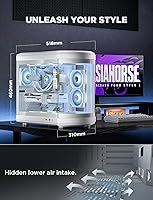
  • Dimensions: The chassis measures 518mm long, 310mm wide, and 460mm tall, placing it squarely within standard mid-tower footprint territory.
  • Materials: The frame is built from SPCC steel, with large-format tempered glass panels forming the signature 180° elliptical panoramic window.
  • Motherboard Support: Compatible with ATX, Micro-ATX, and Mini-ITX motherboard form factors.
  • GPU Clearance: Accommodates graphics cards up to 400mm in length and 180mm in height, covering virtually all current consumer GPUs including large RTX 40-series models.
  • CPU Cooler Height: Tower air coolers up to 185mm tall can be installed without clearance conflict against the side panel or glass.
  • PSU Compatibility: Power supplies up to 200mm in length fit in the dedicated rear chamber; units longer than this will not physically clear the enclosure.
  • Radiator Support: The top panel accepts 360mm and 240mm radiators; a 240mm radiator can also be mounted on the side panel.
  • Fan Support: Up to nine 120mm fans can be installed across the top (3 slots), bottom (3 slots), side (2 slots), and rear (1 slot) positions.
  • Front I/O: The front panel provides one Type-C port running at 10Gbps, one USB 3.0 Type-A port, and a combo HD audio jack.
  • Storage Bays: Internal storage support includes two 3.5-inch HDD bays and two 2.5-inch SSD mounting points.
  • Expansion Slots: Offers seven horizontal PCIe expansion slots and three vertical PCIe slots for optional vertical GPU installation.
  • Glass Design: The 180° elliptical panoramic tempered glass window wraps around the front and sides of the chassis, providing near-full-surround component visibility.
  • Interior Layout: A dual-chamber design physically separates the PSU and cable routing zone from the main motherboard and component area.
  • Vertical GPU: Vertical GPU installation is natively supported via three vertical PCIe slots built into the chassis; a riser cable is required but not included.
  • Case Type: Classified as a mid-tower ATX enclosure, suitable for full-size ATX builds as well as smaller Micro-ATX and ITX configurations.
  • Brand & Model: Manufactured by AsiaHorse under the Perseus product line, with the white variant first made available in June 2024.
  • Weight Note: The 3-ounce weight listed in the product data is a clear data entry error; actual shipping weight is substantially higher given the SPCC steel and tempered glass construction.

Related Reviews

Zalman S2 ATX Mid-Tower PC Case
76%
88%
Airflow Performance
63%
Build Quality
91%
Value for Money
86%
Ease of Assembly
84%
Cooling Expandability
More
SZSKYING CMSVB-1 Mid-Tower PC Gaming Case
74%
91%
Value for Money
88%
Included Fans
86%
Aesthetics & RGB
61%
Build Quality
74%
Airflow Performance
More
KEDIERS K4 ATX Mid Tower PC Case
80%
91%
Value for Money
93%
Aesthetic Design
74%
Build Quality
72%
Cooling Performance
84%
Ease of Assembly
More
SAMA S40 Mid Tower ATX PC Case
79%
88%
Airflow Performance
83%
Included Fan Quality
79%
Build Quality & Finish
92%
GPU Compatibility
61%
Cable Management
More
Vetroo AL800 Mid Tower ATX PC Case
76%
78%
Build Quality
84%
Tempered Glass Panel
76%
Airflow Performance
61%
Fan Included & Expandability
69%
Cable Management
More
Zalman S3 ATX Mid-Tower PC Case
74%
83%
Value for Money
71%
Build Quality
58%
Airflow & Cooling Performance
86%
Ease of Assembly
67%
Acrylic Side Panel
More
darkFlash DS900 ATX Mid-Tower PC Case
75%
76%
Build Quality
83%
Cooling Potential
91%
Aesthetics & Visibility
88%
Value for Money
74%
Cable Management
More
Zalman S4 Mid-Tower ATX PC Case
75%
72%
Build Quality
88%
Value for Money
91%
Ease of Assembly
67%
Airflow Performance
63%
Cable Management
More
Antec Flux Wood Mid-Tower PC Case
83%
91%
Build Quality
88%
Airflow Performance
94%
Aesthetic Design
86%
Fan Inclusion & Quality
89%
Radiator Compatibility
More
DARKROCK EC2 ATX Mid Tower PC Case
77%
88%
Airflow Performance
91%
Cooling Headroom
67%
Build Quality
84%
GPU Compatibility
86%
Ease of Assembly
More

FAQ

In most configurations, yes. The case supports GPU lengths up to 400mm and heights up to 180mm, which covers the vast majority of RTX 4090 models currently available. That said, some particularly wide or thick aftermarket triple-fan coolers can push the height boundary, so it is worth cross-referencing your specific card's listed dimensions against those figures before ordering.

Yes, the top panel is built for it. The key thing to know is that if your radiator and fans together measure more than 52mm thick, you will need to connect your motherboard power cables and finish your primary wiring before mounting the radiator — otherwise there simply will not be enough clearance to reach the connectors afterward. It is not a dealbreaker, but it does require planning your build sequence in advance rather than assembling as you go.

The rear chamber fits power supplies up to 200mm long, which covers most standard ATX units. Where builders get caught out is with premium or high-wattage fully modular PSUs, which sometimes exceed that limit. This is probably the compatibility detail most commonly overlooked with the Perseus mid-tower, so verify your PSU's exact length on the manufacturer spec sheet before buying the case.

You get one USB Type-C port running at 10Gbps and one USB 3.0 Type-A port, plus a combined HD audio jack. That is a modest selection by today's case standards, and it is worth being honest with yourself about whether that is enough for your workflow. If you regularly plug multiple devices into the front, factor in the cost of a USB hub as part of your build budget.

Yes, and it is one of the more genuinely unusual features of this aquarium-style case. The bottom interior chamber and the spaces near the elliptical glass are designed to hold small figurines or memorabilia alongside your components. With ARGB fan lighting casting color across those objects, the visual effect can be quite striking — it is the kind of detail that tends to get noticed immediately by anyone who sees the build in person.

Yes. The chassis provides the three vertical PCIe slots needed to physically support vertical GPU installation, but a compatible riser cable is not included in the box. Make sure to select a riser cable that matches your GPU's PCIe generation — using a lower-generation riser on a current-gen card can result in bandwidth limitations that affect performance.

The PSU and all cable routing are confined to a separate compartment behind the main build area, which keeps the glass-facing interior clean and uncluttered. Most builders find this makes a meaningful visual difference compared to single-chamber designs. The one trade-off is that working inside the hidden chamber can feel a bit cramped if you are using a large modular PSU with particularly thick or bulky cable sets, so leaving yourself some extra time during the build is a good idea.

The AsiaHorse Perseus Mid-Tower ATX PC Case does not include acoustic dampening panels, which is standard for airflow-focused tempered glass designs at this price level. Noise output will depend almost entirely on the fans you install. If quiet operation is a priority, put your budget toward low-noise fans with good dBA ratings rather than expecting the chassis itself to absorb sound.
It is manageable, but it is not the most forgiving chassis for a complete beginner. The dual-chamber layout is logically organized once you understand it, but the AIO installation sequence — when radiator thickness is a factor — requires reading the manual carefully and planning your steps rather than building by instinct. If you are comfortable following structured instructions and thinking a few steps ahead, the process is straightforward enough.

The first wave of owners has responded positively overall, with a 4.3-star average from a growing number of ratings. The most consistent praise centers on the visual impact, the quality of the tempered glass panels, and the overall sturdiness of the construction for its price tier. The friction points that come up most frequently are the AIO thickness constraint during installation and the PSU length limit. Since the review pool is still relatively small, treat these as encouraging early signals rather than a definitive long-term verdict on reliability.