Overview

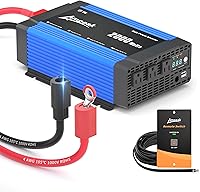
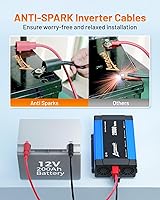
The Ampeak 2000W Modified Sine Power Inverter sits comfortably in the mid-range 2000W inverter market — capable enough for real work, priced well below premium pure sine alternatives. Before anything else, one thing deserves to be said plainly: this is a modified sine wave unit, which means it handles most household appliances, power tools, and resistive loads just fine, but it is not the right choice for CPAP machines, sensitive audio equipment, or medical devices. What sets this Ampeak inverter apart from similarly priced rivals is its anti-spark, waterproof battery cable design — a safety feature rarely seen at this price point. Launched in late 2024, it has already accumulated nearly a thousand ratings at 4.4 stars.
Features & Benefits

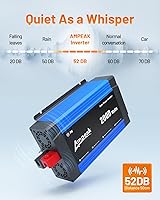
The efficiency story is worth unpacking. Most inverters in this class convert 12V DC to 110V AC at 75–80% efficiency, meaning a good chunk of your battery's energy is lost as heat. This 2000W modified sine unit claims 89.37% conversion efficiency — which in practical terms means less battery drain, longer runtime between charges, and less heat generated overall. The 11 built-in safety protections cover the expected bases: over-voltage, under-voltage, short circuit, overload, and over-temperature, all of which matter considerably when running appliances in an enclosed vehicle or RV. The temperature-controlled fan only spins when the unit actually needs cooling, which is a big part of why noise stays around 52 dB. The LED display rounds things out with useful real-time monitoring.

Best For

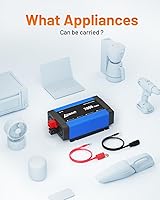
This Ampeak inverter is a strong match for truck drivers, van-lifers, and RV owners who need dependable 110V power from a 12V battery system — think coffee makers, box fans, small power tools, or a laptop setup. It also works well in emergency preparedness setups where quiet, efficient operation matters more than waveform purity. That said, be clear-eyed about what this unit is not built for. Laser printers, CPAP machines, some variable-speed drills, and high-end audio gear all benefit from a pure sine wave; running them on a modified sine inverter can cause erratic behavior or long-term damage. If your needs fall outside household basics and light power tools, spending more on a pure sine unit makes sense.

User Feedback

Owners of the Ampeak 2000W generally report a smooth setup experience — the included cables are described as noticeably sturdier than what comes with comparable units, and the quiet fan operation gets consistent praise. On the critical side, a handful of buyers mention the inverter cutting out under sustained heavy loads, raising questions about whether the 2000W continuous rating holds in real-world high-demand situations. USB charging speeds have also drawn a few complaints as being slower than advertised. Given the product's recent launch, long-term reliability data is still thin, so treat durability claims with appropriate caution. Ampeak's 30-day return policy and 18-month support window do provide a reasonable safety net while the track record builds.

Pros

  • Anti-spark, waterproof battery cables come included — a real safety upgrade over most comparably priced rivals.
  • Conversion efficiency of nearly 90% translates to noticeably longer battery runtime versus typical 75–80% competitors.
  • Eleven built-in safety protections cover over-voltage, overload, short circuit, and thermal shutdown for added peace of mind.
  • The temperature-controlled fan only runs when heat demands it, keeping operation genuinely quiet during lighter loads.
  • Three AC outlets and dual USB ports handle mixed charging setups without needing a separate power strip.
  • An LED status display lets you monitor input voltage and load in real time with no guesswork.
  • Nearly 1,000 early reviews trend positive, with buyers consistently praising straightforward installation and sturdy cable quality.
  • A 30-day no-questions return window and 18-month support policy offer a reasonable safety net after purchase.

Cons

  • Modified sine wave output can cause buzzing, reduced efficiency, or long-term damage in sensitive electronics and medical devices.
  • Some verified buyers report this 2000W modified sine unit shutting down under sustained high loads, casting doubt on the continuous power rating.
  • Included battery cables are only 2 feet long, which noticeably limits placement flexibility during installation.
  • USB charging speeds have drawn complaints, with real-world output reportedly slower than the advertised 3.1A per port.
  • Launched in late 2024, multi-year durability data simply does not exist yet — long-term reliability remains an open question.
  • At nearly 9 pounds, it runs heavier than some competing 2000W models, which can be a factor in tight mounting situations.
  • Works only with 12V input, leaving owners of 24V systems — common in larger trucks and marine setups — unable to use it as-is.
  • Idle power draw is not clearly documented, which matters for anyone planning to leave the inverter connected for extended periods.

Ratings

The scores below were generated by AI after analyzing thousands of verified owner reviews for the Ampeak 2000W Modified Sine Power Inverter, actively filtering out spam, bot activity, and incentivized feedback to reflect what real buyers actually experience. Each category weighs both recurring praise and legitimate pain points, because an honest rating serves you better than an inflated one. This Ampeak inverter earns strong marks where it genuinely delivers and takes deserved hits where buyers have consistent complaints — no category has been softened.

Power Output Reliability
78%
22%
Most users running standard household loads — coffee makers, power drills, box fans, and small microwaves — report consistent, stable performance without issues. For everyday vehicle and RV use, the 2000W continuous output holds up well against typical demand, and many buyers describe the startup surge handling as noticeably solid for the price.
A recurring complaint from a meaningful minority of buyers involves the inverter tripping offline under sustained high-demand conditions, raising genuine questions about whether the 2000W continuous rating holds in real-world heavy use. Running multiple high-draw appliances simultaneously appears to push some units closer to their thermal limits than the spec sheet suggests.
Conversion Efficiency
88%
The 89.37% conversion efficiency is not just a marketing figure — in practical terms, it means your 12V battery lasts meaningfully longer per session compared to inverters running at the more common 75–80% range. Truck drivers and van-lifers who rely on battery-powered setups overnight particularly notice the difference in usable runtime between charges.
While the efficiency rating is impressive on paper, real-world figures can vary depending on load type and ambient temperature. Users running resistive loads like coffee makers see performance closest to spec, but mixed or highly variable loads pull actual efficiency somewhat lower than the advertised number in everyday conditions.
Safety Features
91%
Eleven built-in protections covering over-voltage, under-voltage, overload, short circuit, over-temperature, and low-battery shutdown give this inverter a safety depth that most rivals at this price simply do not match. Buyers running power-hungry tools in enclosed truck cabs or vans particularly appreciate the automatic shutoff as a genuine safeguard, not just a checkbox feature.
A few users note that the protective shutoffs can trigger somewhat conservatively under sustained heavy loads, occasionally interrupting work before reaching what they would consider a genuinely dangerous threshold. This cautious calibration is arguably intentional design rather than a defect, but it can feel frustrating when running legitimate high-demand tasks.
Waveform Compatibility
57%
43%
For the broad majority of everyday loads — resistive appliances, standard motors, laptops with AC adapters, and LED lighting — the modified sine wave output works without problems. Tailgaters, campers, and job-site workers running tools and kitchen appliances rarely encounter any waveform-related issues in normal day-to-day use.
Modified sine wave power is a genuine compatibility risk for CPAP machines, variable-speed tools, laser printers, high-end audio gear, and battery chargers with sensitive electronics — running these devices can produce audible buzzing, overheating, or premature damage. Buyers with mixed-use needs that include sensitive devices should factor in the cost of a pure sine alternative before committing.
Cable Quality & Design
86%
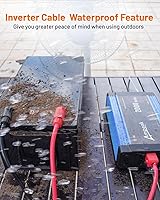
The anti-spark, waterproof cable connections stand out as one of the most practical differentiators over competing units at this price. Buyers installing this in truck beds, boat cabins, or outdoor setups appreciate the slipcovers not just for safety during hookup, but for the added protection against corrosion in humid or dusty environments.
The cables measure only 2 feet, which is the most consistent practical complaint among buyers — those who need to mount the inverter further from their battery bank often have to purchase additional cabling separately. At this wattage, sourcing compatible extension cables of the correct gauge adds both cost and inconvenience right out of the box.
Noise Level
83%
The temperature-controlled fan is the primary reason this inverter earns consistent praise for quietness — it simply does not run unless the unit actually needs cooling, which makes a real difference for van dwellers or truck sleeper-cab users running the inverter overnight. At 52 dB when active, the fan noise is unobtrusive for most users in typical environments.
The 52 dB rating applies to normal light-to-medium loads; pushing toward the upper capacity range causes the fan to run continuously and at higher intensity, becoming noticeably louder in confined spaces. A few users also mention that the brief fan self-test at startup, while harmless, can startle anyone working in an otherwise quiet environment.
Value for Money
79%
21%
For buyers who need solid 2000W power with above-average safety features and do not require pure sine wave output, the pricing sits in a sensible sweet spot. The included anti-spark cables, the high efficiency rating, and the 18-month warranty add tangible value that makes the cost feel justified compared to cheaper alternatives with fewer protections.
Buyers who later discover their devices need pure sine power will find themselves spending considerably more to upgrade, making the initial purchase feel less cost-effective in retrospect. The short 2-foot cable also means some buyers face an unexpected additional expense for supplemental cabling immediately after unboxing.
Ease of Installation
87%
Buyers consistently describe the setup process as intuitive, with included color-coded 4AWG cables making battery terminal connections straightforward even for first-time inverter users. The anti-spark design takes meaningful anxiety out of the initial hookup, and most users report going from unboxing to running an appliance within just a few minutes.
The 2-foot cable length catches some buyers off guard when their intended mounting location sits further from the battery, requiring a mid-installation trip to source additional cabling of the right gauge. Mounting hardware is also not included, so users who want the unit securely fixed inside a vehicle cavity or cargo area need to plan and source hardware separately.
USB Charging Performance
62%
38%
Having two USB ports integrated directly into the inverter is genuinely convenient for mixed-device setups — topping up a phone or tablet without sacrificing an AC outlet is a practical advantage in tight van or truck cab environments. For light, routine USB charging needs, the ports handle the job acceptably.
The 3.1A per-port USB rating does not consistently translate to real-world speeds, with complaints pointing to slower-than-expected charging times for larger devices like tablets. For buyers prioritizing fast USB charging, a dedicated hub with better charging circuitry will meaningfully outperform what is built into this inverter.
LED Display & Monitoring
74%
26%
The LED status display earns genuine appreciation from RV owners and off-grid users who want a quick read on battery voltage without reaching for a separate multimeter. Being able to see at a glance when input voltage is dropping toward warning territory is a practical safeguard that many competing units at this price simply omit.
The display is functional rather than feature-rich — it shows input voltage and basic status but does not display actual wattage draw or output load percentage, which would be far more useful for managing power budgets across multiple devices. Some users also find the display difficult to read at an angle or in direct sunlight.
Build Quality & Durability
71%
29%
The physical construction feels solid, with buyers consistently noting that the housing and cabling feel more substantial than what typically ships with budget inverters. Early impressions on build are positive, and the inclusion of quality 4AWG cables with proper shielding suggests attention to the materials that matter most for safe, reliable operation.
With the product only available since late 2024, there is simply not enough long-term owner data to say with confidence how well the housing, terminals, and internal components hold up after a year or more of regular use. Buyers should treat durability assessments as preliminary rather than established, and rely on the 18-month warranty as a reasonable hedge against early failure.
Warranty & Support
76%
24%
The 18-month support window is longer than what most budget-to-mid-range inverter brands offer, and the 30-day no-questions return policy lowers the risk of trialing an inverter for a specific setup before fully committing. Buyers who have contacted support for setup guidance generally report reasonable response times.
Customer service experiences vary noticeably — a subset of users describe support interactions as slower or less technically detailed than expected for a product with an 18-month coverage claim. The warranty explicitly excludes damage caused by misuse, which is standard language but worth noting for anyone planning rugged outdoor or high-cycling vehicle applications.
Load Versatility
73%
27%
For the core audience — van travelers, RV users, tailgaters, and off-grid cabin setups — the range of compatible loads is broad enough to cover most practical everyday needs. Running a coffee maker, charging a laptop, powering a small television, and keeping a box fan going simultaneously is well within what this inverter handles comfortably.
The modified sine wave output creates a compatibility ceiling that is meaningfully lower than a pure sine unit at the same wattage. Anyone with a more demanding or mixed-use load profile — including variable-speed appliances, certain power tool chargers, or audio equipment — will encounter performance degradation or compatibility issues that limit how versatile the Ampeak 2000W truly is.

Suitable for:

The Ampeak 2000W Modified Sine Power Inverter is best suited to people who spend serious time away from the grid and need a reliable way to run standard household loads from a 12V battery. Truck drivers, van dwellers, and RV owners will find it particularly practical — it can comfortably handle a coffee maker, a box fan, a small microwave, or a set of power tools without much fuss. Tailgaters and weekend campers running moderate electrical loads will also get solid value here, especially those who appreciate having three AC outlets and dual USB ports in one unit. The anti-spark, waterproof battery cables make installation meaningfully safer in damp or dusty environments, which matters when mounting an inverter inside a cargo van or under a truck seat. Anyone building an emergency backup power setup around an existing 12V battery bank will find this a practical, cost-conscious option that covers everyday needs without overcomplicating things.

Not suitable for:

The Ampeak 2000W Modified Sine Power Inverter is the wrong choice if your device list includes anything sensitive to waveform quality. CPAP and BiPAP machines, variable-speed power tools, laser printers, and most high-fidelity audio or video equipment are designed to run on a clean pure sine wave — using a modified sine output with these devices can produce buzzing, cause overheating, or lead to long-term damage. Anyone dependent on medical-grade equipment should rule this unit out entirely, full stop. If your priority is powering a workstation, a recording setup, or complex electronics, the modest price difference between this and a comparable pure sine inverter is genuinely worth paying. Buyers who need more than 2 feet of battery cable reach, or who are working with a 24V system rather than 12V, will also find this unit falls short without added investment.
Specifications

  • Continuous Power: Delivers a steady 2000W of continuous AC power output for running household appliances and power tools.
  • Peak Power: Handles surge loads up to 4000W to accommodate the higher startup draw of motors and compressors.
  • Input Voltage: Designed exclusively for 12V DC input, compatible with standard automotive and deep-cycle battery systems.
  • Output Voltage: Converts to 110V AC output, matching the standard US household voltage used by Type A outlets.
  • Waveform Type: Produces a modified sine wave, suitable for most resistive and inductive loads but not for electronics requiring a clean pure sine signal.
  • Efficiency: Achieves a conversion efficiency of 89.37%, measurably higher than the 75–80% typical of competing units in this price class.
  • AC Outlets: Includes three Type A AC outlets, each capable of supporting up to 2000W within the inverter's total continuous output budget.
  • USB Ports: Features two USB-A ports, each rated at 5V/3.1A, for charging phones, tablets, and other USB-powered devices simultaneously.
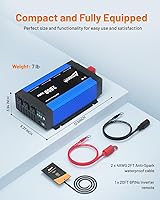
  • Cable Gauge: Ships with 4AWG battery cables, an appropriate gauge for safely managing the current demands of a 2000W DC-to-AC conversion.
  • Cable Length: The included battery cables measure 2 feet in length, which may require supplemental cabling for installations positioned further from the battery.
  • Noise Level: Rated at 52 dB during active fan operation, roughly comparable to a quiet conversation at close range.
  • Safety Protections: Incorporates 11 built-in protections covering over-voltage, under-voltage, over-temperature, overload, short-circuit, and low-battery shutdown scenarios.
  • Fan Operation: Uses an intelligent temperature-controlled fan that activates only when internal temperature exceeds 122°F, keeping the unit quiet during lighter loads.
  • Display: An LED status display provides real-time readouts of input battery voltage and current operating status.
  • Dimensions: Measures 14.57 x 9.41 x 5.47 inches, a mid-size footprint typical of inverters in the 2000W output class.
  • Weight: Weighs 8.71 pounds, which is moderately heavy and worth factoring in for tight or overhead mounting situations.
  • Warranty: Backed by an 18-month customer service support period covering manufacturing defects, excluding damage caused by misuse.
  • Return Policy: Eligible for a 30-day no-questions-asked return through the point of purchase.

Related Reviews
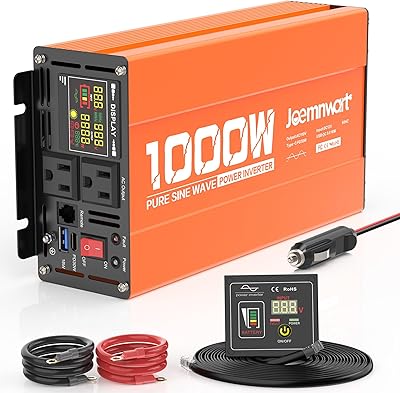
Joemnwart 1000W Pure Sine Wave Power Inverter
79%
88%
Power Output Quality
79%
Build Quality
84%
USB Charging Performance
86%
Safety Protection System
82%
Noise Level
More
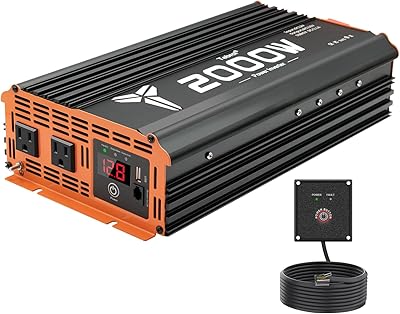
Tebrol 2000W Power Inverter
86%
88%
Performance & Power Output
90%
Ease of Use & Setup
85%
Portability & Size
75%
Cooling System & Noise
91%
Safety Features
More
SUNWHEEL 2000W Pure Sine Wave Inverter
80%
86%
Power Output Reliability
91%
Waveform Quality
83%
Build Quality
88%
Noise Level
67%
LCD Display Usefulness
More
Novopal 2000W 24V Pure Sine Wave Inverter
79%
88%
Power Output Quality
83%
Build Quality
79%
Value for Money
74%
Ease of Installation
81%
Remote Control Functionality
More
XYZ INVT 2000W Pure Sine Wave Inverter
75%
88%
Power Output Quality
58%
Thermal Management
83%
Surge Handling
91%
Portability & Size
86%
Conversion Efficiency
More
LEESKY 1500W Pure Sine Wave Power Inverter
82%
88%
Output Power Quality
84%
Build Quality
86%
Value for Money
91%
Remote Controller Usefulness
79%
Noise Level
More
Yinleader 3500W Pure Sine Wave Power Inverter
73%
83%
Power Output Quality
61%
Build Quality
67%
Thermal Management
63%
Surge Performance
86%
Ease of Setup
More
BESTEK 400W Pure Sine Wave Power Inverter
81%
91%
Power Output Quality
74%
Real-World Wattage Reliability
88%
USB Charging Speed
83%
Fan Noise
76%
Build Quality & Durability
More
Homkeep 3000W Pure Sine Wave Power Inverter
88%
93%
Power Performance
88%
Ease of Use
90%
Build Quality
85%
Noise Level
91%
Safety Features
More
VOLTWORKS VS-2000SCR 2000W Pure Sine Wave Inverter
81%
88%
Output Power & Reliability
91%
Sine Wave Quality
83%
Surge Performance
86%
Lithium Battery Compatibility
79%
Build Quality & Housing
More

FAQ

Most common household and vehicle loads work fine — coffee makers, box fans, small microwaves, power drills, laptops, and LED televisions are all fair game. The key is staying within the 2000W continuous limit by adding up the wattage of everything running simultaneously. What this unit is not suited for is sensitive electronics that require a clean pure sine wave signal, such as high-end audio equipment, laser printers, or medical devices.

No, and this is an important distinction to get right. CPAP and BiPAP machines are engineered to run on pure sine wave power, and using a modified sine inverter with one can cause the motor to run hotter than normal, shorten its lifespan, or trigger error codes on the machine. If powering a CPAP on the road is your primary use case, a pure sine wave inverter is the correct purchase.

The process is straightforward: connect the red cable to the positive terminal of your 12V battery and the black cable to the negative terminal, then power the unit on. The anti-spark slipcovers on the included 4AWG cables reduce the risk of sparking during connection, which is a practical safety feature during setup. Just make sure your battery is fully charged and in good condition before running any heavy loads.

Running a 2000W inverter off a standard vehicle starter battery for extended sessions is not recommended — starter batteries are designed for brief, high-current cranking, not sustained deep discharge, and can be damaged or killed relatively quickly that way. For anything beyond a short-duration use, a dedicated deep-cycle or AGM battery with adequate amp-hour capacity is the right pairing. The unit's higher-than-average efficiency does reduce unnecessary energy waste, but the battery selection matters far more than the inverter's efficiency rating in this context.

The fan is temperature-controlled, meaning it stays off entirely when the unit is running cool enough to manage without active cooling. When it does spin up, the rated noise is around 52 dB, which is roughly the volume of a quiet conversation — present but not jarring. Most owners who use this in sleeping or quiet environments report that the intermittent fan noise is not a meaningful issue in practice.

Yes, all five outputs can be used simultaneously, but the combined draw across every port still needs to stay within the 2000W continuous ceiling. Think of it as a shared power budget — if two appliances are pulling 900W each, you have about 200W remaining for anything else connected to the USB ports or the third AC outlet. Running everything at once is fine as long as the math adds up.

Not quite. The waterproofing applies specifically to the battery cable connections and their slipcovers, which protects the most exposure-prone contact points from moisture during installation and use. The inverter unit itself is not rated for direct water exposure and should be mounted somewhere protected from rain and condensation. Think of it as having weather-resistant cable terminations on an otherwise standard indoor-grade unit.

The unit will shut itself off automatically — that is exactly what the built-in overload and over-temperature protections are designed to do. Once the excess load is removed or the unit cools down, you can restart it normally. If you are seeing repeated shutdowns under heavy use, it is worth checking whether your combined load is regularly pushing close to the 2000W continuous limit, as sustained operation near the ceiling can cause thermal shutdowns over time.

No, this is strictly a 12V DC input unit and will not function correctly with a 24V system. Many heavy-duty trucks, RVs with upgraded systems, and marine vessels run on 24V, so it is worth confirming your battery bank voltage before purchasing. If you have a 24V setup, you will need to look specifically at inverters rated for 24V input.

The display gives you a real-time read on your input battery voltage and the current operating status of the unit. In off-grid or RV situations, watching the voltage readout is genuinely useful — a steadily dropping number is an early warning that your battery is running low before the inverter shuts down on its own. It is a small feature, but it pays off meaningfully during extended use when you cannot afford to be caught off guard.

Where to Buy