Overview

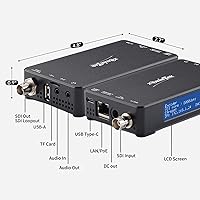
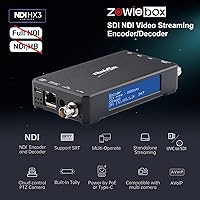
The Zowietek ZowieBox SDI NDI Encoder Decoder is a palm-sized broadcast tool that punches well above its physical weight in professional AV environments. Built into a rigid black aluminum shell, this compact encoder-decoder landed in mid-2024 and quickly climbed to a respectable rank among video converters — a sign that working professionals took notice. It handles SDI-to-NDI encoding and NDI-to-SDI decoding, though not simultaneously — you pick a mode and commit to it. NDI support covers HX3, HX2, and HX certified formats only; full NDI is absent, and that distinction genuinely matters depending on your workflow. Standalone streaming over RTMP, SRT, or RTSP requires no attached computer whatsoever.
Features & Benefits

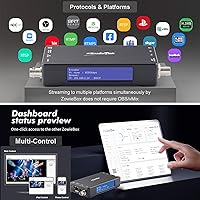
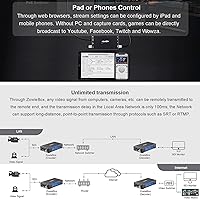
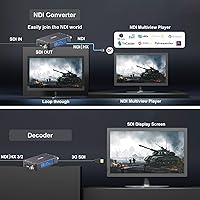
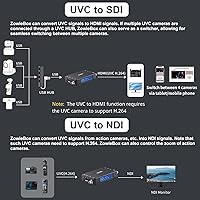
The ZowieBox covers a lot of ground for something smaller than most smartphones. In encoder mode, it converts SDI signals to NDI|HX or streams out via RTMP, SRT, RTP, or RTSP at up to 1080p60 and 50 Mbps. Flip it to decoder mode and it pulls in AVoIP streams — RTMP, RTSP, SRT — then pushes them out as SDI or NDI. There is also a UVC-to-SDI bridge that lets you inject a standard USB webcam into an SDI routing chain without extra hardware. Power arrives via PoE+ or USB-C, and an SDI loop-through keeps your source signal intact. ZowieUI, accessible from any browser or phone, handles PTZ control, tally, OSD overlays, and network config in one place.

Best For

This SDI-NDI converter fits neatly into a handful of real production scenarios. Houses of worship with existing SDI camera infrastructure can fold those feeds into an NDI-based workflow without rewiring anything. Remote production teams benefit from standalone operation — no laptop required at the venue. Corporate AV departments can repurpose UVC webcams as SDI sources, which is a genuinely practical move if you are already invested in SDI routing. Broadcast engineers modernizing older facility gear will appreciate the IP bridging capability. Run two units back-to-back over a LAN and you get point-to-point SDI extension, effectively stretching signal distances through your network rather than running expensive coax.

User Feedback

Buyers have settled on a 4.2-star average, with the most consistent praise pointing to the unit's compact footprint and the reliability of standalone streaming during live events. NDI integration draws positive comments from users transitioning SDI workflows to IP production. On the critical side, the single-mode limitation — encode or decode, never both simultaneously — catches some buyers off guard, so understanding that constraint before purchasing is important. A handful of users flagged compatibility issues with specific Atomos and Blackmagic hardware, particularly on older device revisions. The ZowieUI interface earns mixed marks: functional once configured, but not the most intuitive starting point. Customer support is generally responsive, though firmware-specific questions can take more time to resolve.

Pros

  • Aluminum chassis is genuinely robust for its size and holds up well in portable production environments.
  • Standalone RTMP and SRT streaming runs reliably for multi-hour events with no computer required.
  • SDI loop-through lets you tap into an existing signal chain without interrupting downstream devices.
  • PoE+ support simplifies permanent installs by eliminating the need for a separate power run.
  • NDI|HX3, HX2, and HX certified output integrates cleanly with major NDI-compatible production switchers.
  • UVC-to-SDI conversion is a practical, cost-saving option for teams with quality webcams already on hand.
  • AVoIP stream decoding handles RTMP, RTSP, and SRT inputs, covering most common IP source types.
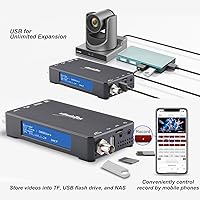
  • Local recording to TF card, USB, or NAS runs simultaneously with live streaming as a built-in backup.
  • ZowieUI provides full remote control over PTZ cameras, tally, OSD, and stream settings from any browser.
  • At its price point, the ZowieBox consolidates functions that would otherwise require multiple separate devices.

Cons

  • Encode and decode modes cannot run simultaneously — you must choose one per session, full stop.
  • Full NDI and NDI|HB are absent, which is a hard blocker for workflows that depend on full-bandwidth NDI.
  • Confirmed signal compatibility issues exist with certain Atomos and Blackmagic hardware revisions.
  • ZowieUI has a meaningful learning curve for users who are not already comfortable with IP video configuration.
  • Firmware update cadence has been inconsistent, with occasional regressions reported after certain releases.
  • Customer support response times slow down noticeably for technical firmware or compatibility questions.
  • Recording reliability depends heavily on storage media speed — slower TF cards cause dropped frames.
  • Network interruptions do not always trigger automatic stream reconnection, requiring manual user intervention.
  • No HDMI interface means mixed HDMI-SDI environments require an additional upstream converter.
  • Thermal performance during extended encoding sessions has raised questions about enclosed or rack-mount use.

Ratings

The Zowietek ZowieBox SDI NDI Encoder Decoder has been evaluated by our AI system after analyzing verified buyer reviews from global markets, with spam, incentivized responses, and bot-generated feedback actively filtered out. Scores reflect the honest distribution of real-world experiences — from broadcast engineers in permanent installs to event technicians using it in the field. Both the standout strengths and the friction points that genuinely affect purchasing decisions are captured transparently below.
Build Quality & Form Factor
88%
Users consistently praised the rigid black aluminum chassis, noting it holds up well in live event environments where gear gets moved often. At just 170g, it fits into a jacket pocket or cable bag without adding meaningful weight, which matters for technicians juggling multiple devices on a production day.
A few buyers found the unit runs warmer than expected during extended encoding sessions, raising questions about long-term thermal performance in rack or enclosed spaces. The plastic port covers, if present, were noted as feeling less premium than the rest of the housing.
SDI-to-NDI Conversion Accuracy
91%
Users integrating the ZowieBox into NDI-based production systems reported clean, low-latency conversions with no noticeable signal degradation at 1080p60. Churches and live event venues routing legacy SDI cameras into vMix or Tricaster workflows found the output reliable across extended broadcasts.
NDI support is limited to HX3, HX2, and HX certified formats — full NDI and NDI|HB are not available. Buyers expecting full-bandwidth NDI for high-demand productions were disappointed and had to reconsider their workflow assumptions after purchase.
Standalone Streaming Reliability
86%
Running RTMP or SRT streams without any attached computer was a standout feature for remote production operators. Users covering sports events and outdoor ceremonies appreciated that the device held streams stable for multi-hour sessions without requiring a laptop in the signal chain.
SRT caller mode is supported but SRT listener mode has limitations depending on firmware version, which tripped up a handful of users expecting full bidirectional SRT flexibility. Some early firmware builds required updates before standalone streaming operated without hiccups.
Encode-Decode Mode Flexibility
58%
42%
Within its chosen mode, each function performs well — encoding SDI to NDI or decoding AVoIP streams to SDI works predictably and without major signal issues. For installations where only one direction of conversion is needed at a time, this limitation is essentially irrelevant.
The inability to encode and decode simultaneously is the single most cited frustration across user reviews. Buyers who assumed bidirectional operation could run concurrently — a reasonable assumption given the product name — were caught off guard, and some had to purchase a second unit to cover both directions at once.
UVC-to-SDI Bridge Performance
74%
26%
Converting a USB webcam into an SDI source without additional hardware is a genuinely useful capability for corporate AV teams and educators who already own quality UVC cameras. Users running Logitech and similar webcams into SDI routing switchers reported stable 1080p output.
USB capture card passthrough is explicitly not supported, which limits the input options. A few users expected broader USB device compatibility and found the UVC support more narrow than the marketing language suggested.
PoE and Power Options
83%
PoE+ support over CAT5e or better means installers can power the unit directly from a managed switch without running a separate power cable, which is a real practical advantage in permanent installs like houses of worship or conference rooms with structured cabling already in place.
The 12V 1A DC output is a nice addition for powering small peripherals, but the PoE requirement for 802.3at means older or budget switches may not supply adequate power. A couple of users had to upgrade their switching infrastructure to take full advantage of this feature.
ZowieUI Control Interface
67%
33%
Once configured, ZowieUI gives browser-based access to virtually every parameter — PTZ control, tally light, OSD overlays, stream settings, and network config — all from a phone or tablet. Experienced AV operators found this level of remote control genuinely useful on busy production days.
The initial setup and navigation drew mixed reactions. Users without a background in IP video workflows described the interface as unintuitive, and documentation quality varied. First-time users often needed community forum help or trial and error before feeling comfortable with the control panel.
NDI HX Latency Performance
79%
21%
For NDI|HX3 specifically, users noted latency was acceptably low for live switching applications, performing well enough for multi-camera productions where a few frames of delay are tolerable. Broadcast engineers working in non-critical-latency workflows found the performance solid.
Latency is higher than full NDI would deliver, which is an inherent trade-off of HX formats over bandwidth-constrained networks. Users on congested or lower-quality LAN infrastructure noticed occasional frame drops that full NDI might have handled more gracefully.
AVoIP Stream Decoding
77%
23%
Pulling in RTMP, RTSP, and SRT streams and converting them to SDI output worked well for users integrating remote camera feeds or cloud-based sources into a local SDI routing environment. The flexibility to decode multiple stream types without additional software was a practical time-saver.
Decoding resolution tops out at 1080p, which is fine for most broadcast uses today but leaves 4K workflows entirely unaddressed. A handful of users noted that stream reconnection after network interruptions was not always automatic and required manual intervention.
Audio Handling
71%
29%
Support for both SDI embedded audio and a 3.5mm TRS line input gives users basic flexibility without needing an external audio breakout device. For simple single-camera setups with a wired mic or on-camera audio, this covers the need cleanly.
Audio configuration options within ZowieUI are somewhat limited compared to dedicated audio-over-IP devices. Users working with more complex audio routing — such as multi-channel or AES formats — found the 3.5mm TRS option too basic for professional audio standards.
Local Recording Capability
72%
28%
The ability to record to a TF card, USB flash drive, or NAS simultaneously with live streaming is a practical backup option for event recording without a separate capture device. MP4, MOV, and TS format support covers the most common post-production workflows.
Recording quality and reliability appeared to vary based on the storage medium used, with slower TF cards causing dropped frames or recording failures reported by a minority of users. There is no redundant recording mode if the primary storage device fills or fails mid-event.
Third-Party Hardware Compatibility
62%
38%
In most standard SDI signal chains, the ZowieBox integrates without issue. Users pairing it with common broadcast switchers, monitors, and IP routers found it straightforward to introduce into an existing setup without reconfiguration of other gear.
Documented incompatibilities with Atomos Shogun Inferno, Shogun Ultra, and Blackmagic Decklink Quad 2 are a real concern for users in post-production or hybrid broadcast environments. These caveats apply specifically to hardware manufactured before a certain production revision, but identifying which unit version you have requires checking product documentation carefully.
Firmware and Software Support
69%
31%
Zowietek provides ZowieX software for batch firmware management and detection of multiple units on a network, which is a useful tool for facilities running several boxes. Firmware updates have addressed some early compatibility and streaming stability issues.
The pace of firmware updates has been inconsistent, and some users reported that newly introduced features in one update occasionally introduced regressions elsewhere. Customer support response times on firmware-specific questions were slower than users expected given the professional price point.
Value for Money
81%
19%
At its mid-range price point for prosumer broadcast gear, the ZowieBox packs in a meaningful set of capabilities — NDI conversion, standalone streaming, UVC bridging, PoE power, and local recording — that would otherwise require multiple discrete devices and considerably more budget.
The simultaneous encode-decode limitation stings at this price tier. Buyers who need true bidirectional operation end up purchasing two units, which roughly doubles the cost and pushes it into territory where competing solutions become worth evaluating more carefully.
Physical Connectivity
84%
SDI in and out with loop-through, USB-C, 3.5mm TRS audio, and a TF card slot are logically arranged on a device this size. The loop-through in particular means you do not have to break your existing SDI signal chain to insert the ZowieBox — it just taps in.
The lack of HDMI is an intentional SDI-focused design decision, but it does limit flexibility for anyone who wants to bridge HDMI sources without an additional converter upstream. In mixed HDMI-SDI environments, this becomes a meaningful gap.

Suitable for:

The Zowietek ZowieBox SDI NDI Encoder Decoder is built for AV professionals who need to bridge established SDI infrastructure with modern IP-based production workflows, without ripping out existing cabling or investing in a full equipment overhaul. It fits particularly well in houses of worship that already run SDI cameras but want to feed those signals into an NDI environment like vMix or Tricaster for switched, networked production. Remote event technicians who need a self-contained streaming device — one that holds an RTMP or SRT stream for hours without a laptop in the chain — will find it dependable in the field. Corporate AV teams and educators can also extract real value from the UVC-to-SDI bridge, which lets them promote an existing USB webcam to a professional SDI signal path. Broadcast engineers managing legacy gear transitions, or operators who need point-to-point SDI extension over a LAN using two units, are squarely in the target audience for this compact encoder-decoder.
Not suitable for:

The Zowietek ZowieBox SDI NDI Encoder Decoder is not the right tool for anyone who needs true simultaneous encode and decode operation — that single architectural limitation rules it out for productions where both directions of conversion must run concurrently from one device. Users expecting full NDI or NDI|HB support will also be disappointed; the HX-only implementation is a deliberate bandwidth trade-off that does not suit high-demand broadcast environments where full-bandwidth NDI is a workflow requirement. Anyone invested in an Atomos Shogun or Blackmagic Decklink Quad 2 ecosystem should verify hardware revision compatibility carefully before purchasing, as documented signal issues exist with certain configurations. This compact encoder-decoder is also not appropriate for 4K production pipelines, since its maximum output caps at 1080p60. Finally, buyers who are new to IP video workflows and expect an immediately intuitive setup experience may find the ZowieUI learning curve frustrating without prior familiarity with network-based AV systems.
Specifications

  • Dimensions: The unit measures 123 x 68 x 22mm (4.8″ x 2.7″ x 0.9″), making it smaller than most smartphones.
  • Weight: At 170g (6.0oz), the device is light enough to mount on a tripod arm or tuck into a cable bag without adding meaningful load.
  • Housing: The chassis is machined black aluminum, providing structural rigidity and passive heat dissipation without adding bulk.
  • Video Encoding: Supports H.265 Main Profile and H.264 High, Main, and Baseline Profiles for output encoding.
  • Max Resolution: Maximum encoding and decoding resolution is 1080p at 60 frames per second; 4K is not supported.
  • Max Bitrate: Output bitrate is adjustable up to a maximum of 50 Mbps, allowing balance between quality and bandwidth consumption.
  • NDI Support: Certified for NDI|HX3, NDI|HX2, and NDI|HX in encoder mode; decoder mode supports NDI|HX3 and NDI|HX2; full NDI and NDI|HB are not supported.
  • Streaming Protocols Out: Outbound streaming supports RTMP, RTMPS, SRT (caller mode only), RTP, UDP, and RTSP.
  • Streaming Protocols In: Inbound stream decoding accepts RTSP, RTMP, RTMPS, and SRT sources.
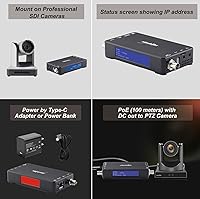
  • Power Input: Accepts power via USB-C or PoE+ (IEEE 802.3at standard) over CAT5e cable or better.
  • Power Output: Provides a 12V 1A DC output port for powering small compatible peripherals.
  • Audio I/O: Handles SDI embedded audio natively, and includes a 3.5mm TRS jack for analog line-level audio input and output.
  • Recording Formats: Local recording is supported in MP4, MOV, and TS container formats simultaneously with live streaming.
  • Storage Options: Records to TF (microSD) card, USB flash drive, or NAS network storage depending on user configuration.
  • SDI Interface: Features SDI input, SDI output, and SDI loop-through, allowing the source signal to pass downstream uninterrupted during encoding.
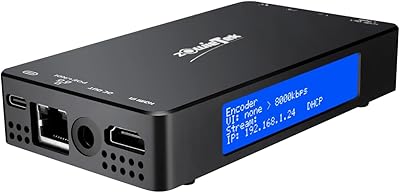
  • Display & Tally: Includes a built-in LCD screen showing streaming status and a tally light that operates in automatic or manual mode.
  • Control Software: Managed via ZowieUI (browser-based, accessible from PC, phone, or tablet) and ZowieX desktop software for batch device detection and firmware upgrades.
  • OSD Capabilities: Supports on-screen display overlays including text captions, logo insertion, timestamps, scoreboard graphics, and stored picture overlays.
  • Mounting: Compatible with standard tripod mounts, enabling flexible positioning in studio, live event, or field production environments.
  • Operating Mode: Functions exclusively in either encoder mode or decoder mode — both modes cannot be active on the same unit simultaneously.

Related Reviews
Zowietek ZowieBox NDI HX3 4K HDMI Encoder/Decoder
81%
83%
Ease of Setup
88%
NDI Performance
91%
Build Quality
82%
Streaming Reliability
63%
Web UI Usability
More
RGBlink mini-MX SDI
RGBlink mini-MX SDI
86%
94%
Video Switching Performance
91%
Audio Mixing Quality
89%
Touchscreen Responsiveness
87%
Connectivity Options
85%
Ease of Setup
More
AVKANS NDI PTZ Camera 30X
82%
91%
NDI Reliability
83%
Installation Simplicity
74%
AI Auto-Tracking Accuracy
88%
Video Output Quality
93%
Multi-Output Flexibility
More
Magewell USB Capture SDI Plus
87%
94%
Video Quality
89%
Ease of Use
92%
Latency
90%
Reliability for 24/7 Use
95%
Setup/Installation
More
SMSL M300SE MQA Audio Decoder
87%
94%
Audio Quality
88%
Build Quality
90%
Connectivity Options
91%
Ease of Setup
72%
Bluetooth Range
More
Blackmagic Design DeckLink SDI 4K
87%
94%
Video Capture Quality
83%
Software Compatibility
89%
Build Quality
91%
Performance & Speed
87%
Cross-Platform Compatibility
More
Tenveo VHD630A-NDI PTZ Camera Bundle
88%
95%
AI Auto-Tracking Accuracy
92%
Video Quality
90%
Zoom Performance
88%
Controller Usability
85%
Installation & Setup
More
RGBlink mini-Edge SDI Video Switcher
86%
89%
Overall Performance
91%
Ease of Use
94%
Video Quality
88%
Multi-Camera Control
92%
Compatibility with Streaming Platforms
More
YoloLiv YoloBox Pro
YoloLiv YoloBox Pro
84%
92%
Portability & Setup Speed
89%
Screen Visibility & Brightness
94%
Input Connectivity
81%
Battery Reliability
78%
Networking & Bonding
More
FoMaKo KN30A Pro NDI PTZ Camera
86%
94%
Video Quality
92%
AI Auto-Tracking Accuracy
89%
Low-Light Performance
90%
Build Quality
88%
PTZ Mechanism Precision
More

FAQ

No, it cannot. The device operates in one mode at a time — you set it to either encoder or decoder before use. If your workflow genuinely requires both directions running concurrently, you would need two separate units, one configured for each role.

It only supports NDI|HX formats — specifically HX3, HX2, and HX in encoder mode, and HX3 and HX2 in decoder mode. Full NDI and NDI|HB are not supported at all. That distinction matters if your production environment depends on full-bandwidth NDI for critical switching or low-latency monitoring.

There are documented compatibility issues with specific devices including the Atomos Shogun Inferno, Shogun Ultra, and Blackmagic Decklink Quad 2. These issues are tied to earlier hardware revisions of the ZowieBox, so it is worth checking your unit version against the manufacturer documentation before integrating it into a setup that relies on those recorders.

No — standalone streaming is one of the genuinely useful aspects of this device. Once configured, it can push RTMP or SRT streams continuously without any computer in the chain, which is exactly what makes it practical for remote events or house-of-worship installations where simplicity matters.

You need a switch that supports the IEEE 802.3at standard, commonly called PoE+. Basic or older PoE switches that only meet the 802.3af standard may not supply enough power. CAT5e cable or better is required for the connection.

It supports UVC-compliant cameras, which covers the majority of mainstream USB webcams from brands like Logitech. However, USB capture cards are explicitly not supported, so you cannot use a capture card as a USB input source — the UVC device needs to be a camera directly.

Primary control is through ZowieUI, a browser-based interface that you access from any phone, tablet, or computer on the same network. There is a built-in LCD screen and tally light on the unit itself for status monitoring, but detailed configuration is handled through the web interface or the ZowieX desktop application for multi-unit setups.

Yes, local recording and live streaming run simultaneously. You can record to a TF card, USB flash drive, or a NAS device at the same time as pushing a live stream. Just make sure your TF card is fast enough — slower cards have caused dropped frames for some users during concurrent operation.

It can push to any platform that accepts RTMP or RTMPS, which covers YouTube Live, Facebook Live, Twitch, and most CDN ingest endpoints. SRT output is supported in caller mode, and RTSP, RTP, and UDP are also available for internal or custom distribution setups.

Honestly, there is a learning curve if IP-based video workflows are new to you. Experienced broadcast or AV engineers tend to find it straightforward, but buyers coming from simpler consumer streaming devices have reported needing time to get comfortable with the network configuration and feature layout. The manufacturer provides documentation and there is community support available, but factor in setup time if this is your first IP video device.