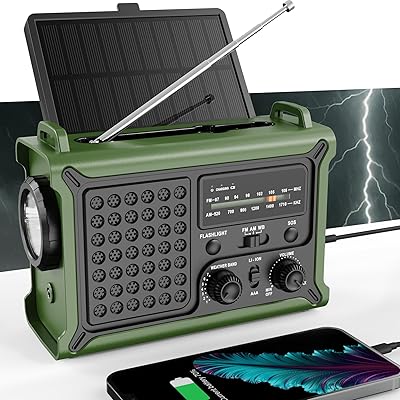
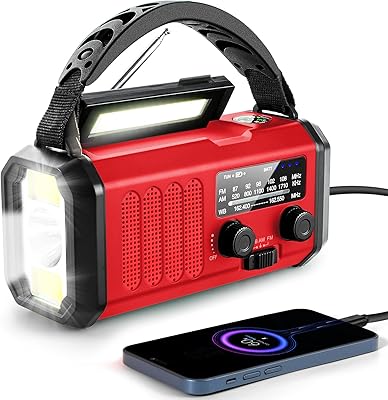
Overview

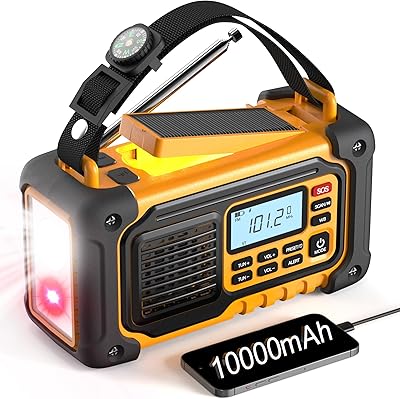
The ZHIWHIS ZWS-905 10000mAh Emergency Weather Radio is a multi-function device built for people who take preparedness seriously — whether that means weathering hurricane season at home or spending weekends off the grid. ZHIWHIS entered the market in 2024, which makes it a relatively new name, but the ZWS-905 packs an impressive range of functions into a compact, affordable package. The honest take: feature density here is genuinely high, but the real-world performance of individual functions is worth scrutinizing before you assume every spec delivers at full value. It sits comfortably in the mid-range of the survival radio market, competing against established names on price and versatility.
Features & Benefits

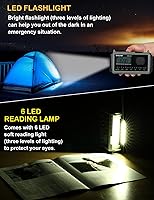
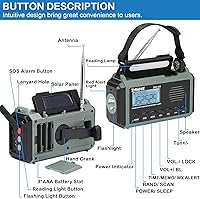
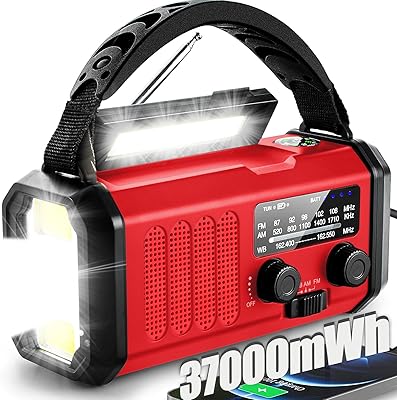
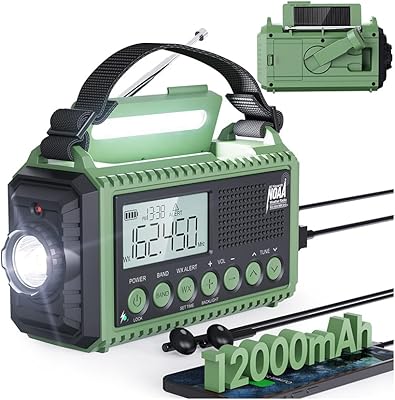
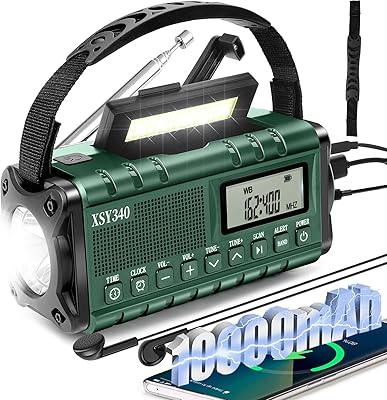
The standout capability is the auto NOAA alert scanning, which monitors all seven weather channels and triggers both a siren and a red alert light when hazardous conditions are detected — genuinely useful if you sleep through phone notifications. Powering the device is a 10,000mAh lithium battery, rechargeable via USB-C, and this emergency radio can also top up other devices in a pinch. When the grid goes down, you still have a hand crank and a solar panel as fallback options, though realistically both are slow — treat them as last-resort tools rather than primary chargers. A dual-mode light system handles both bright flashlight use and softer reading, and the 3W speaker manages everyday listening well enough, with a headphone jack for quieter moments.

Best For

This weather radio makes the most sense for households building out emergency kits ahead of storm or earthquake season — it bundles radio, lighting, and a backup power source into one grab-and-go device. Campers and hikers who prefer traveling light will appreciate not having to carry a separate flashlight, portable charger, and radio. Off-grid and rural users who regularly deal with unreliable power or weak cell signals will find the combination of charging options particularly practical. It also suits people who have difficulty waking to standard phone alarms, given the ZWS-905's audible siren and visual alert. If you want one device that covers multiple bases without buying several individual pieces of gear, this fits the bill.

User Feedback

Buyers consistently praise how straightforward this emergency radio is to set up, and many note the build feels more solid than the price point would suggest. The NOAA alert system draws particular appreciation — people in storm-prone areas report it has reliably triggered when local alerts are issued. On the critical side, buyers flag that solar charging in actual outdoor conditions is noticeably slow, and hand crank output is modest at best. Some users have tested the battery against its rated capacity and found the real-world figure comes in somewhat lower. AM/FM reception is generally adequate, though shortwave clarity varies significantly by location. The bundled compass and carabiner are frequently called out as a welcome, practical bonus.

Pros

  • Auto NOAA scanning alerts you with both a siren and a flashing light, even if you are asleep.
  • Three independent charging methods plus AA battery backup make this emergency radio genuinely hard to strand without power.
  • The 10,000mAh battery is one of the largest capacities available in this price range for a portable emergency radio.
  • USB-C charging is fast and convenient compared to older Micro-USB radios still common on the market.
  • Dual lighting modes — flashlight and reading lamp — add real everyday utility beyond emergency use.
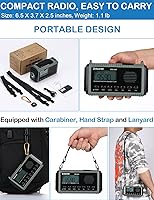
  • At roughly 1.1 pounds and pocket-friendly dimensions, the ZWS-905 travels without adding noticeable weight to a pack.
  • Included accessories like the carabiner, compass, and lanyard feel like practical additions, not cheap filler.
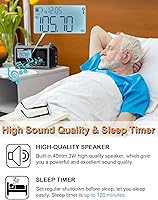
  • The sleep timer function is a small but thoughtful feature for using this as a bedside radio during normal times.
  • Build quality consistently earns positive remarks from buyers, feeling sturdier than the price suggests.
  • Acting as a USB power bank means one less device to pack on a camping trip or tuck into an emergency kit.

Cons

  • Solar charging in real outdoor conditions is slow — expect trickle-level input, not a meaningful quick top-up.
  • Hand crank output is modest at best; sustained cranking produces only enough power for short usage bursts.
  • Real-world battery output tested by users tends to fall short of the stated 10,000mAh capacity figure.
  • AM and FM reception quality can be inconsistent, particularly in areas with weak signal or significant interference.
  • Shortwave performance is unpredictable and varies considerably by location, limiting its usefulness for that band.
  • IPX3 water resistance is easy to misread as full waterproofing — it is not, and the distinction matters outdoors.
  • ZHIWHIS has limited brand history, which raises reasonable questions about warranty support and long-term parts availability.
  • The digital clock and interface controls lack a backlight bright enough for easy reading in complete darkness.
  • AA battery backup requires purchasing batteries separately, which is an extra step often forgotten until they are needed.

Ratings

The scores below for the ZHIWHIS ZWS-905 10000mAh Emergency Weather Radio were generated by our AI system after analyzing verified global buyer reviews, actively filtering out incentivized, bot-generated, and spam submissions to surface what real owners actually experienced. Both the strengths that earned repeat praise and the frustrations that came up consistently are reflected honestly in each category — nothing has been softened to protect the product's image.
NOAA Alert Reliability
88%
Buyers in storm-prone states consistently report that the auto-scan feature picks up local NOAA broadcasts without manual tuning, and the combined siren-plus-red-light alert is loud and bright enough to wake people who would otherwise sleep through a weather emergency. For households in hurricane or tornado corridors, this function alone justifies the purchase.
A small number of users noted that triggering sensitivity can occasionally produce false alerts during normal weather, which is more startling than harmful. Reception of the alert signal itself can degrade in areas with weak NOAA transmitter coverage, which is a limitation of the broadcast infrastructure rather than the radio itself.
Battery Capacity
74%
26%
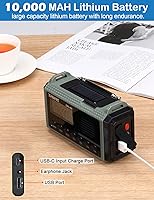
The large internal battery means this emergency radio can run for extended periods without recharging, and the ability to push power out via USB to charge a phone during an outage is a genuinely useful function that buyers call out positively. For a multi-day power outage scenario, having one device that covers both radio and phone charging is a real practical advantage.
Several hands-on testers found that real-world battery output fell noticeably short of the stated 10,000mAh figure under typical mixed-use conditions. The gap between the spec and actual performance is not dramatic, but buyers expecting to match the rated capacity precisely will likely be disappointed.
Charging Versatility
82%
18%
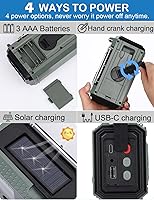
Having four independent ways to replenish power — USB-C, solar, hand crank, and AA batteries — gives this weather radio a meaningful edge over single-input competitors in genuine off-grid or prolonged emergency scenarios. Users preparing go-bags specifically appreciate the AA fallback as an absolute last-resort option that requires no hardware at all.
Both solar and hand crank inputs deliver very slow charge rates that are only useful for extending a low battery marginally, not for meaningfully recharging a depleted unit. Buyers who expect solar or hand crank to serve as practical primary charging methods will find the reality underwhelming compared to the impression the feature list creates.
Build Quality
83%
The physical feel of the ZWS-905 surprises most buyers positively — the housing feels more solid and deliberate than competing radios at a similar price, and the buttons have tactile feedback that does not feel flimsy. For a device meant to sit in an emergency kit for years and still work when needed, this first impression of durability matters.
The unit has not been widely tested across multi-year ownership cycles given its 2024 launch, so long-term durability data is limited. Some buyers noticed minor finish inconsistencies on the casing, though none reported functional defects tied to build quality at the time of their reviews.
AM/FM Reception
67%
33%
In suburban and urban environments with reasonable signal density, AM and FM performance is adequate for pulling in local news and weather broadcasts clearly. The telescoping antenna provides enough length to improve reception with some adjustment, and most buyers in good-signal areas had no serious complaints about everyday listening.
In rural areas or locations with obstructions, AM reception in particular was a recurring frustration, with users noting static and weak signal even with the antenna fully extended. Antenna sensitivity is not class-leading, and buyers who rely on AM for distant station reception should manage their expectations accordingly.
Shortwave Performance
53%
47%
Shortwave coverage adds a layer of utility for users who want access to international or long-distance broadcasts during events where domestic networks are disrupted, and casual shortwave listeners in favorable locations have reported usable reception on strong signals.
Shortwave performance is the most location-dependent and inconsistently reviewed aspect of this radio, with many users struggling to pull in stations reliably. For serious shortwave listeners, the reception quality here falls well short of what a dedicated shortwave receiver would deliver, and in practice this band reads more like a bonus feature than a core capability.
Lighting Utility
79%
21%
The dual-mode lighting is one of the more practical design choices on the ZWS-905 — having a directional flashlight for navigating in darkness and a softer reading lamp mode for close work or ambient light in a tent or room covers two genuinely different needs without requiring a separate device. Buyers consistently mention the lighting as a pleasant functional addition.
Neither the flashlight nor the reading lamp is powerful enough to serve as a primary lighting source for a large space or for outdoor trail navigation at distance. Both modes are utility-grade rather than high-performance, which is appropriate for an emergency radio but worth noting for buyers who prioritize lighting capability.
Portability
86%
At 1.1 pounds and a footprint that fits comfortably in a standard backpack side pocket, this emergency radio travels well without adding noticeable bulk. The included carabiner makes clipping it to a pack or bag strap effortless, and buyers who have used it on hiking trips report it stays accessible without getting in the way.
The device is slightly thicker than the most minimal competing radios, which matters in highly space-constrained kits. The lanyard attachment point also received a few mentions of feeling less robust than the rest of the build, though no reports of failure were noted.
Ease of Setup
91%
Out of the box, the ZWS-905 requires almost no learning curve — the controls are logically laid out, NOAA scanning can be activated within minutes, and the included manual covers the key functions clearly enough for non-technical users. Buyers frequently note they had it operational within minutes of opening the package.
The sleep timer and preset station functions take slightly more button navigation to configure, and a small number of users found the manual instructions for those features less clear than the basic radio controls. Nothing rises to the level of a genuine usability complaint, but the interface is not entirely intuitive for every function.
Speaker Audio Quality
62%
38%
For spoken-word content — weather broadcasts, news radio, emergency announcements — the 3W speaker is sufficiently clear and loud enough to be heard across a room without straining. Buyers who purchased this as a preparedness tool rather than an entertainment device are generally satisfied with audio performance in that context.
Anyone expecting music listening quality from this speaker will be let down, as the audio lacks depth and distorts at higher volume levels. The speaker is optimized for voice clarity rather than full-range audio, which is the right design priority for an emergency device but limits its appeal as a casual radio for music.
Water Resistance
58%
42%
The IPX3 rating offers a genuine measure of protection against accidental water contact — a radio dropped near a sink, caught in a brief drizzle, or splashed by a wave at a lakeside camp will likely survive without damage. For buyers keeping this primarily as a home emergency kit item, IPX3 is more than adequate.
The IPX3 rating is frequently misread as waterproof by buyers who assume an outdoor emergency radio can handle rain or wet conditions without concern, and that misunderstanding has led to disappointment. Any prolonged rain exposure, submersion, or use in genuinely wet outdoor conditions risks damage that the rating does not protect against.
Value for Money
84%
The combination of features bundled into this weather radio at its price point is difficult to match from established brands — buyers consistently note that purchasing a comparable radio, flashlight, and portable charger separately would cost considerably more. For preparedness-focused buyers on a practical budget, the value case is straightforward.
The value proposition depends heavily on accepting that no single function performs at the level of a dedicated device. Buyers who compare the battery output, radio reception, or charging speed against standalone products in each category will find trade-offs at every turn, which is the inherent nature of multi-function devices at this price tier.
Included Accessories
77%
23%
The carabiner, compass, hand strap, and lanyard all strike buyers as practical rather than decorative, and several reviewers specifically called out the compass as a welcome addition they did not expect. Getting a functional accessory bundle rather than just a charging cable in the box adds tangible value.
The compass is basic and suitable for orientation rather than precision navigation, which is appropriate but worth noting for anyone expecting a high-accuracy tool. The hand strap attachment hardware feels slightly less substantial than the rest of the unit, though no structural failures were reported across available reviews.

Suitable for:

The ZHIWHIS ZWS-905 10000mAh Emergency Weather Radio is a strong fit for households in hurricane, tornado, or earthquake-prone regions who want a single, reliable device ready to grab when the power goes out. Its automatic NOAA scanning and audible alert system make it especially practical for people who might sleep through a weather warning on their phone. Campers and hikers will appreciate having a radio, flashlight, reading lamp, and backup battery charger consolidated into one 1.1-pound package that clips onto a bag with the included carabiner. Off-grid and rural users who deal with spotty cell coverage and unreliable electricity will find the multiple charging options — USB-C, solar, hand crank, and AA batteries — genuinely reassuring as a backup stack. Budget-conscious preppers who want to cover the basics without assembling a collection of separate devices will find the value-per-feature ratio hard to match at this price point.
Not suitable for:

Buyers expecting a high-fidelity listening experience should look elsewhere — the ZHIWHIS ZWS-905 10000mAh Emergency Weather Radio is built around utility, not audio quality, and the 3W speaker reflects that priority. Shortwave radio enthusiasts who rely on clear international broadcast reception may find signal quality inconsistent, as shortwave performance in this class of radio is highly dependent on location and atmospheric conditions. Anyone planning to use this in sustained wet conditions should note that the IPX3 rating only covers light splashes — it is not waterproof, and submerging it or using it in heavy rain could cause damage. If your primary goal is a dedicated power bank with serious charging speed, the hand crank and solar panel are far too slow to serve that role; USB-C remains the only practical fast-charging input. Buyers who prioritize a well-established brand with long customer service track records may also want to factor in that ZHIWHIS is a relatively new market entrant, which means long-term support is still an open question.
Specifications

  • Model Number: The unit is identified by model number ZWS-905, manufactured by HRD under the ZHIWHIS brand.
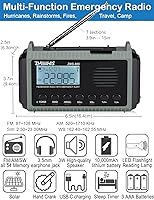
  • Dimensions: The radio measures 6.5″ long by 3.7″ wide by 2.5″ high, making it compact enough to fit in most emergency bags.
  • Weight: The device weighs 1.1 pounds with the internal battery installed, keeping pack weight minimal for outdoor use.
  • Battery Capacity: A built-in 10,000mAh lithium-ion rechargeable battery powers the unit and can also charge external devices via USB output.
  • Charging Inputs: The radio accepts power via USB-C cable, an integrated solar panel, a hand crank generator, or three AA batteries as a last-resort backup (AA batteries sold separately).
  • Radio Bands: Four bands are supported: AM, FM, Shortwave, and NOAA Weather, covering all seven official NOAA weather broadcast channels.
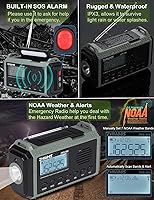
  • NOAA Alerts: The unit features automatic NOAA channel scanning that triggers an audible siren and a red alert light when a hazard broadcast is detected.
  • Speaker Output: A single built-in speaker delivers 3 watts of audio output, suitable for clear voice and spoken weather broadcasts in most environments.
  • Audio Jack: A 3.5mm headphone jack allows private listening without disabling the speaker circuitry.
  • Lighting: Two lighting modes are included: a directional flashlight for distance illumination and a softer reading lamp mode for close-range use.
  • SOS Alarm: A dedicated SOS siren function emits a loud emergency alert tone to signal for help in distress situations.
  • Water Resistance: The radio carries an IPX3 water resistance rating, meaning it can withstand light water splashes but is not designed for submersion or heavy rain exposure.
  • Display: A digital clock display is built into the unit, providing time readout without requiring a separate device.
  • Sleep Timer: An automatic shutdown timer can be set in increments between 10 and 120 minutes for hands-free power management.
  • Included Accessories: The package includes a carabiner, compass, hand strap, lanyard, and a USB Type-C charging cable alongside the radio and user manual.
  • Color: The ZWS-905 is available in green, consistent with outdoor and preparedness gear aesthetics.
  • Connectivity: USB is the primary wired connectivity method, used for both charging the internal battery and outputting power to other devices.
  • Date Available: This model became available for purchase in June 2024, making it one of the newer entries in the portable emergency radio category.

Related Reviews

DexScout Crank Emergency Weather Radio 10000mAh
86%
91%
Value for Money
88%
Battery Life and Charging
94%
Portability & Size
85%
Weather Alert Accuracy
90%
Build Quality and Durability
More
TFTDOUP Emergency Weather Alert Radio
86%
88%
Overall Performance
85%
Battery Life
90%
Charging Options
80%
Ease of Use
87%
Build Quality
More
RAOUOEN 30000mAh Emergency Weather Radio
85%
89%
Battery Life & Charging
91%
Performance in Emergencies
75%
Portability & Weight
84%
Sound Quality & Reception
87%
Ease of Use
More
FosPower A6 5200mAh Emergency Weather Radio
77%
91%
NOAA Reception
84%
Build Quality
67%
Power Bank Utility
53%
Hand Crank Efficiency
49%
Solar Charging
More
OnLyee CR1030 Emergency Weather Radio
76%
88%
Power Source Redundancy
83%
Hand Crank Durability
61%
Solar Charging Performance
79%
NOAA Reception Quality
67%
Battery Capacity & Phone Charging
More
QAUYYW Emergency Weather Radio XSY330
86%
89%
Battery Life
85%
Ease of Use
92%
Portability
75%
Radio Reception
88%
Build Quality
More
ZHIWHIS ZWS-702 Shortwave Radio
84%
83%
Sound Quality
91%
Battery Life
88%
Portability
80%
Ease of Use
72%
Reception Quality
More
Sttfaishen F20 Emergency Hand Crank Weather Radio
72%
82%
NOAA Alert Reception
54%
Battery Capacity & Honesty
61%
Hand Crank Usability
57%
Solar Charging Performance
83%
USB-C Charging Speed
More
Roxicosly CR1009Ultra 12000mAh Emergency Weather Radio
74%
88%
Battery Life
91%
Charging Versatility
86%
NOAA Alert Performance
58%
Hand Crank Durability
44%
Solar Charging Speed
More
ZHIWHIS ZWS-A320 Shortwave Radio
85%
91%
Reception Performance
85%
Sound Quality
88%
Bluetooth Connectivity
82%
Battery Life
93%
Portability
More

FAQ

Yes, the ZWS-905 includes a USB output port that lets you charge other devices from its internal battery. With 10,000mAh on board, you should be able to top up a typical smartphone at least twice, though actual output depends on how much charge the radio itself has and what else is drawing power.

Realistically, quite a while. The hand crank is designed as a last-resort power source, not a primary one. A few minutes of cranking will give you enough juice for short bursts of radio use or a flashlight, but fully charging the battery by hand crank alone is impractical. Rely on USB-C charging whenever possible and treat the crank as an emergency backup.

It has an IPX3 rating, which means it can handle light water splashes — think accidental drips or a light mist. It is not waterproof in any meaningful outdoor sense. Using it in moderate to heavy rain or leaving it exposed to prolonged moisture risks damage, so keep it sheltered during wet conditions.

That is exactly what the auto-alert function is designed to do. When set to monitor NOAA channels, the ZHIWHIS ZWS-905 10000mAh Emergency Weather Radio will trigger both an audible siren and a flashing red light when a hazard alert is broadcast, which is loud and bright enough to wake most people from sleep.
Reception quality is adequate for most users in average signal areas. The telescoping antenna helps, but like any compact radio, performance in rural areas or locations with significant interference can be inconsistent. For FM in particular, positioning the antenna carefully makes a noticeable difference.

Shortwave is included, but temper your expectations. Shortwave reception on radios in this class is functional but not reliably strong. Whether you can pick up a specific station depends heavily on your geographic location, time of day, atmospheric conditions, and the broadcast frequency. If shortwave listening is a primary use case, a dedicated shortwave receiver would serve you better.

The built-in lithium-ion battery comes pre-installed and is included in the box. However, the AA battery backup option — which lets you run the radio if the internal battery is fully depleted — requires three AA batteries that are not included, so it is worth stocking a set alongside this radio in your emergency kit.

In direct, strong sunlight the solar panel will trickle-charge the battery, but it is slow going. On a clear day with optimal sun angle you might add a meaningful percentage over several hours. Think of solar as a supplement that helps extend battery life during sustained outdoor use, not something that will fully recharge the device in an afternoon.

The package includes the radio unit with the internal battery installed, a USB Type-C charging cable, a carabiner, a small compass, a hand strap, a lanyard, and a printed English user manual. The accessories are genuinely useful rather than decorative, and the carabiner in particular makes attaching the radio to a bag easy.

It is a legitimate secondary light mode with a softer, more diffused output compared to the main flashlight beam. It is not going to replace a proper camping lantern, but for reading a map, finding something in a bag at night, or lighting a small space without blinding everyone around you, it is genuinely handy to have as a separate mode.