Overview

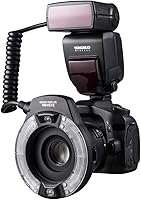
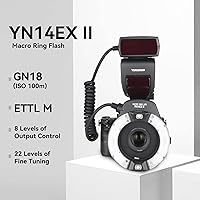
The YONGNUO YN14EX II Macro Ring Flash is a second-generation macro flash built specifically for Canon DSLR shooters who want reliable, even lighting for close-up work. The dual-tube ring design wraps around the lens, flooding the subject with diffused light that eliminates the harsh shadows you'd normally fight with a standard speedlite. As a follow-up to the original YN14EX, it adds refinements in control and usability while staying within reach of hobbyists and working photographers alike. Canon TTL metering is fully supported, which goes a long way toward making it feel like a native accessory. The build is mostly plastic — that's expected here — but the feature list punches well above its weight class.

Features & Benefits

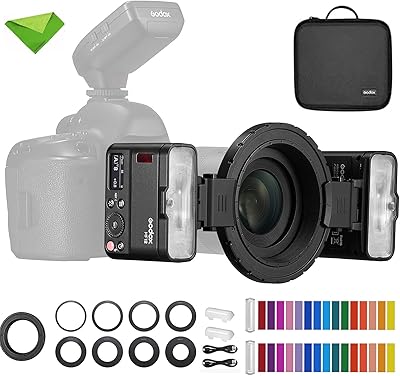
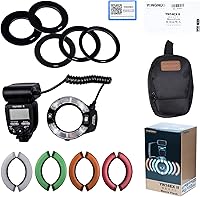
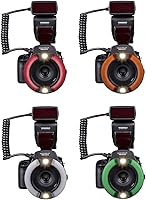
The real standout is the A/B flash tube ratio control, which lets you push more light from one side of the ring than the other — anywhere from 8:1 to 1:8. That means you can deliberately introduce a hint of shadow on a beetle's wing or a gemstone's facet, giving the shot depth rather than the flat, clinical look ring flashes can sometimes produce. TTL mode handles exposure automatically when you're moving fast, while full manual gives you precise control when you're set up and shooting methodically. Recycle time hits roughly three seconds at full power, quick enough that you rarely feel like you're waiting. Four included magnetic color filters and adapter rings for common lens threads mean you can shoot out of the box without hunting for extras.

Best For

This macro ring flash is a natural fit for anyone photographing small subjects up close — insects in the field, wildflowers, jewelry on a light table, or even oral cavity shots in a clinical setting. The even ring illumination is particularly valuable for product and jewelry work, where harsh directional shadows can ruin an otherwise clean image. Canon DSLR users who want TTL convenience without paying first-party flash prices will find it a practical choice. It also suits photographers who like having both automatic and manual control in the same unit — shoot TTL for speed, switch to manual when you need to fine-tune output for a tricky composition. Not the right tool for general portraiture, but for close-up work it covers a wide range of real needs.

User Feedback

With over 300 reviews and a 4.4-out-of-5 average, the YN14EX II holds up well in the court of public opinion. Lighting quality draws the most consistent praise — buyers describe the output as soft, even, and well-suited to macro subjects. TTL metering on Canon bodies gets solid marks, though a handful of users mention that exposure can drift slightly depending on the lens and body combination. The plastic construction gets flagged occasionally, but most owners treat it as a reasonable trade-off rather than a real flaw. The one area where grumbles stack up is the instruction manual, which is thin and can leave first-time users guessing during setup. Overall, sentiment leans clearly positive, with criticism tending toward minor inconveniences rather than fundamental problems.

Pros

  • Independent A/B tube ratio control lets you shape light and add subtle shadow for more dimensional macro shots.
  • Full TTL support on Canon bodies means reliable automatic exposure without constant manual adjustments.
  • Three-second recycle time at full power keeps shooting momentum going during active sessions.
  • Adapter rings for four common filter thread sizes are included, so most macro lenses are covered from day one.
  • Magnetic color filters attach and detach quickly, making creative or corrective adjustments easy in the field.
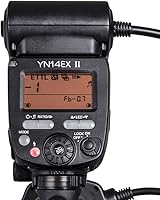
  • The LCD display is large and readable, making it straightforward to check and change settings on the fly.
  • PC sync port and external power socket add flexibility for studio setups beyond simple hot shoe use.
  • Over 300 buyer reviews averaging 4.4 out of 5 suggests consistent real-world satisfaction for a niche product.
  • Overheating protection and auto-save settings show thoughtful engineering for extended shooting sessions.
  • Output can be fine-tuned across 22 levels, giving meaningful control over exposure even in tricky lighting conditions.

Cons

  • The instruction manual is thin and vague — new users often need to rely on online resources to complete setup.
  • TTL exposure can vary slightly depending on which Canon body and lens combination you are using.
  • The all-plastic body feels lightweight in hand, which may raise durability questions for heavy field use.
  • No native TTL compatibility with Nikon, Sony, or other non-Canon mounts limits its audience significantly.
  • Batteries are not included, and four AAs are required — an easy thing to overlook before a first shoot.
  • At 2.05 pounds, the combined rig weight can make handheld macro shooting tiring over long sessions.
  • The ring housing adds noticeable bulk to the front of the lens, which can make transport and storage awkward.
  • Guide number of 18 means output is modest — not suited for subjects beyond close-up flash distances.

Ratings

Our editorial team trained an AI model on verified global buyer reviews for the YONGNUO YN14EX II Macro Ring Flash, actively filtering out incentivized, bot-generated, and duplicate submissions to surface honest, real-world sentiment. The scores below reflect both the genuine strengths that keep buyers satisfied and the friction points that show up repeatedly across independent reviewers. Nothing is softened — the ratings capture the full picture.

Lighting Quality
91%
The even, wrap-around illumination is the single most praised aspect across hundreds of reviews. Photographers shooting insects, jewelry, and botanical subjects consistently report that shadows are virtually eliminated at close range, producing clean, gallery-ready results without any post-processing tricks.
A small number of users shooting very reflective subjects — polished metals, wet insect wings — note occasional hot spots that require diffusion workarounds. The ring output, while even, can look flat on certain subjects if the A/B ratio is left at a neutral 1:1 without any intentional shaping.
TTL Accuracy
78%
22%
On popular Canon bodies like the 5D Mark IV and 90D, TTL metering performs reliably for most shooting situations, letting photographers focus on composition rather than constantly chimping exposures. Users doing run-and-gun macro in the field particularly appreciate not having to dial in manual settings for every new subject.
Exposure consistency is not perfect across all Canon body and lens combinations — some users report needing to apply a fixed exposure compensation offset to get reliable results. On older Canon crop-sensor bodies, a handful of reviewers experienced more frequent metering inconsistencies that required manual intervention.
A/B Ratio Control
88%
The ability to skew light output from one tube to the other transforms this from a flat, clinical ring flash into a genuinely versatile creative tool. Macro photographers working with textured subjects like insect exoskeletons or gemstone facets can introduce deliberate, controlled shadow to add dimensionality that a symmetrical ring simply cannot produce.
The ratio adjustment interface, while functional, takes some time to internalize — new users often default to 1:1 for weeks before experimenting. The half-stop increment steps are useful for precision but can feel slow to navigate when shooting in time-sensitive field conditions.
Build Quality
63%
37%
The unit holds together well under regular shooting conditions, and most long-term owners report no structural failures after extended use. For photographers treating it as a dedicated studio or controlled-environment tool, the construction is entirely adequate.
The all-plastic body feels noticeably lightweight in hand, and some users find that the ring housing wobbles slightly when attached to heavier macro lenses. It is not weather-sealed in any meaningful way, so field photographers shooting in damp or dusty conditions need to take extra precautions.
Value for Money
86%
The included adapter rings, color gel filters, and breadth of flash control features represent strong out-of-box value compared to first-party alternatives at significantly higher price points. Buyers consistently express satisfaction that they did not need to purchase additional accessories to get started.
A few reviewers who compared it directly to Canon's own macro flash system felt the gap in TTL refinement and build solidity was noticeable enough to question the savings. For very high-volume commercial shooters, the long-term reliability trade-off may narrow the value argument over time.
Recycle Speed
82%
18%
At roughly three seconds to full power, the recycle time is fast enough to keep pace with active macro sessions — shooting a moving insect or cycling through multiple product angles without frustrating pauses. Users on rechargeable Ni-MH batteries report this holds up well across extended sessions.
With older or partially depleted alkaline batteries, recycle time stretches noticeably beyond the rated figure, which can disrupt shooting rhythm. A handful of users noted that after 30-plus consecutive full-power flashes, performance slows down before stabilizing again.
Lens Compatibility
79%
21%
Shipping with four adapter ring sizes — 52mm, 58mm, 67mm, and 72mm — covers the vast majority of dedicated macro lenses used by Canon shooters. Most buyers found that at least one included ring matched their primary macro glass without any additional purchase.
Photographers using lenses with 100mm filter threads, common on certain telephoto macro options, are left without a compatible ring in the box. This is a meaningful gap for a segment of the macro community and requires sourcing a third-party adapter before the flash is usable.
Ease of Setup
58%
42%
Once the correct adapter ring is attached and the flash is seated on the hot shoe, basic operation is straightforward enough that most users can start shooting in TTL mode within a few minutes. The LCD display is readable and the layout of controls is logical once you have spent some time with it.
The included instruction manual is consistently described as inadequate — thin, poorly translated in places, and missing guidance for key features like custom function setup. New users frequently report spending significant time on online forums or watching third-party tutorials before feeling confident with the full feature set.
Color Filter System
77%
23%
The magnetic attachment method for the four included gel filters is a practical design choice — filters snap on and off quickly without fiddling with friction-fit rings or tape. The warm yellow filter gets particular praise from users shooting botanical subjects, adding a pleasant natural cast that reduces the clinical feel of flash lighting.
The filter selection is limited to four options, which covers basic needs but leaves creative photographers wanting more variety. The filters affect both tubes simultaneously, so split-color lighting effects — a popular macro technique — require custom solutions beyond what is included in the box.
Output Control Range
84%
Having eight primary power levels plus 22-step fine-tuning gives experienced photographers meaningful precision over exposure, particularly when working at very close subject distances where even small output changes can shift the image significantly. Manual shooters appreciate being able to dial in repeatable settings for consistent product photography setups.
The fine-tuning increments are granular enough that navigating the full range can feel tedious when making large adjustments. Some users expressed a preference for a more direct input method rather than stepping through increments one at a time via the rear controls.
AF Assist Performance
71%
29%
The built-in LED AF assist lamp is genuinely useful when shooting macro subjects in dim conditions — situations that a standard flash alone cannot help with during the prefocus phase. Photographers working indoors or in shaded outdoor environments find it reduces missed focus attempts noticeably.
In bright ambient light the assist lamp adds little practical benefit, and its effective range is limited to the close working distances macro photography already implies. It is a welcome inclusion but not a feature that meaningfully influences the buying decision for most users.
Portability & Weight
66%
34%
The plastic construction keeps the unit lighter than comparable metal-bodied flash options, which matters when the flash is attached to the front of a lens for extended handheld sessions. Field photographers who hike to shooting locations appreciate not adding significant pack weight.
At 2.05 pounds, the combined weight of the flash ring on the front of a macro lens creates a front-heavy rig that accelerates arm fatigue during long handheld sessions. Photographers used to shooting without flash attached often find the balance shift uncomfortable until they adapt their grip.
Connectivity Options
80%
20%
The inclusion of a PC sync port and external power socket gives this flash flexibility well beyond what basic hot shoe units offer. Studio photographers who want to sync to external triggers or connect a battery grip for extended shooting find these ports genuinely useful rather than decorative.
The PC sync port uses a 2.5mm connection rather than the more common 3.5mm standard, which can catch users off guard when sourcing cables or adapters. The external power socket, while a welcome feature, is not compatible with all third-party battery packs without adapter cables.
Longevity & Reliability
72%
28%
The overheating protection system does its job — users who shoot high-volume sessions report that the flash throttles safely rather than failing outright. Auto-save settings mean that a power cycle does not wipe configurations, which reduces daily-use friction considerably.
Long-term reliability data is mixed for heavy users; a subset of reviewers reported flash tube degradation or control unit issues after one to two years of regular use. The plastic housing also shows cosmetic wear faster than metal alternatives, which may concern photographers who invest in gear for the long haul.

Suitable for:

The YONGNUO YN14EX II Macro Ring Flash is a strong match for Canon DSLR photographers who spend serious time shooting close-up subjects — insects in the field, wildflowers, small product arrangements, or jewelry on a light table. The ring design wraps light evenly around the lens axis, which is exactly what you need when your subject is only inches away and a standard flash would blast half the frame into shadow. It works equally well for dental and clinical photographers who need clean, consistent illumination without complicated studio setups. Hobbyists moving into macro photography for the first time will appreciate that TTL mode handles a lot of the exposure guesswork, while more experienced shooters can lean on the manual controls and A/B ratio adjustments to shape light with real intention. If you're a Canon shooter who wants a capable, well-featured macro flash without paying premium first-party prices, this one is worth serious consideration.

Not suitable for:

The YONGNUO YN14EX II Macro Ring Flash is not the right tool for photographers outside the Canon ecosystem — it has no native Nikon, Sony, or Fujifilm TTL support, so non-Canon users would be limited to manual-only operation at best. It is also not designed for general portrait or event photography; the ring flash effect can look stylish in fashion work, but this unit's guide number and form factor are optimized for close distances, not shooting across a room. Photographers who prioritize rugged, weather-resistant gear for demanding outdoor conditions may find the all-plastic construction a concern over the long term. Those who rely heavily on manufacturer documentation and step-by-step setup guides should know the included manual is notably thin, and getting fully up to speed may require time spent in online forums or third-party tutorials. If you already own Canon's own macro flash system and are happy with it, there is little reason to switch.

Specifications

  • Flash Modes: Supports both TTL (automatic through-the-lens metering) and full manual output control.
  • Guide Number: Rated at GN18 measured in meters at ISO 100, appropriate for close-focus macro distances.
  • Tube Configuration: Dual flash tubes labeled A and B, each independently controllable for ratio-based lighting.
  • Flash Ratio Range: A/B ratio adjustable from 8:1 through 1:1 to 1:8, in half-stop increments for precise light shaping.
  • Output Control: Eight primary power levels from 1/128 to full power, with 22-step fine-tuning available across the range.
  • Recycle Time: Returns to full power in approximately 3 seconds; slightly faster at reduced output settings.
  • Sync Speed: Compatible with shutter speeds up to 1/200s or 1/250s depending on the Canon body in use.
  • Color Temperature: Rated at 5600K, consistent with daylight-balanced flash output standard across the industry.
  • Adapter Rings: Includes four threaded adapter rings sized at 52mm, 58mm, 67mm, and 72mm to fit common macro lenses.
  • Color Filters: Four magnetic gel filters are included: white, red, fluorescent green, and warm yellow for creative or corrective use.
  • Power Source: Runs on four standard AA batteries, compatible with both alkaline and Ni-MH rechargeable cells (not included).
  • External Interfaces: Equipped with a hot shoe mount, 2.5mm PC sync port, and an external power socket for studio power packs.
  • Compatible Mounts: Designed exclusively for Canon DSLR cameras with full TTL integration; no native support for other brands.
  • AF Assist: Built-in LED autofocus assist lamp helps the camera achieve focus in low-light macro shooting conditions.
  • Item Weight: The flash unit weighs 2.05 pounds, which adds noticeable front-end weight when mounted on a macro lens.
  • Additional Modes: Supports Flash Exposure Bracketing (FEB), rear-curtain sync, FE lock, and exposure compensation for advanced shooting workflows.
  • Safety Features: Includes overheating protection that automatically throttles or pauses output to protect internal components during long sessions.
  • Settings Memory: Auto-save function retains custom settings between power cycles so you do not need to reprogram from scratch each session.

Related Reviews
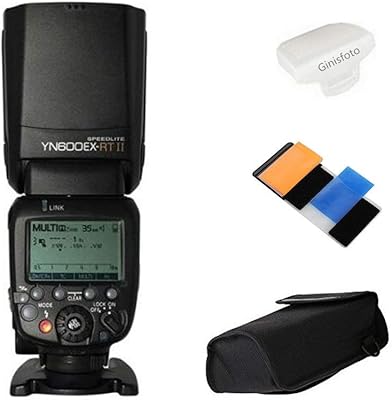
YONGNUO YN600EX-RT II Flash Speedlite
78%
88%
Wireless RT Compatibility
91%
Flash Output & Guide Number
84%
High-Speed Sync Performance
79%
TTL Metering Accuracy
61%
Build Quality & Durability
More
NEEWER RF1-N Macro Ring Flash for Nikon
86%
87%
Lighting Performance
91%
Ease of Use
83%
Build Quality
90%
Portability
78%
Battery Life
More
Godox MF-R76 Macro Ring Flash
82%
93%
Light Quality
88%
Dual-Tube Control
91%
Battery Life
79%
Manual Exposure Control
89%
Camera Compatibility
More
Godox MF12-K2 Macro Flash
85%
91%
TTL Accuracy
84%
Build Quality
88%
Battery Life
86%
Wireless Reliability
71%
Ease of Setup
More
Godox AD200Pro II Pocket Flash Strobe
78%
88%
Build Quality
91%
Portability & Form Factor
87%
Output Power & Consistency
84%
High-Speed Sync Performance
71%
TTL Accuracy
More
Godox AD600BM II Outdoor Flash Strobe
84%
93%
Performance
88%
Battery Life
90%
Recycle Time
85%
Ease of Use
82%
Build Quality
More
Yongnuo YN560 IV Wireless Flash Speedlite
75%
93%
Value for Money
88%
Wireless Reliability
74%
Build Quality
86%
Flash Output Power
89%
Ease of Setup
More
7artisans 60mm F2.8 Mark II Macro Lens
77%
84%
Optical Sharpness
88%
Bokeh Quality
81%
Build Quality
91%
Value for Money
79%
Focus Ring Feel
More
Hourglass Vanish Flash Highlighting Stick Rose Gold Flash
87%
91%
Buildable Coverage
88%
Ease of Application
85%
Natural Finish
87%
Suitability for Medium-Deep Skin Tones
94%
Travel-Friendliness
More
BENIO Ring Gen 2 Smart Ring, Size 7
85%
87%
Health Tracking Accuracy
91%
Waterproof Performance
88%
Comfort & Wearability
82%
Battery Life
85%
Compatibility with Devices
More

FAQ

The YN14EX II is designed and tested for Canon DSLR bodies with a standard hot shoe. Some Canon mirrorless users have reported basic functionality, but full TTL compatibility is not guaranteed on mirrorless systems, and your mileage will vary depending on the specific body. If mirrorless TTL support matters to you, it is worth confirming with other users who own your exact camera model before buying.

Unfortunately, no — the included rings cover 52mm, 58mm, 67mm, and 72mm thread sizes. A 100mm thread is outside that range, so you would need to source a compatible third-party adapter ring separately. Check YONGNUO's accessory listings or look for universal macro ring adapters before assuming it will work out of the box.

It lets you send more light from one side of the ring than the other. For example, setting a 4:1 ratio means one tube is twice as bright as the other, which casts a faint shadow on one side of your subject. On a beetle or a coin, that shadow adds dimensionality and texture that you simply cannot get from a perfectly even ring flash. It is a genuinely useful creative tool, not just a spec on a sheet.

On most Canon DSLR bodies it performs well, and a lot of users are happy with the exposures it delivers straight out of camera. That said, TTL is never perfectly consistent — factors like the reflectivity of your subject, the lens you are using, and the distance to the subject can all nudge the exposure a little. It is worth keeping exposure compensation handy for subjects that fool the metering, like very bright flowers or dark insects against pale backgrounds.

The body is primarily plastic, which is standard at this price point and not something to be alarmed about. It holds up fine under regular field use — plenty of macro photographers take it outdoors regularly without issues. That said, it is not weather-sealed, so you would want to protect it in rain or dusty conditions the same way you would protect any non-sealed flash.

At moderate output levels you can expect a few hundred flashes from a fresh set of alkaline AAs — enough for a solid session of an hour or two. At full power the count drops noticeably. Using quality Ni-MH rechargeables will give you similar or slightly better performance, and the ability to recharge them makes them a smarter long-term choice for frequent shooters.

You are not alone in finding the included documentation thin — it is a common complaint. The good news is that the YONGNUO YN14EX II Macro Ring Flash has been around long enough that there are solid third-party tutorials on YouTube and discussion threads on photography forums covering setup, Canon body pairing, and common configuration questions. A quick search with your specific Canon model name alongside the flash model will usually surface what you need.

Yes — the 2.5mm PC sync port allows you to fire the flash from an external trigger or sync it to other equipment. The external power socket also means you can connect a battery pack if you need faster recycle times or longer shooting sessions than four AAs can support. Both are relatively niche features at this price level and add real versatility for more controlled shooting environments.

The ring design is specifically built to minimize vignetting, and in practice most users do not encounter it at typical macro working distances. If you are shooting with a very short focal length lens at close range, some minor darkening at the corners is possible, but with dedicated macro lenses in the 90mm to 105mm range it is rarely an issue.

The filters slip over the outside of the ring assembly rather than over individual tubes, so they affect the output of both sides at once. If you want to gel only one side for a mixed-color effect, you would need to fashion a custom solution. For most practical uses — color correction or adding a warm cast — applying the filter to the whole ring works perfectly well.

Where to Buy