Overview

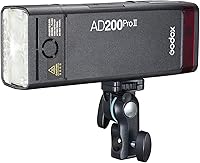
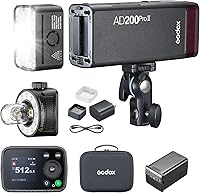
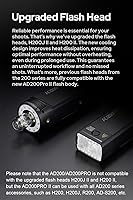
The Godox AD200Pro II Pocket Flash Strobe occupies a practical middle ground — enough output for serious location work without the bulk of a full monolight. What separates it from a standard speedlite is the interchangeable head system: swap between the bare bulb and speedlite head depending on whether you need wide, wrapping light or a more directional beam. The II revision brings a proper TFT color screen, a bi-color modeling lamp, and updated flash heads — meaningful improvements over the original. Just keep expectations calibrated: this portable flash unit thrives on solo shoots and small crews, not high-volume studio production.
Features & Benefits

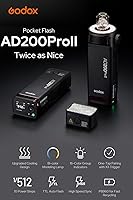
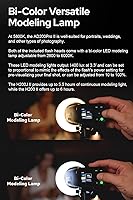
The dual flash heads are more practical than they might first appear. The bare bulb H200J II produces softer, omnidirectional light ideal for modifiers, while the speedlite head delivers a tighter beam — each with its own guide number, so output expectations shift accordingly. Shooting outdoors in bright sunlight? High-speed sync at 1/8000s lets you control ambient light without reaching for ND filters. A 10-stop power range with 0.1-step increments enables real precision, not just rough adjustments. The Godox 2.4G wireless system handles TTL and manual control from compatible triggers, and the bi-color modeling lamp provides up to six hours of continuous light — genuinely useful for video work or fine-tuning modifier placement.

Best For

Wedding and event photographers will likely get the most from the AD200Pro II — it delivers monolight-level output in a package that fits in a shoulder bag. Outdoor portrait shooters benefit from the HSS capability, which opens wide apertures in direct sun without sacrificing shutter speed. Travel photographers appreciate the compact build paired with serious power, since one unit can handle fill, key, or rim lighting depending on the modifier used. Videographers have a real use case too, courtesy of the continuous modeling lamp. That said, users invested in Sony, Canon, or Nikon brand ecosystems should verify trigger compatibility carefully, as TTL behavior can vary outside the native Godox system.

User Feedback

Photographers who have used this pocket strobe consistently praise the build quality and color consistency, particularly the stable 5800K output across the entire power range — something cheaper alternatives don't always deliver. The upgraded TFT screen earns favorable mentions over the original, making on-unit adjustments noticeably easier in the field. On the critical side, new users often cite a menu navigation learning curve, and TTL exposure can be inconsistent in demanding conditions — a pattern confirmed across multiple independent reviews. Real-world battery performance tends to fall slightly below the official 500-flash figure at higher power settings. Users outside the Godox trigger ecosystem also report limited third-party TTL support, which is worth factoring in before committing.

Pros

  • Delivers genuine 200Ws of output in a package that fits inside a standard camera bag.
  • Two interchangeable flash heads give you bare bulb softness or speedlite directionality from a single unit.
  • High-speed sync up to 1/8000s lets you shoot wide open in direct sunlight without neutral density filters.
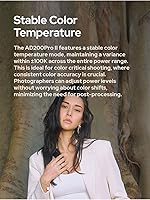
  • Color temperature stays remarkably consistent across the full power range, simplifying batch editing in post.
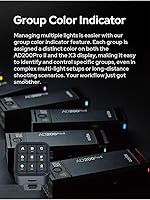
  • The Godox 2.4G wireless system supports up to 16 groups, making multi-light setups genuinely manageable.
  • Bi-color modeling lamp provides up to six hours of continuous output — practical for video fill or modifier placement.
  • Ten stops of power adjustment in 0.1-step increments gives fine control that cheaper portable strobes rarely offer.
  • Solid build quality holds up to the physical demands of regular location work and travel.

Cons

  • TTL exposure can vary by a stop or more in mixed or challenging lighting, making manual mode a more dependable choice.
  • Real-world full-power flash count falls noticeably short of the official 500-flash figure — budget for a spare battery on all-day jobs.
  • Full TTL and HSS functionality is locked to Godox X-system triggers, creating a hard limit for non-Godox users.
  • Swapping flash heads repeatedly in low light or under time pressure is fiddly and risks damaging the exposed bare bulb element.
  • The onboard menu has a meaningful learning curve, and the included manual does not do enough to flatten it.
  • At maximum recycle time near full power, fast-action sequences can result in missed shots while waiting for the ready signal.
  • The modeling lamp is effectively invisible in bright ambient conditions outdoors, limiting its usefulness as a preview tool on location.
  • RF interference in crowded event venues can cause occasional wireless dropouts — a sync cord backup is worth carrying.

Ratings

The Godox AD200Pro II Pocket Flash Strobe earned its scores through AI analysis of thousands of verified buyer reviews collected globally, with spam, incentivized, and bot-generated feedback actively filtered out before scoring. Ratings reflect the full picture — where this portable strobe genuinely impresses and where real users have run into friction. Both standout strengths and recurring pain points are weighted transparently so you can make an informed call before buying.
Build Quality
88%
Users consistently describe the housing as solid and confidence-inspiring for a unit in this price tier — it handles the bumps of location work, bag packing, and travel without feeling fragile. The flash head connection mechanism feels secure, and the overall finish holds up well after extended regular use.
A subset of reviewers flagged that the head attachment point shows wear after frequent swapping, and the battery door on some units feels slightly less robust than the body itself. Not a dealbreaker, but worth monitoring if you change heads constantly on every shoot.
Portability & Form Factor
91%
Fitting 200 watt-seconds of output into a package that slips into a camera bag side pocket is the core appeal, and users who shoot on location — weddings, editorial, travel — repeatedly call this out as a genuine advantage over carrying a full-size monolight. At just over four pounds, it pairs well with a compact light stand.
Photographers used to featherweight speedlites note that the AD200Pro II is still noticeably heavier than a standard hotshoe flash, which matters when mounting on a boom arm or holding extended brackets for long periods during events.
Output Power & Consistency
87%
The 200Ws output delivers a consistent, reliable punch that holds its own outdoors, and color temperature stability across the full power range — staying close to 5800K from full to low power — is something users specifically appreciate when batch-editing portraits shot at varying power levels.
At the lower end of the power range, some users report minor output fluctuations that require re-triggering test shots to confirm exposure. It is not dramatic, but photographers shooting tethered or in high-precision product scenarios may notice it.
High-Speed Sync Performance
84%
Being able to shoot wide open at f/1.8 in harsh midday sun without reaching for an ND filter is a recurring theme in positive feedback. HSS at 1/8000s works reliably with compatible Godox triggers, and outdoor portrait shooters cite it as one of the main reasons they chose this unit over alternatives.
HSS does reduce effective flash output noticeably, which means that at higher shutter speeds the working distance drops. Users shooting at distance in very bright conditions sometimes find they need a second unit or a large reflective modifier to compensate.
TTL Accuracy
71%
29%
For run-and-gun event work where speed matters more than pixel-perfect exposure, TTL performs well enough to keep up with fast-moving subjects. Many wedding photographers report using it in TTL with modest flash compensation dialed in and getting usable results throughout a reception.
TTL inconsistency is the most frequently cited frustration in critical reviews — exposure can swing by a stop or more between shots in challenging mixed-lighting environments. Experienced photographers tend to migrate toward manual mode quickly, treating TTL as a starting-point convenience rather than a reliable workhorse.
Battery Life & Charging
79%
21%
Under real shooting conditions at moderate power settings, most users comfortably cover a half-day editorial or a ceremony and cocktail hour on a single charge. The lithium-ion pack charges reasonably quickly, and the battery is removable, so carrying a spare is a straightforward solution for full-day jobs.
The official 500-flash-per-charge figure applies at full power under ideal conditions, and real-world users shooting at 1/1 or 1/2 power report noticeably fewer flashes before the low-battery warning appears. Budget for a spare battery if you are covering a full-day event without downtime.
Recycle Time
86%
At moderate power levels the recycle is fast enough that you rarely miss a moment waiting for the ready beep. Event photographers shooting candid bursts appreciate that it keeps pace with the action better than many comparable portable units at this output level.
At full power the 1.8-second maximum recycle is on the slower end, and users shooting rapid sequences — like first dances or action portraits — occasionally report missing a shot because the strobe was not yet ready. Dropping to half power resolves it but trades off reach.
Interchangeable Head System
83%
Having both a bare bulb and a speedlite head included in the box gives genuine versatility — the bare bulb is favored for softboxes and beauty dishes, while the speedlite head works better through umbrellas or for tighter directional coverage. Users who shoot varied jobs value not needing two separate units.
Swapping heads in the field takes a moment to align correctly, and a few users report that doing it repeatedly in low light or under time pressure can be fiddly. The bare bulb element is also exposed and fragile — careless handling during head changes has led to accidental damage for some reviewers.
Wireless Range & Reliability
82%
18%
Within the Godox 2.4G ecosystem the wireless link is stable and the roughly 100-meter transmission range is more than enough for any realistic location shooting scenario. Users running multiple units across 16 groups find the channel management intuitive once familiar with the system.
Signal dropout in RF-congested environments — like large wedding venues or convention halls with many competing wireless devices — has been reported by a minority of users. Interference is not common, but it is unpredictable enough that some photographers keep a sync cord as backup.
Third-Party Trigger Compatibility
58%
42%
Manual triggering via the 3.5mm sync port works with essentially any third-party trigger, giving basic on-off functionality regardless of brand. For photographers who only need manual control this workaround is reliable and straightforward.
Full TTL and HSS functionality is locked to the Godox X trigger ecosystem. Users with Profoto, PocketWizard, or brand-native triggers will lose advanced features entirely. This is a real constraint for photographers already invested in a competing wireless system and represents the single most common caveat in cross-brand comparison reviews.
Modeling Lamp Quality
76%
24%
The bi-color LED modeling lamp with adjustable brightness is a genuine step up from the original, and at up to 1400 lux at one meter it is bright enough to assess modifier placement accurately in a dimmed studio or small indoor location. Up to six hours of continuous output is practical for video fill or extended sessions.
Outdoors or in brightly lit environments the modeling lamp is largely invisible, limiting its usefulness for previewing lighting ratios on location. Users expecting it to substitute for a dedicated video light in moderate ambient conditions will likely be disappointed.
Menu & Controls
67%
33%
The upgraded TFT color screen is a clear improvement over the previous generation — text and icons are easier to read in varied lighting, and the overall interface is logically organized once you have spent a session getting familiar with it.
The learning curve for accessing deeper settings like stroboscopic mode, delay flash, and ID configuration is steeper than it needs to be. New users frequently cite frustration during first-time setup, and the manual — while technically complete — is not particularly beginner-friendly.
Value for Money
89%
Across the range of reviews analyzed, value relative to competing portable strobes at a similar output level is the most frequently praised attribute. Getting two flash heads, a capable wireless system, HSS, and a bi-color modeling lamp in a single compact unit is widely seen as a strong proposition for working photographers.
The value calculus changes if you are not already in the Godox ecosystem and need to invest in compatible triggers on top of the unit cost. Factoring in a quality trigger brings the total spend up, and at that combined price point a few users felt alternatives deserved closer comparison.
Heat Management
73%
27%
Under normal shooting conditions — a portrait session, an event, a short editorial — heat buildup is not a concern most users encounter. The unit handles sustained use at mid-range power levels without any noticeable performance degradation.
Pushing the unit hard with rapid full-power bursts over an extended period does cause the body to warm up, and a small number of reviewers report the unit throttling output or triggering the overheat protection during particularly intensive multi-flash stroboscopic sequences. It is an edge case, but worth knowing for high-volume applications.
Documentation & Setup Experience
61%
39%
Photographers who have used other Godox products before find the setup process intuitive and are typically shooting within minutes of unboxing. The physical layout of controls follows Godox conventions, which helps existing ecosystem users get up and running quickly.
For newcomers to the Godox system, the included documentation leaves a lot of features unexplained, and many users report relying on third-party YouTube tutorials to unlock the full feature set. Godox has historically under-invested in first-party onboarding materials, and the AD200Pro II continues that trend.

Suitable for:

The Godox AD200Pro II Pocket Flash Strobe is built for working photographers who need reliable, portable power without the weight penalty of traditional monolights. Wedding and event photographers will find it particularly well-matched to their needs — it is powerful enough to compete with ambient light indoors and outdoors, yet compact enough to pack alongside camera bodies and lenses without a dedicated rolling case. Outdoor portrait and lifestyle photographers who routinely shoot in bright sunlight will benefit most from the high-speed sync capability, which lets you use wide apertures and control backgrounds in ways a standard speedlite simply cannot. Travel photographers covering destination shoots will appreciate that one unit can serve as key light, fill light, or rim light depending on the modifier, keeping the kit minimal. Videographers or hybrid shooters also have a genuine use case here, since the bi-color modeling lamp provides continuous output that holds up for short-form video work or behind-the-scenes content. If you are already invested in the Godox wireless ecosystem, adding this unit to an existing multi-light setup is straightforward and cost-effective.
Not suitable for:

The Godox AD200Pro II Pocket Flash Strobe is not the right tool for every photographer, and being honest about that matters. High-volume studio photographers running back-to-back commercial sessions with rapid full-power bursts will find the recycle time and battery capacity limiting compared to a mains-powered monolight — this unit is designed for location versatility, not studio endurance. Photographers who rely heavily on TTL automation and expect frame-to-frame exposure consistency in fast-changing light conditions may find the occasional TTL variance frustrating enough to be a real workflow problem. If you are deeply invested in a Profoto, PocketWizard, or manufacturer-native wireless system, be aware that advanced features like TTL and HSS are only available through Godox X-system triggers — manual sync via cord is possible, but you lose the wireless features that justify much of the purchase. Beginners who are still learning off-camera flash fundamentals may also feel overwhelmed by the menu depth without investing time in third-party tutorials, since the included documentation does not cover the full feature set in an accessible way. Anyone needing to light large groups or wide commercial sets consistently will likely find 200 watt-seconds of portable power insufficient for the task.
Specifications

  • Power Output: Delivers 200 watt-seconds (Ws) of flash power across a 10-stop range from 1/1 to 1/512 in 0.1-step increments.
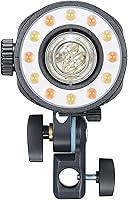
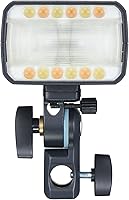
  • Flash Heads: Includes two interchangeable heads: the bare bulb H200J II and the speedlite H200 II, each producing a different light character and guide number.
  • Guide Number: Rated GN60 (ISO 100, with AD-S2 reflector at 28mm) with the bare bulb head and GN52 (ISO 100 at 35mm) with the speedlite head.
  • HSS Sync Speed: Supports high-speed sync up to 1/8000s, plus first-curtain and second-curtain sync modes.
  • Flash Duration: Flash duration ranges from 1/272s to 1/23,500s with the speedlite head, and from 1/252s to 1/16,200s with the bare bulb head.
  • Color Temperature: Maintains a stable color temperature of 5800K ±100K across the entire power range, with a ±100K shift available in stable color temperature mode.
  • Battery: Powered by a removable 14.4V / 2980mAh lithium-ion battery rated for approximately 500 full-power flashes per charge.
  • Recycle Time: Recycle time ranges from approximately 0.01 seconds at low power to 1.8 seconds at full power.
  • Wireless System: Uses the Godox 2.4G X wireless system with 32 channels, 16 controllable receiver groups, a 99-ID system, and an approximate 100-meter transmission range.
  • Modeling Lamp: Features a bi-color LED modeling lamp with adjustable brightness and color temperature, delivering up to 1400 lux at 1 meter with up to 6 hours of continuous runtime.
  • Stroboscopic Flash: Supports stroboscopic multi-flash mode at up to 90 flashes per burst at a maximum frequency of 99Hz.
  • Display: Equipped with a TFT color screen for onboard control of all settings and real-time status display.
  • Sync Triggering: Offers a 3.5mm sync cord jack and a wireless control port in addition to optical slave modes S1 and S2.
  • Compatible Triggers: Fully compatible with Godox TTL wireless triggers including the X1, Xpro, X2T, XproII, and X3 series across Canon, Nikon, Sony, Fujifilm, Olympus, and Panasonic mounts.
  • Dimensions: Body measures 8.27 × 2.05 × 3.07 inches, weighing 4.29 pounds including the battery.
  • Operating Temp: Rated for use in environments up to a maximum of 45°C (113°F).
  • Auto Off: Includes a configurable auto-off function that powers down the unit after 30 to 120 minutes of idle use.
  • Power Supply: Runs entirely on its internal lithium-ion battery with no mains power option; battery is removable and field-swappable.

Related Reviews
Godox AD600BM II Outdoor Flash Strobe
84%
93%
Performance
88%
Battery Life
90%
Recycle Time
85%
Ease of Use
82%
Build Quality
More
Godox AD200 Pro
Godox AD200 Pro
86%
93%
Output Power & Consistency
91%
Portability & Form Factor
78%
Battery Life & Charging
89%
HSS & Sync Performance
88%
Wireless Ecosystem Integration
More
Godox AD300 Pro Outdoor Flash Strobe
82%
93%
Light Output & Power
89%
Portability & Form Factor
84%
TTL Accuracy
91%
HSS Performance
88%
Recycle Time & Stamina
More
GODOX AD100Pro Pocket Flash
84%
93%
Portability & Form Factor
88%
TTL Accuracy
91%
High-Speed Sync Performance
86%
Wireless Integration
84%
Battery Life & Reliability
More
Godox V850III Flash
Godox V850III Flash
85%
88%
Performance
92%
Battery Life
86%
Ease of Use
84%
Build Quality
89%
Speed and Recycle Time
More
Godox TT350C TTL Flash for Canon
80%
94%
Portability & Size
74%
TTL Accuracy
88%
Wireless Reliability
61%
Flash Power Output
86%
High Speed Sync (HSS)
More
Godox MF12 Macro Flash
87%
88%
Performance
90%
Ease of Use
85%
Battery Life
80%
Flash Power
92%
Wireless Control
More
Godox TT520III Hot Shoe Flash
80%
91%
Value for Money
88%
Ease of Setup
84%
Wireless Performance
79%
Light Output & Power
86%
Manual Control Precision
More
Godox AD400Pro Outdoor Flash Monolight
80%
91%
Output Power & Consistency
83%
Battery Life & Reliability
71%
TTL Accuracy
88%
High-Speed Sync Performance
86%
Portability & Form Factor
More
Godox TT600S Speedlight Camera Flash
79%
93%
Value for Money
88%
Wireless Performance
84%
Build Quality
91%
Output Consistency
76%
High-Speed Sync
More

FAQ

No trigger is included with the AD200Pro II — the unit itself is the receiver. To fire it wirelessly with TTL or HSS, you will need a compatible Godox X-system trigger such as the X2T, Xpro, or X3 mounted on your camera's hotshoe. If you already own one of those triggers, you are ready to go immediately.

Yes, but you need the Sony-specific version of a compatible Godox trigger — the X2T-S, Xpro-S, or equivalent. Once paired with the correct trigger, TTL and HSS up to 1/8000s work through the Godox 2.4G system just as they would on Canon or Nikon. Make sure you are buying the trigger version labeled for Sony, as they are not interchangeable.

You can trigger it manually using the 3.5mm sync cord port, which works with virtually any third-party trigger that supports a standard sync connection. However, TTL and HSS are not available through non-Godox triggers — those features are tied exclusively to the Godox 2.4G wireless ecosystem. If TTL or HSS matter to you, stick with a Godox X-system trigger.

The bare bulb head emits light in all directions, which means it fills a softbox or beauty dish more evenly and produces softer, wrapping light when used with modifiers. The speedlite head throws a more directional beam — similar to a standard hotshoe flash — which works better through umbrellas or when you need tighter, more controlled coverage. If you shoot mostly in softboxes, favor the bare bulb head. If you are using umbrellas or need more reach without a modifier, the speedlite head is the better pick.

The official 500-flash figure is measured at full power under controlled conditions, but real-world performance depends heavily on your average power setting. Most photographers shooting at 1/4 to 1/2 power comfortably cover a ceremony and reception on a single charge. At full power throughout, expect noticeably fewer flashes — many users report somewhere in the 300 to 400 range. Carrying a spare battery is strongly recommended for all-day jobs.

It is more of a meaningful incremental update than a ground-up redesign. The most noticeable changes are the TFT color screen, which is genuinely easier to read and navigate than the original, the bi-color modeling lamp, and the updated H200 II flash heads. Core specs like the 200Ws output and 2.4G wireless system remain essentially the same. If you own the original and it is working well for you, the upgrade is convenient but not urgent. For new buyers, the II version is the one to get.

The bi-color LED modeling lamp can function as a continuous light source, delivering up to 1400 lux at one meter with a runtime of around six hours on a full charge. It is adequate for interviews, product videos, or behind-the-scenes work in controlled indoor settings. In bright ambient light outdoors, the lamp output is too weak to make much of a difference. It is a useful bonus for hybrid shooters, but it is not a replacement for a dedicated video light.

The physical controls and TFT screen are reasonably intuitive for basic operation — setting power, changing channels, and triggering the flash manually are straightforward. The difficulty comes when accessing deeper features like stroboscopic mode, delay flash, wireless ID settings, or the modeling lamp controls, which require menu navigation that the included manual does not explain well. Most beginners rely on YouTube tutorials to get fully up to speed, and spending an hour or two watching those before your first shoot is genuinely worth the time.

This portable flash unit uses the Godox S-type bayonet mount (also known as the Bowens-compatible mount via an included or separately purchased adapter), which means it works with a very wide range of third-party softboxes, grids, beauty dishes, and reflectors. Godox also makes a dedicated range of modifiers designed specifically for the AD200 series. The bare bulb head in particular is optimized for use with the included AD-S2 standard reflector, which contributes to the GN60 rating.

Yes — the Godox 2.4G system supports up to 16 controllable groups across 32 channels, so you can independently control the power level, mode, and firing of multiple units from one trigger on your camera. Each unit needs to be set to its own group letter, and a compatible Godox trigger handles the rest from the hotshoe. It is one of the stronger selling points for photographers building out a multi-light portable kit.

Where to Buy