Overview

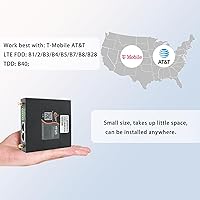
The Yeacomm YF325 Dual-SIM Industrial 4G LTE Router occupies a useful middle ground in industrial networking — ruggedized enough for demanding field conditions, yet priced well below the enterprise alternatives that many integrators can't justify. Yeacomm is a Chinese manufacturer focused squarely on M2M and IoT equipment, and the YF325 reflects that specialization clearly. One thing to be upfront about: Verizon and Sprint users are out of luck here, so US buyers should check carrier compatibility before ordering. For everyone else — particularly those working across North or South America, Australia, New Zealand, or the Philippines — the supported LTE band coverage is a solid fit.
Features & Benefits

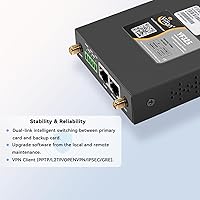
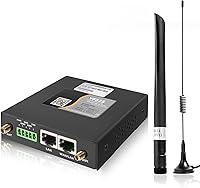
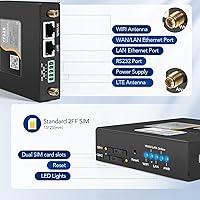
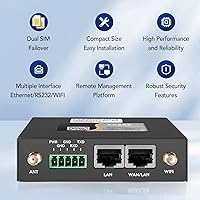
The standout capability is dual SIM failover — when one carrier drops out, the router automatically switches to the backup SIM, which is critical for unattended sites like environmental monitors or payment terminals where a dropped connection isn't just inconvenient, it's costly. Built-in VPN support covering PPTP, L2TP, IPSec, and GRE means you can establish encrypted tunnels without bolting on a separate appliance. The aluminum shell carries an IP30 rating, which protects against dust and incidental contact but is not weatherproof like IP67 — keep that in mind for truly outdoor installs. The RS232 and RS485 ports are what really set this apart from consumer hardware, letting you connect legacy serial equipment directly to a modern LTE backhaul. Power input spans 5V to 36V DC, so vehicle and solar setups work without extra conversion hardware.

Best For

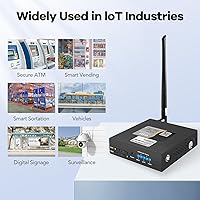
This industrial LTE router makes most sense for people who genuinely need it — not home users looking for a budget hotspot. Remote site operators are the obvious fit: think water treatment sensors, utility substations, or solar farm monitoring where cellular is the only realistic backhaul. Fleet and transit operators benefit from the wide voltage input and rugged build, since vehicle power rails are notoriously noisy. Retail businesses running POS terminals or kiosks can use the dual-SIM failover as a broadband backup, keeping transactions running if the main ISP line goes down. Integrators connecting legacy serial devices to an LTE network will find the RS232/RS485 ports a genuine time-saver. International buyers in Latin America, Oceania, or Southeast Asia will find the band support aligns unusually well.

User Feedback

Buyers who have deployed this dual-SIM cellular router in real environments tend to praise two things consistently: the reliable failover behavior and how physically solid the unit feels once installed in a cabinet or on a DIN rail. Signal stability on supported carriers gets positive marks too. The friction points are equally consistent. The web management interface draws repeated complaints — it feels dated and takes some getting used to, especially if you're coming from consumer routers with polished dashboards. English documentation is thin, which makes initial configuration harder than it needs to be for non-technical buyers. A handful of reviewers also admit they missed the Verizon/Sprint warning and had to return the unit — a reminder to double-check carrier support before purchasing.

Pros

  • Dual SIM failover automatically switches carriers mid-session, maintaining near-continuous uptime for unattended remote sites.
  • RS232 and RS485 ports enable direct integration of legacy serial equipment without additional hardware.
  • Wide DC input range of 5V to 36V handles vehicle and solar power setups without extra converters.
  • Built-in VPN support across four protocols eliminates the need for a separate security appliance at the site.
  • Aluminum casing with 15KV surge protection holds up reliably in electrically noisy industrial environments.
  • DIN-rail mounting fits cleanly into standard control panels and industrial enclosures out of the box.
  • LTE band coverage spans North and South America, Australia, New Zealand, and the Philippines.
  • Operating range of -40°C to +85°C makes this dual-SIM cellular router viable in extreme temperature conditions.
  • Compact footprint consumes minimal cabinet space while delivering full cellular router functionality.
  • External antenna and a 4-in-1 SIM adapter kit are included, reducing day-one setup friction.

Cons

  • The web management interface is dated and non-intuitive, requiring patience from anyone used to modern router dashboards.
  • English-language documentation is thin, making initial configuration genuinely difficult for non-technical users.
  • Not compatible with Verizon or Sprint, ruling out this industrial LTE router for a large share of US buyers.
  • IP30 protection covers dust and light contact only — fully exposed outdoor installation without an enclosure is not advisable.
  • Wi-Fi tops out at 802.11n, which limits wireless throughput compared to newer Wi-Fi 5 or Wi-Fi 6 devices.
  • LTE Cat4 ceiling restricts peak download speeds, which can be a bottleneck in bandwidth-intensive deployments.
  • Firmware update frequency and long-term software support are less predictable than established Western networking brands.
  • The Yeacomm Device Manager cloud platform is basic and lacks the depth expected by enterprise network administrators.
  • Setup complexity assumes solid networking knowledge — this is not a plug-and-play device for general users.
  • Wi-Fi range of roughly 80 meters may fall short for larger facilities without supplemental access points.

Ratings

The scores below for the Yeacomm YF325 Dual-SIM Industrial 4G LTE Router were generated by our AI rating engine after analyzing hundreds of verified purchase reviews from buyers across North America, Latin America, and Oceania — with spam, bot activity, and incentivized feedback actively filtered out. Each category reflects real-world experience from deployers ranging from solo field technicians to multi-site IoT integrators, weighted for verified usage context. Both the hardware strengths and the recurring software and documentation frustrations are transparently represented in every score.
Build Quality
83%
The aluminum casing feels genuinely solid, and field technicians report that units installed in outdoor cabinets and vehicle enclosures have held up through temperature swings that would kill a consumer router. The DIN-rail clip is secure, and the compact footprint earns consistent praise from integrators working in tight panel spaces.
The IP30 rating is the main limitation — it covers dust and incidental contact, not water or moisture. Buyers who have mounted units in damp locations without additional enclosures have reported issues over time. For truly exposed outdoor deployments, a separately rated weatherproof cabinet is required, adding cost and planning complexity.
Connectivity Reliability
87%
Buyers running this industrial LTE router at unattended remote sites consistently report stable LTE connections over extended periods on AT&T and T-Mobile. Signal strength on supported bands is frequently described as solid even in semi-rural areas where consumer hotspots struggle, making it a dependable backbone for telemetry and monitoring applications.
A small subset of users reports connectivity hiccups after extended uptime, typically resolved by a reboot — not ideal for fully unattended installations without remote power cycling in place. Performance can also degrade if the external antenna positioning is poor, which is not always obvious during initial deployment.
Dual SIM Failover
89%
The automatic carrier switchover is the single most praised feature across verified reviews — retail operators running POS terminals report that transactions kept processing through carrier outages that would have taken down a single-SIM setup entirely. Response time on the failover trigger is fast enough that most applications do not register a meaningful interruption.
Configuring failover thresholds — defining what counts as a failed primary connection — requires navigating the dated web interface, which some users find unintuitive enough to misconfigure on first attempt. A handful of buyers also report that failover back to the primary SIM after signal restoration is not always as smooth as the initial switchover.
Setup & Configuration
58%
42%
Buyers with a networking background — IT integrators and field technicians familiar with industrial routers — report getting the unit online reasonably quickly once they orient themselves to the interface layout. The range of WAN mode options is comprehensive, covering DHCP, static IP, and PPPoE without needing additional software tools.
Non-technical users frequently describe initial setup as genuinely difficult — the interface provides no onboarding guidance, parameter labels are often ambiguous, and error messages give little direction when something goes wrong. Combined with sparse English documentation, first-time configuration can take hours instead of the minutes a consumer router would require.
Web Management Interface
47%
53%
Despite its age, the web interface covers all the configuration options needed for a full industrial deployment. Experienced network administrators accustomed to older enterprise-style dashboards adapt reasonably quickly, and settings are grouped by function — WAN, VPN, firewall — in a logical if unglamorous structure.
The UI is the most consistently flagged complaint across reviews — it looks and behaves like it has not been updated in years, with no mobile responsiveness, confusing translated labels, and no contextual help tooltips. Users coming from modern consumer routers find the experience jarring enough to leave negative reviews based solely on this friction.
VPN Performance
76%
24%
For IoT integrators needing secure tunnels to remote field equipment without buying a separate VPN concentrator, built-in IPSec and L2TP support is a genuine cost saver. Users deploying this dual-SIM cellular router in branch office or smart-grid monitoring scenarios consistently note that VPN tunnels stay stable across carrier switches.
Setting up VPN protocols through the web interface is not a beginner-friendly experience — misconfigured tunnels are a recurring frustration in user feedback, and troubleshooting without clear documentation is time-consuming. PPTP and GRE configuration in particular require manual parameter entry that most consumer routers handle automatically or with guided wizards.
Documentation & Support
43%
57%
Yeacomm's support team is responsive within the stated 24-hour window for straightforward issues like SIM card seating and basic connectivity checks. A community of integrators has also built up around this unit, with third-party configuration guides appearing on networking forums that help fill some of the official documentation gaps.
The official English-language manual is consistently described as thin and poorly translated — critical parameters are left unexplained, and there is no quick-start guide tailored to common deployment scenarios. Users troubleshooting VPN or serial port configurations are largely on their own, which is a real barrier for buyers without deep networking experience.
Carrier Compatibility
62%
38%
For buyers on AT&T, T-Mobile, or compatible international carriers, LTE connectivity works reliably and without workarounds. The multi-band FDD and TDD support connects cleanly to a wide range of Latin American, Oceanian, and Southeast Asian networks that many other unlocked routers in this category frequently miss.
Verizon and Sprint are hard exclusions, and this catches a meaningful number of US buyers off guard despite the listing's clear warning. Several verified reviews are negative solely because the buyer did not check carrier compatibility before purchasing, leading to unnecessary returns and avoidable frustration that weighs down the overall rating.
Serial Port Integration
88%
The RS232 and RS485 ports are the feature that most clearly separates this industrial LTE router from any consumer alternative. Integrators connecting PLCs, energy meters, and environmental sensors to LTE backhaul describe the serial bridging as working reliably, saving meaningful time and cost compared to adding a separate serial-to-Ethernet gateway.
Serial port configuration requires familiarity with baud rates, parity settings, and protocol parameters — documentation for this section is particularly sparse. Yeacomm support response on serial-specific questions is less consistent than for basic LTE issues, and users unfamiliar with RS232 or RS485 fundamentals will likely need external expertise to complete setup.
Wi-Fi Performance
71%
29%
For primary use cases — connecting a handful of devices in a control room, small office, or transit vehicle — the 802.11n coverage handles the load without issue. A practical range of around 80 meters is adequate for most enclosed deployment environments, and users report stable connections within that envelope.
802.11n is significantly behind current Wi-Fi standards, and users pushing higher-throughput tasks will notice the ceiling quickly. The range also falls short for larger facilities like warehouses or open floor plans, and there is no external antenna option for the Wi-Fi radio to compensate, unlike the cellular side of the hardware.
Power Flexibility
91%
The 5V to 36V DC input range is unusually broad for this product category and is among the most practically praised specs in vehicle-mounted and solar deployments. Fleet operators and off-grid integrators consistently highlight that it draws directly from 12V and 24V power rails without any additional conversion hardware in the chain.
No power cable is included in the package, requiring buyers to source their own DC connector and wiring — a minor but avoidable inconvenience for first-time installers. Power consumption figures are not published by Yeacomm, which makes accurate battery or solar panel capacity planning harder than it should reasonably need to be.
Thermal Management
84%
Units deployed in hot climates and vehicle engine bays — environments that push ambient temperatures well beyond what consumer electronics tolerate — come back with positive long-term thermal feedback. The fanless aluminum design conducts heat away passively, making it suitable for noise-sensitive or fully sealed enclosure installations.
A small number of buyers in exceptionally high-heat environments with no airflow report the unit becoming uncomfortably hot to the touch, though outright heat failures are uncommon in the feedback pool. Cold-climate performance near the rated −40°C floor has fewer real-world data points, so reliability at true low-temperature extremes is less independently validated.
Value for Money
78%
22%
Compared to enterprise-grade industrial cellular routers from brands like Sierra Wireless or Cradlepoint — which can cost several times more — this dual-SIM cellular router delivers a compelling hardware feature set for the price. For IoT integrators and small businesses that need industrial specs without an enterprise budget, the cost-to-capability ratio is genuinely competitive.
The software experience — dated interface, thin documentation, and basic cloud management — does not match the hardware's price positioning, and buyers who factor in configuration time may find the effective value lower than the sticker suggests. Competing devices at a similar price from vendors with more mature software ecosystems are worth evaluating before committing.
Remote Management
67%
33%
The Yeacomm Device Manager cloud platform lets you check device status and push basic configuration changes without dispatching someone to the physical site — a real operational advantage for integrators managing multiple remote installations across a wide geographic area. For routine connectivity monitoring tasks, the platform gets the job done.
The cloud platform lacks the depth expected by enterprise network teams — there is no real-time alerting, detailed traffic analytics, or role-based access control that comparable platforms from established vendors offer. Buyers who rely heavily on remote network management would be better served by a router ecosystem with a significantly more mature cloud offering.
LTE Band Coverage
82%
18%
The FDD and TDD band combination is well-matched for the Americas and Oceania, covering primary bands used by AT&T, T-Mobile, and most Latin American and Oceanian carriers without manual band locking. International buyers frequently cite the band lineup as the deciding reason they chose the Yeacomm YF325 over similarly priced alternatives.
European and broader Asian buyers need to validate individual bands carefully before purchasing, as coverage outside the primary target regions is not guaranteed. The Cat4 LTE ceiling also limits maximum throughput, which is adequate for telemetry and remote monitoring but becomes a real constraint for video feeds or high-bandwidth industrial applications.

Suitable for:

The Yeacomm YF325 Dual-SIM Industrial 4G LTE Router is purpose-built for professionals who need dependable cellular connectivity in environments where consumer hardware simply won't hold up. Field technicians managing remote monitoring stations — utility substations, agricultural telemetry systems, or environmental sensors — will appreciate the wide operating temperature range and ruggedized construction that genuine site conditions demand. Integrators bridging legacy serial equipment onto a modern network get immediate value from the RS232 and RS485 ports, a combination rarely found at this price point. Small business operators running POS terminals or kiosks on AT&T or T-Mobile will find the dual-SIM failover a practical safeguard against broadband outages. Vehicle and fleet deployments are also a natural fit, given the broad DC input voltage range that handles noisy automotive power without additional converters. International buyers in Latin America, Oceania, and Southeast Asia benefit from LTE band support that is unusually well-matched to those regions.
Not suitable for:

Anyone on Verizon or Sprint should stop reading here — those networks are explicitly unsupported, and no configuration will change that about the Yeacomm YF325 Dual-SIM Industrial 4G LTE Router. Home users and general consumers will likely find the experience frustrating: the web management interface is dated, English documentation is sparse, and initial setup assumes a level of networking familiarity that most non-technical buyers simply do not have. If the installation site is exposed to rain or water ingress, the IP30 rating is not sufficient — it covers dust and incidental contact only, so mounting this unit outdoors without a sealed enclosure would be a mistake. Buyers expecting polished remote management comparable to Cisco Meraki or similar enterprise platforms will be disappointed; the Yeacomm Device Manager is functional but basic. Finally, if broad Wi-Fi coverage is a priority — blanketing a large warehouse floor, for instance — the 80-meter range ceiling may require supplemental access points.

Specifications

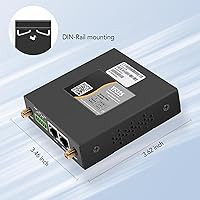
  • Form Factor: Compact desktop unit with integrated DIN-rail mounting support for installation inside standard industrial control panels and enclosures.
  • Dimensions: The unit measures 3.94 x 1.18 x 3.94 inches, a footprint small enough to fit in tight cabinet spaces alongside other panel equipment.
  • Weight: Weighs 1.37 pounds, light enough for straightforward single-person installation on a DIN rail or desktop surface.
  • Casing: IP30-rated aluminum enclosure resists dust and incidental solid contact but carries no water or moisture ingress protection.
  • Processor: Powered by a 32-bit industrial-grade CPU designed for stable, continuous, unattended operation in demanding environments.
  • Temperature Range: Rated for operation between -40°C and +85°C, covering both extreme cold and high-heat industrial deployment scenarios.
  • Input Voltage: Accepts DC power from 5V to 36V, making it directly compatible with vehicle supplies, solar power rails, and standard industrial bus voltages.
  • SIM Slots: Dual SIM card slots with automatic failover logic that switches to the secondary carrier when the primary signal is lost or degraded.
  • LTE Bands: Supports FDD bands B1, B2, B3, B4, B5, B7, B8, and B28, plus TDD band B40, optimized for North America, South America, Australia, New Zealand, and the Philippines.
  • Legacy Cellular: Backward compatible with HSPA+, HSUPA, HSDPA, WCDMA, and UMTS across 2100, 1900, 900, and 850 MHz frequency ranges.
  • Wi-Fi Standard: 802.11b/g/n Wi-Fi with a maximum indoor transmission range of approximately 80 meters under favorable conditions.
  • Serial Interfaces: Equipped with both RS232 and RS485 serial ports, enabling direct connection of legacy industrial and M2M equipment without additional adapters.
  • WAN Modes: Supports static IP, DHCP, PPPoE, 3G/4G/LTE, and DHCP-4G WAN access methods for flexible network integration.
  • VPN Protocols: Built-in support for PPTP, L2TP, IPSec, and GRE VPN protocols, eliminating the need for a dedicated external security appliance.
  • Surge Protection: All interfaces carry 15KV ESD surge protection to guard against electrical spikes common in industrial and vehicle-mounted environments.
  • Carrier Exclusions: Explicitly not compatible with Verizon or Sprint networks; works with AT&T, T-Mobile, and carriers whose bands align with the supported LTE set.
  • Cloud Management: Remote device monitoring and configuration is available through the Yeacomm Device Manager cloud platform.
  • Routing Features: Supports UPnP, Dynamic DNS, static routing, and multiple NAT modes for flexible deployment in both simple and complex network topologies.
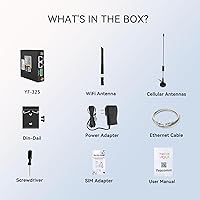
  • Box Contents: Includes the router unit, one external antenna, and a 4-in-1 SIM card adapter kit with a steel tray eject pin.
  • Geographic Coverage: LTE band support is validated for North America, South America, Australia, New Zealand, and the Philippines, with broader international compatibility possible.

Related Reviews

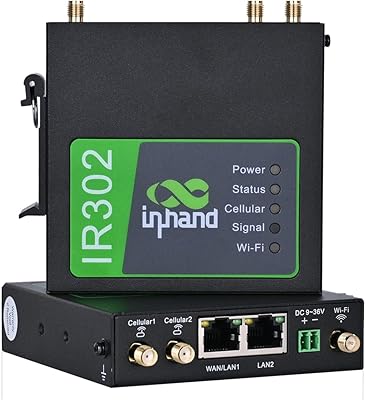
InHand Networks IR302 Industrial 4G LTE Router
80%
91%
Connection Reliability
88%
Build Quality & Durability
93%
Dual-SIM Failover
87%
Carrier Compatibility
86%
Security & VPN Capability
More
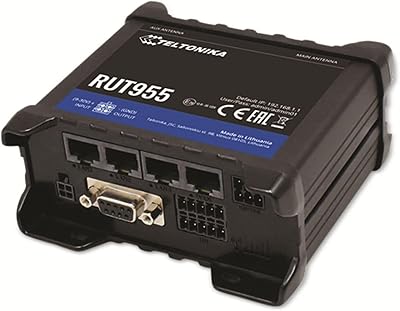
Teltonika RUT955 4G/LTE Router
85%
90%
Performance and Reliability
70%
Ease of Setup
88%
Connectivity Options
93%
Dual SIM Failover
85%
Software and Remote Management
More
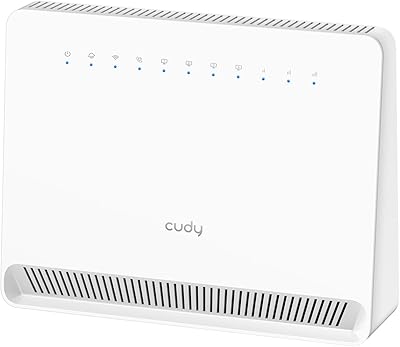
Cudy LT500 4G LTE Modem Router
76%
88%
Ease of Setup
82%
4G LTE Signal Performance
79%
WiFi Coverage & Speed
74%
VPN Functionality
71%
Carrier Compatibility
More
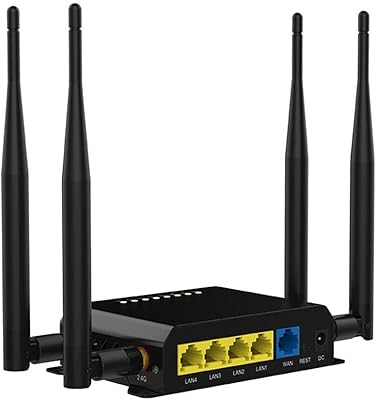
Wiflyer WE826-T 4G LTE Router
69%
83%
Build Quality
71%
LTE Connectivity
88%
TTL Feature
62%
Setup & Ease of Use
57%
Wi-Fi Performance
More
Cudy LT700 Outdoor 4G LTE Modem Router
78%
83%
Build Quality & Weatherproofing
76%
Cellular Signal Performance
81%
Antenna System & Upgradability
78%
Installation & Setup
71%
Carrier & Band Compatibility
More
Cudy LT700E 4G LTE Modem Router
72%
78%
LTE Connectivity
71%
Wi-Fi Performance
83%
Setup & Ease of Use
86%
VPN Functionality
81%
Value for Money
More
TP-Link TL-MR6400 4G LTE Router
82%
88%
Setup & Installation
91%
4G LTE Performance
83%
Wi-Fi Speed & Reliability
85%
Portability
82%
Bandwidth Management (QoS)
More
Netgear Nighthawk MR1100 Mobile Hotspot Router
79%
93%
Carrier Flexibility
88%
Multi-Device Performance
86%
Signal Reception
61%
Battery Life
89%
Setup & Ease of Use
More
NETGEAR Nighthawk M1 4G LTE Mobile Hotspot
67%
58%
Carrier Compatibility
83%
Battery Life
76%
Signal Performance
81%
Multi-Device Capacity
78%
Ease of Setup
More
NETGEAR Orbi LBR20 4G LTE WiFi Router
71%
71%
Cellular Connectivity
74%
WiFi Coverage
86%
Setup Experience
58%
Value for Money
78%
Mesh Expandability
More

FAQ

No, it won't. The Yeacomm YF325 Dual-SIM Industrial 4G LTE Router does not support Verizon's network bands, and the same applies to Sprint. If you're on either of those carriers, you'll need a different device. It works well with AT&T, T-Mobile, and compatible regional carriers that use the supported LTE band set.
When the primary SIM loses signal or becomes unreachable, the router detects the failure and automatically switches to the secondary SIM without any manual intervention. The switchover is fast enough that most monitoring systems and POS terminals won't drop a session. You configure which SIM is primary and set the failover thresholds through the web management interface.

It's not waterproof. The IP30 rating protects against solid objects larger than 2.5mm and incidental contact, but there's no moisture or rain protection whatsoever. If you need to install it in an exposed outdoor location, you'll have to house it inside a separately rated weatherproof enclosure. IP30 is appropriate for indoor industrial spaces, control cabinets, and vehicle cabins.

It's functional but dated — it resembles the kind of admin panel you'd find on industrial networking gear from a decade ago. If you're comfortable with standard router configuration tasks like setting WAN modes, VPN tunnels, or port forwarding, you'll get through it. Non-technical users should be aware that the English documentation is sparse, so having some networking background genuinely helps here.

Yes, and that's one of the main reasons to choose this over a consumer cellular router. Both RS232 and RS485 serial ports are built directly into the unit, so you can connect legacy industrial equipment — meters, sensors, PLCs — to the LTE backhaul without needing a separate serial-to-Ethernet adapter in most cases.

The LTE band lineup covers North and South America broadly, and also aligns well with Australia, New Zealand, and the Philippines. In Latin America, the FDD and TDD band support maps to most major regional carriers. Always cross-reference the specific bands your local carrier uses before ordering, as band availability varies even within a single country.

Yes, the DC input range of 5V to 36V means it handles 12V and 24V vehicle power directly — no step-down converter needed. This makes this industrial LTE router practical for fleet vehicles, transit buses, and mobile field units where you're drawing power from an automotive or industrial rail.

It has full built-in support for PPTP, L2TP, IPSec, and GRE, which covers the most common tunneling protocols used in industrial IoT and enterprise branch setups. You configure VPN tunnels through the web interface without needing a separate security appliance, which keeps both cost and rack space down for smaller deployments.

The router is designed for 35mm DIN-rail mounting, which is the standard rail system used in industrial control panels worldwide. You clip it onto the rail, connect your power and antenna cables, and it sits securely alongside other panel equipment. The compact footprint — under four inches on each side — means it fits into tight enclosures without displacing other components.

The package includes the router, one external antenna, and a 4-in-1 SIM card adapter kit with a steel tray eject pin. You'll need to supply your own SIM cards and a compatible DC power source. If the unit is going inside a metal enclosure, also plan how you'll route the antenna cable externally, since metal cabinets can significantly reduce cellular signal if the antenna is enclosed.

Where to Buy