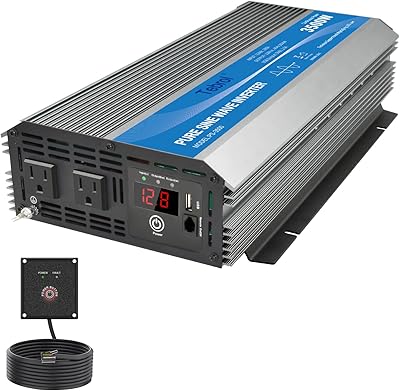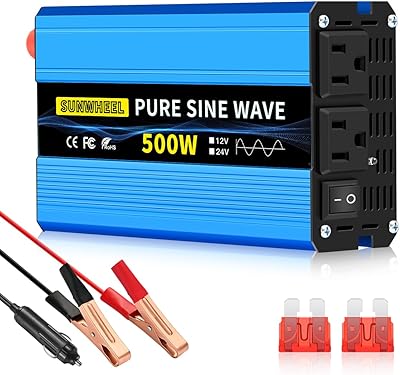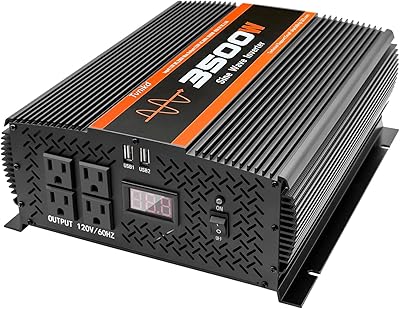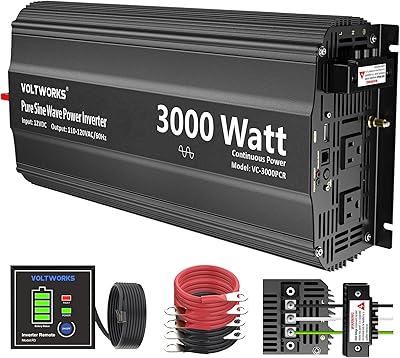
Overview

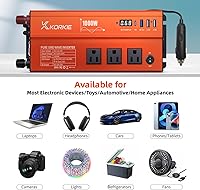
The KORKIE 1000W Pure Sine Wave Inverter is a compact, mid-range unit built for people who need dependable AC power away from the grid — think van builds, RV trips, or roadside emergencies. It converts 12V DC from a vehicle battery or external battery bank into standard 110V AC, letting you run real household devices without a generator. KORKIE launched this model in early 2024, so the review base is still growing, which is worth keeping in mind. That said, its multi-port design and small footprint make it stand out at this price point — just don't expect it to handle whole-home loads or high-draw appliances.

Features & Benefits

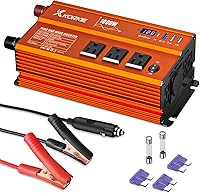
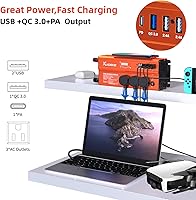
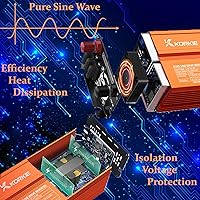
What separates a pure sine wave inverter from a modified sine wave unit matters more than most people realize — sensitive devices like CPAP machines, audio gear, and laptops run cleaner and last longer on pure sine output. This 1000W power inverter offers three AC outlets, so you're not playing musical plugs when you need to run a laptop and a small appliance simultaneously. The USB ports cover modern needs too, with both Power Delivery and Quick Charge options alongside standard ports. Dual cooling fans adjust speed automatically based on internal temperature, keeping things quiet during lighter loads. Built-in protections against overload, overheating, and reverse polarity add real peace of mind for unattended or overnight use.

Best For

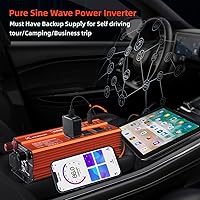
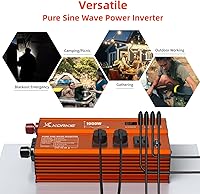
This sine wave inverter hits a practical sweet spot for anyone living or working out of a vehicle. RV owners and van-lifers get clean AC power without the noise and fumes of a generator, which is a meaningful quality-of-life upgrade on longer trips. Truck drivers can keep a small coffee maker or personal appliance running during a rest stop. Campers running drones, mirrorless cameras, or a compact fridge will appreciate the stable output. It also works as a reasonable emergency backup at home — enough to keep a router, a lamp, and phone chargers going. One caveat: if you plan to run anything with a motor-start load, check your device's surge requirements first, since peak surge wattage is not listed.

User Feedback

With around 95 ratings and a 4.1-star average, the KORKIE inverter has earned cautiously positive marks from early buyers. Ease of setup and stable output under normal loads come up frequently in positive reviews, and several users note the fans are noticeably quieter than expected. On the other side, a handful of buyers have raised questions about long-term build quality and whether the included cables feel adequate for the unit's capacity. A few mention that sustained output fell short under heavier loads, which is not unusual for inverters in this class. The 12-month warranty and claimed round-the-clock support are reassuring on paper, but with the brand still new, there is limited real-world data on warranty follow-through to draw from yet.

Pros

  • Pure sine wave output keeps sensitive electronics — laptops, CPAP machines, audio gear — running safely and efficiently.
  • Three AC outlets mean you can power multiple devices at once without needing a power strip.
  • Power Delivery and Quick Charge USB ports handle modern smartphones and tablets at full charging speed.
  • Dual fans adjust speed automatically, staying noticeably quiet during lighter loads — a real plus for overnight RV use.
  • Broad battery compatibility covers AGM, lithium-ion, and lead-acid, so it works with most existing setups.
  • Built-in reverse polarity and overload protection add a meaningful safety net for unattended operation.
  • Compact enough at under three pounds to stash in a truck cab or a van without eating up storage space.
  • Early buyers consistently praise how straightforward the initial setup is — no technical expertise required.
  • The 12-month warranty and stated 24-hour support line give some recourse if issues arise within the first year.

Cons

  • Peak surge wattage is not published, making it difficult to assess compatibility with motor-start devices like small compressors or pumps.
  • With under 100 ratings, there is not enough long-term user data to fully trust the reliability picture yet.
  • Some buyers have flagged concerns about the quality of the included cables, which may need upgrading for heavy regular use.
  • A few users report the inverter falls short of its rated output under sustained heavy loads, which is worth testing early.
  • KORKIE is a new brand with no established repair network or parts availability if the unit fails after the warranty period.
  • No published peak surge spec means buyers have to guess when it comes to devices with high startup current draws.
  • The warranty sounds solid on paper, but real-world warranty resolution experiences from verified buyers remain scarce.
  • Not suited for anyone needing to run large kitchen appliances or climate control — the continuous power ceiling is a firm constraint.

Ratings

The scores below for the KORKIE 1000W Pure Sine Wave Inverter were generated by our AI rating engine after analyzing verified purchaser reviews from global markets, with spam, bot-submitted, and incentivized feedback actively filtered out. The result is a transparent breakdown that reflects both what buyers genuinely appreciate and the friction points that come up repeatedly in real-world use. No score has been smoothed or inflated — the strengths and limitations are both represented as honestly as the data allows.

Output Signal Quality
88%
Buyers who run sensitive electronics — CPAP machines, studio audio interfaces, and newer laptops — consistently report clean, stable power with no interference or humming. For that segment of users, the pure sine wave output is the primary reason they chose this inverter over cheaper modified sine wave alternatives.
A handful of users note that output quality under sustained heavy loads shows minor fluctuation, which is not unusual at this capacity tier but is worth noting for precision-sensitive equipment. There is no third-party waveform verification published by the brand to back up the spec independently.
Port Variety & Charging
82%
18%
Having both a Power Delivery port and a Quick Charge port alongside two standard USB outputs means most modern devices — phones, tablets, laptops via USB-C — charge at full speed without needing a separate adapter block. Truck drivers and van-lifers particularly appreciate being able to top up multiple devices simultaneously on the road.
The standard USB ports are limited to 5.2V/2.4A, which feels slightly underpowered for tablets or older devices that benefit from higher amperage. Some buyers also note there is no USB-A port labeled for high-wattage output beyond the QC port, which can create confusion when plugging in multiple devices.
Ease of Setup
91%
Across the review base, setup is one of the most consistently praised aspects — buyers report going from unboxing to powering devices in under ten minutes without consulting any documentation. The labeling is clear, and the port layout is intuitive enough for users with no prior inverter experience.
The included instruction manual is minimal and lacks guidance for more advanced configurations, such as wiring via ring terminals for permanent vehicle installation. Users building a more integrated setup often have to seek external resources for proper gauge recommendations and fusing guidance.
Fan Noise
79%
21%
During light and moderate loads, the variable-speed fans run quietly enough that multiple buyers specifically call out the low noise as a pleasant surprise — especially during nighttime RV use where a loud fan would be disruptive. The temperature-responsive throttling means the fans only ramp up when genuinely needed.
At higher load levels, the fans become noticeably louder and a few buyers describe the high-speed fan noise as distracting in quiet environments. The fans also cycle on briefly at startup even under no load, which surprised some users expecting complete silence at idle.
Build Quality
63%
37%
The unit feels solid enough for casual mobile use, and the housing does not flex or rattle under normal handling. For buyers using it intermittently during camping trips or occasional road use, the construction holds up adequately within the first few months of ownership.
This is one of the more frequently raised concerns in reviews — several buyers question the long-term durability of the casing and internal components, particularly under daily use or in high-heat environments. At under 100 reviews, there is not yet enough data to assess multi-year reliability with any confidence.
Cable & Accessory Quality
54%
46%
The included battery clamp cables get the unit operational out of the box without any additional purchases, which is convenient for buyers who just want a quick setup for occasional use. For light and infrequent use cases, the included cables perform their basic function.
Multiple reviewers flag the included cables as the weakest part of the package — they feel thin for a 1000W load, and buyers running the inverter near its capacity limit are advised to upgrade to heavier gauge cables before sustained use. This is a recurring enough complaint that it should factor into your initial budget.
Sustained Load Performance
67%
33%
For loads well below the 1000W ceiling — powering a laptop, a small fan, and charging a few devices simultaneously — the KORKIE inverter handles extended runtime without issues. Users in that moderate-use range report consistent output without thermal shutdowns.
A portion of buyers report that the inverter struggles or triggers overload protection when pushed close to its rated continuous limit, suggesting real-world headroom is tighter than the spec implies. The absence of a published peak surge wattage compounds this uncertainty for buyers with motor-start devices.
Thermal Management
76%
24%
The dual intelligent fans do a measurable job of keeping operating temperatures in check during normal use, and the over-temperature protection gives an added layer of security if airflow is partially restricted. Several users report running the unit for multiple hours with no heat-related shutdowns.
The unit does require adequate clearance on all sides to ventilate properly, and buyers who stash it in tight spaces or enclosed compartments have noted thermal shutdowns under load. The manual does not clearly specify minimum clearance requirements, which has caught some installers off guard.
Value for Money
73%
27%
For buyers who specifically need a pure sine wave unit and find modified sine wave alternatives unsuitable for their devices, the pricing represents a reasonable entry point into clean-output inverters. The port count and USB charging capabilities add utility that cheaper units in this class often omit.
Compared to established inverter brands with deeper review histories and better documented surge specs, paying a comparable price for a newer brand with fewer than 100 reviews carries some inherent risk. Buyers who prioritize proven long-term reliability may find better-documented alternatives worth the potential premium.
Safety Protections
84%
The combination of overload, over-temperature, short-circuit, and reverse polarity protection covers the scenarios most likely to cause damage in real mobile setups. Reverse polarity protection in particular is a meaningful safeguard for users who are less experienced with battery wiring.
While the protections themselves are well-regarded, there is no audible alarm when a protection circuit triggers — the unit simply shuts off, which can leave users briefly confused about what caused the shutdown. A status indicator or fault code display would make troubleshooting considerably faster.
Battery Compatibility
86%
Supporting AGM, lithium-ion, and lead-acid batteries without additional configuration makes this inverter easy to drop into a wide range of existing setups — whether that is a truck's starter battery, a dedicated AGM house battery in an RV, or a lithium battery bank in a van build.
There is no low-voltage cutoff threshold adjustment available, which means users with lithium batteries — which have a narrower safe discharge range than lead-acid — need to monitor battery state independently to avoid deep-cycling their pack below safe limits.
Portability
89%
At under three pounds and roughly the footprint of a thick hardback book, this sine wave inverter is easy to move between vehicles, tuck into a truck cab, or carry in a camping kit without adding meaningful weight to a load. The compact form factor is one of its more practical everyday advantages.
While portable, the unit lacks a carrying handle or mounting holes, so there is no clean way to secure it permanently in a vehicle without improvised solutions. Buyers wanting a fixed installation will need to fabricate or purchase a mounting bracket separately.
Warranty & Support
61%
39%
A 12-month warranty with stated around-the-clock customer support is a reasonable commitment for a newer brand, and some buyers report receiving prompt responses to pre-purchase questions. The no-risk framing suggests the company is at least willing to engage with dissatisfied buyers.
Because KORKIE is new to market, there is very little independent data on how warranty claims are actually resolved — whether returns are processed smoothly, whether replacements are shipped promptly, or how the brand handles edge-case failures. This uncertainty is hard to ignore when evaluating long-term value.

Suitable for:

The KORKIE 1000W Pure Sine Wave Inverter is a practical fit for anyone whose power needs revolve around a vehicle battery or portable battery bank rather than a wall outlet. RV owners and van-lifers get the most value here — it delivers quiet, clean AC power that lets you run a laptop, a CPAP, or a compact refrigerator without firing up a noisy generator at the campsite. Truck drivers on long hauls will appreciate having a few real AC outlets and fast USB charging within arm's reach of the cab. It also makes a reasonable emergency backup for home use during short outages, covering essentials like a router, phone chargers, and a small fan. DIY off-grid builders who need a pure sine wave signal for sensitive electronics or small motor-driven devices will find this inverter covers a solid range of everyday loads without overcomplicating the setup.

Not suitable for:

The KORKIE 1000W Pure Sine Wave Inverter is not the right tool if you need to power high-draw appliances like a full-size microwave, a window air conditioner, or an electric kettle — those devices routinely exceed what a 1000W continuous-rated unit can safely sustain. Buyers planning to run equipment with heavy motor-start loads should also be cautious, since the peak surge wattage is not published, making it hard to know whether the inverter can handle the initial spike. If you are building a serious off-grid system that needs to run multiple large appliances around the clock, you will outgrow this unit quickly and should look at higher-capacity options from more established brands. Anyone who relies on long-term warranty support should weigh the fact that KORKIE is a newer brand with a limited track record — the 12-month warranty sounds reassuring, but real-world follow-through data is still thin. Finally, buyers who prioritize premium build materials and the confidence of a brand with thousands of verified reviews may find the current review pool too small to justify the purchase without hesitation.

Specifications

  • Brand: Manufactured by KORKIE, a brand that entered the consumer inverter market in early 2024.
  • Model: The unit is sold under the model designation KORKIE-1000W.
  • Waveform: Outputs a pure sine wave signal, which closely replicates the quality of standard utility grid power.
  • Continuous Output: Rated for 1000 watts of continuous AC power delivery under normal operating conditions.
  • Input Voltage: Accepts 12V DC input from vehicle batteries or compatible external battery banks.
  • Output Voltage: Delivers 110V AC output suitable for standard North American household devices and appliances.
  • AC Outlets: Equipped with three standard AC outlets for simultaneous multi-device operation within the rated power limit.
  • USB Ports: Includes four USB ports: one Power Delivery port, one Quick Charge port, and two standard 5.2V/2.4A ports.
  • Cooling System: Features dual variable-speed intelligent fans that automatically adjust their speed based on internal operating temperature.
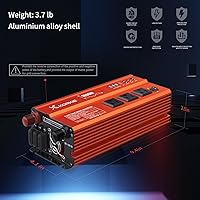
  • Dimensions: The unit measures 9.4 x 4.1 x 2.5 inches, keeping it compact enough for cab, van, or RV storage.
  • Weight: Weighs 2.8 pounds, making it easy to reposition or move between vehicles as needed.
  • Battery Types: Compatible with AGM, lithium-ion, and lead-acid battery chemistries without requiring additional adapters.
  • Protections: Built-in safeguards cover overload, over-temperature, short-circuit, and reverse polarity conditions.
  • Warranty: Backed by a 12-month manufacturer warranty with stated 24-hour customer support availability.
  • Availability: First listed for sale on Amazon in March 2024, making it a relatively recent market entry.

Related Reviews
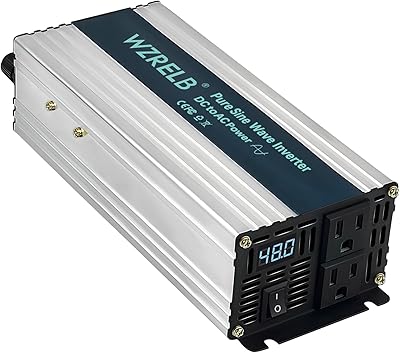
WZRELB SE100048 1000W Pure Sine Wave Inverter
78%
88%
Power Output Quality
91%
Value for Money
61%
Long-Term Reliability
67%
Thermal Management
84%
Voltage Protection
More
Tebrol 3500W Pure Sine Wave Inverter
79%
88%
Output Power Accuracy
92%
Pure Sine Wave Quality
79%
Build Quality
83%
Cooling & Thermal Management
81%
Ease of Installation
More
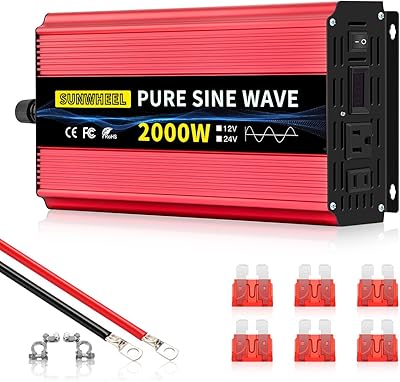
SUNWHEEL 2000W Pure Sine Wave Inverter
80%
86%
Power Output Reliability
91%
Waveform Quality
83%
Build Quality
88%
Noise Level
67%
LCD Display Usefulness
More
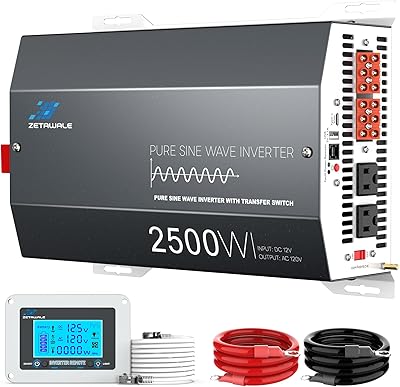
ZETAWALE 2500W Pure Sine Wave Inverter
78%
91%
Pure Sine Wave Quality
87%
Auto Transfer Switch
84%
Value for Money
61%
Long-term Reliability
68%
Cooling & Noise
More
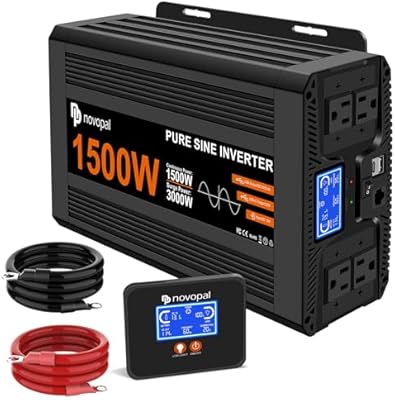
Novopal 1500W Pure Sine Wave Inverter
76%
83%
Power Output Accuracy
88%
Power Quality
74%
Build Quality
86%
Ease of Installation
89%
Remote Control Usability
More
SUNWHEEL 500W Pure Sine Wave Inverter
86%
92%
Power Conversion Efficiency
88%
Noise Level
85%
Build Quality & Durability
80%
Cooling System
83%
Portability
More
VOLTWORKS VS-3000PCR 3000W Pure Sine Wave Inverter
79%
83%
Output Power Accuracy
91%
Output Signal Quality
88%
Cooling & Noise Level
79%
Build Quality & Housing
86%
Installation Ease
More
TVNIKD 2500W Pure Sine Wave Power Inverter
77%
88%
Power Output Quality
81%
Build Quality
63%
Heat Management
86%
Ease of Installation
83%
LCD Display Usability
More
TVNIKD 3500W Pure Sine Wave Inverter
86%
92%
Power Conversion Performance
89%
Ease of Setup
72%
Portability & Size
90%
Reliability & Durability
91%
Power Output (Wattage)
More
OLTEANP 48V 4000W Pure Sine Wave Inverter
83%
90%
Performance Under Load
65%
Ease of Setup
88%
Battery Compatibility & Longevity
91%
Noise & Operation Smoothness
83%
Build Quality
More

FAQ

Yes, the pure sine wave output is exactly what CPAP machines require — modified sine wave inverters can interfere with the motor and pressure regulation, but this unit avoids that problem entirely. Just make sure your CPAP draws well under 1000 watts, which virtually all residential CPAP and BiPAP units do. Keep in mind your battery capacity will determine how many hours of runtime you actually get.

That depends entirely on what you are powering. As a rough guide, a 100Ah 12V battery can theoretically deliver around 1000 watt-hours, but real-world efficiency losses mean you should plan for less. For extended use, a 100Ah to 200Ah AGM or lithium battery is a reasonable starting point for moderate loads like a laptop and a few small devices.

Yes, it is explicitly compatible with lithium-ion batteries in addition to AGM and lead-acid chemistries, so you do not need a separate converter or adapter to connect it to a lithium battery bank.

Several buyers have noted that the fans are noticeably quieter than expected during light to moderate loads, which is one of the more frequently praised aspects of the unit. At higher loads the fans will spin faster and become more audible, but for typical RV or truck cab use the noise level is generally described as non-intrusive.

Compact portable refrigerators with a compressor-style motor are one of the more popular use cases for this inverter, and it handles them well within normal operating conditions. The one thing to be aware of is that compressor fridges have a startup surge when the motor kicks on — since the peak surge wattage for this inverter is not published by the manufacturer, it is worth checking your fridge's surge draw against the inverter's specs before committing.

The built-in overload, over-temperature, short-circuit, and reverse polarity protections do make it safer for unattended use than a unit without those safeguards. That said, no inverter should be treated as completely hands-off — ensure it is mounted or placed with adequate airflow around it, and avoid covering it with fabric or gear while running.

No — a 1000W inverter draws far more current than a standard cigarette lighter socket is rated to handle, typically 150 to 200 watts maximum. You need to connect it directly to your vehicle battery using the included battery clamp cables or ring terminals for safe, full-capacity operation.

It should include battery clamp cables for direct battery connection, but the quality of those included cables has been a mild point of criticism from some buyers. If you plan to run the inverter at higher loads regularly, upgrading to heavier gauge cables is worth considering.

Most countertop microwaves and electric kettles draw between 1000 and 1500 watts or more, which puts them right at or beyond the continuous limit of this sine wave inverter. Running devices at the very edge of the rated capacity for sustained periods accelerates wear and risks triggering the overload protection, so it is better to treat high-draw kitchen appliances as incompatible with this unit.

The reverse polarity protection is designed to handle exactly that scenario — it prevents current from flowing in the wrong direction and shuts the unit down rather than allowing damage to the inverter or the connected devices. It is a genuinely useful safety feature, especially for users who are new to working with battery-connected equipment.