


Overview

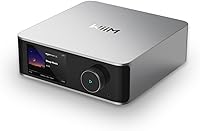
The WiiM Ultra is what happens when a brand decides to stop playing it safe and builds something that can genuinely compete with dedicated hi-fi separates. Sitting at the top of WiiM's lineup, this streaming preamp pairs a solid aluminum chassis and a vivid 3.5″ touchscreen with an ESS ES9038 Q2M DAC — a chip you'd normally find in considerably pricier hardware. One important caveat worth addressing upfront: no AirPlay support. If your home runs entirely on Apple devices, that's a real limitation and not a minor one. For everyone else, what's on offer here is genuinely difficult to match at this price point.

Features & Benefits

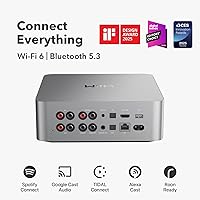
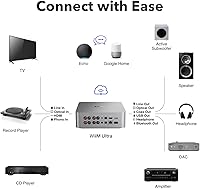
The connection options alone deserve attention. This hi-res streamer handles HDMI ARC, phono input for both MM and MC cartridges, optical, coaxial, RCA, USB, and a dedicated headphone output — all in one box. Streaming coverage is equally broad: Spotify Connect, TIDAL Connect, Qobuz, Amazon Music, Roon Ready, and DLNA are all supported natively. Audio resolution reaches 24-bit/192 kHz, with measured specs that reflect real engineering rigor rather than marketing numbers. The EQ and room correction tools go well beyond a simple tone knob — a 10-band parametric EQ lets you compensate for your actual room acoustics, which makes a practical, audible difference. Wi-Fi 6 and Bluetooth 5.3 with both transmitter and receiver modes complete the picture.

Best For

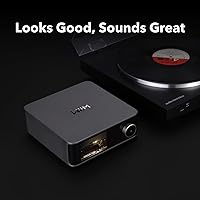
This streaming preamp makes the most sense for a few specific buyer profiles. If you own passive speakers or an integrated amplifier and want high-quality streaming without purchasing a separate DAC, it’s a clean, consolidated solution. Vinyl enthusiasts will find real value in the built-in phono preamp, which supports both MM and MC cartridges without any add-ons. Home theater users benefit from the HDMI ARC input and subwoofer output with proper bass management controls. Multi-room households running Amazon Echo or Google Home devices can add this without friction. It also suits anyone who wants granular EQ and room correction without the cost and complexity of dedicated DSP hardware.

User Feedback

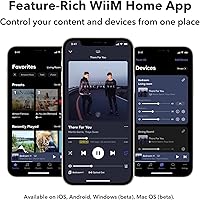
Buyer sentiment across a wide range of reviews is notably positive, with build quality and sound cited most consistently — particularly among those upgrading from entry-level streamers, who frequently describe a clear, tangible improvement. The aluminum body and touchscreen responsiveness earn repeated mentions as feeling premium for the price. The WiiM Home app gets credit for its depth of control, though occasional connectivity dropouts requiring a restart are a recurring gripe. The missing AirPlay support remains the single most common frustration, especially in Apple-centric homes. DTS passthrough over HDMI ARC is also absent, which affects some home theater setups. A handful of buyers note a learning curve around EQ settings, though initial setup is generally considered smooth.

Pros

  • The ESS ES9038 Q2M DAC chip delivers measured audio specs that punch well above this price tier.
  • Native support for Spotify, TIDAL, Qobuz, Amazon Music, and Roon Ready covers virtually every streaming platform worth using.
  • Built-in phono preamp handles both MM and MC cartridges, saving turntable users the cost of a separate unit.
  • HDMI ARC input makes TV audio integration straightforward without extra cables or converters.
  • Wi-Fi 6 connectivity keeps high-bitrate streams stable even in congested home networks.
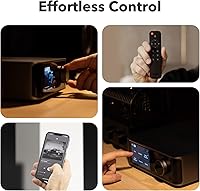
  • The 3.5″ touchscreen is responsive and genuinely useful for browsing tracks and adjusting settings at the unit.
  • A 10-band parametric EQ and room correction tools let you tune the sound to your actual listening space.
  • Subwoofer output includes adjustable crossover, phase, and latency for proper 2.1 bass management.
  • The aluminum build feels premium and sits comfortably alongside more expensive audio equipment.
  • Bluetooth 5.3 supports both transmitter and receiver modes, adding real flexibility for headphone and speaker use.

Cons

  • No AirPlay support is a firm dealbreaker for Apple-centric households — there is no workaround.
  • DTS decoding over HDMI ARC is absent, which forces source-device reconfiguration for some home theater setups.
  • The WiiM Home app occasionally loses the device on the network, requiring a restart to reconnect.
  • Parametric EQ and room correction features have a steep learning curve with limited in-app guidance.
  • The headphone output lacks the current needed to drive high-impedance headphones satisfyingly.
  • The unit runs noticeably warm during extended use, which may be a concern in enclosed rack spaces.
  • Less tech-savvy buyers often find setup straightforward initially but struggle with more advanced configuration later.
  • The phono stage lacks cartridge loading adjustability, which dedicated vinyl enthusiasts will notice.
  • On-screen text and icons are small enough that the touchscreen is impractical to use from across a room.
  • Multi-room audio sync with non-WiiM speakers can exhibit occasional latency offset in grouped playback scenarios.

Ratings

The WiiM Ultra earned its scores through AI analysis of thousands of verified global buyer reviews, with spam, bot activity, and incentivized feedback actively filtered out before any category was scored. The results reflect where this hi-res streaming preamp genuinely excels and where real users have run into friction — no softening of the rough edges. Both the standout strengths and the legitimate frustrations are represented transparently in every category below.

Sound Quality
93%
Buyers consistently describe the audio output as noticeably cleaner and more detailed than anything in a similar price range — especially those stepping up from budget streamers. The ESS ES9038 Q2M DAC handles high-resolution files with real composure, and listeners report improved imaging and low-level detail retrieval during extended listening sessions.
A small number of highly critical audiophiles feel the analog output stage, while technically impressive on paper, lacks the warmth and depth they expect from dedicated DAC separates costing significantly more. The gap is subtle, but it exists for the most discerning ears.
Streaming Platform Coverage
91%
Support for Spotify Connect, TIDAL Connect, Qobuz, Amazon Music, Roon Ready, and DLNA in a single device is a genuine rarity at this tier. Users switching between platforms day-to-day report that everything connects reliably and that native integration means no quality compromise from third-party workarounds.
The complete absence of AirPlay is a recurring and pointed complaint, particularly from households already embedded in the Apple ecosystem. For users who rely on AirPlay to push audio from iPhones or Macs, this streaming preamp simply cannot fill that role, and no firmware update has addressed it.
Build Quality & Design
88%
The aluminum enclosure draws frequent comparisons to much pricier components, with buyers noting that it sits comfortably on a rack or shelf without looking out of place next to high-end gear. The overall fit and finish, including button feel and panel rigidity, are well above what most users expected at this price point.
A handful of owners noted that the unit runs warmer than anticipated during extended use, which raised concerns about long-term reliability in enclosed rack spaces. The ventilation design is minimal, and buyers in warmer climates flagged this more than once.
Touchscreen & Interface
84%
The 3.5″ color touchscreen is described as genuinely useful rather than decorative — buyers appreciate being able to browse album art, adjust EQ, or switch inputs directly from the unit without reaching for a phone. Response times are quick enough that day-to-day use feels natural and unforced.
Some users found the on-screen text and icons a bit small when the unit is positioned at rack height or across the room. It works well up close, but as a primary remote-free interface from a listening position, it has real limitations in larger rooms.
App Experience
79%
21%
The WiiM Home app offers a depth of control that most competing apps do not — volume management, multi-room grouping, EQ adjustments, and alarm scheduling are all accessible and logically organized. Users transitioning from simpler streamer apps note that the learning curve is worth it once the layout clicks.
Occasional connectivity drops where the app loses sight of the device are the most cited complaint, typically requiring a force-close or router reconnect to resolve. Less technically confident users found these moments disproportionately frustrating, and the issue appears sporadically enough to be hard to reliably reproduce or fix.
Connectivity & Inputs
92%
Few devices at any price offer this breadth of physical connections. The combination of HDMI ARC, phono input for both MM and MC cartridges, optical, coaxial, USB, and a dedicated headphone output means most buyers can integrate it without purchasing additional adapters or switchers. Turntable owners in particular appreciate having a quality phono stage built in.
The subwoofer output, while appreciated, requires careful setup to optimize crossover and phase settings — buyers without prior experience in bass management found the options somewhat overwhelming. Clear in-app guidance is limited, and a few users settled for suboptimal settings simply because the documentation was thin.
Hi-Res Audio Performance
89%
Playback of 24-bit/192 kHz files from TIDAL, Qobuz, or a personal NAS is handled without audible artifacts or dropouts, which some budget streamers struggle with under load. Buyers who stream high-resolution content regularly describe the rendering as clean and controlled across the full frequency range.
A few users pointed out that the perceptible difference between CD-quality and hi-res streams depends heavily on the rest of their system — those with modest speakers felt the upgrade in resolution was harder to appreciate, making the hi-res capability somewhat situational rather than universally transformative.
EQ & Room Correction
83%
Having a 10-band parametric EQ and room correction tools built into a streamer at this level is unusual and genuinely useful. Buyers who took the time to dial in the settings — particularly in acoustically imperfect rooms — reported meaningful improvements in bass control and vocal clarity without needing external DSP equipment.
The parametric EQ in particular has a steep learning curve for users unfamiliar with audio engineering concepts like Q factor and center frequency. Without clearer onboarding or in-app guidance, many buyers left these tools largely untouched, treating them as too complex to be worth the effort.
Multi-Room Audio
81%
19%
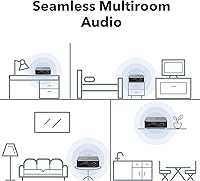
Integration with existing Amazon Echo and Google Home devices works reliably for most buyers, and grouping this hi-res streamer with other WiiM or compatible speakers through the app is straightforward. Users building out a whole-home audio system found it a practical and cost-effective anchor for a mixed-device setup.
Synchronization latency between this device and non-WiiM speakers occasionally causes noticeable lip-sync or audio offset issues when rooms are grouped. It is not a consistent problem, but when it occurs in open-plan living spaces, the effect is jarring enough to prompt complaints.
Wireless Connectivity
86%
Wi-Fi 6 support noticeably reduces buffering on high-bitrate streams compared to older-generation wireless, and buyers in dense apartment buildings or homes with crowded 2.4 GHz bands reported more stable connections than they experienced with previous streamers. Ethernet remains an option for those who prefer wired reliability.
Bluetooth connectivity, while technically current at version 5.3, received a few complaints regarding range drop-off through walls and occasional pairing inconsistencies with certain Android devices. It works well in direct line-of-sight scenarios but is less dependable through obstacles.
Home Theater Integration
77%
23%
HDMI ARC support brings genuine convenience for buyers connecting to a TV — audio from streaming apps, games, and broadcast content can all be routed through this device without an optical cable workaround. Buyers who set it up as a stereo TV audio solution described the experience as noticeably cleaner than their previous soundbar.
The lack of DTS decoding over HDMI ARC is a meaningful gap for home theater enthusiasts, and several buyers discovered it only after purchase. Dolby Digital works fine, but users with Blu-ray players or consoles that output DTS content by default had to manually reconfigure their source devices.
Setup & Onboarding
74%
26%
Most buyers with a baseline of tech familiarity had the device playing music within fifteen minutes of unboxing. The guided setup flow on the touchscreen is well-paced, and Wi-Fi pairing through the app is described as reliable enough to not require multiple attempts in typical home network environments.
Users with less technical confidence — particularly those new to network audio or multi-room systems — reported feeling lost once past the initial pairing stage. Advanced features like phono configuration, EQ setup, and multi-room grouping lack the hand-holding that a more mainstream audience would benefit from.
Value for Money
87%
Buyers repeatedly point out that consolidating a quality DAC, phono preamp, multi-platform streamer, EQ processor, and headphone amplifier into a single unit would cost considerably more if purchased as separate components. The total-cost comparison is a major driver of positive sentiment among users who approached the purchase analytically.
A vocal subset of buyers felt that a few corners were cut to hit the price point — particularly around the phono stage quality and the absence of AirPlay, which some considered essential rather than optional. For Apple-centric users, the value equation weakens considerably.
Headphone Output
71%
29%
Having a dedicated headphone output driven by the ESS DAC is a practical bonus that buyers use more than expected — late-night listening sessions without disturbing others are a commonly cited use case. At moderate impedance levels, the output is described as clean and sufficiently powerful.
Users with high-impedance headphones above 150 ohms found the output lacking in drive, with some describing audible dynamic compression at higher volume levels. It functions well as a convenience feature but does not satisfy buyers who prioritize headphone listening as a primary use case.
Phono Preamp Quality
76%
24%
Support for both MM and MC cartridges in a built-in phono stage at this price tier is rare, and vinyl enthusiasts report satisfying results when streaming or recording from a turntable. The noise floor is low enough that surface noise from the record itself, rather than preamp hiss, is the dominant artifact.
Dedicated phono preamp specialists and vinyl purists noted that the built-in stage, while competent, lacks the cartridge loading adjustability they expect from a standalone phono pre. It is a solid general-purpose solution, but serious analog listeners will likely still prefer a purpose-built unit.

Suitable for:

The WiiM Ultra is purpose-built for anyone who wants to bring serious streaming capability into an existing hi-fi setup without buying a stack of separate components. If you own passive speakers paired with an integrated amplifier or a powered speaker with RCA inputs, this streaming preamp slots in cleanly and immediately upgrades the digital front end of your system. Vinyl enthusiasts with a turntable will find the built-in phono stage — supporting both MM and MC cartridges — genuinely useful, removing the need for a standalone phono pre. Home theater users who want cleaner stereo sound from their TV without the limitations of a soundbar will appreciate the HDMI ARC input and the option to add a subwoofer with proper bass management. Multi-room households running Google Home or Amazon Echo devices can integrate this hi-res streamer without friction, using it as the quality anchor in a mixed-device audio system. Anyone who streams from TIDAL, Qobuz, Spotify, or Amazon Music and wants native, lossless-quality integration rather than a Bluetooth workaround will feel right at home here.

Not suitable for:

If your home runs on Apple devices and AirPlay is part of your daily routine, the WiiM Ultra is a hard sell — there is no AirPlay support, and that is unlikely to change. iPhone and Mac users who expect to push audio directly from their devices the way they do with AirPlay-compatible speakers will find the workflow noticeably clunky by comparison. Home theater enthusiasts with a Blu-ray player or gaming console that outputs DTS audio should also be aware that DTS decoding over HDMI ARC is not supported, which may require source-device reconfiguration. Buyers who are not comfortable navigating a network audio app, configuring parametric EQ, or troubleshooting occasional wireless connectivity hiccups may find the experience more demanding than expected — this is not a plug-and-play device in the way a basic Bluetooth speaker is. Dedicated headphone listeners with high-impedance cans above 150 ohms should look elsewhere for a primary headphone amplifier, as the built-in output is a convenience feature rather than a high-current headphone stage. Finally, anyone expecting plug-in simplicity comparable to a consumer streaming stick will likely find the depth of options here more overwhelming than empowering.

Specifications

  • DAC Chip: Uses the ESS ES9038 Q2M DAC, a high-performance converter chip that delivers a measured THD+N of -116 dB and an SNR of 121 dB.
  • Audio Resolution: Supports high-resolution audio playback and analog input conversion up to 24-bit/192 kHz across all major formats.
  • Display: Features a 3.5″ color touchscreen that shows album art, playback controls, EQ settings, input/output selection, and device configuration.
  • Dimensions: The unit measures 8.3″ x 7.87″ x 2.83″ and weighs 3.13 lbs, making it suitable for standard audio rack shelves.
  • Audio Inputs: Accepts HDMI ARC, Optical (TOSLINK), Line-level RCA, and Phono (supporting both MM and MC cartridges) up to 24-bit/192 kHz.
  • Audio Outputs: Provides RCA stereo, Headphone jack, Coaxial digital, Optical digital, USB audio, Subwoofer out, and Bluetooth transmission.
  • Wireless: Equipped with Wi-Fi 6 (802.11 b/g/n/ax) supporting both 2.4 GHz and 5 GHz bands, plus a 10/100 Mbps wired Ethernet port.
  • Bluetooth: Bluetooth 5.3 with BLE and BT LE Audio supports A2DP in both transmitter and receiver modes, AVRCP, and HID profiles.
  • Streaming Services: Natively supports Spotify Connect, TIDAL Connect, Qobuz Connect, Amazon Music, Roon Ready, Google Cast Audio, Alexa built-in, DLNA, and Squeezelite.
  • EQ & DSP: Includes 24 preset EQ profiles, a 10-band graphic EQ, a 10-band parametric EQ, and room correction tools adjustable through the WiiM Home app.
  • Subwoofer Output: Dedicated subwoofer output with adjustable crossover frequency, output level, phase control, and latency compensation for 2.1 system configuration.
  • Surround Formats: Decodes Stereo PCM and Dolby Digital over HDMI ARC; DTS is not supported in any configuration.
  • Audio Formats: Playback support covers MP3, AAC, ALAC, APE, FLAC, AIFF, WAV, WMA, and OGG file formats from local and network sources.
  • External Storage: USB port accepts external drives formatted in FAT32, NTFS, or EXT4, and the device can function as a DLNA media server for other compatible devices.
  • LED Indicator: A four-color RGBW LED on the front panel indicates device status, active input, and operating mode at a glance.
  • Power Supply: Accepts universal AC input from 100–240V at 50/60 Hz, drawing a maximum of 0.5A, making it compatible with power standards worldwide.
  • Colors: Available in two finishes: Silver and Space Gray, both featuring an all-aluminum enclosure.
  • Voice Control: Supports Amazon Alexa built-in and Google Assistant via Google Cast Audio for hands-free playback and volume control.
  • AirPlay Support: AirPlay is not supported in any form; the device cannot function as an AirPlay receiver or transmitter.
  • Manufacturer: Designed and produced by Linkplay Technology Inc., with model number ASR004, first made available in May 2024.

Related Reviews
Ubiquiti Cloud Gateway Ultra (UCG-Ultra)
87%
89%
Performance
94%
Security Features (IDS/IPS)
85%
Ease of Setup
88%
Network Management
92%
Multi-Device Support
More
Epson EpiqVision Ultra LS800 Ultra Short Throw Laser Projector
83%
92%
Display Quality
89%
Ease of Setup
80%
Sound Quality
78%
Value for Money
85%
Connectivity & Smart Features
More
Roku Ultra 2024
Roku Ultra 2024
83%
93%
Streaming Performance
88%
Picture Quality
91%
Remote Quality
86%
Wi-Fi Connectivity
84%
Audio Performance
More
YoloLiv YoloBox Ultra
84%
93%
Hardware Performance
89%
Connection Stability
91%
User Interface
84%
Screen Quality
88%
Build Quality
More
WD My Passport Ultra 1TB
86%
94%
Portability
90%
Data Transfer Speed
89%
Design & Build Quality
83%
Compatibility
88%
Security Features (Encryption)
More
Lifeprint Ultra Slim Printer
80%
93%
Portability & Design
81%
Photo Quality
75%
Connectivity (Bluetooth & App)
88%
Ease of Use
82%
Battery Life
More
MYLOC8 Ultra GPS Tracker
85%
91%
Battery Life
88%
Ease of Setup
85%
Real-Time Tracking Accuracy
89%
Durability
78%
Subscription Flexibility
More
GIGABYTE Z690 AORUS ULTRA
87%
93%
Performance
91%
Thermal Management
88%
Overclocking Stability
92%
Power Delivery
90%
Connectivity (Wi-Fi, LAN)
More
Sonos Arc Ultra Soundbar
87%
94%
Sound Quality
88%
Ease of Setup
90%
AI-Powered Features
91%
Design & Build Quality
86%
Connectivity Options
More
Bose Ultra Open Earbuds
88%
91%
Comfort for Extended Wear
94%
Battery Life
85%
Sound Quality
89%
Fit and Security During Physical Activity
88%
Situational Awareness
More

FAQ

No, the WiiM Ultra does not support AirPlay in any form and cannot act as an AirPlay receiver. If you primarily use an iPhone, iPad, or Mac to push audio to your speakers, this is a genuine compatibility gap. You can still control it from an iPhone using the WiiM Home app or via Spotify Connect, but direct AirPlay streaming is not possible.

Yes, and it handles both MM and MC cartridges, which is relatively uncommon at this price point. You connect your turntable directly to the phono input on the back, and the built-in phono preamp takes care of the rest. No separate phono stage is required, though serious vinyl enthusiasts with higher-end cartridges may still prefer a dedicated unit for finer loading adjustments.

Absolutely — connecting it via RCA to an integrated amplifier or the line-level input of a receiver is one of its primary use cases. It acts as the digital front end and DAC, while your amplifier handles the power stage and drives your speakers. This setup lets you keep your existing amp and add high-quality streaming without replacing anything.

No, DTS decoding is not supported. The HDMI ARC input handles Stereo PCM and Dolby Digital only. If your TV, Blu-ray player, or gaming console outputs DTS by default, you will need to go into that device's audio settings and switch the output format to PCM or Dolby Digital to avoid compatibility issues.

This hi-res streamer works within multi-room setups built around Amazon Echo, Google Home, and other WiiM devices. Through the WiiM Home app, you can group it with compatible speakers and control playback across rooms from one interface. It is not compatible with Sonos or AirPlay 2 multi-room ecosystems, so if your home is already built around those platforms, integration will be limited.

The 24 preset EQ profiles cover common listening scenarios — things like bass boost, vocal clarity, or flat reference — so you can improve the sound without touching any technical settings. The parametric EQ is there if you want to go deeper, but it does require some understanding of how frequency bands and Q values work. Most users stick to the presets and find them more than adequate.

It has a dedicated headphone output and works well with most standard headphones. If your headphones have an impedance above roughly 150 ohms — think of certain Sennheiser or Beyerdynamic models — the output may not deliver enough current to drive them to satisfying volume levels without audible compression. For everyday headphones and anything in the low-to-mid impedance range, it performs solidly.

Basic setup is manageable for most people — the 3.5″ touchscreen walks you through the initial Wi-Fi connection, and the WiiM Home app guides you from there. Most users are streaming music within fifteen minutes of unboxing. Where things get more involved is if you want to configure room correction, set up the parametric EQ, or get multi-room grouping working properly — those steps benefit from some patience and willingness to explore the app.

Both TIDAL Connect and Qobuz Connect are supported natively, meaning the device streams directly from the internet rather than receiving a compressed Bluetooth signal from your phone. This preserves the full resolution of TIDAL Max (up to 24-bit/192 kHz MQA or FLAC) and Qobuz Studio quality. Your phone or tablet acts as a remote control, not an audio source, which is exactly how it should work.

Yes, and it goes a step further than basic USB playback. Drives formatted in FAT32, NTFS, or EXT4 are all recognized, and the device can serve that local library to other WiiM or DLNA-compatible devices on your network. So if you have a large FLAC collection on an external drive, you can access it from multiple rooms without a dedicated NAS or media server running on a PC.