Overview

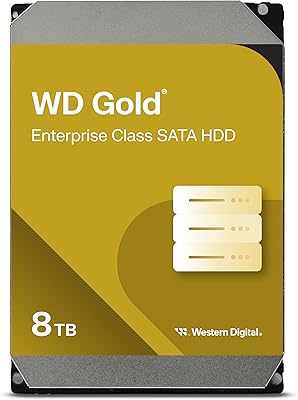
The Western Digital RE 3TB Enterprise Hard Drive belongs to a generation of workhorses built for one purpose: keeping storage running around the clock without complaint. Listed as an older model, this WD RE drive still circulates as new old-stock or refurbished inventory — and for the right buyer, that is entirely acceptable. Unlike WD's consumer Blue or even prosumer Red lines, the RE series was engineered for 24/7 datacenter operation, with stricter tolerances and firmware tuned for sustained punishment. IT managers stretching server budgets, homelab builders scaling beyond consumer NAS drives, and small businesses standing up their first proper storage array are the people who still seek this out. The 5-year limited warranty sweetens the deal, though always confirm whether that coverage comes from WD directly or the third-party seller.
Features & Benefits

At 7200 RPM with sustained sequential reads hitting 171 MB/s, this enterprise HDD holds its own for large file transfers and streaming storage workloads — think backup jobs, video surveillance archives, or bulk database reads. The SATA III interface keeps it compatible with older SATA II controllers, useful when refreshing legacy rack servers. Where this WD RE drive really pulls ahead of desktop alternatives is in its RAID-optimized firmware: error recovery timing is tuned to prevent RAID controllers from dropping a drive mid-rebuild, a failure mode that quietly haunts budget builds. The dual-processor controller and 64 MB cache sustain consistent throughput when multiple drives compete for I/O simultaneously. Layered on top is Enhanced RAFF technology, which corrects both linear and rotational vibration in real time — a genuine advantage inside densely packed multi-drive enclosures.

Best For

The WD3000FYYZ is well-matched to anyone running a TrueNAS or Unraid array where drives spin continuously and downtime is not negotiable. Synology and QNAP NAS owners who have outgrown consumer Red drives and want something built to a harder standard will find the reliability profile reassuring. IT teams refreshing storage on a tight budget using available old-stock enterprise units also fit naturally here — the 100% duty cycle rating reflects a physically different build, not just a marketing claim. Continuous-write surveillance installations are another solid match. That said, this WD RE drive is not the right pick if you need capacities above 4 TB, are building an SSD-tiered setup, or require aggressive random I/O for transactional databases. Know your workload before committing.

User Feedback

With over 800 ratings averaging 3.9 stars, the WD3000FYYZ sits in a telling spot — consistently praised by users who deployed it correctly, but a source of frustration for those who did not. Long-term RAID users frequently report years of quiet, uninterrupted service and highlight that error recovery never caused array dropouts. On the other end, a visible subset of reviewers encountered early failures within the first year, with a few receiving DOA units outright. Some of this reflects batch variance across an aging product cycle; some is simply the risk of buying older enterprise stock. Desktop users running this enterprise HDD outside RAID occasionally clashed with the firmware's aggressive error timing. Buy from a reputable source, verify seller warranty terms carefully, and factor the drive's age into your overall risk assessment.

Pros

  • RAID-optimized firmware prevents controller timeouts that routinely kill arrays built on desktop drives.
  • The 1.2 million hour MTBF rating reflects genuinely different internal tolerances compared to consumer HDDs.
  • Enhanced RAFF vibration correction keeps performance stable inside densely packed multi-drive enclosures.
  • Sustained sequential reads up to 171 MB/s handle large backup jobs and media archives without throttling.
  • SATA III interface with backward compatibility makes it easy to drop into legacy SATA II server builds.
  • The dual-processor controller helps the WD3000FYYZ maintain consistent throughput under simultaneous I/O demands.
  • Rated for 100% duty cycle — this drive was designed to spin without rest, not just tolerate it occasionally.
  • Quiet acoustic profile makes it practical in small office or homelab environments where noise matters.
  • 5-year limited warranty coverage (when sourced correctly) offers meaningful long-term protection for a storage investment.

Cons

  • 3 TB capacity is increasingly limiting for modern NAS builds where 8 TB or larger drives are standard.
  • Purchasing aging new old-stock introduces real uncertainty about how long the drive has been sitting unused.
  • Seller warranty terms vary widely — some listings do not carry genuine WD factory-backed coverage.
  • Firmware error recovery timing can cause compatibility issues when this enterprise HDD is used outside a RAID environment.
  • No SAS interface option means it cannot slot into SAS-exclusive enterprise backplanes without an adapter.
  • Early failure rates appear in a notable portion of user reviews, suggesting batch consistency issues over the product's long run.
  • Random I/O performance is limited by its spinning-disk architecture, making it a weak choice for transactional database workloads.
  • Refurbished units available online offer little transparency about prior usage hours or operational history.
  • The product is officially discontinued by the manufacturer, which means replacement units will only get harder to source over time.

Ratings

The scores below reflect our AI-powered analysis of hundreds of verified owner reviews for the Western Digital RE 3TB Enterprise Hard Drive, with spam, incentivized feedback, and bot-generated content actively filtered out before scoring. We weighted recent reviews more heavily given this drive's decade-long sales history, since purchase conditions and available stock have shifted meaningfully over time. Both the genuine strengths that keep enterprise users loyal and the real pain points that have frustrated others are transparently reflected in every category.

Long-Term Reliability
76%
24%
Users who deployed the WD3000FYYZ in proper RAID arrays and NAS enclosures frequently report multi-year runs without a single failure. Several IT administrators note drives still spinning reliably after four or five years of 24/7 operation, which is exactly the outcome the enterprise-grade MTBF specification promises.
A notable portion of reviewers — disproportionate for a drive in this class — reported failures within the first 12 to 18 months, with some receiving units that were dead on arrival. The variability across production batches makes reliability feel inconsistent rather than confidently predictable.
RAID Performance
88%
The firmware-level error recovery tuning is the standout feature for RAID users — drives stay in arrays during rebuilds instead of being dropped by the controller, which is the exact failure mode that plagues desktop drives pressed into RAID service. Homelab builders running TrueNAS or Unraid consistently call this out as a meaningful real-world advantage.
Outside of a proper RAID environment, the same firmware tuning can cause minor friction, particularly for users who plug this enterprise HDD into a desktop system and encounter unexpected error reporting behavior that standard disk utilities misread.
Sequential Throughput
83%
Sustained sequential reads up to 171 MB/s handle large workloads — full NAS backups, multi-gigabyte archive restores, and surveillance footage writes — without the throughput degradation that lighter-duty drives show under sustained load. Users running backup jobs overnight consistently report clean, uninterrupted transfer sessions.
Random I/O performance is where the spinning-platter architecture shows its age; workloads involving many small concurrent reads or writes, such as virtual machine disk images with heavy random access, will feel noticeably slower than even a mid-range SSD.
Vibration Resistance
91%
The Enhanced RAFF technology draws specific praise from users running eight-bay or larger NAS enclosures, where neighboring drive vibrations are a real source of performance degradation. In dense chassis deployments, reviewers report more consistent throughput compared to non-RAFF drives under the same conditions.
The benefit is largely invisible to users running only two or four drives in a small enclosure, where ambient vibration is minimal anyway — making this a feature whose value scales with how many drives share the chassis.
NAS Compatibility
86%
The standard SATA III interface and 3.5-inch form factor mean this WD RE drive slots into Synology, QNAP, and custom FreeNAS builds without adapter hassles. Most users report straightforward recognition by NAS operating systems without any manual configuration.
Some Synology and QNAP models display compatibility warnings for drives not on their official approved list, which can unsettle less experienced users even when the drive functions correctly. Checking the NAS manufacturer's HDD compatibility database before purchasing remains a necessary extra step.
Value for Money
67%
33%
For buyers who specifically need enterprise RAID firmware behavior and 24/7 duty cycle ratings, sourcing the WD3000FYYZ at a discount versus current enterprise alternatives represents a genuine cost saving. IT teams refreshing servers on tight budgets find the price-to-specification ratio defensible when units are in good condition.
Modern drives offering 4 TB to 6 TB at comparable or lower prices make the 3 TB capacity feel expensive per terabyte. Buyers who do not specifically need enterprise firmware are paying an enterprise premium for features a WD Red Pro would deliver more reliably and with better manufacturer support.
Acoustic Profile
84%
For a 7200 RPM enterprise drive, the WD3000FYYZ runs quieter than many buyers expect. Homelab users with NAS units in home office environments report the drive blending into background noise, with only light seek chatter audible when the enclosure is open.
It is not silent, and in a very quiet room with the enclosure nearby, periodic seek noise during active workloads is perceptible. Users who prioritize near-silent operation in living spaces would need to factor in an acoustically isolated enclosure.
Purchase Risk
51%
49%
When sourced from a reputable seller with clearly stated new old-stock provenance, buyers have reported receiving drives in genuinely unused condition with strong initial S.M.A.R.T. readings and no signs of prior operation. Due diligence at the point of purchase does reduce but not eliminate the risk.
This is where the product loses the most confidence in current buyer feedback. Aging stock with opaque storage histories, variable seller warranty terms that may not be backed by WD directly, and the inherent uncertainty of buying a discontinued drive all combine to make this a higher-risk purchase than any equivalent current-production alternative.
Warranty Coverage
58%
42%
The original 5-year limited warranty specification was genuinely strong for its era and gave enterprise buyers meaningful protection. Sellers who honor equivalent coverage in their own terms do provide some degree of assurance for buyers willing to document their purchase carefully.
With Western Digital having discontinued this model, the practical value of any warranty claim is murky at best. Several reviewers who attempted to pursue warranty service on failed units encountered difficulty, and third-party seller warranty terms vary enough that buyers cannot assume uniform protection across listings.
Legacy System Fit
89%
The backward compatibility of the SATA III interface with SATA II controllers makes this enterprise HDD a practical drop-in upgrade for aging rack servers that cannot be fully replaced. IT managers refreshing storage capacity without overhauling controllers appreciate that no adapter or firmware update is required to make it work.
In a SATA II system, the interface bandwidth ceiling means buyers will not see the full rated throughput, though in practice the drive's mechanical limits keep real-world speeds well within what SATA II can handle regardless.
Batch Consistency
47%
53%
Buyers who received units from well-stored batches report excellent initial health metrics and no early anomalies, suggesting the underlying drive design is sound when manufacturing and storage conditions were favorable.
The dispersion of failure reports across this drive's review history points to meaningful batch-to-batch variance that is difficult for any individual buyer to screen for before committing. Early DOA rates higher than expected for an enterprise product suggest quality control was not uniform across all production runs.
Heat Management
78%
22%
Operating temperatures reported by users in well-ventilated NAS enclosures sit comfortably within the drive's rated range during sustained workloads, with S.M.A.R.T. temperature readings staying stable even during long sequential transfers.
In poorly ventilated enclosures or chassis with marginal airflow, a few users noted higher-than-expected operating temperatures under continuous write load — a reasonable concern for a drive rated to run at 100% duty cycle in real installations that may not always have ideal cooling.
Capacity Relevance
53%
47%
For secondary archive tiers or supplemental array expansion in an existing setup, 3 TB is still a workable and usable amount of storage that integrates cleanly without reconfiguring an entire array.
As a primary drive choice for a new NAS or server build in the current market, 3 TB per bay feels genuinely limiting. The storage density per dollar and per watt delivered by modern 6 TB to 8 TB drives is substantially better, making this capacity a harder case to justify for fresh deployments.
Ease of Setup
87%
Physical installation is plug-and-play for anyone familiar with 3.5-inch drive bays — standard SATA power and data connectors, standard mounting holes, no proprietary accessories required. Most NAS operating systems detect and initialize the drive without any manual intervention.
Desktop users unfamiliar with enterprise firmware behavior sometimes encounter confusing error reporting during initial diagnostics, not because the drive is failing, but because its error recovery settings differ from what consumer-oriented tools expect to see.
Availability
44%
56%
Units do still appear through third-party marketplace sellers, giving buyers with specific requirements for this exact drive model some ability to source it without resorting to secondhand marketplaces entirely.
As a discontinued product, availability is unreliable and shrinking. Stock levels fluctuate without warning, seller pricing varies significantly from listing to listing, and there is no manufacturer channel ensuring a consistent supply of factory-fresh units — a structural limitation that only worsens over time.

Suitable for:

The Western Digital RE 3TB Enterprise Hard Drive was built for people who need storage that simply does not stop — and the right buyer today is still out there. Homelab enthusiasts running Proxmox, Unraid, or TrueNAS on a budget will find this WD RE drive punches well above what consumer-grade alternatives offer, especially in RAID arrays where firmware behavior under stress actually matters. Small business IT teams refreshing aging rack servers or NAS enclosures with new old-stock enterprise drives get a meaningful reliability upgrade without the complexity or cost of moving to SAS. Synology and QNAP owners who have hit the ceiling on WD Red performance and want something spec'd for 24/7 continuous operation will feel the difference in sustained workloads. Surveillance deployments and archival storage setups — where writes are constant and drive failure is disruptive — are also a natural fit for this enterprise HDD, assuming the unit sourced is genuinely new or lightly used.

Not suitable for:

Buyers chasing modern storage density should look elsewhere — 3 TB is a modest ceiling in today's market, and the WD3000FYYZ does nothing to address workloads that demand 8 TB, 12 TB, or beyond. This enterprise HDD is also a poor fit for anyone building an all-flash or SSD-tiered architecture, where spinning-disk latency and random I/O limitations become the bottleneck rather than a manageable trade-off. General desktop users or home PC builders hoping to use this as a straightforward secondary drive may run into friction: the RAID-optimized firmware has error recovery timing that can cause compatibility quirks outside of a proper RAID controller environment. Anyone purchasing without carefully vetting the seller's warranty terms faces real risk — the stated 5-year coverage may reflect a third-party seller policy rather than direct WD backing, which is a meaningfully different level of protection. Finally, buyers sensitive to the risks of aging hardware stock should be cautious: production dates on available units vary, and a drive that has sat in a warehouse for several years carries different risk than a freshly manufactured one.

Specifications

  • Storage Capacity: This drive provides 3 TB of formatted storage capacity, suitable for NAS arrays, archival workloads, and datacenter applications.
  • Form Factor: Built in the standard 3.5-inch form factor, it fits directly into desktop tower bays, rack-mount server caddies, and compatible NAS enclosures.
  • Interface: Uses a SATA III (6 Gb/s) interface and is backward-compatible with SATA II (3 Gb/s) controllers, making it viable for legacy server refreshes.
  • Spindle Speed: Operates at 7200 RPM, delivering consistent rotational performance suited to sequential read-heavy workloads and sustained data throughput.
  • Cache Buffer: Equipped with a 64 MB cache buffer, which helps smooth out burst I/O and supports sustained multi-drive array performance.
  • Transfer Rate: Achieves a maximum sustained sequential data rate of 171 MB/s, making large file transfers, backups, and media streaming efficient under continuous load.
  • MTBF Rating: Rated at 1.2 million hours Mean Time Between Failures, reflecting enterprise-grade internal tolerances significantly higher than consumer or prosumer drives.
  • Duty Cycle: Supports up to 100% duty cycle operation, meaning it is designed and warranted to run continuously without scheduled downtime or rest periods.
  • Vibration Control: Features Enhanced RAFF (Rotary Acceleration Feed Forward) technology, which uses onboard electronics to detect and correct both linear and rotational vibration in real time.
  • Drive Processor: Incorporates a dual-core drive controller that provides twice the processing headroom of single-processor designs, helping sustain throughput under simultaneous I/O demands.
  • RAID Support: Ships with firmware specifically tuned for RAID environments, including error recovery timing adjustments that prevent RAID controllers from dropping the drive during a rebuild.
  • Warranty: Covered by a 5-year limited warranty, though buyers should verify whether coverage is backed directly by Western Digital or by the third-party seller at point of purchase.
  • Model Number: The official Western Digital model number is WD3000FYYZ, part of the WD RE (RAID Edition) enterprise hard drive lineup.
  • Dimensions: Physical dimensions measure 5.8 x 4 x 1 inches (L x W x H), conforming to the standard 3.5-inch drive footprint for universal compatibility.
  • Weight: The drive weighs 1.66 pounds, consistent with standard enterprise 3.5-inch HDDs and within the operating tolerance of most NAS and server drive trays.
  • Target Environment: Designed for 24/7 deployment in datacenters, high-end NAS and SAN systems, surveillance storage arrays, and performance-oriented high-capacity storage builds.

Related Reviews
WD RE 2TB Enterprise Hard Drive
76%
74%
Long-Term Reliability
69%
Value for Money
83%
RAID Array Performance
86%
Vibration Tolerance
78%
Sequential Read/Write Speed
More
Western Digital WD4000FYYZ 4TB Enterprise Hard Drive
72%
88%
Long-Term Reliability
91%
RAID Performance
83%
Value for Money
58%
Condition on Arrival
82%
Throughput Speed
More
Western Digital WD Purple 3TB Hard Drive
76%
91%
NVR Compatibility
83%
24/7 Recording Reliability
88%
Noise & Heat Output
79%
Value for Money
86%
Multi-Camera Stream Handling
More
WD Blue 3TB Internal Hard Drive
80%
91%
Value for Money
86%
Reliability & Longevity
93%
Installation Ease
62%
Read & Write Speed
84%
Noise & Vibration
More
WD Red Plus 3TB NAS Hard Drive
78%
91%
Long-Term Reliability
93%
NAS Compatibility
87%
RAID Performance
67%
Sequential Read/Write Speed
48%
Random I/O Performance
More
Western Digital RE4 WD5003ABYX 500GB SATA2 7200rpm Enterprise Hard Drive
85%
89%
Performance in Demanding Environments
91%
Reliability and Longevity
68%
Noise Levels
88%
Data Transfer Speed
90%
Compatibility with Devices
More
Western Digital WD Gold 8TB Hard Drive
76%
83%
Reliability & Endurance
74%
Performance
88%
RAID Compatibility
81%
NAS Compatibility
78%
Noise & Vibration
More
Western Digital WD Gold 16TB Internal Hard Drive
79%
88%
Long-Term Reliability
84%
Sustained Performance
91%
Build & Engineering Quality
63%
Noise & Vibration
67%
Thermal Management
More
Western Digital 12TB WD Gold Enterprise Class Internal Hard Drive
86%
88%
Performance under Load
93%
Storage Capacity
91%
Reliability
85%
Ease of Integration
90%
Endurance for Demanding Workloads
More
Western Digital 1TB WD Gold Enterprise Class Internal Hard Drive
84%
91%
Performance Under Load
88%
Reliability for 24/7 Operation
75%
Ease of Setup
90%
Data Transfer Speed
87%
Durability and Build Quality
More

FAQ

Yes, in most cases it will. The WD3000FYYZ uses a standard SATA III interface and 3.5-inch form factor that fits virtually all NAS enclosures from Synology, QNAP, and similar brands. That said, always cross-check your specific NAS model against the manufacturer's hard drive compatibility list before purchasing, since some enclosures have firmware-level restrictions on which drives are officially supported.

Yes, SATA III drives are fully backward-compatible with SATA II controllers. You will not get the full 6 Gb/s bandwidth ceiling, but in practice the drive's sustained throughput of 171 MB/s falls comfortably within what SATA II can handle anyway, so real-world performance loss is minimal for most use cases.

It means the drive's error recovery behavior has been tuned specifically for RAID environments. Standard desktop drives are configured to spend a long time attempting to recover a bad sector before reporting an error — long enough that a RAID controller may assume the drive has failed and kick it from the array. This WD RE drive is set to report errors quickly, letting the RAID controller handle recovery itself, which prevents unnecessary drive drops and array rebuilds.

That depends entirely on the seller. The original WD factory warranty on the WD3000FYYZ was 5 years from the date of purchase, but since this is a discontinued model, Western Digital may no longer service warranty claims directly. Some sellers offer their own equivalent coverage in lieu of the manufacturer warranty. Always read the warranty terms on the specific listing you are buying from before assuming WD will handle any potential claim.

Quieter than many buyers expect from a 7200 RPM enterprise drive. Most users in homelab and small business environments report the WD3000FYYZ as unobtrusive during normal operation — seek noise during random access is audible up close but not disruptive. In a closed rack or NAS enclosure, fan noise typically dominates over drive noise anyway.

Probably not the best fit. The Western Digital RE 3TB Enterprise Hard Drive was designed with RAID arrays and 24/7 server environments in mind, and its firmware is optimized accordingly. Using it as a standalone secondary drive in a desktop is not harmful, but you would be paying an enterprise premium for features you will not actually use. A WD Blue or WD Red (for NAS) would be a more practical and cost-effective choice for that scenario.

The WD Red Pro is the more current, actively supported option and is specifically marketed for NAS use, with NASware firmware and modern capacity options. This enterprise HDD offers a harder-spec MTBF rating and more aggressive RAID firmware tuning, which appeals to users who want datacenter-grade tolerances. However, the WD Red Pro comes with an active manufacturer warranty and fresher production dates, which lowers the purchasing risk that comes with buying aging old-stock RE drives.

MTBF is a statistical reliability measure, not a prediction that any individual drive will last 1.2 million hours — no drive will. What it signals is that this class of drive was built and tested to fail at a much lower rate per hour of operation than consumer drives, which are typically rated at 600,000 to 800,000 hours MTBF. In practical terms, that means lower expected failure rates across a large fleet or over an extended continuous deployment.

It is a legitimate concern worth factoring into your decision. Hard drives can develop issues from prolonged inactivity — lubricants settle, and platters can develop stiction in extreme cases, though modern drives are fairly resilient in storage. The bigger practical risk is that you have no visibility into how the specific unit was stored, how old the manufacture date is, or how many power cycles it has already seen. If you do buy, run a full S.M.A.R.T. test and a burn-in test immediately upon receipt to catch any problems early.

For a budget-conscious build or a secondary archive tier, 3 TB per drive is workable but tight by current standards. If you are planning a multi-drive RAID array and cost per terabyte is a priority, modern 4 TB to 8 TB drives will give you considerably better storage density for the space and power consumed. That said, if you already have a compatible enclosure and can source this enterprise HDD at a compelling price, adding it to an existing array as an expansion drive is still a reasonable choice.