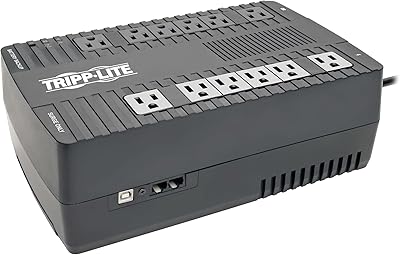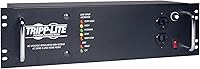
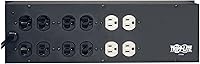
Overview

The Tripp Lite LCR2400 Line Conditioner 2400W is a serious piece of power infrastructure — the kind of rackmount unit that belongs in a real server room, AV installation, or home lab where voltage instability is a genuine concern. Its two defining strengths are automatic voltage regulation and a 2400W power capacity that handles demanding loads without flinching. Worth noting upfront: this unit has been discontinued by the manufacturer, so buyers are working with new-old-stock or refurbished units from secondary sellers. That said, it remains a well-regarded option in Tripp Lite's power protection lineup, which spans everything from basic surge strips to full UPS systems.

Features & Benefits

What makes this line conditioner genuinely useful day-to-day is how it handles voltage swings that most power strips simply ignore. Its automatic voltage regulation keeps output locked at 120V even when incoming power dips as low as 89V or climbs to 147V — a range that covers brownout-prone commercial buildings and older residential wiring alike. 1440-joule surge protection handles transient spikes, while 14 outlets split across two isolated filter banks prevent switching noise from one device bleeding into another. The 12-foot cord is a practical touch that removes the need for extension cables in most rack installations, and the 19-inch rackmount form factor slots into standard enclosures without any modification.

Best For

The LCR2400 fits a specific kind of buyer. IT professionals managing small server environments will appreciate the outlet count and stable output, especially in buildings where power quality fluctuates. Audio and video engineers who have dealt with hum, noise, or interference on recordings caused by dirty AC lines often cite clean-power conditioners like this one as a quiet fix that makes a noticeable difference. Home lab enthusiasts racking up network switches, NAS drives, and mini servers also land squarely in the target audience. It is less suited to someone who just wants basic surge protection for a desktop — at this capacity and form factor, this rackmount conditioner is built for a rack, not a desk.

User Feedback

Across roughly 91 ratings, this rackmount conditioner holds a 4.1-star average — respectable for a specialty power product — and the reviews tell a consistent story. Long-term owners praise build quality and reliability, with several noting the unit has run without issue for years in demanding rack setups. Voltage stabilization gets mentioned frequently as a tangible benefit in areas with unreliable utility power. On the negative side, the weight draws occasional complaints from solo installers, and some buyers raise fair concerns about parts availability now that the unit is discontinued. A handful of reviewers also note that this is not a UPS — no battery backup means a power outage still takes everything down, which catches a few first-time buyers off guard.

Pros

  • Automatic voltage regulation actively corrects brownouts and overvoltages rather than just surviving them.
  • Fourteen outlets across two isolated filter banks handle a full rack of gear without compromise.
  • A 1440-joule surge rating provides meaningful spike protection for expensive server and studio equipment.
  • The 12-foot power cord covers most rack installation scenarios without needing an extension.
  • Standard 19-inch rackmount dimensions drop into existing enclosures with no modifications required.
  • Tripp Lite's lifetime equipment protection policy is a genuine confidence builder for long-term owners.
  • Real-world voltage stabilization performance holds up well according to verified long-term users.
  • Two isolated filter banks prevent electrical noise from one device from affecting others on the same circuit.
  • Build quality is consistently praised across user reviews, with many units running reliably for years.

Cons

  • Discontinued by the manufacturer, meaning buyers must rely on secondary-market stock with no guarantee of condition.
  • No battery backup means a utility outage still cuts power to everything connected.
  • At 14 pounds, solo rack installation is awkward without a second set of hands or a shelf rail.
  • Parts availability is a legitimate concern for buyers who need long-term serviceability.
  • Buyers unfamiliar with the line conditioner vs. UPS distinction frequently purchase this expecting outage protection it cannot provide.
  • Secondary-market pricing can be inconsistent, making it harder to assess true value without comparison shopping.
  • No built-in display or monitoring means there is no way to verify output voltage at a glance.
  • The physical depth of 30 inches may not fit shallower rack enclosures without careful pre-purchase measurement.

Ratings

Our AI-generated scores for the Tripp Lite LCR2400 Line Conditioner 2400W were produced by analyzing verified purchaser reviews from multiple global sources, with automated filtering applied to remove incentivized, bot-generated, and duplicate submissions. The result is a transparent breakdown that reflects both the genuine strengths long-term owners consistently report and the real frustrations that have surfaced across the review pool. Nothing has been smoothed over — if a category showed mixed or weak sentiment, the score reflects that honestly.

Voltage Regulation
91%
Owners running equipment in older commercial buildings and brownout-prone areas consistently report that this is where the LCR2400 earns its keep. The automatic regulation kicks in reliably, and several long-term users note that voltage-sensitive gear — particularly audio interfaces and network equipment — has run without incident for years.
A small number of users in regions with extreme or sustained voltage instability noted that the unit occasionally could not fully compensate at the outer edges of its rated input range. No monitoring display makes it impossible to observe regulation in real time without adding an external meter.
Surge Protection
86%
The 1440-joule surge rating is meaningful protection for a rack full of expensive hardware, and buyers in areas with frequent electrical storms specifically call it out as a reason they chose this unit over cheaper alternatives. It handles transient spikes without tripping or requiring a manual reset in most reported cases.
Like all surge protectors, the joule capacity degrades with each significant strike absorbed, and there is no indicator to tell you when the protection has been compromised. Buyers relying on it as their sole line of defense after a major spike should be aware that a replacement or inspection may be warranted.
Build Quality
88%
The metal chassis and overall construction quality are among the most consistently praised aspects across the review pool. Multiple owners describe the unit as feeling solidly industrial — the kind of hardware that belongs in a real rack environment rather than a consumer strip dressed up to look professional.
A handful of reviewers purchasing refurbished or secondary-market units reported cosmetic wear and, in a few cases, concerns about internal component condition that were not detectable externally. This is less a criticism of the original build than a caution about verifying unit condition when buying discontinued stock.
Outlet Count & Layout
83%
Fourteen outlets is a genuinely useful number for a populated server or AV rack, and the split into two isolated filter banks adds practical value that a simple power strip cannot match. Users building home labs with mixed switching and analog gear specifically appreciate that they can segregate noisy devices from sensitive ones.
The physical spacing between outlets can make it awkward to fit large wall-wart style adapters side by side without blocking adjacent sockets. A few reviewers noted they could not use all 14 outlets simultaneously due to adapter size conflicts, which is a common frustration with rackmount power designs of this era.
Rack Compatibility
89%
The standard 19-inch form factor fits cleanly into the vast majority of server and AV rack enclosures without any modification, and the unit's 5.25-inch height is predictable and easy to plan around. IT professionals setting up wiring closets cite this as a zero-friction part of the installation process.
The unit's depth of roughly 19 inches can be a problem in shallower rack enclosures, particularly older or compact two-post racks where rear clearance is limited. Buyers with non-standard or shallow cabinets should measure carefully before purchasing, especially given that returns on secondary-market units can be complicated.
Installation Experience
74%
26%
For anyone with rack installation experience, mounting this conditioner is a routine task — standard hardware, predictable dimensions, and a cord long enough to reach most nearby power sources without an extension. The 12-foot cord length specifically gets positive mentions from users who have dealt with shorter cords on competing units.
At 14 pounds, solo installation in an overhead or tight rack position is genuinely awkward and can be a two-person job in practice. New home lab builders who have not racked heavy equipment before may underestimate how much the weight complicates alignment and screw insertion during mounting.
Power Capacity
85%
The 2400W capacity comfortably handles a populated rack with a server, NAS, switches, and ancillary devices without running close to its limits under normal loads. Users appreciate having headroom rather than running near the ceiling, which is a common problem with lower-capacity conditioners used in growing setups.
For very large rack deployments or high-draw servers, 2400W can become a constraint, and some buyers have had to add a second unit as their lab or server room expanded. It is sized for small-to-mid deployments, not enterprise-scale installations.
Value for Money
71%
29%
Buyers who purchased this unit at original retail pricing or close to it generally feel the protection capability justifies the cost, particularly when they factor in the value of the equipment being protected. Long-term owners who have used the unit for multiple years without incident tend to view it as having paid for itself.
Secondary-market pricing is inconsistent, and some buyers have found units listed at or above original retail despite being discontinued, which makes the value calculation harder to justify. A few reviewers felt that newer in-production alternatives now offer comparable specs with better availability and monitoring features for similar money.
Noise & Heat
81%
19%
The unit operates passively without a fan, which means it runs silently — a meaningful advantage in audio recording environments or quiet office settings where fan noise from active cooling would be disruptive. Thermal output under normal loads is reported as modest and not a concern in adequately ventilated racks.
In poorly ventilated rack enclosures or high-ambient-temperature environments, a small number of users noted the chassis runs warm under sustained heavy load. This is not unusual for passive power conditioning equipment, but it underscores the importance of maintaining adequate rack ventilation.
Discontinued Status & Availability
52%
48%
For buyers who find a verified new-old-stock unit from a reputable seller, the discontinued status is largely an abstract concern — the hardware itself has not changed, and Tripp Lite's warranty and protection policy still apply to qualifying purchases. The product's long production run means units are not especially scarce in the secondary market.
The lack of manufacturer support, no guarantee of future replacement parts, and the inability to purchase direct from Tripp Lite all represent real risks for buyers who need long-term serviceability. If a unit develops a fault outside the warranty window, repair options are limited and replacement sourcing is unpredictable.
Warranty & Support
77%
23%
The 2-year product warranty and lifetime equipment protection policy are meaningful commitments that give buyers more confidence than typical power conditioning products at this tier. Users who have engaged Tripp Lite's support describe the process as straightforward for in-warranty claims.
Because the unit is discontinued, the practical enforceability of the lifetime equipment protection policy for units purchased on the secondary market is a grey area that several reviewers flagged. Buyers should retain purchase documentation carefully and confirm eligibility with Tripp Lite before assuming full coverage applies.
Monitoring & Feedback
43%
57%
The absence of active components like fans or displays means there are fewer things that can fail over time, which some technically minded owners view as a reliability advantage in a unit intended to run continuously for years without intervention.
There is no voltage display, no protection status indicator, and no way to verify output quality without adding an external monitoring device. For buyers accustomed to UPS systems with LCD panels showing real-time power data, the complete lack of feedback can feel like flying blind — and it is a genuine functional gap in modern mixed-use rack environments.
UPS Capability
22%
78%
The unit delivers genuinely excellent power conditioning and surge protection within its intended scope, and buyers who understand from the outset that it is not a UPS tend to rate it very positively for what it actually does.
This rackmount conditioner provides zero battery backup — a hard limitation that catches a meaningful number of buyers off guard and accounts for a notable share of negative reviews. For any environment where even brief power interruptions are unacceptable, this unit must be paired with a separate UPS or replaced by one entirely.

Suitable for:

The Tripp Lite LCR2400 Line Conditioner 2400W was built for buyers who already know why clean power matters — and feel the consequences when they don't have it. IT professionals managing small server rooms or wiring closets will find the 14-outlet capacity and automatic voltage regulation genuinely useful, particularly in older commercial buildings where brownouts are a recurring headache rather than a rare event. Audio and video engineers running recording or mixing setups through a rack will also get real value here, since conditioned AC reduces the low-level hum and interference that degrades signal quality in ways that are hard to diagnose but easy to prevent. Home lab enthusiasts who have invested serious money in rackmounted networking, storage, or compute hardware are another natural fit — protecting that investment with stable, filtered power is a straightforward decision. If you operate in an area with unreliable utility power and your equipment lives in a standard 19-inch rack enclosure, this rackmount conditioner addresses exactly that problem.

Not suitable for:

The Tripp Lite LCR2400 Line Conditioner 2400W is the wrong choice for anyone expecting battery backup during a power outage — this is a conditioner and surge protector, not a UPS, and that distinction matters if uptime continuity is a hard requirement. Buyers who just need basic surge protection for a desktop workstation or home entertainment center will find the rackmount form factor impractical and the capacity overkill for their needs. Because this unit has been discontinued by the manufacturer, anyone who relies on factory-fresh stock, ongoing firmware support, or easy parts sourcing should approach with caution and verify seller reputation carefully before purchasing. The unit is also heavy enough that solo rack installation can be awkward, so single-person IT operations without proper rack-mounting tools may find setup more cumbersome than expected. Budget-conscious buyers who don't yet have a rack enclosure should factor in the total setup cost before committing.

Specifications

  • Power Capacity: The unit delivers a maximum power capacity of 2400W, suitable for handling demanding rack-mounted equipment loads.
  • Outlets: Fourteen AC outlets are distributed across two isolated filter banks to minimize electrical interference between connected devices.
  • Voltage Regulation: Automatic voltage regulation maintains a stable 120V nominal output across an input range of 89V to 147V.
  • Surge Protection: Integrated surge suppression is rated at 1440 joules, providing a substantial buffer against transient voltage spikes.
  • Amperage: The unit is rated for 20A at 120V on a single 20A circuit, compatible with standard North American commercial wiring.
  • Frequency: Designed to operate at 60Hz, matching the standard AC frequency used throughout North America.
  • Cord Length: The attached power cord measures 12 feet, offering installation flexibility within most rack enclosure environments.
  • Form Factor: Built to fit standard 19-inch rack enclosures, the unit mounts into existing server, AV, or network racks without modification.
  • Dimensions: Physical dimensions measure 19 x 7.76 x 5.25 inches, occupying a standard rack unit footprint in a typical enclosure.
  • Weight: The unit weighs 14 pounds, which should be accounted for when planning rack load capacity and installation logistics.
  • Filter Banks: Two isolated filter banks separate outlet groups to prevent switching noise or interference from crossing between connected devices.
  • Warranty: Tripp Lite covers this unit with a 2-year product warranty from the original date of purchase.
  • Equipment Policy: A lifetime equipment protection policy covers connected devices against damage attributable to a failure of the unit's protection circuitry.
  • Manufacturer: Designed and manufactured by Tripp Lite, a long-established brand in the North American power protection and infrastructure market.
  • Model Number: The official model designation is LCR2400, used to identify this specific unit within Tripp Lite's line conditioner product family.
  • Availability Status: This model has been discontinued by the manufacturer and is available only through secondary-market and new-old-stock channels.

Related Reviews
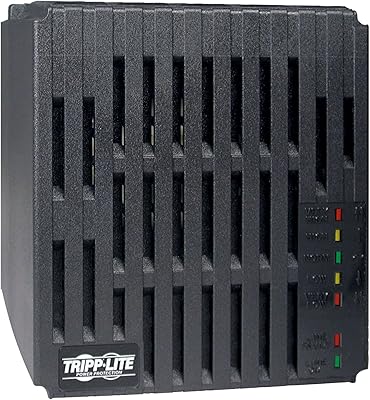
Tripp Lite LC2400 Power Conditioner
83%
93%
Voltage Regulation
88%
EMI/RFI Noise Filtering
86%
Surge Protection
91%
Build Quality
79%
Outlet Configuration
More
Tripp Lite PDUMV15 Metered PDU
86%
88%
Performance Under Load
93%
Ease of Installation
90%
Reliability and Durability
91%
Outlets and Flexibility
85%
Safety Features
More
Tripp Lite PDUMH15 Metered Rack PDU
75%
91%
Build Quality
86%
Outlet Count & Layout
68%
Load Metering
93%
Switch-Free Safety Design
82%
Mounting Flexibility
More
Tripp Lite SMART500RT1U 500VA UPS
83%
88%
Performance
91%
Surge Protection
85%
Build Quality
87%
Usability/Installation
62%
Runtime at Full Load
More
Tripp Lite PDUMH16HV Metered PDU
88%
92%
Power Distribution Performance
90%
Build Quality
88%
Ease of Integration
85%
Digital Current Meter Accuracy
89%
Rack-Mounting Compatibility
More
Tripp Lite SU1000RTXLCD2U 1000VA Rackmount UPS
79%
94%
Power Protection Quality
92%
Output Waveform Purity
58%
Battery Runtime
89%
Display & Monitoring
61%
Network Management Readiness
More
Tripp Lite PDUMV20-24 Metered PDU
79%
88%
Build Quality
84%
Metering Accuracy
61%
Outlet Count & Layout
91%
Installation & Setup
77%
Value for Money
More
Tripp Lite SmartOnline 750VA UPS SU750RTXLCD2U
86%
95%
Power Reliability
88%
Value for Money
85%
Ease of Setup
90%
Build Quality
89%
Runtime Performance
More
Tripp Lite SMX1500XLRT2U 1500VA 230V UPS
85%
91%
Battery Backup Performance
89%
Energy Efficiency (ECO Mode)
93%
Surge Protection Reliability
87%
Ease of Setup and Integration
84%
Build Quality / Durability
More
Tripp Lite SMART1500LCDT UPS Battery Backup
86%
88%
Value for Money
94%
Ease of Setup
86%
Surge Protection Performance
83%
Battery Backup Duration
90%
Voltage Regulation Reliability
More

FAQ

No, it does not. The LCR2400 is a line conditioner and surge protector, not an uninterruptible power supply. If your utility power cuts out entirely, connected devices will lose power. If outage protection is a requirement, you would need a separate UPS in addition to or instead of this unit.

Yes, assuming your rack accepts standard 19-inch equipment. The unit is designed specifically for 19-inch rack enclosures and mounts without any special hardware or modifications. Just verify your rack has enough free rack units and depth to accommodate the unit's 5.25-inch height and roughly 19-inch depth.

Voltage regulation actively corrects incoming power that is running too high or too low before it reaches your equipment. In practical terms, if your facility experiences brownouts — where voltage sags below normal — the conditioner boosts output back to a stable 120V. The same applies in reverse for overvoltages. This matters because sustained voltage irregularities can shorten the lifespan of sensitive electronics even when no dramatic spike occurs.

Tripp Lite's 2-year product warranty applies from the original date of purchase, so a unit bought new from a reputable secondary-market seller would still carry that coverage. The lifetime equipment protection policy is also tied to the product itself rather than its production status. That said, it is worth buying from a seller who can verify the unit is genuinely new or in like-new condition, since a used unit's original purchase date affects warranty calculations.

There are 14 AC outlets in total, split across two isolated filter banks. In a real rack setup, that is enough to cover a modest server, a network switch, a patch panel's power supply, a NAS, and several ancillary devices simultaneously, all within the 2400W total power budget.

Yes, and it is actually a popular choice in that application. Audio interfaces, preamplifiers, and mixing consoles are sensitive to line noise, and conditioned power can reduce low-level hum or interference that is otherwise difficult to trace. The isolated filter banks are particularly useful here, since they prevent one device's switching noise from contaminating adjacent outlets.

It means the 14 outlets are divided into two separate groups, each with its own filtering circuitry. The practical benefit is that electrical noise generated by one device — say, a switching power supply in a server — cannot travel back through the outlet strip and affect a more sensitive device on the other bank. It is a meaningful design detail for mixed-use racks.

It is not extreme, but it is heavy enough that solo installation in a rack can be awkward, especially if you are reaching overhead or working in a cramped wiring closet. Having a second person to hold the unit in position while you secure the mounting screws makes the job significantly easier. A rack shelf or rail system also helps.

The unit is rated for 20A circuits, which use a different plug style than standard 15A household outlets. You would need a 20A outlet, typically found in commercial environments, wiring closets, or dedicated circuits in newer construction. Running it through a 15A outlet adapter is not recommended and could pose a safety risk under load.

Unfortunately, this rackmount conditioner does not include a built-in voltage display or monitoring interface, so there is no visual readout of input versus output voltage. If you want to verify performance, an inexpensive plug-in power meter or voltage monitor on one of the outlets will show you what the unit is delivering. Most owners in stable environments simply trust the unit to do its job and confirm it is working by the absence of problems rather than active monitoring.

Where to Buy