

Overview

The Tripp Lite PDUMH16HV Metered Rack PDU is a professional-grade power distribution unit built for server rooms and data centers that run on higher-voltage circuits — not the kind of gear you would confuse with a consumer power strip. It handles 3.8kW at 16A single-phase and covers the full range of international voltages from 200 to 240V, which makes it equally at home in a North American colocation cage or a European data hall. At its price point, buyers reasonably expect solid construction, accurate metering, and reliable outlet density — and for regulated procurement, TAA compliance is often a hard requirement, not a nice-to-have.

Features & Benefits

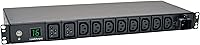
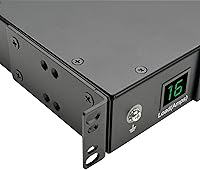
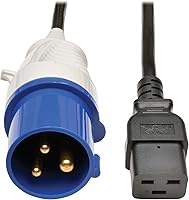
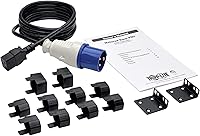
The digital current meter on the front panel is the standout practical feature here — you get a live amperage readout without logging into any software or deploying management agents. That kind of local visibility matters when you are troubleshooting a tripped breaker at 2 a.m. The outlet mix of 8 C13 and 2 C19 ports handles everything from standard 1U servers to high-draw PDUs and UPS bypass connections within the same strip. The IEC-309 16A Blue input and included 2.5-meter cord cover the most common international cabinet configurations, while the 1U horizontal form factor keeps precious rack space free for actual equipment.

Best For

This metered rack PDU is well-suited to IT administrators running small-to-midsize server racks who want load visibility without the overhead of a networked or switched PDU. It is a practical fit for colocation tenants who need to stay within their cabinet's allocated amperage and want a reliable local readout to prove it. The multi-voltage support makes the Tripp Lite unit genuinely useful for international deployments — European and Asian data centers running 230V or 220V infrastructure can deploy it without adapters. Government buyers and contractors will also appreciate that TAA compliance means it qualifies for GSA schedule purchases without procurement headaches.

User Feedback

With a 4.6-star average across nearly 300 ratings, this 16A PDU has earned consistently positive marks from professional installers and IT staff. Build quality and accuracy of the current meter come up repeatedly as strengths — buyers note it reads true and holds up well in permanent rack installations over years of continuous use. That said, a few reviewers have flagged that the 2.5-meter cord can fall short depending on cabinet layout, and anyone expecting remote monitoring or per-outlet switching will need to look elsewhere, as this unit does not offer those capabilities. On balance, most buyers feel the long-term reliability justifies the cost over cheaper, unbranded alternatives.

Pros

  • Front-panel digital meter gives a real-time amperage readout with no software or network setup required.
  • Ten outlets (8 C13 and 2 C19) handle a solid mix of standard servers and higher-draw equipment in one strip.
  • Multi-voltage support from 200 to 240V makes this 16A PDU genuinely deployable across international sites.
  • TAA compliance clears the unit for government and GSA schedule procurement without extra paperwork.
  • 1U horizontal form factor keeps rack space consumption minimal even in dense installations.
  • Tripp Lite's build quality is consistently praised by professional installers for long-term reliability.
  • IEC-309 16A Blue plug is a recognized standard in international data center environments, reducing compatibility guesswork.
  • Two-year limited warranty from an established manufacturer provides reasonable procurement confidence.
  • Installation is straightforward — rack, plug in, and read the meter; no configuration required.

Cons

  • No remote monitoring, SNMP support, or networked management of any kind — purely local metering.
  • Per-outlet switching is unavailable, so remotely rebooting a hung server requires a separate solution.
  • The 2.5-meter line cord can fall short in taller cabinets or awkwardly positioned power panels.
  • Rated for 200–240V only, which makes it incompatible with standard North American 120V rack circuits.
  • No outlet-level current monitoring — you only see total load, not which device is drawing what.
  • At this price tier, buyers might expect a longer cord or an optional cord extension in the box.
  • Limited to single-phase input, which may not suit all high-density rack configurations requiring three-phase PDUs.
  • No surge protection or filtering is built in, so upstream power quality protection falls on the facility or UPS.

Ratings

Our AI-driven scoring for the Tripp Lite PDUMH16HV Metered Rack PDU was built by analyzing verified purchaser reviews globally, with spam, bot activity, and incentivized feedback actively filtered out before any score was calculated. The ratings below reflect both the genuine strengths that keep professional IT buyers coming back and the recurring frustrations that real installers encounter in the field — nothing is glossed over.

Build Quality
91%
The metal chassis consistently draws praise from IT professionals who have racked this unit in live data center environments. Reviewers who have kept it running continuously for two or more years report no housing cracks, outlet wear, or structural issues — a meaningful endorsement for always-on infrastructure.
A small number of users noted that the outlet labeling can fade in high-heat environments over extended periods, making it slightly harder to identify ports during maintenance. Nothing structural, but worth noting for installations where frequent hot-swap activity is expected.
Metering Accuracy
88%
The front-panel digital current meter is the feature buyers most frequently call out as genuinely useful, with many noting it closely matches readings from their facility's upstream monitoring tools. For colocation tenants trying to stay under a cabinet power threshold, this level of reliability is not a minor convenience — it is operationally important.
The meter reflects aggregate load only, so users who expected outlet-level granularity have expressed disappointment. In environments where identifying which specific device is causing a load spike matters, this unit requires supplemental investigation rather than providing an immediate answer.
Outlet Configuration
84%
The combination of 8 C13 and 2 C19 receptacles works well in mixed-device racks where most gear uses standard IEC connections but a UPS or high-draw server also needs to share the strip. Several reviewers specifically noted that having the C19 ports on the same unit eliminated the need for a secondary PDU in their rack.
With only 10 total outlets, denser racks can exhaust available ports quickly, especially if the two C19 slots are already committed. Outlet spacing on the unit has also drawn occasional criticism for making it tight to fit wider power bricks side by side.
Installation Ease
89%
Reviewers across skill levels describe installation as refreshingly simple — rack the unit, connect the cord, and the meter is live with no configuration required. For IT admins managing multiple rollouts simultaneously, that zero-setup overhead is a genuine time saver compared to networked PDUs that require IP assignment and firmware updates.
The mounting hardware is functional but not exceptional, and a few users mentioned that aligning the unit solo in a tight rack required more patience than expected. Instructions are minimal, though for this type of product that is rarely a practical barrier for the intended audience.
Cord Length
63%
37%
In standard-depth cabinets where the circuit panel or floor PDU is positioned conveniently nearby, the 2.5-meter cord handles the connection without issue. Buyers in well-configured colocation environments or small network closets tend not to flag it as a concern at all.
This is the most consistently mentioned friction point in user feedback. Buyers in taller cabinets, or facilities where floor power is routed at a distance from the rack, frequently find the cord too short and need an extension or a custom-length replacement. It feels like a spec decision that prioritizes cost over real-world installation flexibility.
Value for Money
78%
22%
The majority of professional buyers conclude that the Tripp Lite unit earns its price through long-term reliability and the credibility that comes with a known brand and a 2-year warranty. In procurement contexts where a failed PDU means emergency replacement cost and downtime, paying for a proven unit makes clear financial sense.
Buyers comparing it purely on outlet count or metering capability against lower-cost alternatives sometimes feel the premium is harder to justify on paper. The value proposition leans heavily on brand trust and TAA compliance rather than any feature exclusive to this price tier.
Remote Management
31%
69%
For buyers who explicitly want a local-only metered PDU with no network attack surface, the absence of remote management is a feature rather than a gap. Some security-conscious deployments actively prefer hardware with no network-facing interface.
For anyone who needs SNMP alerting, remote outlet cycling, or integration with a DCIM platform, this unit is simply the wrong product category. Multiple reviewers who did not read the spec carefully enough discovered this limitation only after installation, which created avoidable replacement costs.
TAA Compliance
93%
Government buyers and contractors report that TAA compliance on this metered rack PDU removes a common procurement bottleneck entirely. In agencies where non-compliant products get rejected at the purchasing stage regardless of technical merit, having that designation pre-verified saves meaningful administrative time.
For private-sector buyers with no compliance obligations, TAA status is functionally invisible and contributes nothing practical to daily operation. It is a genuine differentiator only in specific procurement contexts, which means some buyers are effectively paying a premium for a feature irrelevant to them.
Voltage Compatibility
87%
Support across 200V, 220V, 230V, and 240V makes this 16A PDU a versatile choice for organizations deploying consistent hardware across multiple international facilities. IT teams managing European and Asian sites alongside domestic deployments appreciate not needing separate PDU SKUs for each region.
The high-voltage-only rating is a hard blocker for North American environments running standard 120V circuits — there is no workaround. Buyers who do not verify this upfront occasionally discover the incompatibility after purchase, which is an entirely avoidable but recurring issue in user feedback.
Long-term Reliability
92%
Multi-year owners consistently describe this metered rack PDU as a set-it-and-forget-it component in their infrastructure. Reports of units still performing accurately after three to five years of continuous operation are common, which matters significantly in environments where replacing a live PDU requires scheduled downtime.
The sample size of extremely long-term reviews is smaller than short-term feedback, so some caution is warranted in extrapolating durability claims beyond five years. No widespread patterns of premature failure emerged in the review data, but as with any power hardware, individual unit variance exists.
Rack Space Efficiency
86%
Occupying just 1U of vertical rack space while delivering 10 outlets at 3.8kW is a strong ratio for dense installations. Network closet administrators managing tight enclosures specifically call out the form factor as a practical advantage over bulkier alternatives they considered.
The horizontal 1U mounting is the only officially supported orientation, which limits flexibility for side-mount or 0U vertical installation scenarios that some rack layouts favor. Buyers looking to reclaim horizontal rack units by mounting the PDU vertically will need a different model.
Warranty & Support
79%
21%
Tripp Lite's 2-year limited warranty is backed by a brand with established customer support infrastructure, which matters to procurement teams who need to know a replacement process exists. Reviewers who needed to use the warranty generally describe the resolution experience as professional and not overly bureaucratic.
Two years is respectable but not exceptional at this price point — some competing brands at similar tiers offer three-year coverage. Buyers with long hardware refresh cycles who plan to run the unit well beyond the warranty window are ultimately relying on build quality alone after that point.

Suitable for:

The Tripp Lite PDUMH16HV Metered Rack PDU is a strong fit for IT professionals who need straightforward, reliable power distribution with local load visibility in a server rack or network closet. If you manage a small-to-midsize deployment and want to know at a glance whether you are approaching your circuit capacity, the front-panel current meter does exactly that without requiring any software, network access, or management infrastructure. Colocation tenants who must stay within cabinet power allotments will find it particularly useful, since the live amperage display makes it easy to demonstrate compliance to a facility provider. The multi-voltage input covering 200 through 240V also makes this metered rack PDU a practical choice for international deployments where a single unit needs to work across different regional power standards. Government agencies and contractors will appreciate that TAA compliance removes procurement friction for GSA schedule purchases.

Not suitable for:

Buyers who need per-outlet switching, remote power cycling, or SNMP-based monitoring should look elsewhere — the Tripp Lite PDUMH16HV Metered Rack PDU is a local-metering-only unit, and that is a hard limitation, not a gap that can be patched with accessories. If your data center strategy depends on remotely rebooting hung servers or tracking per-outlet load data through a management platform, you need a switched or networked PDU at a higher price tier. The included 2.5-meter cord may also fall short in taller cabinets or installations where the power panel is not conveniently located near the rack, which can create cable management headaches. Home lab users or small businesses hoping to save money relative to a UPS or basic power strip will likely find this unit over-specified and overpriced for their needs. And if your rack infrastructure runs on standard North American 120V circuits, this unit simply will not work — it is rated exclusively for higher-voltage 200–240V environments.

Specifications

  • Form Factor: 1U horizontal rack-mount design fits standard 19-inch equipment racks without consuming additional vertical space.
  • Power Capacity: Rated at 3.8kW maximum continuous load under single-phase operation.
  • Input Current: Accepts up to 16A single-phase input current from the facility circuit.
  • Input Voltage: Compatible with 200V, 220V, 230V, and 240V AC power environments for broad international deployment.
  • Input Connector: C20 inlet paired with an IEC-309 16A Blue plug handles the high-voltage connection to the wall or floor circuit.
  • Cord Length: Includes a 2.5-meter (approximately 8-foot) line cord for reaching facility power panels in standard cabinet configurations.
  • Total Outlets: Provides 10 output receptacles in a mixed configuration of 8 C13 and 2 C19 ports for versatile device compatibility.
  • Metering: Front-panel digital current meter displays real-time aggregate amperage draw with no software or network connection required.
  • Compliance: TAA (Trade Agreements Act) compliant, qualifying this unit for U.S. government procurement and GSA schedule purchasing.
  • Dimensions: Unit measures 10.94 x 20.47 x 3.03 inches, fitting standard 1U rack space in most professional enclosures.
  • Weight: Fully assembled unit weighs 6.5 pounds, which is typical for a metal-chassis rackmount PDU of this outlet density.
  • Warranty: Covered by a 2-year limited manufacturer warranty from Tripp Lite against defects in materials and workmanship.
  • Brand: Manufactured by Tripp Lite, a U.S.-based brand with a long track record in professional power and connectivity products.
  • Model Number: Official model identifier is PDUMH16HV, which corresponds to this specific 16A high-voltage metered variant in the Tripp Lite PDU lineup.
  • Availability: This model has been commercially available since March 2015, indicating a mature, stable product with a well-established support history.

Related Reviews

Tripp Lite PDUMV15 16-Outlet Metered PDU

78%
88%
Build Quality
91%
Outlet Density
82%
Current Metering
61%
Load Rating Clarity
84%
Cord Length
More
Tripp Lite PDUMH15 Metered Rack PDU
75%
91%
Build Quality
86%
Outlet Count & Layout
68%
Load Metering
93%
Switch-Free Safety Design
82%
Mounting Flexibility
More
Tripp Lite PDUMV20-24 Metered PDU
79%
88%
Build Quality
84%
Metering Accuracy
61%
Outlet Count & Layout
91%
Installation & Setup
77%
Value for Money
More
Tripp Lite PDUMH30HV 30A Metered Rack PDU
78%
91%
Build Quality
93%
Reliability
88%
Metering Accuracy
62%
Display Readability
89%
Outlet Layout
More
Tripp Lite RS1215-RA
83%
93%
Build Quality
91%
Outlet Layout & Accessibility
88%
Cable Management & Cord Design
84%
Power Capacity & Circuit Protection
41%
Surge & Spike Protection
More
Tripp Lite SMART2200RMXL2U 2200VA Rack Mount UPS
79%
93%
Power Protection Reliability
96%
Output Waveform Quality
88%
Build Quality
61%
Battery Runtime
91%
AVR Performance
More
Tripp Lite SMART1500LCD 1500VA Rackmount UPS
77%
91%
Voltage Regulation (AVR)
93%
Battery Replaceability
54%
Waveform Compatibility
62%
Runtime Under Load
88%
Rack Installation
More
Tripp Lite SR12UBFFD 12U Rack Enclosure Server Cabinet

84%
94%
Build Quality & Durability
76%
Ease of Setup & Installation
88%
Cooling Performance
91%
Dust Protection & Filter Effectiveness
68%
Weight & Portability
More
Tripp Lite PDU2430 24-Outlet Rack PDU
73%
88%
Build Quality
91%
Outlet Capacity
83%
Circuit Protection
22%
Power Monitoring
18%
Outlet Switching
More
Tripp Lite SR4POST 45U 4-Post Open Frame Rack
84%
94%
Build Quality & Durability
89%
Ease of Assembly
92%
Weight Capacity
90%
Airflow & Heat Dissipation
85%
Adjustability of Depth
More

FAQ

No, it will not. This unit is rated exclusively for 200–240V environments — think international data centers, colocation facilities, or any site running high-voltage single-phase circuits. Plugging it into a standard 120V North American wall outlet is not a supported use case and could damage the unit or trip the circuit.

The meter shows total aggregate current draw across all outlets — there is no per-outlet monitoring. If you need granular per-device load visibility, you would need a more advanced switched or outlet-metered PDU, which sits in a different product category and price range entirely.

It does not. The Tripp Lite PDUMH16HV Metered Rack PDU is strictly a local-metering unit — the digital display on the front panel is the only monitoring interface. There is no network port, no web UI, and no SNMP agent. If remote access or automated alerting is a requirement, look at Tripp Lite's networked PDU lineup instead.

For the majority of standard-depth cabinets where the power panel is located at the side or bottom, 2.5 meters is generally sufficient. That said, a handful of users with tall or deep cabinets, or facilities where floor PDUs or overhead busways are positioned further away, have noted it falls a bit short. If your installation has an unusual layout, measure before assuming the cord will reach.

C13 outlets are the standard receptacles you see on most 1U and 2U servers, switches, and other rack equipment — they accept C14 plugs. C19 outlets are a heavier-duty format designed for higher-draw devices like large UPS units, high-density blade servers, or some PDU-to-PDU daisy-chain scenarios — they accept C20 plugs. Having two C19 ports on the same strip means you are not forced to choose between standard gear and higher-draw equipment.

Technically it can work in a home lab if you have a proper 240V circuit, but realistically it is overkill for most home setups and the voltage requirement alone rules it out for standard residential wiring. A basic metered PDU designed for 120V environments would be a more practical and cost-effective fit for home lab use.

TAA compliance means the product was manufactured or substantially transformed in a country covered by the U.S. Trade Agreements Act. In practice, it is a procurement requirement for many U.S. federal agencies, military contracts, and GSA schedule purchases. If you are buying for a government agency or a contractor that sells to government, TAA compliance is often a non-negotiable checkbox. For private-sector buyers, it generally just signals that the product meets a higher standard of supply chain accountability.

User feedback consistently describes the meter as reliable and accurate for day-to-day load monitoring. It is not a laboratory-grade instrument, but for the purpose of staying within a circuit's safe operating range and tracking rack load trends, it performs well. Most IT professionals find the readings trustworthy enough to use as a basis for capacity planning decisions.

It is designed and rated as a 1U horizontal rack-mount unit, and that is the orientation Tripp Lite recommends for proper installation and air flow. Some users do mount similar PDUs vertically in 0U positions along the side of a cabinet, but doing so with this specific model is not an officially supported configuration and may affect readout visibility and stability.

The general consensus from long-term users is that the Tripp Lite unit is built to last in always-on environments. Multiple reviewers who have run it continuously for several years report no significant degradation in metering accuracy or outlet reliability. The metal chassis construction contributes to that durability, and the 2-year warranty provides a reasonable safety net if something does go wrong early in its service life.