Overview

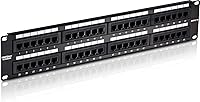
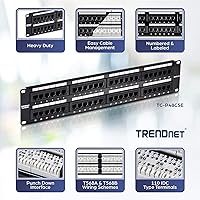
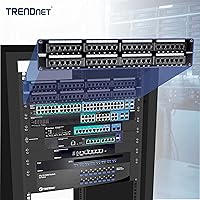
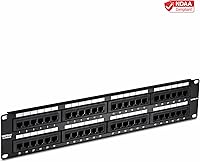
The TRENDnet TC-P48C5E 48-Port Cat5e Patch Panel has been a fixture in structured cabling installations for over two decades, and its staying power in a competitive market is not accidental. It fits a standard 19-inch rack in 2U of space, and doubles as a wall-mount option when rack infrastructure is not part of the picture. One credential worth calling out early is its NDAA compliance for U.S. and Canadian government deployments — not something every panel at this price tier can claim. That said, keep expectations grounded: this is a passive component, and throughput depends on your full cabling system, not the panel itself.
Features & Benefits

All 48 ports terminate to RJ-45 punch-down connections rated for Cat5e at 100MHz, with backward compatibility stretching back to Cat3 — useful in older buildings where not every run has been refreshed. The dual-purpose mounting design is practical: rack it in a standard 2U slot or pull it off the rails and wall-mount it if that is what your space demands. Cable management support is built in, which matters when you are feeding 48 runs into a single panel — without it, the back of the rack becomes unmanageable fast. TRENDnet also backs this Cat5e panel with a three-year warranty and English-speaking support, a reasonable assurance at this price point.

Best For

This patch panel is a natural fit for IT admins building out a server room or wiring closet on a modest budget — the kind of deployment where you need 48 organized termination points without spending on Cat6a hardware the rest of the infrastructure will not use. Government contractors working under NDAA procurement rules will find this one of the few panels at this tier that actually qualifies. It also suits schools, small offices, and anyone consolidating a building's Ethernet runs into a single rack location. One honest caveat: if you are laying new cable today and anticipate 10-Gigabit speeds down the road, Cat6 or Cat6a is the smarter long-term investment.

User Feedback

The TRENDnet 48-port panel carries a 4.4-star average, and the praise is fairly consistent: buyers appreciate the solid build quality relative to what they paid, and professional installers often note that the punch-down process is clean and port labeling is legible enough to work with quickly. Cable management support gets mixed reactions — adequate for moderate cable density, but installers running a full 48-port load sometimes wish for a more robust rear bracket. A recurring criticism in lower-star reviews involves included mounting hardware, with some buyers reporting missing or mismatched rack screws. Home-lab enthusiasts tend to be more forgiving overall, while professional installers hold it to a stricter standard — and most still find it delivers for the price.

Pros

  • Fits 48 termination points into just 2U of rack space, an efficient density for small server rooms.
  • NDAA compliant for U.S. and Canadian government and public sector network installations.
  • Backward compatible with Cat3, Cat4, and Cat5 cabling — genuinely useful in older building infrastructure.
  • Clean punch-down termination process praised by both professional installers and first-time home-lab builders.
  • Dual-purpose mounting works in a standard 19-inch rack or flat against a wall without extra adapters.
  • Three-year manufacturer warranty and English-speaking tech support are reassuring for a passive component at this price.
  • Port labeling is clear and legible enough to work through all 48 ports without losing track mid-installation.
  • The cost-per-port ratio is one of the most competitive available in the NDAA-compliant segment.

Cons

  • Rack mounting screws are frequently reported as missing or mismatched straight out of the box.
  • No punch-down tool included — a real inconvenience for first-time installers who do not own one yet.
  • Rear cable management bracket struggles to handle a full 48-port load of thicker cables cleanly.
  • The rear wiring diagram is printed too small to read comfortably in a dim wiring closet.
  • Cat5e tops out at 1Gbps, making this panel a short-term solution for anyone planning a multi-gig network upgrade.
  • Support hours are limited to standard business times, which is a problem for after-hours installation troubleshooting.
  • The front faceplate shows minor flex under firm, repeated punch-down pressure across all 48 ports in one session.
  • No write-on labeling strip included, requiring additional labeling supplies for port documentation on professional jobs.

Ratings

The TRENDnet TC-P48C5E 48-Port Cat5e Patch Panel scores below are generated by AI after analyzing verified buyer reviews from multiple global sources, with spam, bot submissions, and incentivized feedback actively filtered out. This panel has accumulated a meaningful review base across professional installers, IT administrators, and home-lab enthusiasts — enough to surface genuine patterns in both satisfaction and frustration. Strengths and recurring pain points are reflected here with equal transparency so you can make a confident, informed decision.
Build Quality
83%
Most buyers comment positively on the steel chassis, noting it feels appropriately solid for a passive panel in this price tier. Installers who have handled competing budget panels often remark that the port density does not come at the cost of flimsy plastic construction.
A subset of professional installers found the front faceplate slightly flex-prone under firm punch-down pressure across all 48 ports in one session. It is not a structural failure risk, but it is noticeable compared to higher-end panels from brands like Panduit or Leviton.
Port Labeling & Organization
79%
21%
The port numbering is printed clearly enough that most installers can work through a full 48-port termination without losing track of position, even under poor wiring closet lighting. Several reviewers appreciated having enough visual spacing between port groups to reduce errors during patching.
The labeling strip area is workable but tight — anyone using custom label inserts for zone identification may find the real estate limiting. A few buyers noted the factory labels are not write-on friendly, which adds a small step for installations that require custom port documentation.
Punch-Down Termination
86%
Termination is one of this panel's genuine strengths. The IDC contacts seat cable pairs cleanly, and users report that the process goes quickly across all 48 ports when using a proper 110-style punch-down tool. Professional installers especially praised the consistent contact tension.
The panel ships without a punch-down tool, which catches some first-time buyers off guard — you will need TRENDnet's own TC-PDT or a compatible 110-style tool. A handful of reviewers noted the printed wiring diagrams on the rear are small and harder to read without good lighting.
Cable Management
67%
33%
For moderate-density installations — say, 24 to 36 active ports — the built-in cable management support does its job and keeps runs from flopping into adjacent gear. Smaller deployments in schools or branch offices found it more than adequate for day-to-day cable routing.
Running a full 48-port load is where the rear management becomes a real constraint. Several experienced installers noted they supplemented with a separate 1U cable management bar, which adds cost and rack space. The integrated management bracket is thin and offers limited depth for thicker cable bundles.
NDAA Compliance
91%
For government contractors and public sector IT teams operating under NDAA procurement requirements in the U.S. and Canada, this compliance certification is a genuine differentiator at this price tier. Buyers in federal and municipal IT roles specifically cited it as the primary reason they chose this panel over cheaper alternatives.
NDAA compliance is only relevant for U.S. and Canadian government procurement contexts — international buyers or private-sector buyers gain nothing from this credential. The compliance also requires buyers to verify their full bill of materials independently; the panel alone does not certify an entire installation.
Value for Money
88%
At its price point, fitting 48 Cat5e-rated ports into a 2U rackmount chassis with NDAA credentials attached is a combination most competing panels cannot match without a meaningful price jump. Budget-conscious IT buyers consistently rate the cost-per-port ratio as one of the panel's strongest selling points.
Buyers who later needed Cat6 compatibility felt the savings were short-lived if a network refresh came sooner than expected. Those planning infrastructure that will support multi-gig or 10GbE switches down the line may find the Cat5e spec a cost burden rather than a saving over a two-to-three year horizon.
Mounting Flexibility
76%
24%
The dual-purpose design — rack or wall mount — gives installers genuine options in environments where a full rack is not in place yet. Small offices and schools setting up temporary or semi-permanent network closets particularly appreciated not being locked into a rack-only install.
Included mounting hardware drew criticism from a notable share of buyers, with some reporting missing or non-matching rack screws in the box. Wall mounting requires additional hardware not always included, which is a minor but frustrating gap for installers on tight job timelines.
Included Accessories
54%
46%
The panel itself arrives well-protected and in good condition according to the majority of reviewers. For buyers who already own a full toolkit from prior installations, the sparse accessories are a non-issue.
This is one of the more consistent complaint areas in lower-star reviews. Missing rack screws, absent or minimal documentation, and no punch-down tool in the box are all cited repeatedly. For a first-time installer, these gaps can cause a real delay on installation day.
Backward Compatibility
82%
18%
Support for Cat3, Cat4, and Cat5 cabling alongside Cat5e makes this panel genuinely useful in older buildings where infrastructure has been upgraded in phases. Installers working in commercial spaces built in the 1990s or early 2000s found this flexibility practically valuable.
Backward compatibility is a practical asset but also a ceiling — nothing above Cat5e is supported, so buyers in mixed environments with some Cat6 runs will need to manage two panel types or accept a Cat5e bottleneck across the board.
Port Durability
74%
26%
Under normal patch cable insertion and removal cycles, the RJ-45 ports hold up well according to multi-year users. IT admins in small server rooms who have had this panel in service for two or more years generally report no port degradation with typical use.
Heavy-rotation environments — think help desk patch bays where ports are cycled daily — have produced some early wear complaints over extended periods. This panel is better suited to semi-permanent termination points than high-churn patching scenarios.
Warranty & Support
78%
22%
Three years of manufacturer protection is above average for this product category, and buyers who contacted TRENDnet support reported mostly positive experiences with English-speaking agents who understood the technical details of structured cabling questions.
A minority of buyers found the warranty claims process slower than expected, and support hours are limited to standard business times — not ideal for IT teams dealing with installation issues during weekend or after-hours network deployments.
Rack Space Efficiency
84%
Fitting 48 termination points into 2U is genuinely efficient for small-to-medium deployments where rack space is at a premium. Network admins managing compact 12U or 18U wall-mount racks particularly valued the density this panel provides without sacrificing accessibility.
In very dense racks where every U counts, the 2U footprint competes directly with patch cable routing space above and below. Pairing this panel with active switches in a tight rack can create cable management challenges that require careful planning upfront.
Installation Experience
81%
19%
Home-lab builders and first-time structured cabling installers consistently rate the installation process as approachable, even without professional experience. The port layout is logical, and the wiring guide printed on the rear — while small — provides enough reference to complete a clean T568B termination.
Professional installers working at speed on commercial jobs found the lack of a color-coded wiring guide on each individual port a minor but real friction point. When terminating all 48 ports in one pass, any ambiguity in the rear diagram slows down the workflow.

Suitable for:

The TRENDnet TC-P48C5E 48-Port Cat5e Patch Panel is a strong fit for IT administrators managing structured cabling in small-to-medium server rooms, wiring closets, and network equipment racks where organization and port density matter more than cutting-edge specs. Schools, small businesses, and branch offices consolidating dozens of Ethernet runs into a single termination point will find the 48-port layout practical and the 2U footprint efficient. Government contractors and public sector installers in the U.S. and Canada will particularly value the NDAA compliance, which narrows the field considerably at this price tier. If your existing infrastructure runs Cat5e — or even older Cat5 or Cat4 cabling — this panel slots in cleanly without forcing an unnecessary upgrade. Home-lab builders who want a professional-grade termination panel without a professional-grade price tag will also get genuine mileage out of this one.
Not suitable for:

The TRENDnet TC-P48C5E 48-Port Cat5e Patch Panel is not the right call if you are laying fresh cable today and expect to run multi-gigabit or 10GbE speeds within the next few years — Cat5e tops out at 1Gbps under real-world conditions, and a Cat6 or Cat6a panel now will save you a full rewiring headache later. High-churn patching environments, such as help desk bays where cables are plugged and unplugged daily across dozens of ports, are better served by panels built with reinforced port contacts designed for frequent cycling. Buyers outside the U.S. and Canada will not benefit from the NDAA compliance that is one of this panel's signature credentials, so that differentiator simply disappears for international deployments. If you need shielded (STP or FTP) termination for environments with high electromagnetic interference — industrial floors, broadcast facilities, or densely cabled data centers — this unshielded panel is not engineered for that duty. Finally, anyone expecting a complete out-of-the-box installation kit will be frustrated: the included accessories are minimal, and you will need your own punch-down tool and likely your own rack screws.
Specifications

  • Model Number: The panel is manufactured by TRENDnet and carries the official model designation TC-P48C5E.
  • Port Count: It provides 48 individually numbered RJ-45 punch-down ports across the front face of the panel.
  • Cable Category: The panel is rated for Cat5e cabling at up to 100MHz, supporting Ethernet, Fast Ethernet, and Gigabit applications.
  • Backward Compatibility: It accepts terminations from older Cat3, Cat4, and Cat5 cabling, making it practical for phased infrastructure upgrades.
  • Shielding: This is an unshielded (UTP) panel and is not designed for shielded (STP or FTP) cable termination.
  • Form Factor: The panel occupies 2U of space in a standard 19-inch equipment rack.
  • Mounting Options: It supports both 19-inch rackmount and wall-mount installations, giving installers flexibility in equipment room configurations.
  • Dimensions: Physical dimensions measure 19.8 x 4.1 x 2.3 inches, keeping the footprint compact within a 2U rack slot.
  • Weight: The panel weighs 2.35 pounds, making it easy to handle during single-person rack or wall installations.
  • Connector Type: All 48 ports use a standard 110-style IDC punch-down connection on the rear for cable termination.
  • NDAA Compliance: The panel is NDAA compliant, qualifying it for use in U.S. and Canadian government and public sector network installations.
  • Compatible Tools: TRENDnet recommends the TC-PDT punch-down tool and the TC-CT68 crimp, cut, and strip tool for a complete termination workflow.
  • Cable Management: An integrated cable management bracket on the rear helps organize and route incoming cable runs behind the panel.
  • Warranty: TRENDnet covers this panel with a 3-year manufacturer protection plan backed by English-speaking technical support during business hours.
  • Wiring Standards: The panel supports both T568A and T568B wiring configurations, with a reference diagram printed on the rear of the unit.
  • Application: It is designed as a passive termination and organization component for Ethernet, Fast Ethernet, and Gigabit copper network infrastructure.
  • Brand: TRENDnet is a U.S.-based networking hardware brand that has manufactured and supported this panel continuously since its introduction in 2003.

Related Reviews
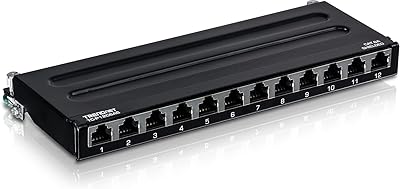
TRENDnet TC-P12C6AS 12-Port Cat6A Shielded Patch Panel
86%
89%
Build Quality
85%
Ease of Installation
91%
Shielded Design (EMI Reduction)
90%
Performance (10G Ethernet Support)
87%
Compatibility (Networking Standards)
More
Rapink 48-Port Cat6 Patch Panel
82%
93%
Value for Money
86%
Port Termination Quality
67%
Build Quality & Housing
91%
Ease of Installation
89%
Compatibility & Cable Flexibility
More
Cable Matters 48-Port 2U Keystone Patch Panel
86%
91%
Build Quality
87%
Value for Money
93%
Port Density & Rack Efficiency
88%
Cable Management
84%
Port Labeling & Documentation
More
Lysymixs 24-Port Cat6 Keystone Patch Panel
76%
88%
Ease of Installation
93%
Port Repairability
71%
Build Quality
74%
Keystone Jack Quality
86%
Mixed-Media Flexibility
More
Cable Matters 24-Port Cat6 Patch Panel
87%
91%
Ease of Installation
87%
Build Quality
68%
Cable Management
94%
PoE Support
90%
Reliability
More
Lysymixs 24 Port RJ45 Patch Panel Cat6 Feed Through
89%
91%
Ease of Installation
94%
Performance (Speed/Connectivity)
88%
Build Quality
82%
Cable Management
85%
Durability
More
Rapink 24-Port Cat6A Patch Panel with Inline Keystone
88%
94%
Setup & Installation
89%
Build Quality
91%
Performance (Network Speed)
85%
Ease of Use
87%
Compatibility with Ethernet Cables
More
Cable Matters 8-Port Mini Patch Panel
84%
91%
Ease of Installation
86%
Build Quality
58%
Port Capacity
83%
PoE & Power Delivery
88%
10G Performance
More
Lysymixs 24 Port RJ45 Patch Panel Cat7 STP Feed Through
87%
92%
Ease of Installation
88%
Build Quality
89%
Performance & Speed
85%
Cable Management
91%
Value for Money
More
keepLiNK 48-Port Gigabit PoE Switch
86%
89%
Performance
85%
Ease of Setup
91%
Build Quality
88%
Power Delivery (PoE+)
84%
Security Features
More

FAQ

Officially it is listed as including mounting hardware, but this is one of the most common complaints in user reviews — missing or mismatched rack screws show up repeatedly. It is worth having a set of standard M6 cage nuts and screws on hand before installation day, just in case.

Any quality 110-style punch-down tool will work fine with this panel. TRENDnet sells their own TC-PDT tool, which is a perfectly reasonable option, but you are not locked into their brand — any 110-blade punch-down tool from a reputable supplier will terminate the ports cleanly.

You can physically terminate Cat6 cables into it, but the panel itself is only rated to Cat5e performance at 100MHz. That means the panel becomes the limiting factor in your link — you will not get Cat6 performance out of it regardless of what cable you run. If your infrastructure is Cat6 throughout, you should really be using a Cat6-rated panel.

Yes, it carries NDAA (National Defense Authorization Act) compliance, which means it qualifies for procurement in U.S. federal and Canadian government network installations under current NDAA supply chain restrictions. This matters specifically for government contractors and public sector IT teams — if you are in private industry, the compliance designation does not change anything about how the panel functions.

Yes, it supports wall mounting directly. You will need to source appropriate hardware for your wall type, since the included hardware is oriented toward rack installation. Several buyers have successfully wall-mounted it in small offices and wiring closets where a full rack is not practical.

It occupies exactly 2U of vertical rack space and fits any standard 19-inch rack, including wall-mount enclosures rated for 19-inch equipment. Just confirm your enclosure has at least 2U of open space and the standard rail spacing.

Honestly, it is adequate for moderate-density setups — somewhere around 24 to 36 active ports — but professional installers running all 48 ports simultaneously often find the integrated management bracket too thin and shallow for the resulting cable volume. Many add a separate 1U horizontal cable manager directly below the panel when running a full load.

It fully supports Gigabit (1000BASE-T) connections — Cat5e was specifically designed with Gigabit in mind and handles it without issue. Just keep in mind that the panel is passive, so actual link speed depends on your switches, NICs, and the quality of your cable runs as a whole system.

It terminates Cat3, Cat4, and Cat5 cable just as cleanly as Cat5e. If you are working in an older building where not every run has been upgraded, the panel will accommodate the legacy cabling without any workarounds. Performance on those older runs will naturally be limited by the cable category, not the panel itself.

The practical difference comes down to speed ceiling and future-proofing. Cat5e maxes out at 1Gbps over standard distances, while Cat6 supports up to 10Gbps over shorter runs and is better positioned for multi-gig infrastructure down the road. If your current network is fully 1Gbps and you have no near-term plans to upgrade switches or NICs to multi-gig speeds, this panel does the job cleanly. If you are pulling new cable today and expect a network refresh within three to five years, spending a bit more on a Cat6 panel now is a smarter long-term decision.

Where to Buy