Overview

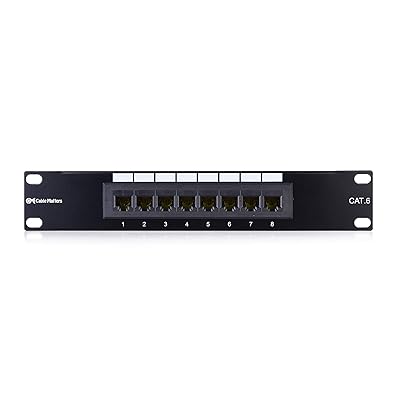
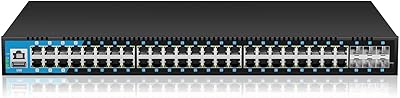
The Rapink 48-Port Cat6 Patch Panel lands in a price range that makes structured cabling accessible to anyone not running an enterprise budget. It fits a standard 19-inch rack or wall-mount enclosure without any adapter fussing, which matters when you're working inside a tight network closet. The panel handles Cat5, Cat5e, and Cat6 runs interchangeably, so mixed-cable environments are not a problem. Rapink also includes screws and zip ties in the box — a small detail, but one that saves a separate hardware store trip when you're mid-install and just want to get the job done.
Features & Benefits

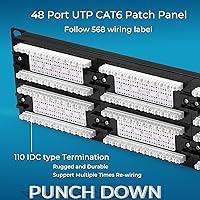
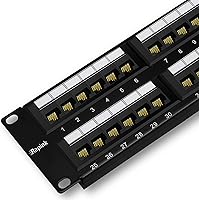
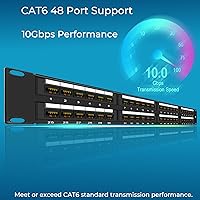
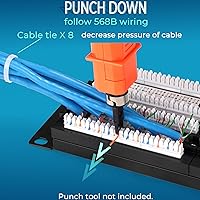
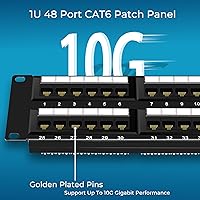
All 48 ports use gold-plated 8P8C contacts, which helps with long-term conductivity and reduces the risk of corrosion causing headaches down the road. The 568B wiring diagram is printed directly on the faceplate — genuinely useful when you're punching down solo and can't hold a reference card at the same time. At 1U tall, this network panel stays compact in crowded racks. It also supports up to 10 Gigabit speeds, though hitting that ceiling depends entirely on the rest of your cabling chain, not just the panel itself. The dual-mount design covers both rack and wall installations without modification.

Best For

This punch-down panel is a natural fit for home lab builders who've outgrown a 24-port setup and want full 48-port capacity without stepping into enterprise pricing territory. Small office IT staff will also appreciate having every run terminated in one place rather than split across multiple smaller panels. It works well for installers dealing with a mix of cable generations — Cat5 legacy runs alongside newer Cat6 drops — since everything terminates cleanly here. If you're comfortable with a punch-down tool and want a no-frills, reliable panel, this covers the fundamentals without unnecessary complexity.

User Feedback

Across more than 300 verified reviews, the 48-port panel holds a 4.6-star average, and the most consistent praise centers on value for the port count. Buyers frequently mention that terminations seat firmly and the punch-down process goes smoothly. The 568B labeling gets called out regularly as a practical time-saver, not just a spec checkbox. On the critical side, some users note the plastic housing feels lightweight compared to pricier alternatives — fair feedback, and expected at this price point. A handful of installers recommend verifying port alignment after punching down to catch any intermittent connections before buttoning up the rack.

Pros

  • Delivers 48 ports of Cat6-compatible termination capacity at a price point most competing brands cannot match.
  • Accepts Cat5, Cat5e, and Cat6 cabling in the same panel — ideal for mixed or legacy network environments.
  • 568B wiring diagram printed on the faceplate saves real time during solo punch-down work.
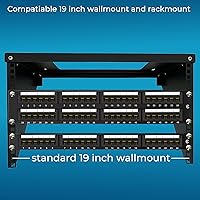
  • Fits standard 19-inch racks and wall-mount enclosures with no adapter hardware required.
  • Gold-plated contacts on all 48 ports help resist oxidation and maintain reliable conductivity over time.
  • Ships with zip ties and mounting screws, so you can start the install without a hardware store detour.
  • Consolidates 48 terminations into a single 1U panel, saving valuable rack space compared to stacking two smaller units.
  • Strong 4.6-star average across hundreds of verified reviews reflects consistent satisfaction among budget-conscious installers.
  • Ports hold terminations firmly after punch-down, reducing the chance of intermittent connections under normal use.

Cons

  • Plastic housing feels noticeably lightweight in hand — experienced installers will sense the material trade-off immediately.
  • Not rated for Cat6A, limiting compatibility for future high-speed or long-distance 10G network builds.
  • 10G support is conditional on the full cabling chain being up to spec, not guaranteed by this panel alone.
  • No punch-down tool included, which first-time buyers may not realize until they are mid-install.
  • Port labels are small and can be difficult to read in poorly lit rack enclosures without additional lighting.
  • A minority of users report needing to verify port alignment after punch-down to avoid intermittent link failures.
  • Does not include a dedicated wall-mount bracket for all enclosure types, despite wall-mount use being advertised.
  • Long-term durability data is limited given the product's relatively short time on the market.
  • Dense 48-port cable bundle requires careful management and may need supplemental cable rings in tight rack setups.

Ratings

The Rapink 48-Port Cat6 Patch Panel has been evaluated by our AI rating system after processing verified buyer reviews from multiple global markets, with spam, bot-generated, and incentivized submissions actively filtered out before scoring. The scores below reflect a balanced picture — where this punch-down panel genuinely delivers and where real installers have run into friction. Both the wins and the trade-offs are represented transparently.
Value for Money
93%
For a 48-port punch-down panel at this price point, buyers consistently feel they are getting significantly more than they paid for. Home lab builders and small office installers in particular note that comparable port counts from better-known brands cost considerably more without offering proportionally better performance for everyday structured cabling work.
A small number of buyers who expected commercial-grade durability were disappointed once the panel arrived and they handled it in person. The value proposition holds strongly for budget-conscious installs, but buyers expecting premium materials at this price point will likely reset their expectations quickly.
Port Termination Quality
86%
Most installers report that punching down cables into the ports goes smoothly, with conductors seating firmly on the first pass. The contacts hold their terminations without backing out during cable dressing, which reduces the risk of chasing down intermittent connections after the rack is closed up.
A minority of users flagged occasional alignment inconsistencies between ports, where a cable punched down cleanly but produced a weak link that only showed up during testing. Careful post-termination verification with a cable tester is advisable before finalizing any install with this panel.
Build Quality & Housing
67%
33%
The panel is solidly functional for the environments it is designed for — home closets, small server rooms, and light commercial installs. The port rows are evenly spaced and the faceplate holds up well under normal punch-down force without flexing excessively during installation.
The plastic housing is noticeably lighter than mid-range or enterprise-tier alternatives, and experienced installers will feel the difference immediately. It is not a dealbreaker for a home lab or small office, but anyone managing a high-traffic rack that takes regular physical abuse may find the chassis less reassuring over a multi-year lifespan.
Ease of Installation
91%
The 568B wiring diagram printed directly on the panel face is one of the most consistently praised practical details. Solo installers working without a second set of hands do not need to tape a reference card to the rack or keep pulling up a diagram on their phone — the layout is right there at eye level throughout the job.
The panel does not include a punch-down tool, which is standard practice in this price tier but worth noting for first-time buyers who may not already own one. A few reviewers also noted that the port labels are relatively small and can be hard to read in dimly lit rack enclosures without a flashlight.
Compatibility & Cable Flexibility
89%
Accepting Cat5, Cat5e, and Cat6 runs in the same panel is genuinely useful in real-world installs where older cable generations are still in the walls. Upgraders expanding an existing network do not need to re-run every drop before the panel becomes usable, which saves both time and money during transitions.
The panel is not rated for Cat6A, which limits future-proofing for anyone planning to push 10G over longer distances or through more demanding channel configurations. Buyers building a network from scratch with long-term 10G goals should factor this ceiling into their planning before committing.
10G Speed Support
74%
26%
The gold-plated contacts and Cat6-rated termination points do provide a credible foundation for 10G links over short distances when the rest of the cabling chain is up to spec. For home lab users running short patch runs between switches and servers, the panel does not appear to be the bottleneck.
10G throughput depends entirely on the full channel — the patch cables, the runs in the wall, and the equipment on each end — not just this panel in isolation. Buyers should not treat 10G support as a guaranteed outcome; it is a ceiling the panel can theoretically support, not a performance it delivers on its own.
Rack & Wall Mount Versatility
88%
Fitting standard 19-inch racks and wall-mount enclosures without any adapter hardware is a straightforward but genuinely appreciated feature. Installers switching between a wall-mount bracket setup and a traditional rack mid-project do not need to source alternative mounting hardware, which keeps the job moving.
The included mounting screws cover basic rack installation, but the panel does not ship with a dedicated wall-mount bracket in all configurations. A few buyers noted they needed to source additional hardware for specific enclosure types, which was mildly inconvenient given that wall-mount use is advertised on the packaging.
Contact & Pin Quality
82%
18%
Gold-plated 8P8C contacts across all 48 ports help guard against the oxidation and conductivity degradation that can develop on bare copper contacts over time, especially in environments with humidity fluctuations. Long-term installers appreciate this detail as a quiet quality indicator that often separates reliable panels from those that develop connection issues after a year or two.
Gold plating at this price tier is typically a thin flash coating rather than a heavy deposit, so the corrosion resistance benefit, while real, should not be overstated. In harsh or industrial environments, the contacts may not hold up as long as those on more robustly constructed alternatives.
Cable Management
79%
21%
Including zip ties in the box is a small but practical touch that most competing panels at this price skip entirely. Being able to start dressing and bundling cables immediately after termination, without a separate trip to find hardware, keeps the workflow clean and the rack tidy from the first install.
The zip tie anchors integrated into the panel are functional but limited in number, which can feel constraining when managing 48 active ports with heavy bundles of incoming cable. Installers running dense, fully populated panels often supplement with additional cable management rings or a dedicated 1U manager above or below the panel.
Label Clarity & Port Identification
76%
24%
Port numbering is printed clearly enough for normal lighting conditions, and the sequential layout makes it straightforward to map physical ports to patch cables and network documentation. For small installs where every port matters, the labeling does its job without requiring custom label tape on day one.
The factory labels are not designed to be written on or covered easily, which creates friction for installers who use custom port labeling schemes. In a fully populated 48-port panel, keeping track of which port connects to which room or device can require additional labeling solutions that the panel itself does not provide.
Packaging & Unboxing
81%
19%
The panel arrives adequately protected and the included accessories — screws and zip ties — are bagged and accounted for in every unit. There are no reports of ports arriving damaged or misaligned due to shipping, which matters for a product with 48 individual termination points that would be tedious to inspect one by one.
The packaging is functional rather than refined, and some buyers note it does not inspire confidence before the panel is actually tested. This is a cosmetic concern rather than a practical one, but buyers ordering for a client-facing install where unboxing perception matters may want to set expectations accordingly.
Scalability vs. Smaller Panels
84%
Consolidating 48 ports into a single 1U panel rather than running two 24-port units saves a rack unit of space and reduces the number of individual mounting points to manage. For anyone who has dealt with the cable chaos of stacking multiple smaller panels, having a single organized termination point is a real workflow improvement.
A fully populated 48-port panel generates a dense incoming cable bundle that requires more careful management than two smaller panels with cables split across two separate zones. Installers with limited rack depth or tight cable routing paths may find the single dense bundle harder to dress neatly than a split configuration.
Long-Term Reliability
71%
29%
Early feedback from buyers who have had the panel in service for over a year is generally positive, with no widespread reports of port failures or degrading connections under normal home lab or small office traffic loads. For low-to-moderate density installs, the panel appears to hold up without requiring re-termination.
There is limited long-term data given the product's age, and the lighter plastic construction raises reasonable questions about how the panel will hold up in environments with significant physical activity around the rack. Buyers planning a permanent install in a production environment may want to factor in a longer replacement cycle than they would with a more robustly built panel.

Suitable for:

The Rapink 48-Port Cat6 Patch Panel is a strong pick for home lab enthusiasts, DIY networkers, and small office IT staff who need serious port capacity without serious spending. If you are upgrading from a 24-port setup and want to consolidate everything into a single, tidy 1U panel, this network panel handles that transition without requiring a rewire — it accepts Cat5, Cat5e, and Cat6 runs interchangeably, which is a genuine advantage in environments where the cabling history is mixed. Solo installers will find the on-panel 568B wiring diagram a practical aid, reducing the back-and-forth of referencing an external diagram mid-job. It fits any standard 19-inch rack or wall-mount enclosure straight out of the box, and the included screws and zip ties mean you can start the install without a separate hardware run. For anyone building a clean, organized network closet on a realistic budget, this punch-down panel hits the right balance of capacity and cost.
Not suitable for:

The Rapink 48-Port Cat6 Patch Panel is not the right choice for production environments that demand enterprise-grade durability or panels that will take regular physical abuse over many years. The plastic housing, while functional, is noticeably lighter than commercial-tier alternatives, and installers managing high-traffic data closets in schools, hospitals, or busy offices may find it underwhelming under sustained heavy use. This network panel is also not rated for Cat6A, which rules it out for anyone planning long-distance 10G runs or building a network infrastructure designed to last well into the next cabling generation. Buyers who need to meet strict commercial cabling standards or structured wiring certifications should look at panels with verifiable compliance documentation, which this panel does not prominently provide. If your install requires a punchdown panel that will go unserviced for a decade in a demanding environment, investing in a more robustly built option from an established commercial cabling brand is worth the extra cost.
Specifications

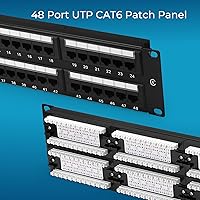
  • Port Count: The panel provides 48 individual RJ45 punch-down ports arranged across a single 1U faceplate.
  • Form Factor: It is a 1U panel measuring 19″ in width, compatible with standard 19-inch rack and wall-mount enclosures.
  • Package Dimensions: The packaged unit measures 19.96 x 6.81 x 2.48 inches and weighs 2.98 pounds including accessories.
  • Cable Compatibility: The panel supports Cat5, Cat5e, and Cat6 unshielded twisted-pair cabling through its punch-down termination blocks.
  • Max Speed: When used with a compliant Cat6 cabling channel, the panel supports Ethernet speeds up to 10 Gigabits per second.
  • Contact Material: All 48 ports feature gold-plated 8P8C contacts designed to resist oxidation and maintain stable conductivity over time.
  • Wiring Standard: The panel is labeled with the 568B wiring scheme directly on the faceplate for quick reference during termination.
  • Connector Type: Each of the 48 ports uses an RJ45 connector interface on the front and a punch-down block on the rear.
  • Mount Type: The panel supports both rackmount and wall-mount installation in any standard 19-inch enclosure or open-frame rack.
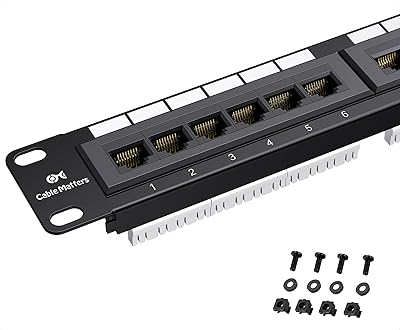
  • Included Accessories: The package includes mounting screws and zip tie wraps to assist with cable dressing and rack installation.
  • Model Number: The manufacturer model number for this panel is C6PP-PUNCH48.
  • Brand: This panel is manufactured and sold under the Rapink brand.
  • Housing Material: The panel body is constructed from plastic, keeping the overall unit lightweight at under 3 pounds.
  • Rack Height: The panel occupies exactly 1U of vertical rack space, making it one of the most space-efficient 48-port options available.
  • Cabling Type: This is an unshielded twisted-pair panel and is not designed for shielded or Cat6A cabling installations.

Related Reviews
Cable Matters 48-Port 2U Keystone Patch Panel
86%
91%
Build Quality
87%
Value for Money
93%
Port Density & Rack Efficiency
88%
Cable Management
84%
Port Labeling & Documentation
More
Lysymixs 24-Port Cat6 Keystone Patch Panel
76%
88%
Ease of Installation
93%
Port Repairability
71%
Build Quality
74%
Keystone Jack Quality
86%
Mixed-Media Flexibility
More
Cable Matters 24-Port Cat6 Patch Panel
87%
91%
Ease of Installation
87%
Build Quality
68%
Cable Management
94%
PoE Support
90%
Reliability
More
Lysymixs 24 Port RJ45 Patch Panel Cat6 Feed Through
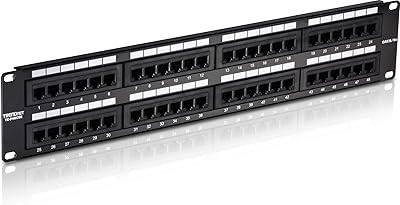
89%
91%
Ease of Installation
94%
Performance (Speed/Connectivity)
88%
Build Quality
82%
Cable Management
85%
Durability
More
TRENDnet TC-P48C5E 48-Port Cat5e Patch Panel
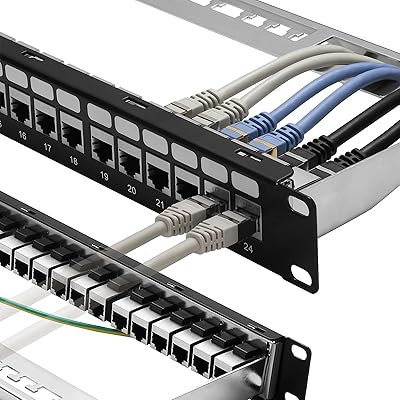
79%
83%
Build Quality
79%
Port Labeling & Organization
86%
Punch-Down Termination
67%
Cable Management
91%
NDAA Compliance
More
Rapink 24-Port Cat6A Patch Panel with Inline Keystone
88%
94%
Setup & Installation
89%
Build Quality
91%
Performance (Network Speed)
85%
Ease of Use
87%
Compatibility with Ethernet Cables
More
Cable Matters 8-Port Mini Patch Panel
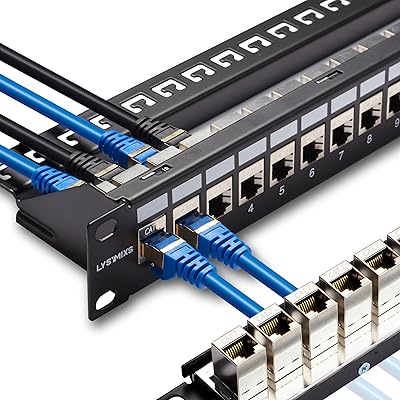
84%
91%
Ease of Installation
86%
Build Quality
58%
Port Capacity
83%
PoE & Power Delivery
88%
10G Performance
More
Lysymixs 24 Port RJ45 Patch Panel Cat7 STP Feed Through
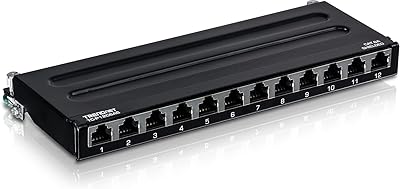
87%
92%
Ease of Installation
88%
Build Quality
89%
Performance & Speed
85%
Cable Management
91%
Value for Money
More
TRENDnet TC-P12C6AS 12-Port Cat6A Shielded Patch Panel
86%
89%
Build Quality
85%
Ease of Installation
91%
Shielded Design (EMI Reduction)
90%
Performance (10G Ethernet Support)
87%
Compatibility (Networking Standards)
More
YuanLey YS4802GS-P8 48-Port Gigabit PoE Switch
79%
91%
Value for Money
93%
Ease of Installation
84%
PoE Performance
86%
Build Quality
52%
Fan Noise
More

FAQ

Yes, you will need a standard punch-down tool, typically one that accepts both 110 and 66-style blades. The panel itself does not include a tool, so if you are new to structured cabling, pick up an inexpensive punch-down tool before starting. Most electricians and network installers already have one in their kit.

No, this punch-down panel is rated for Cat5, Cat5e, and Cat6 only. Cat6A requires a different termination standard and shielding that this panel does not support. If you are planning a Cat6A install for extended 10G runs, you will need a panel specifically designed for that cable type.

The panel is designed to support 10G Ethernet, but whether you actually achieve those speeds depends on your entire cabling channel — the patch cables, the in-wall runs, the switch ports, and the NIC cards on each end all need to be up to spec. The panel itself will not be the bottleneck in a properly built Cat6 channel over short distances, but it alone cannot guarantee 10G performance.

Yes, the 48-port panel is designed to fit any standard 19-inch rack or wall-mount enclosure without modification or adapter hardware. Mounting screws are included in the box, so you can bolt it directly into an open rack or enclosed cabinet right away.

No, patch cables are not included. The panel handles the punch-down termination side of your structured cabling — you will need to purchase short patch cables separately to connect from the front ports to your switch.

The 568B wiring diagram is printed directly on the panel body, right next to the punch-down blocks. For most residential and commercial installs, 568B is the standard you want to follow. Just make sure both ends of each run use the same scheme — mixing 568A on one end with 568B on the other will give you a crossover cable, not a straight-through connection.

The panel is built around a plastic body, which keeps it lightweight but does mean it feels less substantial than commercial-grade alternatives. For a home lab, small office, or low-traffic network closet, it holds up fine under normal use. If your environment involves heavy daily physical activity around the rack, you may want to consider a metal-chassis panel for long-term peace of mind.

Absolutely, and this is good practice with any patch panel regardless of brand. A basic cable tester run on each terminated port before closing up the rack takes only a few minutes and can save hours of troubleshooting later. A handful of users have noted occasional port alignment issues, so testing upfront is the best way to catch any weak terminations early.

Yes, the panel is designed for both rackmount and wall-mount installations. As long as you have a standard 19-inch wall-mount bracket or enclosure, it will fit. Just make sure the bracket you are using has proper depth clearance behind the panel for the terminated cable runs, since 48 ports generate a fairly dense bundle of cable at the rear.

Not for this panel — it handles Cat5, Cat5e, and Cat6 in the same unit without issue. Each port terminates whichever cable type you feed it, so you do not need to separate runs by cable generation. Just keep in mind that the maximum speed of any individual link will be limited by the lowest-rated component in that specific run, so a Cat5e run will not magically perform like Cat6 just because the panel supports it.