Overview

The Tenergy T101 Emergency Hand Crank Weather Radio is a compact, multi-function preparedness device that punches well above its mid-range price in a category full of flimsy, single-purpose tools. Certified by CE, PSE, and RoHS standards, and backed by a California-based support team, it carries genuine credibility — something that matters when you're buying something you hope never to need. With over 1,100 ratings averaging 4.5 stars, buyers clearly trust it. It's built for people who want one reliable device covering communication, lighting, and emergency signaling without hauling a bag full of separate gadgets into a crisis situation.
Features & Benefits

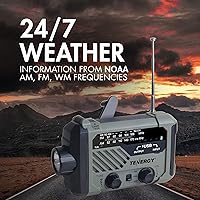
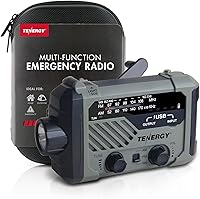
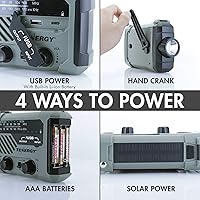
What sets this emergency radio apart is the redundancy in its power system. You can charge the internal 2000mAh battery via USB, top it off with the solar panel on a sunny windowsill, or crank it by hand when everything else fails — with AAA batteries as a final backstop. It covers AM, FM, and all NOAA weather frequencies for real-time storm alerts. Two LED lights handle different jobs: a 120-lumen flashlight for navigating in the dark, and a 100-lumen reading light for sustained use. The built-in battery also outputs 5V to charge a phone, which becomes critical the moment your outlets go dead.

Best For

This preparedness device makes the most sense for households in storm-prone regions building out a proper emergency kit, as well as campers and hikers who want weather alerts and backup lighting without adding much weight to their pack. It also makes a genuinely thoughtful gift — buyers frequently pick it up for elderly parents who want something simple to operate without a learning curve. If your goal is a single device that handles communication, lighting, and phone charging in one compact package, it fits cleanly. Those chasing strong FM fidelity or fast phone charging should look elsewhere — this is a survival tool, not a consumer audio device.

User Feedback

Across hundreds of verified purchases, owners consistently highlight ease of operation, the peace of mind from having multiple power backups, and the 14-hour radio runtime — which stands out as longer than many rivals at this price. The hand crank earns specific praise as a dependable last resort. On the critical side, some buyers note the solar panel charges slowly in anything less than direct sunlight, and the USB output won't fast-charge a modern smartphone. A handful of dedicated radio enthusiasts mention that AM and FM reception is adequate but not exceptional against single-purpose units. Still, for staying informed during an outage, most owners consider it money well spent.

Pros

  • Four independent power sources mean you are almost never left without options, even days into an outage.
  • The 14-hour radio battery runtime is genuinely strong for this device category and price tier.
  • NOAA weather band coverage works reliably and is the core feature that most buyers depend on in a real storm.
  • At under 10 oz, this emergency radio fits in a glove box, a backpack side pocket, or a bedside drawer without any compromise.
  • The 120-lumen flashlight is bright enough to handle a real power outage, not just a token glow.
  • Simple controls and clear labeling make it accessible to users of all ages, including those who rarely handle electronics.
  • CE, PSE, and RoHS certifications add meaningful credibility in a category crowded with uncertified off-brand devices.
  • The built-in battery doubling as a phone charger eliminates the need to pack a separate power bank in an emergency kit.
  • The SOS siren and Morse code light flash provide a genuine safety layer for solo hikers and outdoor travelers.
  • Buyers consistently report solid build quality with no mechanical failures under normal storage and occasional use conditions.

Cons

  • The solar panel charges too slowly to be a practical primary power source in anything less than direct outdoor sunlight.
  • USB output at 5V 1A will frustrate anyone expecting to meaningfully recharge a modern smartphone in a hurry.
  • AM and FM reception is adequate at best; weak-signal areas will require frequent antenna repositioning to hold a stable station.
  • Extended hand cranking is physically tiring and generates charge slowly — it is a backup, not a real charging solution.
  • No water resistance rating is a notable omission for a device marketed toward outdoor and disaster-preparedness use cases.
  • The flashlight produces a wide flood beam rather than a focused throw, limiting its usefulness for distance visibility outdoors.
  • Running the radio and flashlight simultaneously shortens the battery life noticeably faster than the individual runtime figures suggest.
  • The included AAA batteries and charging cable are functional but basic, and will likely be replaced by regular users within months.
  • Button sequencing for switching between light modes is not intuitive in total darkness before you have memorized the layout.
  • Brand recognition is limited compared to established names in the emergency radio space, which gives some buyers pause before committing.

Ratings

The scores below were generated by AI after analyzing thousands of verified global reviews for the Tenergy T101 Emergency Hand Crank Weather Radio, with spam, bot-submitted, and incentivized feedback actively filtered out. Each category reflects the full spectrum of real buyer experiences — from the aspects owners consistently praise to the friction points that surface across multiple independent reviewers. Nothing has been softened or inflated.

Power Source Versatility
92%
Owners repeatedly highlight how reassuring it is to have four independent ways to keep this device running — crank, solar, USB, and AAA batteries. In real outage scenarios, that redundancy is exactly what separates a useful emergency tool from one that fails you when the power is out for three days straight.
The solar input is slow and highly dependent on direct sunlight, which limits its practical utility in overcast climates or indoor settings. A few buyers expected faster solar replenishment and were caught off guard by how long full solar charging actually takes.
NOAA Weather Alert Reception
88%
Coverage of all NOAA weather frequencies is the core reason most buyers pick this device, and it delivers reliably. Users in hurricane-prone states and tornado alley frequently note that tuning into live weather alerts during active storms was fast and the audio was clear enough to understand urgent broadcasts without straining.
Reception quality drops noticeably in areas with weak signal coverage or when the antenna is not fully extended and positioned correctly. This is not unique to this device, but first-time emergency radio buyers occasionally find the tuning less intuitive than expected.
Hand Crank Charging
84%
The hand crank is consistently cited as the feature that gives buyers genuine peace of mind. Knowing you can generate power from zero infrastructure — no grid, no sun, no spare batteries — makes this feel like a true last-resort tool rather than a marketing checkbox.
Sustained cranking to meaningfully charge the battery takes real effort and time, which can be fatiguing in a stressful situation. Several reviewers noted it works best as a short-term power bridge rather than a primary charging method, and expectations should be set accordingly.
LED Flashlight Performance
83%
At 120 lumens, the main flashlight is bright enough to navigate a darkened home or illuminate a campsite path without blinding everyone nearby. Users who have used it during actual power outages say it handled the job confidently for hours without the battery draining noticeably.
While 120 lumens is respectable for an emergency multi-tool, dedicated flashlight users will find it underwhelming for tasks requiring a tight, long-distance beam. The light spread is broad rather than focused, which suits indoor use better than outdoor terrain navigation.
USB Phone Charging
67%
33%
Having the ability to charge a phone directly from the built-in battery during an outage is a genuinely useful feature that many competing devices in this category skip entirely. Owners appreciate being able to send a check-in message or look up evacuation routes even when the grid is down.
The 5V 1A output is slow by modern standards, and buyers with newer smartphones expecting quick-charge speeds will be frustrated. It is better understood as a trickle-charge backup to get a phone from 5% to 30% in an emergency rather than a full refueling solution.
Build Quality & Durability
79%
21%
Most buyers describe the construction as sturdy and well-assembled for the price tier, with no reports of the crank mechanism breaking under normal use. The device feels dense and solid in hand, which contributes to the confidence buyers want from emergency gear sitting on a shelf for months at a time.
The plastic housing, while functional, does not feel particularly rugged against drops or heavy outdoor abuse. A few users who stored it in a vehicle reported minor cosmetic wear, and it lacks any IP water resistance rating — a meaningful gap for a device meant for disaster scenarios.
AM/FM Radio Quality
63%
37%
For casual listening during a calm power outage or a camping trip, the AM and FM reception is serviceable and covers a reasonable range of local stations. Buyers who primarily use it for NOAA alerts — which is the intended primary use — rarely raise any complaints about radio performance.
Against standalone radios even at a lower price point, the AM and FM sensitivity is noticeably weaker. Dedicated radio enthusiasts or buyers in rural areas with fewer strong signals report the need to reposition the antenna frequently to hold a stable station, which gets annoying quickly.
SOS Alarm & Signaling
81%
19%
The 85dB siren is loud enough to attract attention in an outdoor emergency, and the Morse code SOS light flash adds a layer of versatility that most buyers genuinely appreciate even if they hope to never use it. Hikers and campers mention this as a meaningful safety net when heading into low-service terrain.
At 85dB the alarm is effective at short range but may not cut through ambient outdoor noise at significant distances. There is no way to adjust the volume, and in an enclosed space the siren can be uncomfortably loud with no modulation.
Portability & Size
91%
Weighing under 10 oz and fitting easily in a side pocket of most backpacks or emergency kits, this is one area where the device genuinely excels without compromise. Multiple buyers mention keeping one in a car glove box and another in their home kit precisely because the size makes duplication easy.
The compact dimensions mean the hand crank folds into a relatively small lever, which reduces torque and makes extended cranking harder on the wrist than larger models. It is a direct trade-off between portability and ergonomic cranking comfort.
Ease of Use
89%
Buyers who purchased this device as a gift for elderly relatives specifically call out how simple the controls are to understand without reading a manual. Clear labeling, intuitive button placement, and a no-fuss tuning mechanism make it accessible to users of all technical comfort levels during high-stress moments.
The reading light and flashlight share controls that can be slightly confusing in the dark before you have memorized the button sequence. A small number of first-time users report accidentally cycling through modes when they just wanted to turn the flashlight on quickly.
Battery Life
86%
The 14-hour radio runtime on a full internal charge is a genuine differentiator that buyers mention repeatedly in positive reviews. For a multi-day outage situation, being able to run continuous weather updates through a full night and into the next day without recharging is exactly the performance this category demands.
LED runtime of 7 to 10 hours is adequate but shorter than some competing devices at similar price points. Running both the flashlight and radio simultaneously drains the battery noticeably faster, so buyers should plan around prioritizing one function at a time during extended emergencies.
Value for Money
87%
Relative to the number of functions packed into the device — radio, lighting, phone charging, SOS signaling, and quad-mode power — buyers broadly agree the price represents fair value. Most reviewers note they compared alternatives and found comparable feature sets costing noticeably more.
If a buyer only needs a basic NOAA radio and does not care about the charging and lighting features, there are simpler, lighter options available for less. The value calculation depends entirely on how many of the bundled functions a buyer actually intends to use.
Solar Panel Effectiveness
51%
49%
On a clear, sunny day with the panel facing direct sunlight, the solar charging does top up the battery slowly and provides a self-sufficient option that requires no external infrastructure whatsoever. For buyers in sunny climates who store the device near a window, it works as a slow maintenance charger.
In practice, the solar panel is the weakest link in the power system and should not be relied upon as a primary charging method. Overcast skies, partial shade, or indoor artificial lighting renders it nearly ineffective, and several buyers have flagged that it performs far below their initial expectations.
Included Accessories
73%
27%
The inclusion of AAA batteries and a charging cable out of the box means buyers can test and use the device immediately without a separate accessory run. For a gift purchase especially, having everything ready in the box is a detail that earns consistent appreciation.
The charging cable is a basic micro-USB type and the AAA batteries included are standard alkaline with no brand indication, so long-term users will replace them quickly. A carrying pouch or wrist strap would improve the package meaningfully for outdoor-focused buyers.
Brand Trust & Support
78%
22%
Tenergy's California-based customer support team and multi-certification status — CE, PSE, and RoHS — provide measurable credibility in a category where off-brand devices with no certifications are common. Buyers who have contacted support generally report responsive and helpful service.
Tenergy is not a household name in the emergency radio space, and some buyers note a period of hesitation before purchasing due to limited brand recognition. Warranty documentation could be clearer, and a few users were unsure of the exact terms of the stated lifetime support offering.

Suitable for:

The Tenergy T101 Emergency Hand Crank Weather Radio is the kind of device that earns its place in a household long before anyone actually needs it. It makes the most sense for families in hurricane corridors, tornado-prone states, or earthquake zones who want a single, reliable tool that covers communication, lighting, and basic phone charging without requiring wall power. Campers and weekend hikers will also find real value here — tuning into live NOAA weather alerts before a storm rolls in is exactly the kind of low-effort, high-value safety habit this device supports. It is particularly well-suited as a gift for elderly relatives or anyone who wants straightforward, no-fuss operation; the controls are simple enough to use under stress without consulting a manual. Anyone building out a 72-hour emergency kit who wants to consolidate gear rather than carry separate flashlights, radios, and power banks will appreciate how much ground this single compact device covers.
Not suitable for:

The Tenergy T101 Emergency Hand Crank Weather Radio is genuinely not the right pick for buyers who prioritize any one of its functions at an enthusiast level. If you want a serious AM/FM radio with strong reception in rural or low-signal areas, a dedicated single-purpose radio will outperform it without question — this is a preparedness multi-tool, and radio sensitivity reflects that compromise. Buyers expecting to charge a modern smartphone quickly via the USB output will be disappointed; the 1A output is a trickle by current standards, barely adequate for an emergency top-up rather than a meaningful charge cycle. The solar panel, while a genuine feature, is practically useless in overcast conditions or indoors, so anyone assuming solar will serve as a reliable daily charging method needs to recalibrate expectations. Finally, buyers who need a device that can handle rough outdoor conditions — drops, rain, dusty environments — should note there is no water or impact resistance rating, which is a real gap for serious backcountry use.
Specifications

  • Dimensions: The device measures 155 x 94 x 49 mm (approximately 6.1″ x 1.93″ x 3.7″), making it compact enough to fit in a standard go-bag side pocket.
  • Weight: At 275g (9.7 oz), the unit is light enough to carry without adding meaningful burden to an emergency kit or backpack.
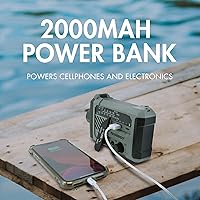
  • Built-in Battery: A 3.7V 2000mAh lithium-ion rechargeable battery is built into the unit and also functions as a USB power bank for external devices.
  • Radio Bands: Receives AM (522–1710 kHz), FM (87–108 MHz), and all seven NOAA weather alert frequencies (162.400–162.550 MHz).
  • Radio Runtime: The built-in battery supports approximately 14 hours of continuous radio playback on a full charge.
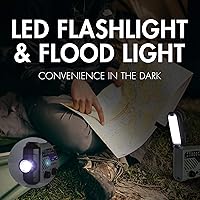
  • LED Flashlight: The primary flashlight outputs 120 lumens and is designed for navigation and general-purpose illumination during power outages.
  • Reading Light: A secondary LED reading light outputs 100 lumens, intended for sustained close-range use such as reading maps or manuals.
  • LED Runtime: Combined LED lighting functions run for approximately 7 to 10 hours per full charge depending on brightness mode and usage pattern.
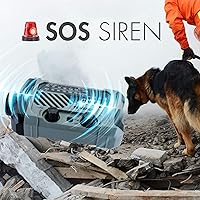
  • SOS Siren: The built-in SOS siren reaches 85dB and accompanies a flashing Morse code SOS light pattern for dual-mode emergency signaling.
  • USB Output: The device outputs 5V at 1A via USB, sufficient for trickle-charging smartphones and small electronics when grid power is unavailable.
  • USB Input: The internal battery recharges via USB input at 5V and 1.2A using the included charging cable.
  • Power Sources: Four independent power inputs are supported: hand crank generation, solar panel absorption, USB charging, and AAA alkaline battery backup.
  • Solar Panel: An integrated solar panel provides passive charging capability in direct sunlight, best suited as a supplemental rather than primary power source.
  • Operating Temp: The unit is rated for use between -10°C and 50°C (14°F to 122°F), covering most real-world emergency and outdoor conditions.
  • Certifications: The device carries CE, PSE, and RoHS certifications, confirming compliance with international electrical safety and hazardous materials standards.
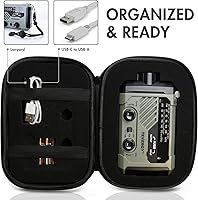
  • Included Items: Each unit ships with AAA batteries, a USB charging cable, and an owner's manual — everything needed for immediate out-of-box use.
  • Model Number: The official model designation is T101, manufactured by Tenergy, a brand with customer support operations based in California.
  • Water Resistance: No official IP water or dust resistance rating is listed for this device, so it should be kept away from rain and moisture during use.
  • SOS Light: In addition to the audible siren, the SOS light flashes the internationally recognized Morse code distress signal to attract visual attention.
  • Warranty & Support: Tenergy offers lifetime customer support for this product through a team based in California, though specific warranty terms should be confirmed directly with the manufacturer.

Related Reviews
ZZMICHP 16000mAh Hand Crank Emergency Weather Radio
85%
92%
Battery Life & Power
87%
Ease of Use
68%
Portability & Size
85%
Durability & Build Quality
90%
Radio Performance
More
Rckskaya Condor 1 Emergency Hand Crank Radio
73%
88%
Power Source Versatility
72%
NOAA Weather Reception
83%
Flashlight Performance
67%
Phone Charging Capability
79%
SOS Alarm & Signaling
More
AXYEBI AB-US-107Y Emergency Weather Radio
75%
91%
Value for Money
82%
NOAA Signal Reception
88%
Flashlight Performance
63%
Build Quality & Durability
67%
Hand Crank Usability
More
RunningSnail Emergency Crank Weather Radio
72%
88%
Value for Money
84%
Power Redundancy
91%
Built-in Cables
73%
NOAA Reception Quality
62%
Battery Capacity
More
Pristar Hand Crank 10000mAh Emergency Weather Radio
71%
83%
Value for Money
76%
Build Quality
52%
Hand Crank Performance
78%
NOAA Reception
47%
Solar Charging
More
Givoust MD-107R Hand Crank Emergency Weather Radio
75%
83%
NOAA Reception Quality
78%
Battery Life
81%
Charging Versatility
57%
Hand Crank Efficiency
66%
Build Quality & Durability
More
DexScout Crank Emergency Weather Radio 10000mAh
86%
91%
Value for Money
88%
Battery Life and Charging
94%
Portability & Size
85%
Weather Alert Accuracy
90%
Build Quality and Durability
More
Esky 10000mAh Emergency Hand Crank Radio
73%
91%
Value for Money
84%
Radio Reception
72%
Battery Performance
47%
Hand Crank Charging
53%
Solar Panel Efficiency
More
GIDEZH H27 30000mAh Emergency Weather Radio
75%
82%
Battery Capacity
86%
NOAA Reception Quality
78%
Charging Versatility
88%
All-in-One Convenience
74%
Flashlight Performance
More
KAYINOW DF-580B Hand Crank Emergency Radio
88%
89%
Battery Performance
91%
Build Quality
87%
Portability
95%
Power Sources Flexibility
82%
Sound Quality
More

FAQ

Yes, but go in with realistic expectations. The USB output runs at 5V and 1A, which is on the slower side by modern standards. You are not going to fully charge a recent flagship smartphone, but you can get a dead phone to 20 or 30 percent — enough to make a call or send a message — which is exactly what matters in a crisis.

Quite a while, honestly. Hand cranking is best thought of as an emergency top-up rather than a full recharge method. A few minutes of cranking can give you enough power for a short radio session or a brief flashlight burst, but charging the full 2000mAh battery entirely by crank would take sustained effort over a long period. Use it to bridge the gap, not as your main charging strategy.

Very slowly, if at all. The solar panel needs direct sunlight to charge at any meaningful rate. Indirect indoor light through a window produces minimal charge. If you are in a sunny climate and can place the device outside or on a south-facing sill on a clear day, it will trickle charge over several hours. In overcast or indoor conditions, lean on USB or the crank instead.

It is one of the better starting points in this category. The controls are clearly labeled and the device does not require any complicated setup or programming. You tune it like a traditional radio, the flashlight turns on with a simple button press, and the power sources are self-explanatory. Multiple buyers have specifically noted gifting it to parents or grandparents who are not comfortable with technology, and the feedback on usability is consistently positive.

You need to tune manually to one of the NOAA weather frequencies — there is no automatic alert activation on this model. The seven NOAA weather channels are accessible directly, so it is a quick process to find the active broadcast for your area, but it does require you to turn the device on and tune in rather than having it wake itself up when an alert is issued.

At 85dB it is genuinely loud — roughly equivalent to a busy road or a loud vacuum cleaner. In an open outdoor environment it should attract attention at a reasonable distance. In an enclosed room it is uncomfortably loud, which is actually a feature in a distress situation. There is no volume adjustment, so it is full volume or nothing.

No, it carries no water resistance or IP rating. Using it in rain or leaving it exposed to moisture is a real risk. For an emergency radio, this is a meaningful limitation to be aware of — if you plan to use it outdoors during a storm, keep it sheltered or in a zip-lock bag when not actively in use.

The main flashlight at 120 lumens is brighter and produces a wider flood beam suited for moving around in the dark. The reading light at 100 lumens is slightly softer and better aimed for close-range sustained tasks like reading a map, looking through a first-aid kit, or checking notes. In practice both are useful, and having two distinct modes means you are not burning through battery on maximum brightness when a gentler light will do.

That is one of the key design intentions, and the quad-power system helps here. For long-term shelf storage, the internal lithium-ion battery will slowly self-discharge over months, so topping it up via USB once or twice a year is a good habit. The AAA backup batteries provide a separate insurance layer that does not depend on the internal battery staying charged. Most owners report the device performs reliably after months of inactivity when they follow basic maintenance charging.

It handles everyday listening passably well in areas with strong local signals, but it was not designed to compete with a quality tabletop or portable radio. In urban areas with plenty of nearby transmitters you will get clean, stable reception. In rural or fringe-signal areas you may need to reposition the antenna regularly to hold a station. If casual daily radio listening is your primary goal, a dedicated radio will serve you better. For emergency weather monitoring, the NOAA reception is solid and that is where this device truly earns its place.

Where to Buy