Overview

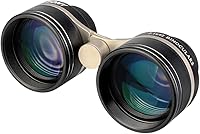
The SVBONY SV407 2.1x42mm Astronomy Binoculars are built around a concept most buyers don't immediately expect: low magnification is actually an advantage for stargazing. While typical binoculars run 8x to 10x, that narrow field makes constellation-hunting feel like searching through a keyhole. These wide-angle astronomy binoculars flip that logic — at 2.1x, you're scanning massive swaths of sky with both eyes open, taking in whole star fields at once. The rubber-armored, IPX6 waterproof build makes them genuinely suited to cold, damp nights outdoors. Just set expectations correctly: the SV407 is not a telescope substitute. It's a sky-touring companion.
Features & Benefits

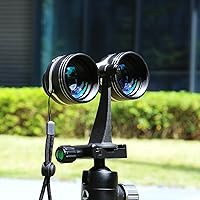
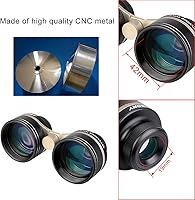
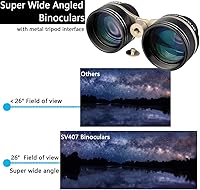
The 26° field of view is the headline feature here, and it genuinely stands out — most standard binoculars offer 6° to 8°, so this is an entirely different optical experience. The BAK4 prisms paired with fully multi-coated lenses push more light through to your eyes, and that 19mm exit pupil is enormous by any standard, which really matters under dark skies. The fixed-focus design is worth explaining: there's no focusing ring to fiddle with in the dark. Everything from one meter to infinity stays sharp, by deliberate design. Pair that with the 2-inch filter thread on the objective, and experienced stargazers can add light-pollution filters without any adapters.

Best For

This stargazing binocular is an ideal first optical instrument for someone stepping beyond naked-eye observation. If you've ever stood under a clear sky wanting to see Orion or the Pleiades just a little more vividly — without hauling out a telescope — this is precisely what you need. Dark-sky travelers will appreciate the weatherproof build and compact weight on hiking trips or remote camping. At star parties, the SV407 works brilliantly as a wide-field complement to a telescope, letting you sweep the Milky Way between eyepiece sessions. It also doubles reasonably well for indoor venue use — theaters and concert halls — where low magnification is perfectly adequate.

User Feedback

Across roughly 100 ratings, these wide-angle astronomy binoculars hold a 4.3-star average, and the pattern in reviews is fairly consistent. Buyers who understood what they were purchasing — wide-field sky scanning, not planetary detail — tend to be genuinely impressed by how immersive the view feels and how effortless the no-focus design is on a dark night. Build quality earns regular praise too. The most common frustration comes from buyers who expected more magnification and felt underwhelmed. A handful of reviewers with eyeglasses noted the eye relief is not especially generous. Performance under rural dark skies draws noticeably warmer comments than suburban use, which is worth keeping in mind.

Pros

  • A 26-degree field of view lets you frame entire constellations in a single look — genuinely rare at this price.
  • The fixed-focus design means zero fumbling in the dark; raise them to your eyes and you are observing instantly.
  • The 19mm exit pupil is exceptional for light gathering, making stars noticeably brighter under dark skies.
  • IPX6 waterproofing holds up on cold, damp outdoor nights without extra protection needed.
  • At 375g, the SV407 is light enough for extended handheld sessions without arm or neck fatigue.
  • FMC-coated BAK4 prisms keep bright stars clean and point-like, with minimal internal glare or blooming.
  • The 2-inch standard filter thread lets experienced observers add light-pollution filters without any adapters.
  • Compact enough to slip into a travel bag — a practical dark-sky companion for camping or remote site visits.
  • Virtually no setup or learning curve makes this a strong first optical instrument for astronomy beginners.

Cons

  • Eyeglass wearers may lose a significant portion of the field of view due to limited eye relief.
  • Performance drops noticeably in light-polluted urban or suburban skies — dark-sky access matters a lot here.
  • The lack of a conventional focus wheel confuses some buyers who mistake the fixed-focus design for a defect.
  • At 2.1x, no meaningful detail is visible on the Moon, planets, or individual deep-sky objects.
  • Edge sharpness softens slightly at the extreme periphery of the ultra-wide field, noticeable under scrutiny.
  • The included accessories — case and strap — were described by several buyers as basic and underwhelming.
  • The hinge tension can feel slightly loose out of the box, requiring manual adjustment to hold interpupillary distance.
  • Documentation is sparse; new users often need to seek external guidance to understand the eyepiece focusing system.

Ratings

The SVBONY SV407 2.1x42mm Astronomy Binoculars have been evaluated by our AI system after processing verified purchase reviews from buyers worldwide, with spam, bot-submitted, and incentivized feedback actively filtered out before scoring. The ratings below reflect a genuinely balanced picture — where these wide-angle astronomy binoculars punch above their weight class, and where real buyers ran into frustration. Both sides are represented without softening the edges.
Field of View
94%
The 26-degree field of view is the single most praised aspect across all verified reviews. Buyers describe the experience of sweeping across the Milky Way or framing the entire Orion constellation in one glance as genuinely surprising — nothing in this price range comes close to matching it for wide-sky immersion.
A small number of reviewers noted slight edge softening at the very periphery of the field, which is common with extreme wide-angle designs. For purely central viewing this is a non-issue, but perfectionists who scrutinize the full frame may notice it.
Light Gathering & Optical Brightness
88%
The 19mm exit pupil is unusually large, and buyers who used the SV407 at genuinely dark rural sites reported noticeably brighter star images than expected. The FMC coating on BAK4 prisms adds meaningful contrast, making fainter stars visible that the naked eye completely misses.
Under suburban or light-polluted skies, the brightness advantage shrinks considerably. A few reviewers in urban areas felt the optical performance was ordinary, not realizing the design depends heavily on ambient darkness to show its full capability.
Ease of Use
91%
The fixed-focus system is a genuine convenience win at night — there is nothing to adjust, no knobs to fumble with in the dark, and no hunting for focus on a moving target. Buyers consistently describe picking these up and being ready to observe within seconds, which matters a lot during cold outdoor sessions.
The fixed-focus design confused a portion of buyers who assumed the lack of a central focus wheel meant the unit was defective. This is a documentation and expectation problem more than an optical one, but it does generate unnecessary return attempts and negative reviews.
Build Quality & Durability
83%
The rubber-armored body feels solid in hand and inspires confidence for outdoor use. Buyers who took the SV407 on camping trips or to damp, cold observing sessions reported no issues with fogging, water ingress, or grip slippage — the IPX6 rating appears to hold up in practical conditions.
A handful of reviewers noted the hinge tension felt slightly loose out of the box, requiring minor adjustment for interpupillary distance to stay set. Nothing structural failed, but the refinement level does not quite match premium optical brands at higher price points.
Magnification Suitability
76%
24%
For its intended purpose — wide constellation scanning and naked-eye sky enhancement — 2.1x is the right magnification. Buyers who understood this upfront were consistently satisfied, describing it as seeing the sky the way your eyes should see it but rarely do.
This is the most polarizing spec in the review pool. Buyers expecting standard 8x or 10x binocular performance felt misled, and some gave low ratings purely because objects did not appear zoomed in. The low magnification is a feature, not a flaw, but it is poorly self-explanatory on a retail listing.
Portability & Weight
89%
At 375g the SV407 is light enough to wear around the neck for an entire star party without discomfort. Travelers mention fitting it easily into a carry-on bag alongside other gear, and its compact footprint means it does not dominate a backpack the way larger astronomical instruments do.
There is no included neck strap reported by some buyers, and the carrying case — where included — was described as basic. For long handheld sessions without support, arm fatigue still sets in eventually, particularly if you are scanning overhead.
Optical Coating Quality
81%
19%
The fully multi-coated lenses produce visibly less internal glare than entry-level single-coated alternatives, and buyers note that bright stars stay clean points rather than blooming into halos. This matters especially when scanning near the Moon or toward brighter regions of the Milky Way.
Some reviewers who compared the SV407 directly against higher-end astronomical binoculars noted a slight warmth or color shift in star color rendering. It is subtle and unlikely to bother casual users, but astrophotographers or color-sensitive observers may find it worth noting.
Filter Thread Utility
77%
23%
The inclusion of a standard 2-inch filter thread on the objective lens is an uncommon and genuinely useful feature at this price. Experienced observers who own light-pollution or UHC filters appreciated being able to slot them in without adapters, extending the SV407's usefulness in compromised skies.
This feature is largely irrelevant to beginners, who make up a significant portion of buyers and rarely own compatible filters. It adds perceived value on paper without translating to a practical benefit for the majority of the user base.
Eye Relief & Eyeglass Compatibility
63%
37%
For observers without eyeglasses, the viewing experience is comfortable and relaxed at normal eye-to-eyepiece distance. The wide field of view does not require precise positioning for most users, and casual observers rarely report discomfort during typical session lengths.
Eyeglass wearers reported a noticeably reduced effective field of view and some vignetting when wearing corrective lenses. The eye relief is not generous by design, which is a real limitation for a portion of buyers — particularly older stargazers who rely on glasses full-time.
Value for Money
82%
18%
For buyers who match the right use case — constellation touring, dark-sky trips, star parties — the SV407 represents strong value. The optical specifications, waterproofing, and filter thread would command a higher price under a premium brand name, and verified buyers in this camp consistently rate it favorably on cost-to-performance grounds.
Buyers who purchased expecting standard binocular utility and found the 2.1x magnification limiting tend to rate value poorly regardless of price paid. A meaningful share of dissatisfied reviews trace back to mismatched expectations rather than product failure, which muddies the true value picture.
Performance in Dark Sky Conditions
87%
Reviews from buyers at Bortle 1 to 3 sites are disproportionately positive — the SV407 genuinely rewards a dark sky. Users describe being able to trace the full arc of the Milky Way, pick out the Andromeda galaxy without hunting, and see background star density in familiar constellations that they had never noticed before.
The performance gap between dark and suburban skies is steep. Buyers in light-polluted areas get a noticeably less impressive experience, and a few described the SV407 as underwhelming when used from a city backyard — a setting where higher magnification might have felt more rewarding.
Setup & Learning Curve
86%
There is almost no setup involved — adjust the interpupillary distance, raise them to your eyes, and you are observing. Beginners in particular appreciated not having to learn collimation, focus adjustment, or eyepiece mechanics before their first session under the stars.
The eyepiece focusing mechanism, used for very close subjects inside the 1-meter minimum, was confusing for a subset of buyers who expected a conventional center-focus wheel. The included instructions were described as sparse, and some users needed to find external guidance before understanding the design.
Versatility Beyond Astronomy
59%
41%
A modest number of buyers found the SV407 worked reasonably well in mid-sized theaters and concert halls, where the wide view and low magnification allowed comfortable scanning of a stage without over-zooming. The fixed-focus also means no adjustments between acts.
For birdwatching, nature observation, or sports events — where identifying detail at distance is essential — 2.1x is simply too low to be practical. Buyers who needed a true all-purpose binocular found this a poor fit, and several mentioned they would not recommend it outside of astronomy or large-venue use.

Suitable for:

The SVBONY SV407 2.1x42mm Astronomy Binoculars are purpose-built for a specific kind of sky observer — one who wants to sweep across broad star fields, trace constellation outlines in a single glance, and experience the night sky with far more richness than the naked eye alone delivers. Beginners stepping into astronomy for the first time will find the fixed-focus, no-setup design genuinely welcoming; there is nothing to calibrate, nothing to collimate, and no learning curve before your first session under the stars. Travelers who make a point of visiting dark-sky reserves, national parks, or remote camping sites will appreciate how little space the SV407 takes up in a bag and how its IPX6 waterproofing holds up on cold, damp nights. Regular star-party attendees who already own a telescope will find these a natural complement — something to sweep the Milky Way with between eyepiece sessions rather than constantly re-pointing a mount. Even buyers with no astronomy ambitions at all can get reasonable use from them in mid-sized theaters or concert halls, where the wide view and instant focus make casual use easy.
Not suitable for:

Anyone expecting the SVBONY SV407 2.1x42mm Astronomy Binoculars to behave like a standard 8x or 10x pair will be disappointed — and that disappointment shows up clearly in the lower-end reviews. If your goal is to resolve lunar craters, split double stars, study planetary detail, or closely examine individual deep-sky objects, 2.1x magnification will not get you there; a proper telescope or high-power binocular is what you actually need. Birdwatchers, sports fans, and anyone who needs to identify fine detail at a distance will find this optic completely impractical for those tasks. Eyeglass wearers should be aware that the eye relief is not generous, and the full 26-degree field of view may not be accessible with corrective lenses on, which is a real drawback for that segment of buyers. Finally, observers based in light-polluted suburban or urban areas may find the experience underwhelming — this instrument genuinely rewards a dark sky, and without one, the wide-field advantage shrinks considerably.
Specifications

  • Magnification: The optic delivers 2.1x magnification, intentionally low to maximize field of view for wide-sky astronomical observation.
  • Objective Diameter: Each objective lens measures 42mm in diameter, allowing a substantial amount of light to enter the optical system.
  • Field of View: The angular field of view spans 26 degrees, enabling full constellation framing within a single stationary view.
  • Exit Pupil: The exit pupil diameter is 19mm, which is exceptionally large and supports strong light transmission directly into the observer's eyes.
  • Prism Type: BAK4 borosilicate glass prisms are used internally, a higher-grade material that reduces light scatter and improves edge-to-edge clarity.
  • Lens Coating: All optical surfaces feature fully multi-coated (FMC) treatment to maximize light transmission and minimize internal reflections.
  • Focus System: The SV407 uses a fixed-focus design with no central focus wheel, keeping everything from 1 meter to infinity in acceptable focus at all times.
  • Min. Focus Distance: The minimum usable focus distance is 1 meter, below which subjects will appear noticeably soft.
  • Filter Thread: Each objective lens barrel features a standard 2-inch (48mm) filter thread for direct compatibility with astronomical filters.
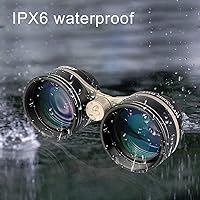
  • Waterproofing: The body carries an IPX6 waterproof rating, meaning it can withstand strong water jets and sustained outdoor exposure without water ingress.
  • Weight: The complete unit weighs 375g (13.2 oz), light enough for extended handheld use during outdoor observing sessions.
  • Dimensions: Overall body dimensions measure 6.3 x 5.51 x 3.15 inches, making it compact enough to fit in most day bags or large jacket pockets.
  • Body Material: The exterior is finished in rubber armoring, providing a secure grip in cold or damp conditions and protecting against minor impacts.
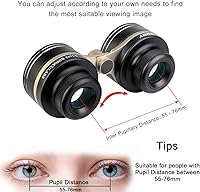
  • Interpupillary Adj.: The central hinge allows the eyepiece barrels to be adjusted for interpupillary distance to suit individual users.
  • Primary Use: Designed specifically for wide-field astronomical viewing — constellation touring, star-field scanning, and Milky Way observation.
  • Secondary Use: The low magnification and fixed focus also make the SV407 usable for large indoor venues such as theaters and concert halls.
  • Target User: Intended for adult users, including beginners and casual astronomy enthusiasts who prioritize simplicity and portability.
  • Brand: Manufactured and sold by SVBONY, a brand specializing in entry-to-mid-range astronomical and outdoor optical instruments.

Related Reviews

SVBONY SV605 Binocular Compound Microscope
85%
90%
Value for Money
88%
Ease of Setup
85%
Build Quality
89%
Optical Performance
91%
Illumination System
More
Bushnell Powerview 2 8x21 Binoculars
74%
93%
Portability & Compact Design
81%
Build Quality & Durability
74%
Optical Clarity
58%
Low-Light Performance
52%
Eye Relief & Eyeglass Compatibility
More
Celestron Cometron 7x50 Binoculars
81%
73%
Optical Clarity
84%
Light Gathering
89%
Field of View
71%
Build Quality
91%
Value for Money
More
Celestron SkyMaster 15x70 Astronomy Binoculars
83%
92%
Optical Performance
88%
Build Quality
91%
Value for Money
78%
Ease of Use
75%
Weight & Portability
More
dockteck DH0002 M.2 NVMe/SATA SSD Enclosure
84%
88%
Transfer Speed (NVMe)
76%
SATA Drive Performance
83%
Build Quality
93%
Ease of Setup
79%
Thermal Management
More
Waxness Spa Choice Natural Honey Gel Hard Wax Beads 2.2 lb / 1 kg Pack of 2
85%
88%
Effectiveness for Coarse Hair Removal
91%
Gentleness on Sensitive Skin
84%
Ease of Use and Application
75%
Texture Consistency
90%
Pack Size and Value for Money
More
Nécessaire The Hand Cream, 2.2 fl oz
89%
91%
Hydration Effectiveness
94%
Absorption Speed
93%
Non-Greasy Formula
89%
Skin Sensitivity Compatibility
87%
Fragrance-Free Quality
More
adidas Moves for Her 2 Piece Gift Set, 2.5oz
86%
87%
Fragrance Longevity
91%
Scent Freshness
92%
Value for Money
80%
Packaging Design
88%
Compact & Travel-Friendly Size
More
BolAAzuL 2-Port HDMI 2.1 KVM Switch
84%
91%
Value for Money
94%
Video Quality
88%
Ease of Setup
85%
Build Quality
80%
Usability and Controls
More
ELAC Debut 2.0 B5.2 Bookshelf Speakers
82%
93%
Sound Quality
71%
Bass Performance
89%
Treble Clarity
88%
Soundstage & Imaging
84%
Build Quality
More

FAQ

It is low by conventional binocular standards, and that is entirely the point. The SVBONY SV407 2.1x42mm Astronomy Binoculars are designed for wide-field sky scanning, not zooming in on individual objects. At 2.1x with a 26-degree field of view, you can see entire constellations at once — something impossible with 8x or 10x binoculars. Think of it less as zooming in and more as giving your eyes a serious brightness and field upgrade over naked-eye viewing.
It is not defective at all; the fixed-focus design is intentional. The SV407 uses a long depth-of-field optical system that keeps everything from about 1 meter to infinity in focus simultaneously, so there is nothing to adjust. This is actually a significant advantage at night — no fumbling for a knob in the dark. If stars still look blurry, the more likely culprit is interpupillary distance not being set correctly for your eyes.

Honestly, not well. At 2.1x magnification, distant subjects will appear only slightly larger than they do with the naked eye, which is nowhere near enough detail for identifying birds or following sports action. These wide-angle astronomy binoculars are specialized for sky use. If you need a general-purpose pair, a standard 8x42 binocular would serve those activities far better.

They will work mechanically, but light pollution significantly reduces the experience. The wide field and large exit pupil are most impressive under genuinely dark skies where faint stars are visible. From a typical suburban backyard, brighter constellations still look lovely, but you will miss a lot of the sky richness that makes these special. If you can get to a dark-sky site even occasionally, the difference is dramatic.

Probably not the full 26 degrees. The eye relief on these stargazing binoculars is not particularly generous, which is a common trade-off with wide-angle eyepiece designs. Eyeglass wearers typically see a reduced effective field with some vignetting around the edges. If your prescription is mild enough that you can observe comfortably without glasses, that is generally the better approach with these.

Yes — that is one of the more useful features on this instrument. The objective lenses have standard 2-inch filter threads, so you can screw on compatible broadband or narrowband light-pollution filters directly without any adapters. This is not common at this price point and makes the SV407 more versatile for observers in moderately compromised skies.

You can see them, but do not expect much detail. At 2.1x, the Moon appears about twice as large as it does to your naked eye, which looks nice but shows very little surface detail. Planets remain essentially point-like. For serious lunar or planetary observation, you need a telescope or a high-powered binocular in the 15x to 25x range. The SV407 is the wrong tool for that job.

They are rated and sized for adults, but older teenagers with enough patience for a sky-scanning activity would manage fine. Younger children may struggle with setting the interpupillary distance correctly and holding the unit steady for long enough. The fixed-focus design does remove one complexity, but the wide, heavy eyepieces can be awkward for small faces. As a shared family astronomy instrument for older users, they work well.

Based on buyer feedback, it performs reliably in the conditions most observers encounter — rain showers, heavy dew, and cold humid nights. IPX6 means protection against strong water jets from any direction, which covers virtually every realistic outdoor astronomy scenario short of submersion. There are no reports of fogging or water ingress during normal outdoor sessions, which is reassuring for use in coastal or high-humidity environments.

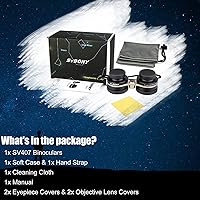
Typically the box includes the binoculars themselves, lens caps for the objectives and eyepieces, a basic carrying case, and a cleaning cloth. Some buyers noted the accessories feel fairly minimal for the price — the case in particular is functional but not padded or premium. If you plan to travel with these regularly, investing in a separate padded pouch is worth considering.