Overview

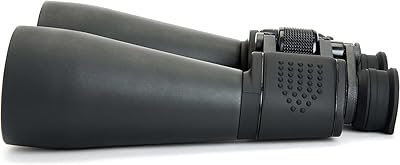
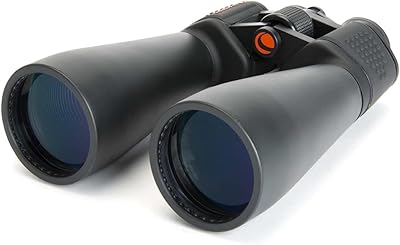
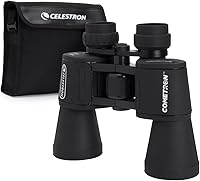
The Celestron Cometron 7x50 Binoculars have been a quiet staple in the beginner astronomy market since 2013, and it's easy to understand the appeal. Celestron has been crafting optics out of California since 1960, and that pedigree carries weight even at this accessible price point. These stargazing binoculars tip the scales at just 2 pounds — compact and light enough to grab on impulse for a backyard session or a proper night at a dark-sky site. Dual-purpose design means they handle birdwatching and hiking just as capably as stargazing. Nearly 4,000 verified ratings over more than a decade point to sustained buyer confidence that most entry-level gear never achieves.
Features & Benefits

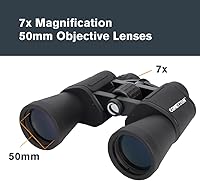
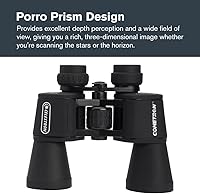
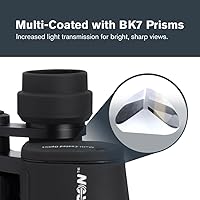
The 7x magnification paired with a 6.6° field of view is the headline spec here, and it genuinely works for sky-scanning. Sweep across the Milky Way or hunt down a comet without constantly repositioning — the wide view does most of the work. The 50mm objective lenses gather enough light for bright, usable images in dim conditions, and the multi-coated optics cut glare noticeably. One honest caveat: these entry-level astronomy binoculars use BK-7 prism glass rather than the BAK-4 glass found in pricier models, so edge sharpness has its limits. The built-in tripod socket is a practical inclusion for longer sessions, but the adapter is sold separately — worth factoring into your budget. Folding eyecups and water-resistant housing round out the package.

Best For

This Celestron 7x50 is a natural fit for anyone just stepping into astronomy — someone who wants to look up and actually see something interesting without a large investment. Beginners and students who aren't ready to spend on premium glass will find it a capable starting point. It also works well as a multi-purpose pair for birdwatchers or hikers who want one tool for daytime outings and occasional nights under the sky. If you want tripod-mountable binoculars for extended sky sessions without serious upfront cost, this fits the bill neatly. Experienced astronomers with higher optical expectations, however, will likely feel constrained by the BK-7 prisms before long.

User Feedback

Across nearly 4,000 ratings, this Celestron 7x50 holds a 4.5-star average — a score that holds up when you actually read the feedback. Beginners consistently report views that are brighter and wider than they anticipated, and the tripod adapter socket draws frequent praise as a thoughtful practical touch. The criticism, though, is equally consistent: experienced buyers point to the BK-7 prisms and basic multi-coating as the ceiling of the optics, with several noting peripheral edge softness across the full field of view. The pattern is straightforward — arrive expecting premium performance and you will be let down. Arrive expecting solid, honest beginner capability and it genuinely delivers on that promise.

Pros

  • Wide 6.6-degree field of view makes scanning the Milky Way and large star fields effortless.
  • 50mm objectives gather enough light to reveal star clusters and bright comets on dark nights.
  • Trusted Celestron brand backs the purchase with a lifetime warranty and US-based support.
  • At just 2 pounds, these stargazing binoculars are light enough for extended handheld sessions.
  • Water-resistant housing handles dewy nights and light rain without any special care required.
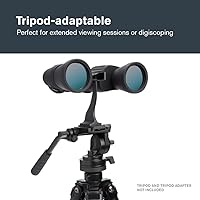
  • Built-in tripod adapter socket is a genuinely useful feature at this price tier.
  • Folding eyecups and wide IPD range accommodate glasses wearers and different face widths well.
  • Close focus of 26.2 feet makes them practical for daytime birdwatching and nature observation.
  • Nearly a decade on the market with thousands of real buyer ratings signals proven reliability.

Cons

  • The tripod adapter is not included in the box — a frustrating omission given how prominently it is marketed.
  • BK-7 prism glass produces noticeable edge softness that more experienced buyers will find disappointing.
  • Multi-coated rather than fully multi-coated lenses limit performance under light-polluted suburban skies.
  • The center focus wheel can develop looseness or grit after extended regular use.
  • 13mm eye relief sits at the lower end of comfortable for users with strong prescription glasses.
  • Chromatic fringing around high-contrast edges appears in bright daytime conditions.
  • The plastic chassis feels its budget origins when handled alongside mid-range alternatives.
  • Not well-suited for planetary viewing — 7x magnification is too low for Saturn's rings or lunar detail.
  • International buyers face limited warranty support outside the United States.

Ratings

The Celestron Cometron 7x50 Binoculars earn a strong overall showing in our AI-generated scorecard, built by analyzing thousands of verified global purchases while actively filtering out incentivized, bot-generated, and outlier reviews. Scores reflect where these entry-level astronomy binoculars genuinely shine for casual stargazers and where they fall short for buyers with more demanding optical expectations. Both the strengths and the friction points are represented here without softening either side.
Optical Clarity
73%
27%
For a budget pair of stargazing binoculars, the central image quality regularly surprises first-time buyers. Stars in the core of the field resolve cleanly, and the Milky Way comes through as a genuinely impressive sweep of light on a dark night.
The BK-7 prism glass — rather than the BAK-4 found in step-up models — introduces noticeable softness and slight vignetting toward the edges of the field. Buyers who have used better glass will feel this limitation almost immediately.
Light Gathering
84%
The 50mm objective lenses pull in a meaningful amount of light for nighttime use, making faint star clusters and diffuse nebulae visible in ways that smaller binoculars simply cannot match. Several buyers specifically noted how well these performed in semi-dark suburban skies.
Multi-coating rather than fully multi-coated optics means light transmission is good but not exceptional. On very faint targets like distant galaxies, the image can appear slightly washed out compared to what fully multi-coated glass delivers.
Field of View
89%
The wide 6.6-degree angular field of view is one of the strongest arguments for these stargazing binoculars. Sweeping across the Milky Way or tracking a comet feels natural and unhurried — you can take in large star fields in a single glance without constantly repositioning.
A small number of experienced users mention that the wide field comes with some trade-off in edge sharpness, which is a common optical compromise at this price tier. It is not a dealbreaker, but worth knowing before you buy.
Build Quality
71%
29%
The chassis feels solid enough for regular outdoor use, and the water-resistant housing adds genuine peace of mind during dewy nights or light rain. The folding rubber eyecups have held up well for most buyers across years of use.
At this price point, the body materials are functional rather than premium — the plastic chassis shows its budget origins when compared side by side with more expensive optics. A few buyers have reported loosening of the center focus wheel after extended use.
Value for Money
91%
Few binoculars in this price bracket offer this combination of aperture, field of view, and brand credibility. Buyers consistently describe feeling like they got more than they paid for, particularly those coming from cheap drugstore binoculars or no binoculars at all.
The value equation shifts slightly once you factor in that the tripod adapter is not included — a surprising omission given that tripod compatibility is a highlighted feature. Buyers who need stable mounting for extended sessions face an additional purchase right out of the box.
Tripod Compatibility
78%
22%
Having a built-in tripod adapter socket is a thoughtful design choice that opens up longer, steadier viewing sessions. Experienced buyers who already own a standard tripod appreciate being able to mount these without any modifications.
The adapter itself is not in the box, which catches a notable number of buyers off guard. For someone brand new to astronomy who does not already own tripod accessories, this is an unexpected extra cost that should be called out clearly before purchasing.
Eye Comfort & Ergonomics
76%
24%
The 13mm of eye relief is workable for most eyeglass wearers, and the folding rubber eyecups adjust easily between use with and without glasses. The interpupillary distance range of 56 to 72mm covers a wide spread of face widths comfortably.
Some buyers with larger hands find the grip somewhat narrow for extended handheld sessions, and 13mm eye relief sits at the lower acceptable threshold for glasses wearers. Those with strong prescriptions may still lose some field of view at the edges.
Ease of Use
88%
The straightforward focusing mechanism and intuitive diopter adjustment make these genuinely accessible for complete beginners. Kids and adults alike report being able to get a clear, focused image within a few minutes of picking them up for the first time.
The wide field of view, while an asset, can make precise centering of smaller targets like planets slightly tricky for newcomers. There is a short learning curve to pointing accurately at a specific sky object, especially without a mount.
Daytime Performance
81%
19%
These entry-level astronomy binoculars handle daytime birdwatching and scenic viewing better than many buyers expect. The 26.2-foot close focus distance is practical for nature observation, and colors render naturally in good daylight conditions.
Against very bright, high-contrast scenes, some chromatic fringing appears around hard edges — a known characteristic of BK-7 glass under strong illumination. It is minor enough that casual daytime users rarely flag it, but birders tracking fast-moving subjects may notice it.
Portability
83%
At 2 pounds and with a footprint that fits in a small backpack pocket, these binoculars are genuinely easy to bring along on hiking trips or impromptu stargazing outings. The weight is well-distributed, so handheld use does not feel front-heavy.
Compared to compact 8x25 or roof-prism binoculars, this Celestron 7x50 is noticeably bulkier. Buyers who prioritize ultra-light travel kits may find the size a compromise, particularly on longer hikes where pack weight matters.
Warranty & Brand Support
86%
Celestron's Limited Lifetime US Warranty is a legitimate confidence booster for a budget purchase. The brand has US-based technical support, and buyers report responsive service when they have needed to use it.
The lifetime warranty applies to US buyers; international purchasers may face more limited coverage depending on their region. A small number of non-US reviewers have flagged difficulties navigating warranty claims from outside North America.
Star Cluster & Comet Viewing
87%
Open star clusters like the Pleiades or the Beehive look genuinely spectacular through these stargazing binoculars — wide enough to fit the whole cluster in frame with room to spare. Comet watching, the product's namesake use case, is well-served by the combination of aperture and field width.
Globular clusters, which require tighter resolution to resolve individual stars, push the optical limits of the BK-7 glass noticeably. Faint deep-sky objects beyond the brightest Messier targets require very dark skies and even then deliver only soft, unresolved glows.
Focus Mechanism
74%
26%
The center focus wheel turns smoothly and covers the full range without excessive play. Most buyers find it easy to land on a sharp focus quickly, which matters a lot when you are trying to lock onto a moving or faint target.
A portion of long-term owners report that the focus wheel develops a slightly loose or gritty feel after a year or two of regular use. It does not usually affect function, but it does undercut the sense of quality build for those who notice it.
Low-Light Night Performance
79%
21%
On truly dark nights away from city lights, the 50mm aperture delivers impressively bright images for the price tier. The Andromeda Galaxy, bright nebulae, and comet tails all become visible targets that genuinely reward the effort of getting to a dark site.
Under light-polluted suburban skies — which is where most buyers actually use them — sky glow competes with the brightness advantage. The optics cannot fully compensate for poor sky conditions the way premium glass with fully multi-coated lenses sometimes can.

Suitable for:

The Celestron Cometron 7x50 Binoculars are an excellent starting point for anyone who has looked up at a clear night sky and felt the pull to see more than their naked eyes allow. If you are a complete beginner who wants to learn the constellations, scan the Milky Way, or catch a passing comet without spending a lot of money, this is one of the most sensible first purchases you can make. Students, younger astronomers, and parents looking to introduce a child to the night sky will find the wide field of view and simple focusing mechanism genuinely welcoming rather than intimidating. These stargazing binoculars also serve casual dual-purpose users well — birdwatchers or hikers who want one capable pair for both daytime trails and occasional evening sky sessions will get solid mileage out of them. Anyone who already owns a standard tripod and wants to set up a stable backyard viewing station on a budget will appreciate the built-in adapter socket, even though the adapter itself requires a separate purchase.
Not suitable for:

Buyers who already have some astronomy experience and are accustomed to BAK-4 prism glass or fully multi-coated optics will likely feel limited by the Celestron Cometron 7x50 Binoculars fairly quickly. The BK-7 prisms are a real ceiling — edge sharpness and contrast under light-polluted skies do not match what step-up models deliver, and that gap becomes hard to ignore once you have seen the difference firsthand. These entry-level astronomy binoculars are also not the right tool for planetary observation or resolving fine detail in globular clusters, where higher magnification and tighter optical quality matter far more than wide field coverage. Dedicated birders who prioritize fast autofocus response or ultra-sharp edge-to-edge clarity for tracking birds in flight will find better options at a modest price increase. Finally, international buyers should verify warranty coverage in their region before purchasing — Celestron's lifetime warranty is US-based, and support options outside North America are considerably more limited.
Specifications

  • Magnification: These binoculars deliver 7x magnification, making distant objects appear seven times closer than they do to the naked eye.
  • Objective Diameter: Each objective lens measures 50mm across, providing a large light-gathering aperture well-suited to low-light and nighttime observation.
  • Field of View: The angular field of view spans 6.6°, equivalent to 357 feet of visible width at 1,000 yards — broad enough to frame large sky regions in a single view.
  • Lens Coatings: Optics are multi-coated, meaning at least one lens surface on each element carries an anti-reflective coating layer to reduce glare and improve contrast.
  • Prism Glass: BK-7 borosilicate crown glass prisms are used throughout, offering acceptable clarity at this price tier but not reaching the transmission quality of BAK-4 barium crown glass.
  • Eye Relief: Eye relief measures 13mm, sitting at the lower end of comfortable clearance for eyeglass wearers but workable for most prescriptions with the eyecups folded down.
  • Eyecups: Folding rubber eyecups allow users to quickly switch between bare-eye and eyeglass-wearing positions without tools or adjustment knobs.
  • IPD Range: The interpupillary distance adjusts from 56mm to 72mm, covering the majority of adult and adolescent face widths comfortably.
  • Close Focus: The minimum focus distance is 26.2 feet, making these binoculars usable for birdwatching and nature observation at relatively short ranges.
  • Tripod Adapter: A built-in tripod adapter socket is integrated into the body, accepting a standard binocular-to-tripod adapter — note that the adapter itself is not included in the box.
  • Water Resistance: The housing is water-resistant, providing protection against light rain, dew, and field moisture, though these binoculars are not rated for full submersion.
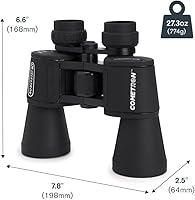
  • Dimensions: The body measures 9 x 8 x 3 inches, making it a standard full-size binocular form factor that fits in most backpacks but is not pocketable.
  • Weight: Total weight is 2 pounds, which is manageable for short handheld sessions but benefits from tripod support during extended stargazing.
  • Warranty: Celestron provides a Limited Lifetime US Warranty covering manufacturing defects, backed by US-based technical support — coverage for international buyers may vary.
  • Brand Origin: Celestron has been designing and manufacturing optical instruments in California since 1960, with a longstanding reputation in the consumer astronomy market.
  • Model Number: The official Celestron model number for this product is 71198-CGL, useful when registering the product or contacting support.
  • First Available: This product was first listed in August 2013, giving it over a decade of real-world use data and verified buyer feedback across multiple retail platforms.

Related Reviews

Celestron TrailSeeker 8x42 Binoculars
82%
91%
Optical Clarity
93%
Field of View
88%
Build Quality
74%
Focusing Mechanism
78%
Eyecup Comfort & Usability
More
Celestron SkyMaster 25x100 Binoculars
76%
88%
Optical Brightness
79%
Image Sharpness & Clarity
53%
Optical Alignment Out of Box
67%
Chromatic Aberration
82%
Build Quality & Durability
More
Celestron SkyMaster 25x70 Binoculars
75%
84%
Optical Clarity
91%
Light Gathering
79%
Magnification Performance
72%
Build Quality
58%
Collimation Consistency
More
Barska Floatmaster 7x50
81%
94%
Buoyancy & Water Safety
76%
Optical Clarity
91%
Waterproofing
83%
Build Quality & Durability
81%
Ergonomics & Grip
More
Celestron SkyMaster Pro 20x80 Binocular
83%
91%
Optical Performance
89%
Build Quality & Durability
75%
Ease of Use
94%
Magnification & Clarity
85%
Waterproof & Weather Resistance
More
Celestron Outland X 10x42 Binoculars
81%
88%
Optical Clarity
91%
Build Quality & Durability
93%
Weatherproofing
89%
Value for Money
61%
Eye Relief & Eyeglass Compatibility
More
Celestron EclipSmart 10x25 Solar Binoculars
79%
94%
Solar Filter Safety
78%
Optical Clarity
91%
Ease of Use
83%
Build Quality
89%
Portability & Form Factor
More
Celestron Nature DX 10x42 Binoculars
82%
86%
Optical Clarity
83%
Build Quality
89%
Weather Resistance
91%
Value for Money
88%
Ease of Focus
More
Celestron Outland X 8x25 Binoculars
84%
92%
Portability
89%
Image Quality
90%
Waterproof Performance
87%
Ease of Use
83%
Magnification
More
Celestron SkyMaster 15x70 Astronomy Binoculars
83%
92%
Optical Performance
88%
Build Quality
91%
Value for Money
78%
Ease of Use
75%
Weight & Portability
More

FAQ

No, it is not — and this trips up a surprising number of buyers. The binoculars have a built-in socket that accepts a standard binocular tripod adapter, but you will need to purchase that adapter separately. If you plan to use them mounted, budget for the extra accessory before you order.

Yes, with some caveats. The 13mm of eye relief is workable for most glasses wearers when the rubber eyecups are folded down flat. If you have a particularly strong prescription or large frames, you may lose a small portion of the outer field of view, but the central image remains usable.

The Celestron Cometron 7x50 Binoculars use BK-7 prism glass, which is a step below the BAK-4 glass found in mid-range and premium models. In practice, the difference shows up most at the edges of the field — BK-7 tends to produce softer, slightly vignetted corners compared to the more uniform sharpness of BAK-4. For beginners, it is rarely a dealbreaker, but experienced users switching down from better glass will notice it.
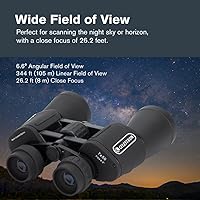
Absolutely — this is actually one of their strongest use cases. The wide 6.6-degree field pulls in a large sweep of sky at once, and the 50mm lenses gather enough light to show the Milky Way as a genuinely textured, cloud-like band on a dark night. You will not resolve individual stars in dense clusters, but the overall view is impressive for the price.

Yes, these are well-suited for older children and teenagers. The focusing mechanism is simple, the interpupillary distance adjusts narrow enough for younger faces, and the wide field makes it easier for beginners to find objects. Just supervise use and make sure they know not to point them at the sun under any circumstances.

They work for birdwatching, though they are not optimized for it. The 26.2-foot close focus distance handles most field scenarios, and daytime color rendering is natural and pleasant. The main limitation is that 7x magnification is on the lower end of what dedicated birders prefer — most birdwatching binoculars run 8x to 10x — so fast-moving birds at close range can feel harder to track.

Use a blower brush first to remove any loose dust or grit before touching the glass. Then use a clean microfiber cloth with a drop or two of lens cleaning solution, wiping in gentle circular motions from center to edge. Never use paper towels, shirt fabric, or household cleaners — the multi-coatings are durable but not impervious to scratches from abrasive materials.

Water-resistant, not waterproof. They can handle light rain, splashes, and heavy dew without issue, which covers most normal outdoor use. Do not submerge them or leave them out in a downpour — the sealing is not rated for that level of exposure.

On a clear, dark night away from city lights, you can expect to see the Andromeda Galaxy as a soft smudge, open star clusters like the Pleiades and Beehive in striking detail, the Orion Nebula with visible structure, and the moons of Jupiter as small pinpoints. Bright comets, when visible, are excellent targets. Planets will show as brighter-than-normal discs but without meaningful surface detail at 7x.

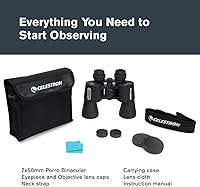
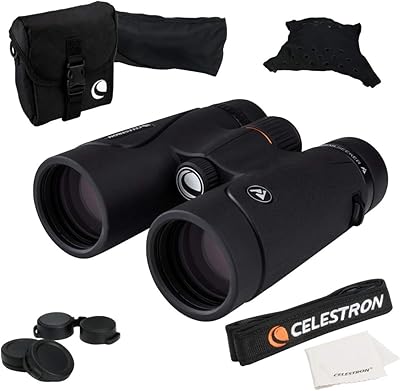
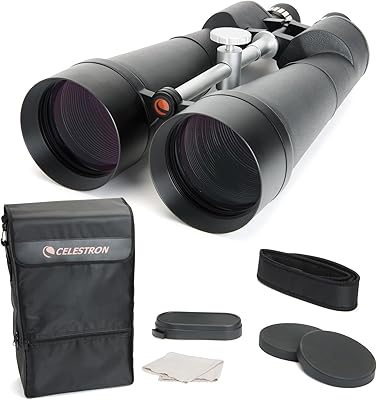
Yes, Celestron includes a neck strap and a soft carrying case in the box, along with lens caps for the objectives and eyepieces. The case is basic but functional for transport and storage — it is not a hard-shell case, so treat it accordingly if you are packing these in checked luggage or a crowded backpack.