Overview

The Sound Town STCA360-6Z 6-Zone Commercial Amplifier is built for venue owners who want reliable multi-zone audio without calling in a specialist or spending on enterprise-level systems. At its core, this is a 70V/100V distributed audio amplifier — the architecture commercial installers rely on when running ceiling speakers across long cable runs through multiple rooms, rather than wiring up a standard hi-fi setup. The six independently controlled zones are the main draw, letting you push different volume levels to different areas from a single rack unit. Bluetooth, optical, USB, FM, and three mic inputs round out the package. Don't approach this expecting audiophile fidelity — it's a reliable commercial workhorse, not a listening room centerpiece.
Features & Benefits

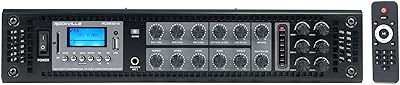
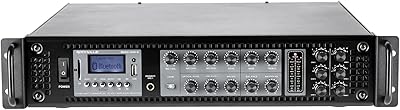
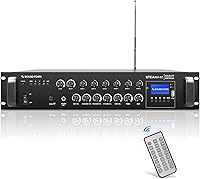
What sets this 6-zone commercial amp apart from a basic stereo amplifier is how much it consolidates into a single chassis. Each of the six output zones has its own volume knob, so you can run the bar area louder than the dining room without touching anything else. The two phantom-powered mic inputs let you connect condenser microphones directly — no external preamp required — while the third mic input on the front panel acts as a priority override, cutting through background music for announcements. Every mic channel also includes echo, repeat, and speed controls, useful for venues that host karaoke nights. A built-in clipping limiter and active cooling fan protect your speaker investment during long operating days.

Best For

This distributed audio unit is a natural fit for restaurant or bar owners who want independent zone volume control across multiple areas — think different levels for a dining room, patio, bar counter, and restrooms, all managed from one location. Schools and houses of worship also benefit from the paging and priority mic capability, which handles daily background audio and urgent announcements without switching equipment. Small commercial AV installers will appreciate how much this consolidates into a single box, reducing rack space and cabling complexity. If you are currently running a single-zone PA system and need more granularity, this is a logical step up. Retail stores and warehouses that need music and PA combined will find it covers both without additional hardware.

User Feedback

Across roughly 80 ratings, the Sound Town PA amplifier holds a 4.4-star average — solid for a commercial niche product where buyers tend to have very specific installation expectations. Positive reviews consistently highlight ease of initial setup, reliable Bluetooth pairing, and the convenience of having so many input types built in, which saves buyers from sourcing additional switching hardware. On the critical side, some users have flagged that the documentation could be clearer, particularly around zone wiring and 70V/100V speaker tap configuration. A few buyers also noted the unit runs noticeably warm during extended operation, though most reported the cooling fan handles it adequately. Overall, the consensus leans positive for what this unit delivers at its price tier.

Pros

  • Six independently controlled output zones let you fine-tune volume room by room without any additional hardware.
  • Phantom power on two mic inputs means you can run condenser microphones straight in, no external preamp needed.
  • The front-panel priority mic input is genuinely useful for venues that need to cut through music for announcements.
  • Bluetooth, optical, USB, RCA, and FM tuner inputs are all built in, eliminating the need for a separate source switcher.
  • The built-in clipping limiter helps protect connected speakers during high-volume or extended operation sessions.
  • Rack-mountable and surface-mount compatible design fits cleanly into permanent commercial installs.
  • Holds a 4.4-star average across a meaningful number of real commercial-use reviews — not inflated by casual buyers.
  • Per-mic DSP controls including echo and repeat make it versatile enough for karaoke nights alongside standard background music.
  • At its price point, the all-in-one feature set is difficult to match without buying and integrating several separate components.

Cons

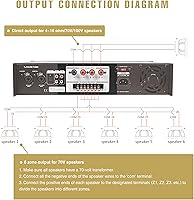
  • The included documentation is thin and can leave installers guessing on 70V speaker tap wiring and zone configuration.
  • Bluetooth range is limited and may not reach across larger rooms or through thick commercial walls reliably.
  • The unit runs noticeably warm during extended operation, which demands good ventilation in any enclosed rack or cabinet.
  • Physical knob and build quality feels functional rather than premium, which may be a concern for long-term heavy use.
  • At 31 pounds and roughly 21 inches wide, installation requires proper planning and mounting infrastructure.
  • No per-zone EQ or DSP control limits fine-tuning options for venues with acoustically different spaces.
  • Only six zones may not be enough for larger venues or multi-floor commercial properties without adding a second unit.
  • FM tuner and karaoke-style mic effects feel dated and may go entirely unused in most modern commercial deployments.

Ratings

The scores below reflect an AI-driven analysis of verified buyer reviews for the Sound Town STCA360-6Z 6-Zone Commercial Amplifier, sourced globally and filtered to exclude incentivized, bot-generated, and duplicate feedback. Our model weighs both praise and recurring frustrations equally, so the numbers you see here represent honest consensus — not a polished marketing average. Strengths in zone flexibility and input versatility are balanced against real pain points around documentation and thermal management.

Zone Control
91%
Buyers who installed this in restaurants and multi-room retail spaces consistently praised how easy it is to dial in different volume levels per area without touching other zones. The per-zone knobs are intuitive enough that non-technical staff can adjust levels on the fly during a busy service shift.
A recurring frustration is that zone control is volume-only — there is no per-zone EQ, tone shaping, or source assignment. Venues with acoustically different rooms, like a tiled bathroom versus a carpeted dining area, have to accept a one-size-fits-all sound character.
Input Versatility
88%
The breadth of inputs — Bluetooth, optical, USB, RCA, and FM — is one of the most praised aspects of this distributed audio unit across installations of all sizes. Buyers regularly highlighted that it eliminated the need for a separate source switcher, saving both rack space and budget on smaller commercial jobs.
You can only use one source at a time, and there is no automatic source switching or priority routing for non-mic inputs. A few integrators noted that the input selection process via the front panel can feel clunky in fast-paced environments where sources change frequently.
Ease of Setup
79%
21%
For buyers who already have basic familiarity with 70V distributed audio, getting this amp up and running is fairly straightforward. Many restaurant owners reported completing their initial installation within a few hours, particularly when pairing it with ceiling speakers pre-wired for 70V taps.
The instruction manual is the most common complaint across all reviews — it is thin, sometimes vague on zone wiring specifics, and offers little guidance for buyers new to commercial audio. First-time installers frequently had to rely on third-party online resources to fill the gaps left by the documentation.
Mic Performance
82%
18%
The priority mic input is genuinely effective for PA announcements — buyers in schools and warehouses noted that it reliably cuts through background music without requiring manual source switching. The phantom power on the rear inputs adds real value for venues that already own condenser microphones.
The mic DSP effects like echo and repeat, while technically present, are considered novelty features by most commercial buyers and rarely used in professional settings. A handful of users also noted that mic gain staging can require careful adjustment to avoid feedback in smaller, reflective spaces.
Bluetooth Reliability
73%
27%
Initial Bluetooth pairing is consistently described as quick and hassle-free across most buyer environments. For standard restaurant or retail use where the source device stays in a fixed location near the amp, the connection holds steady throughout full operating days.
Range is the persistent weak point — buyers report signal degradation beyond roughly 25 to 30 feet, and thick commercial walls can reduce that further. In venues where staff move around with a phone or tablet as the audio source, the Bluetooth connection is not reliable enough to serve as the primary input.
Thermal Management
68%
32%
The active cooling fan does its job under typical commercial operating conditions, and the majority of buyers who run this unit eight-plus hours a day report no thermal shutdowns or heat-related failures. The clipping limiter adds an additional layer of protection that several users credited with protecting their speaker investment.
The unit runs noticeably warm after extended operation, which has made some buyers nervous about long-term reliability. Ventilation clearance is non-negotiable — several users who initially installed it in a tightly enclosed cabinet reported concerning heat buildup until they added spacing or ventilation fans.
Build Quality
66%
34%
The overall chassis feels solid enough for a fixed commercial installation and the general structural construction handles the demands of permanent rack mounting without issue. At 31 pounds, the unit has a physical heft that reinforces its positioning as a serious commercial tool rather than a consumer-grade device.
The front-panel knobs and controls are the most frequently criticized hardware element — several buyers described them as feeling lightweight or plasticky relative to the price point. For a unit that staff may interact with daily, the tactile quality of those controls does not inspire long-term confidence.
Audio Clarity
71%
29%
For its intended purpose — distributing background music and announcements across commercial spaces — the audio output is clean and intelligible at typical listening levels. Bars and restaurants using it for ambient background music reported that it performs exactly as expected for the application.
This is a commercial distribution amplifier, and buyers who approached it with audiophile expectations were uniformly disappointed. The sound character at the output is functional rather than refined, and anyone prioritizing tonal accuracy or dynamic resolution for a listening room environment should look at entirely different product categories.
Value for Money
86%
The consolidation of six zones, three mic inputs, phantom power, and five source inputs into a single unit at this price tier is difficult to match with separately purchased components. Integrators and venue owners consistently cited the all-in-one nature as the defining reason they chose the Sound Town PA amplifier over piecing together a custom rack.
Buyers who only need two or three zones may feel they are paying for zone capacity they will never use, and those who need advanced DSP features will still need to supplement this unit regardless of its price. The value proposition is strongest when all six zones are genuinely needed.
Installation Flexibility
77%
23%
Compatibility with both surface mount and standard rack configurations gives installers meaningful flexibility during commercial buildouts. The dual voltage support for 70V and 100V systems means it works across a wide range of existing commercial speaker infrastructure without adapter hardware.
At nearly 21 inches wide and over 31 pounds, this is not a lightweight or compact solution — physical installation requires planning, proper mounting hardware, and realistically a two-person lift. The size also limits placement options in tight equipment closets or shallow rack bays.
Documentation Quality
43%
57%
The unit ships with a manual that covers the basic input and output labeling, which is enough for experienced AV professionals who just need a quick reference. For installers who already know 70V system architecture, the sparse documentation is rarely a true blocker.
For everyone else, the manual is the biggest friction point in the entire ownership experience. Real-world wiring scenarios, zone configuration guidance, and troubleshooting steps are either missing or too vague to be actionable, and this is one of the most consistent complaints across the entire review base.
Long-Term Reliability
74%
26%
Buyers who have operated this unit across multi-year commercial installations — in restaurants, schools, and retail environments — generally report it holding up without major failures under continuous daily use. The built-in protection circuitry appears to contribute meaningfully to component longevity.
The sample size of long-term reviews is still relatively modest given the product launched in early 2020, making it difficult to draw firm conclusions about five-plus year reliability. A small percentage of buyers did report unit failures within the first year, though it is unclear whether these were installation errors or component issues.
FM Tuner Utility
54%
46%
For venues in areas with strong FM broadcast signals, the built-in tuner provides a genuinely cost-free background music source that requires no subscriptions, streaming accounts, or device pairing. A small segment of buyers — particularly those running older or more traditional establishments — found this feature meaningfully useful.
The FM tuner is increasingly a niche feature that most modern commercial buyers ignore entirely in favor of Bluetooth or streaming services. Reception quality is dependent on location and antenna placement, and several buyers in urban or structurally dense buildings reported poor signal quality that made the tuner effectively unusable.

Suitable for:

The Sound Town STCA360-6Z 6-Zone Commercial Amplifier is a strong match for small-to-medium venue owners who need to manage background audio across multiple separate areas without building out a complex, expensive system. Restaurant and bar operators will find it particularly practical — being able to set different volume levels for a dining room, bar counter, outdoor patio, and restrooms independently from one unit is exactly the kind of day-to-day control a busy venue needs. Schools, houses of worship, and retail environments also benefit from the built-in priority mic input, which allows staff to make announcements over background music without fiddling with external switchers. Small AV integrators working on commercial installs will appreciate how much this consolidates into a single rack-mountable chassis, cutting down on both equipment cost and cabling overhead. If you are currently running a single-zone PA system and have outgrown it, this distributed audio unit represents a practical, well-priced upgrade path.
Not suitable for:

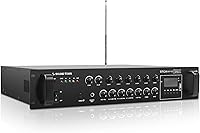
The Sound Town STCA360-6Z 6-Zone Commercial Amplifier is not the right tool for anyone prioritizing high-fidelity audio reproduction — this is a 70V/100V distributed audio amplifier designed for coverage and control, not sonic transparency or audiophile-grade output. Home theater enthusiasts or recording studio owners should look elsewhere entirely, as this unit is purpose-built for commercial public address applications where reliability and zone flexibility matter far more than audio nuance. Buyers who need more than six zones, or who require advanced DSP features like parametric EQ or delay per zone, will find this unit too basic for larger or more complex installations. At just over 31 pounds and nearly 21 inches wide, it also demands a proper rack or dedicated mounting space, making it impractical for truly portable or temporary setups. Anyone expecting plug-and-play simplicity with a polished instruction manual may also run into frustration, as the documentation has been noted as a weak point by some buyers.
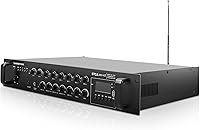
Specifications

  • Output Power: The amplifier delivers a total of 360W across all six output zones combined.
  • Speaker Zones: Six independently controlled speaker zones each have their own dedicated volume knob for room-by-room level adjustment.
  • Voltage Support: Compatible with 70V and 100V distributed audio systems, the standard architecture used in commercial ceiling speaker installations.
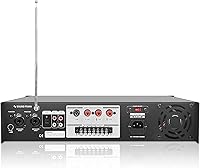
  • Mic Inputs: Three microphone inputs are included: two phantom-powered rear inputs for condenser mics and one priority mic input on the front panel.
  • Phantom Power: The two rear mic inputs supply phantom power, allowing condenser microphones to be connected without an external preamp or power supply.
  • Audio Inputs: Source inputs include RCA stereo, optical (SPDIF), USB, Bluetooth wireless streaming, and a built-in FM tuner with antenna connection.
  • Mic DSP Controls: Each microphone channel includes individual echo, repeat, and speed controls adjustable directly from the front panel.
  • Protection: A built-in clipping limiter prevents signal distortion from damaging connected speakers, and an active cooling fan manages internal heat during extended operation.
  • Mounting Type: The unit supports both surface mounting and standard rack mounting, making it suitable for fixed commercial installs or equipment rack integration.
  • Dimensions: The chassis measures 20.9 x 18.7 x 6.9 inches, occupying significant rack or shelf space that should be accounted for during installation planning.
  • Weight: At 31.1 pounds, the unit requires proper mounting hardware and ideally a second person during physical installation.
  • Brand: Manufactured by Sound Town, a brand focused on commercial and professional audio equipment at accessible price points.
  • Model Number: The official model identifier is STCA360-6Z, which should be referenced when contacting support or sourcing compatible accessories.
  • Priority Mic: The front-panel priority microphone input automatically attenuates other audio sources when in use, making it suitable for PA announcements.
  • FM Tuner: A built-in FM radio tuner with antenna input is included, allowing broadcast radio to serve as a background music source without additional hardware.
  • Availability: The product has been available on the market since February 2020, giving it a multi-year track record in commercial installations.

Related Reviews

Rockville RCS350-6
Rockville RCS350-6
74%
84%
Ease of Setup
88%
Zone Control Flexibility
73%
Audio Output Quality
66%
Bluetooth Stability
61%
Build Quality & Durability
More
Rockville RCS650-6
Rockville RCS650-6
74%
88%
Value for Money
91%
Ease of Installation
86%
Multi-Zone Functionality
74%
Audio Quality
77%
Build Quality
More
Rockville RCS2-320-6
77%
83%
Zone Independence & Control
86%
Ease of Installation
88%
70V Output Performance
67%
Bluetooth Connectivity
71%
Mic Input & Echo Control
More
Juke Audio Juke-6 6-Zone Multi-Room Amplifier
77%
83%
Ease of Setup
91%
AirPlay 2 Integration
86%
Spotify Connect Performance
78%
Audio Output Quality
93%
Multi-Zone Independence
More
CT Sounds Meso-6.5-D4 6.5 Inch Dual 4 Ohm Car Subwoofer
83%
90%
Bass Performance
85%
Power Handling
88%
Build Quality
65%
Installation Ease
92%
Cooling System Effectiveness
More
CT Sounds TROPO-6.5-D2 6.5″ Car Subwoofer
77%
83%
Bass Output for Size
88%
Value for Money
79%
Build Quality
76%
Thermal Management
84%
Installation Ease
More
Rockville RCS80-1 Commercial Amplifier
76%
88%
Value for Money
84%
Ease of Setup
73%
Audio Output Quality
76%
Bluetooth Performance
71%
Build Quality & Durability
More
Rockville DBM65 6-Channel Marine Amplifier
73%
88%
Value for Money
83%
Power Output
71%
Waterproofing & Weather Resistance
91%
Channel Flexibility
67%
Build Quality
More
Authentic Beauty Concept Amplify Mousse 6.7 oz
76%
88%
Volumizing Performance
63%
Hold Strength
93%
Lightweight Texture
79%
Heat Protection
91%
Formula Cleanliness
More
Sound Town STLF-21500A 21″ Subwoofer Woofer
80%
88%
Build Quality
91%
Bass Output
86%
Power Handling
83%
Value for Money
89%
Spec Accuracy
More

FAQ

Yes, to take full advantage of the distributed audio output you need speakers with a 70V or 100V transformer tap — these are standard in commercial ceiling speaker lines from brands like Atlas Sound, Speco, or TOA. Using regular 4-ohm or 8-ohm home speakers directly on the 70V output will damage them. Check your speaker specs before wiring anything up.

Technically yes, but keep in mind the 360W total output is shared across all active zones. If you are pushing all six zones hard at the same time, each zone gets a fraction of that total headroom. For most background music applications in restaurants or retail spaces, this is rarely a real-world issue, but it is worth factoring in if you are covering large or acoustically demanding areas.

Most buyers report that Bluetooth pairing is straightforward and stays connected reliably under normal conditions. That said, a few users noted the effective range is limited — expect solid performance within about 20 to 30 feet with a clear line of sight. Thick walls or interference from other wireless devices can reduce that range, so positioning your source device close to the unit is a good habit.

For a typical small-to-medium venue with ceiling speakers properly matched to the 70V output, 360W spread across six zones is generally sufficient for background music and light paging. It is not designed to power a concert-level sound system. If you are covering a large open warehouse floor or an outdoor venue with significant ambient noise, you may find the headroom limiting.

You can use both types. Dynamic microphones do not require phantom power, so you can plug them into any of the three mic inputs without issue — the phantom power is simply there when you need it for condenser mics. Just make sure ribbon microphones stay away from phantom power inputs, as that can damage them.

The Sound Town STCA360-6Z 6-Zone Commercial Amplifier does run warm after several hours of continuous use, which is normal for a commercial amp of this output class. The active cooling fan handles heat management adequately under typical operating conditions. That said, make sure it has proper ventilation clearance in any rack or cabinet — do not box it in tightly or stack equipment directly on top of it.
If you already understand the basics of 70V distributed audio wiring, the physical setup is fairly intuitive. The challenge most buyers hit is the instruction manual, which several users described as sparse and not always clear on zone wiring specifics. Having a basic familiarity with PA systems or access to online wiring guides for 70V systems will save you real time during installation.

This amp handles background audio and priority announcements well, but it is not a full intercom system — it does not support two-way communication or automatic bell scheduling. For a school that just needs background music in classrooms and a mic for PA announcements, it works fine. For a full intercom integration, you would need additional dedicated equipment.

Yes, the optical SPDIF input means you can connect it directly to any device with a digital optical output, including televisions. This is useful if you want to route TV audio through your ceiling speaker zones rather than relying solely on the TV's built-in speakers. Just confirm your TV outputs a compatible PCM signal, as some TV optical outputs default to compressed formats that may require a settings adjustment.

No — this unit routes a single audio source to all six zones simultaneously; you control the volume per zone independently, but you cannot send different sources to different zones at the same time. If you need true multi-source, multi-zone audio where zone A plays jazz while zone B plays a game broadcast, you would need a more advanced matrix amplifier or a separate signal routing solution.