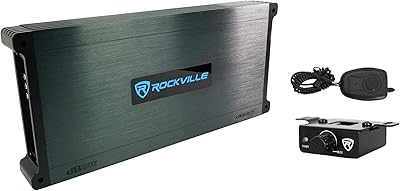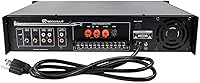
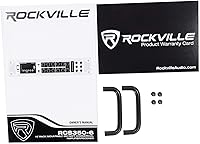
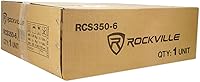
Overview

The Rockville RCS350-6 sits in an interesting spot — it's not a consumer receiver dressed up with a rack-mount face, nor is it the kind of professional-grade hardware you'd find in a large stadium install. It's a mid-range commercial amplifier built specifically for the kind of multi-zone audio work that small businesses actually deal with: background music in a dining room, a separate feed to a patio, maybe a third zone for a bar area. Setup is approachable enough that you don't need an AV contractor to get it running, and the all-in-one input options mean fewer boxes cluttering the rack.

Features & Benefits

The total 350 watts gets distributed across up to six independent zones, so think of it less as raw power and more as coverage — enough to push a solid background level through 70V ceiling speakers in a moderately sized venue. The 70V line output is really what makes this unit practical for commercial installs; it keeps signal clean over long cable runs, which matters when speakers are spread across multiple rooms. Bluetooth and USB inputs mean you can stream from a phone or plug in a thumb drive without needing a separate media player. The optical and RCA inputs round things out, and the built-in chime button lets staff make quick announcements without reaching for a separate PA system.

Best For

This commercial amplifier is a strong fit for small-to-mid-size restaurants, cafés, retail shops, and offices where background music meets the occasional need for PA-style announcements. If you're running one room, a cheaper stereo amp probably does the job. But the moment you need to independently control volume in a dining room, a patio, and a waiting area — all from one box — this multi-zone unit starts to make real sense. AV integrators on a tighter budget will appreciate the modern inputs alongside the 70V architecture. It's also a solid pick for venues without dedicated audio staff, since the front-panel controls are labeled clearly enough for non-technical employees to manage day-to-day.

User Feedback

Buyers consistently highlight easy setup and zone control flexibility as the biggest wins — people who braced for a complicated install are often pleasantly surprised. Bluetooth gets mixed marks; it works fine for basic streaming, but some users report inconsistent range in larger, wall-heavy spaces. The mic echo feature divides opinion: genuinely useful to some for live announcements, pure novelty to others. Longer-term reliability is the recurring concern worth noting. Rockville isn't Crown or QSC, and buyers who understand that going in tend to be satisfied. Those expecting pro-audio durability occasionally report issues after extended use, but for the right application, the value-to-feature ratio is genuinely hard to argue with.

Pros

  • Six independently controlled zones let you match volume to the mood in each area without extra hardware.
  • The 70V output keeps signal clean across long cable runs — no level drop, no extra amplifiers needed.
  • Bluetooth, USB, optical, and RCA inputs cover virtually every source scenario a small business might face.
  • Setup is approachable enough that a non-technical staff member can handle basic adjustments without calling a technician.
  • The built-in chime button and mic input handle quick announcements without adding a separate PA processor to the rack.
  • Standard 19-inch rack mounting means it integrates cleanly into any existing AV cabinet.
  • For the feature set offered, the price point undercuts comparable multi-zone commercial alternatives by a meaningful margin.
  • USB playback from a thumb drive is a reliable, low-maintenance option for venues that want set-it-and-forget-it background music.

Cons

  • Bluetooth range degrades noticeably in venues with thick walls or significant RF interference — exactly the environments this amp targets.
  • Long-term reliability concerns surface in reviews from users past the 12-to-18-month mark of daily commercial use.
  • Customer support response times have been inconsistently reported, which is a real risk for a business-critical piece of equipment.
  • The mic echo effect cannot be fully disabled on all firmware versions, leaving buyers stuck with a processed sound they may not want.
  • No per-zone wattage documentation makes speaker tap calculations unnecessarily difficult for installers.
  • There is no remote, app, or networked control — every zone adjustment requires someone to physically reach the unit.
  • USB playback is limited to MP3 files only, with no track display or navigation interface to speak of.
  • The unit's weight of nearly 32 pounds makes solo rack installation awkward and requires a second pair of hands.

Ratings

The Rockville RCS350-6 has been evaluated by our AI rating system after analyzing verified buyer reviews from multiple global sources, with spam, incentivized, and bot-generated feedback actively filtered out. The scores below reflect a balanced picture — genuine strengths are credited, and recurring pain points are not softened. Whether this multi-zone commercial amplifier earns a place in your rack or falls short of your expectations depends heavily on the use case, and that nuance is baked into every category below.

Ease of Setup
84%
Most buyers — including those with little to no AV background — report getting the unit up and running within an hour. Front-panel labeling is clear enough that a café owner or office manager can make basic zone adjustments without consulting a manual.
Users attempting more complex configurations, like integrating 70V speaker taps alongside RCA sources simultaneously, have noted the documentation is thin in spots. A few installers wished for a more detailed quick-start guide.
Zone Control Flexibility
88%
The ability to independently dial volume per zone is the feature buyers most consistently praise. Restaurant operators especially appreciate being able to keep the bar area louder than the dining room without any extra hardware or complicated routing.
There is no remote or app-based zone management, which limits flexibility in larger or more dynamic venues. If staff need to adjust a zone that is not near the amp, someone physically has to walk to the unit.
Audio Output Quality
73%
27%
For background music in a restaurant, retail shop, or office corridor, the audio output is clean and consistent. The 70V architecture keeps the signal stable across longer cable runs, which matters in venues where speakers are spread across several rooms.
Audiophiles and anyone running foreground listening environments will notice the ceiling. This commercial amplifier is not designed for high-fidelity reproduction, and at higher volumes some users report a slight harshness in the upper midrange.
Bluetooth Stability
66%
34%
Bluetooth works reliably in smaller, open-plan spaces and is genuinely convenient for staff who want to queue music from a phone without hunting for aux cables. Pairing is fast and consistent in favorable conditions.
In venues with thick walls, multiple floors, or significant RF interference — exactly the kind of environments this unit is marketed for — Bluetooth range and stability become unreliable. Several users noted dropout issues beyond 20–30 feet in real commercial settings.
Build Quality & Durability
61%
39%
The chassis feels solid enough for light commercial use, and the rack-mount form factor gives it a professional appearance when installed. For buyers who understand they are buying a value-tier product, the construction meets expectations at this price point.
Compared to established commercial brands, the internal build raises questions about longevity under continuous daily use. A pattern of issues emerging after 12–18 months of heavy use has appeared in long-term reviews, and Rockville is not in the same reliability tier as Crown or QSC.
Value for Money
86%
For small businesses that need 70V multi-zone distribution with Bluetooth and a built-in mic input — without spending two or three times more on a brand-name equivalent — this multi-zone unit delivers a compelling package. Most buyers feel the feature-to-price ratio is genuinely fair.
If you factor in potential replacement costs over a 3–5 year horizon, the long-term value calculation gets murkier. Buyers who need a set-it-and-forget-it solution for a high-traffic venue may find the savings offset by reliability concerns.
Input Variety & Compatibility
82%
18%
Having optical, RCA, Bluetooth, USB, and a microphone input on a single unit removes the need for an external switcher or additional gear in most small commercial installs. Buyers regularly highlight this breadth as one of the unit's strongest practical advantages.
Input switching is manual rather than automatic, so there is no priority routing — for example, a mic announcement will not auto-duck the background music without the operator manually adjusting levels. That is a meaningful gap for some PA use cases.
Microphone & Announcement Features
67%
33%
The built-in chime button and microphone input make quick staff announcements possible without a separate PA processor. For a small retail store or café, this is a genuinely useful feature that saves both money and rack space.
The mic echo effect divides users sharply — some find it useful for adding presence to announcements in reflective spaces, while others describe it as cheap-sounding. There is no way to disable it entirely on some firmware versions, which has frustrated buyers who just want a clean mic signal.
70V Line Performance
81%
19%
The 70V output is the technical backbone of this unit, and it performs its core job well. Long cable runs to ceiling speakers in a 3,000–5,000 square foot venue hold their signal integrity without the level drop you would get from a low-impedance setup.
The unit does not explicitly state per-zone wattage allocation, which creates confusion for installers trying to calculate tap settings on 70V speakers. Some users had to experiment to avoid underpowering or clipping on specific zones.
Rack Mount Integration
79%
21%
The standard 19-inch rack form factor slides into existing AV cabinets cleanly, and the front panel layout is organized enough to work with in a dimly lit server closet. Integrators working on restaurant or retail installs appreciate not needing a custom shelf or adapter.
At nearly 32 pounds, the unit is on the heavier side for its rack height, which can be awkward during solo installation. A small number of users also noted that included rack hardware felt lightweight relative to the chassis.
USB Playback Functionality
72%
28%
The USB input reads MP3 files from a thumb drive reliably, which is a low-maintenance option for venues that want pre-programmed background music without a streaming subscription or phone dependency. Staff find it easy to manage.
File format support is limited to MP3, so buyers with FLAC or WAV libraries will need to convert their audio. There is also no display screen or track information readout, which makes navigating a large playlist on the drive essentially impossible.
Customer Support Experience
54%
46%
Some buyers have reported successful warranty resolutions and responsive email support when issues were straightforward. For standard questions, Rockville's online resources cover the basics adequately.
A recurring theme in negative reviews is difficulty reaching timely support for more complex warranty claims or unit failures. Response times and resolution quality appear inconsistent, which is a real concern for a business-critical piece of equipment.
Noise Floor & Signal Clarity
69%
31%
In normal operating conditions with properly matched 70V speakers, the background noise floor is low enough for restaurant and office use. Most buyers do not notice hum or hiss during quiet passages at moderate listening levels.
Some users have reported audible hiss when the microphone input is active but not in use, particularly noticeable in quieter environments like waiting rooms or small offices. Grounding sensitivity has also been flagged in a handful of installs.
Front Panel Usability
77%
23%
Zone knobs and input selectors are laid out logically, and the labeling is large enough to read at a glance. For day-to-day adjustments by non-technical staff, the learning curve is minimal once initial setup is complete.
The panel can feel crowded when all six zone controls and input options are in play simultaneously. A few users noted that the knobs feel slightly loose compared to what they expected, raising minor tactile quality concerns over time.

Suitable for:

The Rockville RCS350-6 is a practical choice for small-to-mid-size business owners who need reliable background music across multiple areas without hiring an AV contractor or building a complex signal chain. A restaurant operator who wants independent volume control for a dining room, a bar area, and a patio — all from one rack-mounted box — will find this commercial amplifier fits that brief well. Retail shops and offices with up to six distinct zones benefit from the straightforward front-panel controls, which are approachable enough for a non-technical manager to handle day-to-day. The Bluetooth and USB inputs are genuinely useful for venues that rotate staff playlists from a phone or a preloaded thumb drive, eliminating the need for a separate media player. AV integrators working on budget-conscious commercial installs will also appreciate the 70V architecture combined with modern connectivity at this price point — it removes several line items from a typical equipment list.

Not suitable for:

Buyers expecting the long-term reliability and build quality of established commercial brands like Crown, QSC, or Biamp should look elsewhere — the Rockville RCS350-6 is a value-tier product, and the gap in component quality becomes apparent in high-traffic venues running the unit continuously for years. Anyone who needs foreground-quality audio, such as a live music venue, a high-end listening bar, or a recording facility, will find the audio ceiling too low for their standards. Businesses in large or acoustically complex spaces — think multi-floor retail or convention areas — may struggle with Bluetooth unreliability and the absence of any remote or networked zone management. If your operation requires a mic input with clean, echo-free output for professional-grade PA use, this multi-zone unit is not the right tool; the echo effect is difficult to fully bypass and the mic preamp is basic at best. Finally, buyers who need responsive, hands-on customer support as part of a mission-critical install should factor in reports of inconsistent after-sale service before committing.

Specifications

  • Model Number: The unit is manufactured by Rockville under the model designation RCS350-6.
  • Total Output Power: This amplifier delivers 350W of total output power distributed across all active zones, not per individual zone.
  • Audio Zones: Up to 6 independently controlled audio zones can be managed simultaneously from the front panel.
  • Distribution Standard: The amplifier operates on a 70V constant-voltage distribution architecture, suitable for commercial ceiling speaker installations.
  • Dimensions: The chassis measures 19″ wide by 16″ deep by 4″ tall, conforming to standard 19″ rack specifications.
  • Weight: The unit weighs 31.75 pounds, which should be accounted for during rack installation planning.
  • Supply Voltage: The amplifier accepts an AC supply voltage range of 70V to 120V, compatible with standard North American mains power.
  • Bluetooth: Wireless Bluetooth streaming is supported, enabling direct audio playback from smartphones or tablets without a physical connection.
  • USB Input: A USB port accepts thumb drives loaded with MP3 audio files for standalone background music playback.
  • Optical Input: A digital optical (TOSLINK) input is included for connecting compatible source devices such as TVs or media players.
  • RCA Input: Stereo RCA line-level inputs allow connection of standard audio sources including CD players, mixers, or media servers.
  • Microphone Input: A dedicated microphone input with adjustable echo effect — including speed and repeat controls — supports live announcements.
  • Chime Function: A front-panel chime button triggers an audible alert tone, useful for staff announcements in retail or hospitality environments.
  • Form Factor: The unit is rack-mountable and fits any standard 19″ equipment rack without adapters or custom shelving.
  • Rack Height: The chassis occupies 2U of vertical rack space based on its 4″ height profile.
  • Manufacturer: Rockville is a US-based consumer and commercial audio brand known for value-oriented amplifiers, speakers, and AV equipment.

Related Reviews
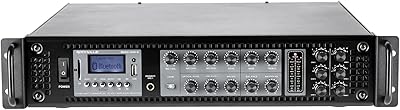
Rockville RCS2-320-6
77%
83%
Zone Independence & Control
86%
Ease of Installation
88%
70V Output Performance
67%
Bluetooth Connectivity
71%
Mic Input & Echo Control
More
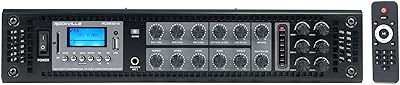
Rockville RCS650-6
Rockville RCS650-6
74%
88%
Value for Money
91%
Ease of Installation
86%
Multi-Zone Functionality
74%
Audio Quality
77%
Build Quality
More
Rockville Rock Party 6 Bluetooth Speaker
85%
88%
Sound Quality
90%
Battery Life
85%
Portability
78%
LED Light Effects
84%
Build Quality
More
Rockville RTB65A 6.5″ Powered Subwoofer
85%
88%
Bass Performance
91%
Installation Ease
85%
Build Quality & Durability
92%
Value for Money
83%
Power Output
More
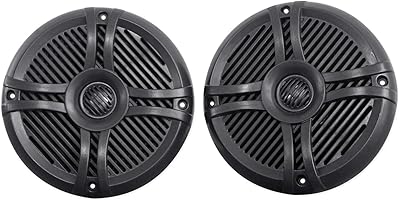
Rockville RSM65B 6.5″ Marine Speakers
85%
88%
Sound Quality
85%
Build Durability
91%
Ease of Installation
87%
Waterproofing Performance
83%
Bass Performance
More
Rockville DBM65 6-Channel Marine Amplifier
86%
89%
Sound Quality
94%
Build Quality
91%
Waterproof Durability
75%
Installation Ease
88%
Power Output
More
Rockville UT65B 6.5″ Marine Speakers
83%
88%
Sound Quality
93%
Waterproof Performance
85%
Build Quality
80%
Installation Ease
76%
Durability
More
Rockville RMSTS65B 6.5″ Marine Speakers
88%
91%
Sound Quality
95%
Durability
89%
Ease of Installation
94%
Waterproof Performance
87%
Bass Response
More
Rockville RVL6KIT 6.5″ Component Car Speakers
84%
88%
Sound Clarity
80%
Bass Performance
94%
Ease of Installation
86%
Build Quality
92%
Value for Money
More
Rockville ROCKBOX 6.5″ 100W Bluetooth Speaker
83%
88%
Sound Quality
91%
Battery Life
84%
Portability
86%
Build Quality
89%
Ease of Use
More

FAQ

It is designed primarily for 70V constant-voltage speaker systems, which are standard in commercial installs. Using standard 8-ohm speakers directly is not the intended use case and could damage the amplifier or produce poor results. If you have 8-ohm speakers, you would need a matching transformer to connect them safely to the 70V output.

That depends on the wattage rating of your 70V speakers and their tap settings. Each zone draws from the shared 350W total output, so you need to add up the tap wattages of all speakers across all zones and stay within that ceiling. A rough starting point is keeping each zone under 50–60W if you are running all six simultaneously.

In open, smaller spaces it holds up reasonably well. The challenges show up in venues with thick concrete or brick walls, multiple floors, or heavy wireless traffic from POS systems and customer devices. In those environments, some users report occasional dropouts beyond 20–30 feet. For a more reliable solution in complex spaces, a wired source like USB or RCA is the safer bet.

The echo controls let you dial the effect down significantly, but fully bypassing it depends on the firmware version your unit ships with. Some buyers have found they cannot get a completely dry, unprocessed mic signal regardless of the settings. If clean mic audio is important for your use case, this is worth verifying with Rockville support before purchasing.

Plenty loud for background music in a typical small-to-mid-size venue. The 350W is shared across all zones, so you are not getting 350W per zone — think more in the range of 50–70W per zone in real-world use. For a dining room or retail floor with properly matched 70V ceiling speakers, that is more than adequate for background and moderate foreground listening levels.

Yes, the 19″ chassis fits any standard equipment rack without modification. It takes up 2U of rack space based on its 4″ height. Just plan for its weight — nearly 32 pounds — and have a second person handy during installation to avoid dropping it into the rack.

Yes, if your TV or streaming device has a digital optical output, you can connect it directly to this commercial amplifier using a standard TOSLINK cable. It is a straightforward connection and works well for venues that want to pipe TV audio into their speaker zones.

Honestly, the gap is real — especially in long-term reliability and internal component quality. Crown and QSC units are built for continuous, years-long commercial duty cycles and backed by stronger support infrastructure. This multi-zone unit makes sense when budget is the primary constraint and the installation is not in a mission-critical or high-traffic environment where downtime would be costly. For light-to-moderate commercial use, many buyers find it delivers solid value; for demanding, high-uptime installs, the premium brands are worth the extra investment.

All zone control is done manually via the front-panel knobs — there is no app, IR remote, or network interface included. If your amp is installed in a back room or locked AV closet, someone will need to physically access it to make adjustments. For most small restaurant or office setups this is fine, but it is a notable limitation if your zones need frequent changes throughout the day.

The USB input supports MP3 files only. There is no support for FLAC, WAV, AAC, or other formats, and there is no display screen to browse tracks or show file names. If your library is in a lossless format, you will need to convert files to MP3 before loading them onto the drive. For basic background music rotation, it works fine; for anything more dynamic, Bluetooth or a dedicated media player is a better option.