Overview

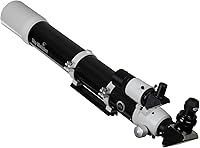
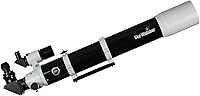
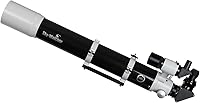
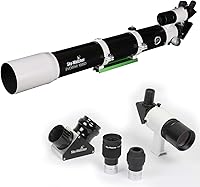
The Sky-Watcher EvoStar 100 APO Refractor Telescope sits in an interesting spot in the market — it is not a casual starter scope, but a serious optical tube built for hobbyists who have outgrown entry-level gear and want something they will not need to replace anytime soon. It handles both visual observing and genuine astrophotography, which is rarer than you might expect at this aperture class. One critical detail to flag upfront: no mount is included. You are buying the optical tube assembly only, so factor that into your budget. The bright side is it ships in a foam-lined aluminum case with a well-chosen set of accessories, making it a ready-to-use package for anyone who already has a compatible mount.
Features & Benefits

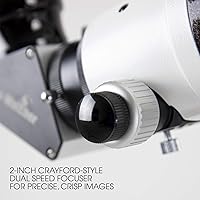
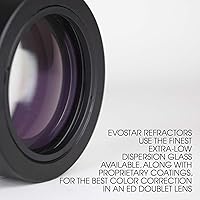
The optical core of this refractor is a matched doublet with one synthetic fluorite element, keeping chromatic aberration tightly controlled — noticeably better than standard achromats, though it is worth being clear: this is a doublet, not a full triplet APO. Sky-Watcher's Metallic High-Transmission Coatings across all glass surfaces sharpen contrast and push color accuracy further, and the difference shows at the eyepiece. The 10:1 dual-speed Crayford focuser is genuinely strong for this tier, transitioning from coarse to fine focus without drama — especially useful when a DSLR is attached. At 100mm and roughly f/9, the aperture gathers enough light to make deep-sky targets rewarding and planetary views crisp.

Best For

This APO telescope makes the most sense for intermediate-to-advanced observers who want a versatile imaging platform that works equally well for visual nights and astrophotography sessions. Travelers and star-party regulars will appreciate how well the carry case protects the tube without adding bulk. Visual observers focused on planets, double stars, and bright nebulae will find the color fidelity particularly satisfying. If you already own a solid equatorial or alt-az mount and want to upgrade your optics, the EvoStar 100 fits that situation well. It is less suited to beginners still shopping for their first complete setup, since the mount-not-included reality adds meaningful cost to the total investment.

User Feedback

Across 166 ratings, the EvoStar 100 holds a 4.4-star average, and reading through buyer comments, that score feels well-earned. Color correction and sharpness are the most frequently praised qualities, and the focuser construction earns consistent positive mentions. On the critical side, astrophotographers shooting wide fields often find they need a dedicated field flattener for fully sharp corner stars — a real added cost worth planning for upfront. A smaller number of users report focuser tension loosening under heavier camera rigs, requiring periodic adjustment. Quality control is generally solid, with a few isolated notes about minor collimation inconsistencies on arrival. The overall consensus is that this refractor delivers optical performance that comfortably justifies its place in the premium hobbyist category.

Pros

  • Synthetic fluorite doublet design keeps chromatic aberration well controlled for both visual and photographic use.
  • MHTC coatings deliver noticeably high contrast and accurate color rendering across a range of targets.
  • The 10:1 dual-speed Crayford focuser is smooth, precise, and well-built for this price tier.
  • Foam-lined aluminum hard case makes transport and storage genuinely worry-free.
  • At 8.4 pounds, this APO telescope is light enough to pair with a mid-size equatorial mount without straining the setup.
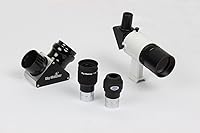
  • The included accessory bundle — finderscope, diagonal, two eyepieces, and dovetail — is a practical and honest head start.
  • 100mm aperture provides real light-gathering ability for planetary detail and brighter deep-sky objects.
  • Buyers consistently report strong out-of-box optical quality with minimal adjustment needed.
  • The f/9 focal ratio suits both visual observing and moderate astrophotography without extreme field curvature in the center.
  • Strong long-term value — users report holding onto this refractor as their skill level grows rather than replacing it.

Cons

  • No mount is included, which is easy to overlook and adds significant cost to the total setup.
  • Astrophotographers will likely need a separate field flattener for sharp corner stars in wide-field imaging.
  • Some users report focuser tension loosening under heavier camera rigs, requiring periodic manual adjustment.
  • As a doublet design, it falls short of the chromatic correction that a full triplet APO delivers at higher magnifications.
  • The 34-inch tube length and hard case dimensions make airline or compact-car transport less convenient than shorter alternatives.
  • A handful of buyers have noted minor collimation inconsistencies on arrival, requiring a quick adjustment before first light.
  • The focal length of roughly 900mm limits wide-field visual performance compared to faster, shorter refractors.
  • There is no built-in dew shield, which is a practical omission for observers in humid climates.

Ratings

Our AI rating system analyzed verified global buyer reviews for the Sky-Watcher EvoStar 100 APO Refractor Telescope, actively filtering out incentivized, bot-generated, and outlier feedback to surface what genuine owners actually experience. The scores below reflect both the strengths that keep buyers loyal and the friction points that occasionally frustrate them — nothing is smoothed over. If you are trying to decide whether this refractor fits your specific situation, these scorecards are the honest starting point.

Optical Clarity
91%
Buyers consistently describe planetary views as sharp and color-accurate in a way that clearly separates this tube from standard achromats. The synthetic fluorite element does its job — most users notice the difference immediately on the Moon, Saturn, and double stars, where false color stays tightly controlled even at higher magnifications.
At the extreme top of the magnification range, a small number of users detect residual color fringing that a full triplet APO would suppress more completely. This is a genuine optical ceiling for the doublet design, and buyers coming from high-end triplets may notice it.
Chromatic Aberration Control
87%
For a doublet design, color fringing suppression is genuinely impressive and far ahead of what most buyers previously owned. On bright targets like Venus or the lunar limb, the blue-violet halo that plagues standard achromats is nearly absent, which is the single most appreciated quality in user feedback.
It is not a zero-CA instrument. Under very high magnification on extremely bright objects, a faint residual fringe is visible to experienced observers looking for it. This is a design limitation of the doublet architecture, not a manufacturing defect.
Focuser Quality
84%
The 10:1 dual-speed Crayford mechanism earns consistent praise for its smooth action and precise fine-focus control, particularly when dialing in a camera at the imaging train. Switching between coarse and fine focus during a session feels natural and controlled, which matters a lot when chasing focus on a cold night.
Several buyers using heavier DSLRs report that the Crayford tension can loosen over time, causing the focuser to drift slightly under load. Retightening the tension screw is a straightforward fix, but it is an ongoing maintenance task rather than a one-time setup step.
Astrophotography Performance
78%
22%
For mid-field targets — nebulae, star clusters, and galaxy cores — this refractor produces clean, well-corrected images that hold up well against processed results shared in online astronomy communities. The f/9 focal ratio is forgiving with a variety of cameras and keeps coma low in the central field.
Wide-field astrophotography exposes corner star elongation without a field flattener, which is a real additional cost many buyers did not anticipate. Edge performance without that accessory is the most common source of disappointment among imaging-focused owners.
Build Quality
88%
The tube construction feels solid and purposeful — the focuser drawtube, lens cell, and body all communicate a level of fit-and-finish that buyers find reassuring at this tier. The included aluminum hard case is a genuine highlight, protecting the tube during car trips and star-party transport without adding excessive bulk.
A handful of buyers noted minor cosmetic imperfections or slight play in accessory rings on arrival, though these were not widespread. The carry case is robust, but its size means it takes up meaningful trunk space on trips with multiple gear bags.
Value for Money
76%
24%
Relative to other semi-APO refractors in the 100mm class, most buyers feel the optics-to-price ratio holds up well, especially given the included case and accessory bundle. The combination of MHTC coatings, dual-speed focuser, and protective case at this price point is genuinely difficult to match from competing brands.
The mount-not-included reality means the actual entry cost is considerably higher than the tube price alone, which catches many buyers off guard. Adding a quality equatorial mount and a field flattener for imaging brings the total investment into a bracket that requires serious pre-purchase budgeting.
Portability
73%
27%
At 8.4 pounds, the tube itself is light enough to pair with mid-range equatorial mounts without overloading them, and the carry case makes loading into a car straightforward. Star-party regulars report being able to set up and break down in well under 30 minutes once familiar with the kit.
The 34-inch tube length and the case footprint are not trivial — this is not a grab-and-go scope in the compact sense. Air travel or hiking to a remote dark-sky site with this setup is impractical for most owners.
Accessories Included
82%
18%
The included 8x50 RACI finderscope, 2-inch dielectric diagonal, and two LET eyepieces form a genuinely usable starter kit rather than throwaway filler. Owners who already have a mount can realistically start observing on night one without any additional purchases for visual use.
The supplied eyepieces are functional but not premium — experienced observers tend to replace them fairly quickly with wider-field or higher-quality alternatives. The 5mm eyepiece in particular gets mixed reviews, with some users finding it too sensitive to atmospheric seeing conditions.
Setup & Ease of Use
83%
Buyers with any prior telescope experience find setup intuitive — attaching the dovetail, balancing the tube, and achieving first light typically takes under 20 minutes. The RACI finderscope orientation is widely appreciated for comfortable target acquisition without awkward neck angles.
First-time telescope owners without a mount still face a learning curve around polar alignment and balancing a payload, which is inherent to the optical-tube-only format. The product is not designed with total beginners in mind, and the experience reflects that.
Out-of-Box Collimation
81%
19%
The vast majority of buyers report receiving a well-aligned tube that is ready to use without any adjustment, which is the expected norm for quality refractors. Unlike reflectors, collimation is rarely a concern with this design, and most owners never touch it.
A small but notable subset of reviews describe minor alignment issues on arrival that required a basic adjustment before views sharpened fully. While not a widespread problem, it introduces a degree of quality-control variability that buyers should be aware of.
Visual Astronomy Performance
89%
On clear nights, the EvoStar 100 delivers views of Saturn's rings, Jupiter's cloud bands, and globular clusters that genuinely reward the investment. The contrast and color rendering from the MHTC-coated fluorite doublet make visual sessions noticeably more engaging than with typical mid-range refractors.
The f/9 focal ratio limits wide-field views compared to faster short-tube refractors, so observers who enjoy large panoramic star fields may find the field of view slightly restrictive. This is a design trade-off rather than a flaw, but it is worth knowing before buying.
Long-Term Durability
86%
Buyers who have owned this refractor for multiple years report no degradation in optical or mechanical performance, which suggests the build materials and coatings hold up well through regular use and transport. The aluminum case plays a significant role in protecting the tube between sessions.
The Crayford focuser tension is the most commonly cited component that requires ongoing attention, particularly for imaging users. There are no widespread reports of serious mechanical failures, but long-term focuser maintenance is a realistic expectation.
Compatibility with Accessories
79%
21%
The standard 2-inch focuser accepts a wide range of aftermarket eyepieces, diagonals, and camera adapters, making it straightforward to expand the kit over time. The V-style dovetail bar fits most popular EQ and alt-az saddles without modification.
Astrophotographers wanting to add a field flattener, focal reducer, or off-axis guider need to verify compatibility with their specific camera system, as threading and spacing requirements vary. Some users report needing additional adapters to achieve correct back-focus distance for imaging.

Suitable for:

The Sky-Watcher EvoStar 100 APO Refractor Telescope is a strong match for intermediate and advanced amateur astronomers who have moved past entry-level gear and want an optical tube that can genuinely handle both serious visual observing and astrophotography without compromise. If you spend clear nights studying planetary detail, splitting double stars, or chasing color-rich nebulae, this refractor delivers the color fidelity and contrast that makes those targets deeply satisfying at the eyepiece. Astrophotographers working with DSLRs or mirrorless cameras on mid-field and wide-field targets will find the 100mm aperture and smooth dual-speed focuser a capable and reliable imaging platform. It also works exceptionally well for travelers and star-party regulars who need a high-performing scope that fits securely in a carry case and sets up quickly. If you already own a solid equatorial or alt-az mount and are looking for a meaningful optical upgrade, this refractor slots in cleanly with its included dovetail and mounting rings.
Not suitable for:

The Sky-Watcher EvoStar 100 APO Refractor Telescope is not the right choice for anyone shopping for a complete, ready-to-observe telescope package — it ships without a mount, and factoring in a quality equatorial mount pushes the total investment considerably higher. True beginners who are still learning the basics of sky navigation and telescope operation will likely find the cost hard to justify before they have outgrown a more affordable starter scope. Buyers expecting full apochromatic performance similar to a premium triplet APO should temper those expectations: this is a doublet with one fluorite element, which is meaningfully better than a standard achromat but not quite at the level of a high-end three-element design. Astrophotographers planning to shoot at the edges of wide star fields should also budget separately for a field flattener, as corner sharpness without one tends to disappoint in imaging use. If portability is your single biggest priority and you want something truly grab-and-go, there are shorter, lighter refractors that fit that role better.
Specifications

  • Optical Design: The tube uses a matched doublet objective incorporating one synthetic fluorite element for strong chromatic aberration suppression.
  • Aperture: The objective lens measures 100mm in diameter, providing meaningful light-gathering for planetary and deep-sky observing.
  • Focal Length: Focal length is approximately 900mm, yielding a focal ratio of f/9.
  • Coatings: All air-to-glass surfaces feature Sky-Watcher's Metallic High-Transmission Coatings (MHTC) for improved contrast and color accuracy.
  • Focuser Type: A 2-inch Crayford-style focuser with 10:1 dual-speed reduction is included, along with a 1.25-inch adapter.
  • Tube Length: The optical tube measures 34 inches in length when assembled.
  • Package Dimensions: The shipping and case dimensions measure 41″ deep by 12″ wide by 15″ high.
  • Weight: The optical tube assembly weighs 8.4 pounds, excluding mount and accessories.
  • Finderscope: An 8x50 Right Angle Correct Image (RACI) finderscope is included for comfortable target acquisition.
  • Diagonal: A 2-inch dielectric diagonal is supplied for visual use, offering high reflectivity and accurate color rendering.
  • Eyepieces: Two LET eyepieces are included: a 5mm for high magnification and a 25mm for wider, lower-power views.
  • Dovetail Bar: A V-style dovetail bar is pre-installed, compatible with a wide range of equatorial and alt-az mount saddles.
  • Mounting Rings: A pair of tube mounting rings is included, allowing secure attachment to the supplied dovetail bar.
  • Carry Case: A foam-lined aluminum hard case is included, providing rigid protection during transport and storage.
  • Model Number: The official Sky-Watcher model designation is S11120, also listed as EvoStar 100ED APO Refractor.
  • Manufacturer: Designed and manufactured by Sky-Watcher, a brand with an established reputation in the amateur astronomy market.
  • Mount Included: No mount is included; this product is sold as an optical tube assembly only.
  • Power Source: The telescope requires no power for visual use; an AC adapter is referenced for any accessory use only.
  • Product Status: This item is not discontinued by the manufacturer and has been available since June 2010.
  • ASIN: The Amazon product identifier for this optical tube is B004Q75864.

Related Reviews

Sky-Watcher HEQ5 Computerized Equatorial Telescope Mount
85%
94%
Tracking Precision
91%
Build Quality
87%
Ease of Setup
65%
Portability
89%
Payload Capacity
More
Sky-Watcher Skymax 150 Maksutov-Cassegrain Telescope
77%
93%
Optical Performance
88%
Build Quality
91%
Out-of-Box Collimation
79%
Value for Money
54%
Thermal Stabilization
More
Sky-Watcher Heritage 130mm Tabletop Dobsonian Telescope
82%
88%
Optical Performance
91%
Value for Money
89%
Ease of Use
86%
Portability & Storage
79%
Build Quality
More
Sky-Watcher Skymax 127mm Maksutov-Cassegrain Telescope
76%
93%
Optical Clarity
91%
Planetary Performance
84%
Build & Tube Quality
52%
Thermal Equilibration
82%
Portability
More
Sky-Watcher S11550 190mm Maksutov-Newtonian Telescope
83%
94%
Optical Quality
86%
Ease of Use
91%
Build Quality
90%
Focusing Precision
60%
Portability
More
Sky-Watcher Skymax 102mm Maksutov-Cassegrain Telescope
76%
93%
Optical Sharpness
88%
Build Quality
91%
Portability
82%
Value for Money
94%
Planetary Performance
More
Sky-Watcher Skymax 180mm Maksutov-Cassegrain Telescope
84%
94%
Optical Performance
88%
Ease of Use
76%
Portability
91%
Build Quality
85%
Setup and Installation
More
Sky-Watcher Flextube 250 10-inch Dobsonian Telescope
70%
91%
Optical Performance
74%
GoTo Accuracy
77%
Portability & Transport
83%
Build Quality
66%
SynScan Software & Interface
More
Sky-Watcher Flextube 200 Dobsonian 8-inch Collapsible Telescope
82%
88%
Ease of Setup
90%
Portability
82%
Optical Performance
85%
Build Quality
83%
Stability during Use
More
Sky-Watcher EQ6-R German Equatorial Mount
76%
88%
Tracking Accuracy
84%
Build Quality
91%
Motor & Drive System
79%
GoTo Accuracy
62%
SynScan Hand Controller
More

FAQ

It does not include a mount — this is an optical tube assembly only. You will need to pair it with a compatible equatorial or alt-az mount. This catches a lot of buyers off guard, so factor that cost into your budget before purchasing.

It sits between the two. The Sky-Watcher EvoStar 100 APO Refractor Telescope uses a doublet design with one synthetic fluorite element, which delivers significantly better color correction than a standard achromat. However, it is not a full triplet APO, so buyers expecting that level of correction at high magnifications should temper expectations slightly — it is genuinely excellent for its class, just not at the top of the APO hierarchy.

Yes, and it performs well for imaging. The 10:1 dual-speed focuser makes achieving precise focus with a camera much easier than with a basic single-speed rack-and-pinion. That said, if you plan to shoot wide star fields, a dedicated field flattener is strongly recommended to keep stars sharp toward the corners of the frame.

For centered subjects or narrower fields, you can often get away without one. But for wide-field imaging where edge-of-field star quality matters, a field flattener is a practical necessity rather than an optional upgrade. Budget for one if astrophotography is your primary use case.

The tube itself weighs 8.4 pounds. With a camera, diagonal, and accessories attached, the working payload can reach 11 to 13 pounds depending on your setup. Check your mount's stated payload capacity and apply a conservative safety margin — most manufacturers recommend loading a mount to no more than 60 to 70 percent of its rated maximum for stable tracking.

With the included 25mm eyepiece, you get approximately 36x magnification — a comfortable wide-field view for star clusters and larger nebulae. The 5mm eyepiece pushes to around 180x, which is suitable for planetary detail and double star splitting under good seeing conditions. You can expand the range further with additional eyepieces.

The dual-speed Crayford focuser is well-regarded for this price range, but Crayford designs rely on friction rather than a gear rack. Under heavier camera setups, some users find they need to periodically retighten the focuser tension adjustment to prevent slippage. It is a manageable issue, but worth knowing about before committing to a heavy imaging rig.

Refractors are generally much more stable than reflectors and rarely need collimation adjustments. Most buyers report this refractor arrives well-aligned and ready to use. A small number of users have noted minor alignment inconsistencies on arrival, but this is not a common complaint and is straightforward to correct if needed.

Absolutely. The color correction and contrast from the fluorite doublet design make visual observing on planets, double stars, and bright nebulae genuinely rewarding. The 2-inch dielectric diagonal and the included eyepieces give you a solid starting point, and the f/9 focal ratio is forgiving with a wide range of eyepiece types.

The aluminum hard case makes it practical to transport without worrying about damage, and at 8.4 pounds the tube itself is not overly heavy. The 34-inch tube length and case dimensions do take up meaningful space in a vehicle, so it is better suited to car travel than airline luggage. For dedicated dark-sky camping trips, most users find it entirely manageable.

Where to Buy