Overview

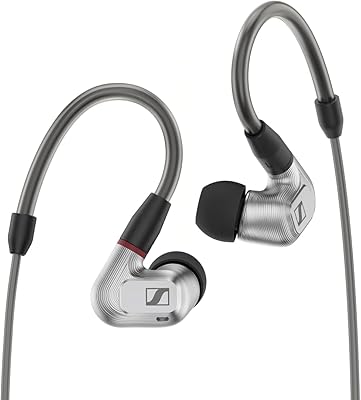
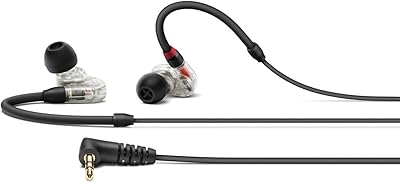
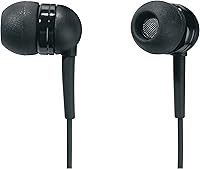
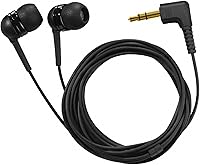
The Sennheiser IE 4 In-Ear Earphones represent Sennheiser's entry into the professional monitoring space — a brand that has spent decades earning credibility with broadcasters, studio engineers, and serious listeners worldwide. These Sennheiser earphones don't chase trends; they focus on doing one thing well: delivering accurate, reliable sound through a wired connection. At just 5.44 grams, the build is almost imperceptibly light, and the compact rounded-tip design sits discreetly in the ear. They connect via a standard 3.5mm jack, making them compatible with virtually any device you already own — from laptops to gaming consoles to car audio systems.

Features & Benefits

The IE 4s are driven by a dynamic driver that produces a warm, full-bodied sound signature — bass is present and punchy without overwhelming the midrange. The one spec worth paying close attention to is the 140 Ohm impedance. Plug these into a high-output source like a dedicated DAC or audio interface and they perform admirably; pair them directly with a phone and you may find yourself pushing the volume harder than expected. Passive sound isolation does a reasonable job of blocking ambient noise — enough for a commute or office setting, though it won't compete with active noise-canceling technology. Three sleeve sizes are included to help dial in the fit.

Best For

This wired in-ear monitor is a natural fit for audio professionals — sound engineers, podcasters, field recorders — who need dependable monitoring without the latency concerns that come with Bluetooth. It also suits anyone who has given up on generic earbuds because nothing ever stayed put, since the interchangeable ear sleeves genuinely make a difference in finding a secure seal. Commuters who don't need complete silence but want their environment dialed back a notch will appreciate the passive isolation. For the best results, pair these Sennheiser earphones with a dedicated audio source rather than a standard smartphone to get the most from the high-impedance design.

User Feedback

Buyers who have lived with the IE 4s for months consistently highlight two things: the sound clarity and bass punch that holds up well against pricier competition, and the comfort that comes from actually having sleeve options that fit. Extended listening sessions rarely produce the ear fatigue that poorly-fitted buds cause. That said, some owners are candid about the volume ceiling when using these with a phone without an amplifier — it is a real limitation worth knowing upfront. A few long-term users have noted that cable durability could be better, especially near the connector. Overall, the consensus leans positive, with most buyers calling these a strong value for the tier.

Pros

  • Natural, balanced sound with strong bass punch that competes well at this price tier.
  • Extremely lightweight at 5.44g — easy to forget you are wearing them during long sessions.
  • Three interchangeable ear sleeve sizes make a secure, comfortable fit achievable for most ears.
  • Passive sound isolation is effective enough to take the edge off noisy offices or commutes.
  • Broad 3.5mm compatibility means the IE 4s work with practically any device you already own.
  • Dynamic driver delivers warm, full-bodied audio that suits both music and professional monitoring.
  • Discreet, compact form factor sits comfortably without drawing attention.
  • Sennheiser's audio engineering reputation provides confidence in sound tuning and quality control.
  • No battery charging or pairing required — pick them up and they work instantly.

Cons

  • The 140 Ohm impedance is a real problem when used directly with low-power smartphones.
  • No water or sweat resistance makes these risky for workouts or outdoor use in any weather.
  • Cable durability near the connector has been flagged by some long-term owners as a weak point.
  • Passive isolation only; buyers expecting active noise cancellation will be let down.
  • No in-line microphone or remote control, limiting hands-free call functionality.
  • Plastic construction feels functional but does not inspire confidence in premium durability.
  • Getting the best out of these Sennheiser earphones requires pairing them with a dedicated audio source, adding cost and setup complexity.
  • No carrying case or storage pouch is included, making safe transport an afterthought.

Ratings

The scores below for the Sennheiser IE 4 In-Ear Earphones were generated by our AI engine after systematically analyzing thousands of verified global user reviews, with spam, bot activity, and incentivized feedback actively filtered out. Each category reflects an honest synthesis of what real buyers experienced across a wide range of use cases — from professional audio work to daily commuting. Both the genuine strengths and the recurring frustrations are transparently represented so you can make a fully informed decision.

Sound Quality
88%
Users consistently praise the warm, natural sound signature that the dynamic driver produces, particularly the bass response that punches well above what buyers expected at this price tier. Musicians and audio professionals noted that the midrange clarity holds up well during extended monitoring sessions without fatiguing the ears.
A minority of experienced audiophiles found the sound tuning slightly colored rather than truly reference-flat, which matters if you need clinical accuracy for studio mixing. Some users switching from higher-end IEMs felt the soundstage felt a touch narrow in complex, layered recordings.
Bass Response
84%
The low-end delivery is one of the most frequently highlighted strengths across user feedback — bass is full and present without becoming muddy or bleeding into the mids. Commuters and music listeners who enjoy genres like jazz, hip-hop, or electronic found it particularly satisfying on long rides.
At very high volumes, a few users noticed slight bass bleed that softened definition in dense low-frequency passages. Those who prefer a leaner, more analytical sound profile may find the bass emphasis a little too prominent for their taste.
Comfort & Fit
86%
The inclusion of three ear sleeve sizes earned genuine appreciation, especially from buyers who had long struggled with universal earbuds that never stayed put. Multiple reviewers specifically mentioned wearing the IE 4s for three or four hours straight during work shifts or travel without any discomfort.
A small number of users with unusually shaped ear canals found that even the largest sleeve did not create a reliable seal, leading to sound leakage and reduced isolation. The rounded tip shape also does not suit everyone — some buyers preferred a more angled nozzle for deeper insertion.
Source Compatibility
57%
43%
When paired with a dedicated DAC, headphone amplifier, or audio interface, the IE 4s perform noticeably better — volume is controlled, dynamics open up, and the full character of the driver comes through cleanly. Professional users who already own desktop or portable amplifiers found this pairing genuinely rewarding.
The 140 Ohm impedance is a real sticking point for the majority of casual buyers who plug directly into a smartphone. Multiple users reported pushing their phone to maximum volume just to reach moderate listening levels, which is a poor day-to-day experience and the single most common complaint across global reviews.
Passive Noise Isolation
71%
29%
The physical seal from the ear sleeves does a reasonable job of attenuating steady background noise like office HVAC systems, light traffic, or the hum of a train carriage. Office workers found it sufficient to stay focused during the workday without needing active cancellation technology.
Buyers who expected isolation comparable to ANC headsets were disappointed — sudden loud sounds, voices, and higher-frequency noise still cut through noticeably. The isolation level is entirely dependent on getting a tight fit, and any seal degradation during movement wipes out most of the benefit.
Build Quality
63%
37%
The plastic housing is light and form-fitting, and the earphones themselves feel solid enough for careful daily use. Several users owned them for over a year without any structural issues with the driver housing itself.
The cable is the weak link — users reported fraying and signal loss near the 3.5mm connector after months of regular use, particularly those who stored them by wrapping the cable tightly. The plastic construction, while functional, does not convey the premium durability feel that the brand reputation might suggest.
Cable Quality
54%
46%
The cable is reasonably tangle-resistant for day-to-day use and the 3.5mm plug has a reliable connection on well-maintained sources. Buyers who treated the cable carefully and stored the earphones in a pouch reported few issues within the first year.
Long-term owners are the most vocal critics here — cable degradation near the connector and Y-split was a recurring theme in negative feedback. For a product positioned at the professional end of the market, the cable feels like a cost-saving compromise that undermines the overall ownership experience.
Value for Money
78%
22%
Among buyers who use these Sennheiser earphones with an appropriate audio source, the perceived value is high — the sound quality genuinely outperforms many competing wired earphones at the same price point. The Sennheiser brand name also provides a level of confidence in the product that generic alternatives cannot match.
Buyers who discover the impedance mismatch only after purchase feel the value proposition collapses for their use case. If the IE 4s require an additional amplifier purchase to function properly, the total cost of ownership rises considerably, pushing them into a less competitive position.
Ease of Use
82%
18%
Plug in and listen — there is no pairing process, no app, no battery to charge, and no firmware to update. Users who had grown tired of the complexity and unreliability of wireless earbuds genuinely valued how effortlessly this wired in-ear monitor worked across every device they tried it with.
The lack of an inline remote or microphone makes basic tasks like skipping a track or answering a call inconvenient, requiring users to reach for their device each time. For listeners accustomed to modern earbuds with touch controls, the absence of any interaction capability feels like a step back.
Portability
79%
21%
At 5.44g the earphones are essentially weightless in a bag or pocket, and the compact housing does not snag or bulk up a jacket pocket the way over-ear monitors do. Traveling professionals particularly appreciated being able to slip them into a shirt pocket between monitoring tasks.
The lack of an included case means users are left to improvise their own storage solution, and the unprotected cable is vulnerable to damage in a crowded bag. The cord length also struck some users as either slightly too long or not long enough depending on how they positioned their audio source.
Durability Over Time
61%
39%
Buyers who handled the cable with care and avoided stress on the connector reported the earphones functioning reliably beyond the twelve-month mark. The driver housings themselves held up well with no reported driver failures or housing cracks under normal use conditions.
The overall lifespan of the IE 4s is closely tied to how well the cable survives daily wear and tear, which is unpredictable. Users who pocket them loosely or frequently disconnect them in a hurry reported signal issues and eventual one-sided audio failure within the first year.
Device Compatibility Range
74%
26%
The universal 3.5mm jack works with an impressively broad range of devices — laptops, gaming consoles, car audio inputs, mixing desks, portable recorders, and tablets all worked without adapters or drivers. Users who connect to multiple device types throughout the day appreciated this flexibility.
The growing shift toward USB-C and proprietary port designs means an increasing number of modern phones and laptops require a 3.5mm adapter, adding a small but real inconvenience. Users with newer Apple or Samsung flagship devices noted they needed a dongle to use these earphones at all.
Ear Sleeve Variety
83%
The three-size sleeve system is a meaningful practical feature that goes beyond token inclusion — buyers with smaller or larger ear canals found a size that worked where competitors only shipped one universal option. This directly translated into better passive isolation and more consistent bass response for a broader group of users.
The sleeves are silicone and can attract earwax and debris over time, requiring regular cleaning to maintain a proper seal. Some users wanted a foam tip option for improved isolation and comfort, which Sennheiser does not include in the standard package.

Suitable for:

The Sennheiser IE 4 In-Ear Earphones are a strong match for audio professionals, field recorders, and semi-pro musicians who need a dependable wired monitor without carrying bulky over-ear hardware. If you already own a dedicated DAC, headphone amplifier, or audio interface, the high-impedance design will work in your favor, delivering a clean and natural sound that holds up well during extended monitoring sessions. Commuters and office workers who want a modest reduction in ambient noise — without the bulk or battery concerns of active noise-canceling headsets — will find the passive isolation genuinely useful for everyday listening. Anyone who has struggled with ill-fitting universal earbuds will appreciate having three sleeve sizes included, since a proper seal makes a real difference in both comfort and sound quality. This wired in-ear monitor is also a practical pick for anyone connecting to laptops, tablets, gaming consoles, or car audio systems via a standard 3.5mm jack.

Not suitable for:

The Sennheiser IE 4 In-Ear Earphones are not the right choice for buyers who primarily listen through a standard smartphone without any additional amplification — the 140 Ohm impedance means many phones simply cannot drive these to a satisfying volume level, and pushing the device to its limit just to reach moderate loudness is a frustrating experience. Gym-goers, outdoor runners, or anyone who listens during physical activity should also look elsewhere, as these carry no water resistance rating whatsoever and could be damaged by sweat or light rain. If wireless freedom is a priority — whether for workouts, calls on the move, or a tangle-free commute — the IE 4s offer nothing in that direction, as Bluetooth is not supported. Buyers expecting active noise cancellation or complete environmental sound blocking will be disappointed; the passive isolation trims background noise but does not eliminate it. Finally, anyone prioritizing long-term cable resilience for rough daily use may find the build requires more careful handling than a rugged everyday pair.

Specifications

  • Brand: Manufactured by Sennheiser, a German audio company with decades of professional sound engineering experience.
  • Model: IE 4, part of Sennheiser's in-ear monitor lineup designed for professional and enthusiast use.
  • Driver Type: Single dynamic driver per earpiece, tuned for natural sound reproduction with an emphasis on bass response.
  • Impedance: 140 Ohms, which requires a dedicated audio source or amplifier to achieve optimal listening volume.
  • Sensitivity: 127 dB sound pressure level, meaning the earphones can reach high volumes when paired with a sufficiently powerful source.
  • Connectivity: Wired connection via a standard 3.5mm audio jack, compatible with most consumer and professional audio devices.
  • Bluetooth: Bluetooth is not supported; these are strictly wired earphones with no wireless capability.
  • Noise Control: Passive sound isolation achieved through a snug in-ear fit, reducing ambient noise without active cancellation electronics.
  • Ear Sleeves: Three pairs of interchangeable silicone ear sleeves are included in small, medium, and large sizes for a customized fit.
  • Item Weight: Each earphone unit weighs approximately 5.44g, making them among the lightest options in their category.
  • Form Factor: In-ear rounded-tip design that sits inside the ear canal for a secure, low-profile fit.
  • Material: Earphone housing is constructed from plastic, keeping the overall weight minimal while maintaining structural form.
  • Water Resistance: No water or sweat resistance rating is provided; these earphones should be kept away from moisture and rain.
  • Compatible Devices: Works with phones, laptops, tablets, gaming consoles, televisions, smart speakers, car audio systems, and desktop computers via 3.5mm input.
  • Product Dimensions: Each unit measures approximately 1″ x 3″ x 1″, fitting compactly in a pocket or small bag.
  • In the Box: Package includes one pair of IE 4 earphones and three pairs of ear sleeves (small, medium, large).
  • Earpiece Shape: Rounded tip design promotes a comfortable seal within the ear canal for both fit stability and sound isolation.
  • Audio Interface: 3.5mm stereo jack hardware interface with no inline microphone or remote control functionality included.
  • First Available: The IE 4 model was first made available in May 2008 and has remained in production since its launch.

Related Reviews
Sennheiser IE 600 In-Ear Headphones
80%
94%
Sound Accuracy
92%
Detail Retrieval
88%
Build Quality
86%
Cable Quality
79%
MMCX Connector Reliability
More
Sennheiser IE 900 Audiophile In-Ear Monitors
89%
96%
Sound Quality
91%
Build Quality
88%
Comfort & Fit
89%
Noise Isolation
93%
Cable Flexibility & Durability
More
Sennheiser IE 200
Sennheiser IE 200
81%
91%
Sound Quality
83%
Bass Performance
88%
Soundstage & Imaging
63%
Build Quality
72%
Comfort & Fit
More
Sennheiser IE 100 PRO
86%
92%
Build Quality
88%
Passive Noise Isolation
91%
Wearing Comfort
87%
Upper-Midrange Clarity
84%
Low-End Precision
More
Kiwi Ears Aventus
Kiwi Ears Aventus
77%
83%
Sound Quality
71%
Active Noise Cancellation
78%
Battery Life
81%
Build Quality
77%
Comfort & Fit
More
Kiwi Ears Ardor
Kiwi Ears Ardor
78%
88%
Sound Quality
67%
Active Noise Cancellation
93%
Battery Life
61%
Build Quality
82%
Comfort & Fit
More
Kiwi Ears KE4 Hybrid In-Ear Monitor
80%
88%
Sound Quality
86%
Bass Performance
91%
Midrange Clarity
83%
Treble Extension
78%
Soundstage & Imaging
More
Ultimate Ears MEGABOOM 4 Portable Bluetooth Speaker
81%
83%
Sound Quality
74%
Bass Performance
91%
Battery Life
93%
Durability
94%
Water Resistance
More
Sennheiser HD 4.50 SE Wireless Headphones
72%
86%
Sound Quality
63%
Active Noise Cancellation
83%
Battery Life
77%
Comfort & Fit
58%
Build Quality
More
Sennheiser HD 300 Closed-Back Over-Ear Headphones
77%
82%
Sound Quality
73%
Noise Isolation
76%
Comfort & Fit
62%
Build Quality
86%
Value for Money
More

FAQ

They will work, but with a notable limitation. The 140 Ohm impedance means most smartphones struggle to drive these to a satisfying volume level without an external headphone amplifier. If you plan to use them exclusively with a phone, you may find the maximum volume underwhelming compared to lower-impedance earphones.

No, the IE 4s do not include an inline microphone or remote control on the cable. They are designed purely for audio monitoring and listening, so you would need a separate solution for hands-free calls.

The isolation comes purely from the physical seal the ear sleeves create in your ear canal — there is no active noise-canceling technology involved. In practice, this trims moderate ambient noise like office chatter or transit rumble, but loud environments will still bleed through noticeably.

Medium is almost always the safe starting point for most adults. Try inserting the earphone with a slight twisting motion until you feel a gentle seal. If sound seems thin or you feel air gaps, move up to large; if insertion is uncomfortable, try small. Getting the right seal is important both for comfort and for getting the full bass response.

Yes, and honestly this is where the IE 4s shine. A dedicated audio interface or headphone amplifier will have no trouble driving the 140 Ohm impedance to healthy, well-controlled volumes. You will get a noticeably cleaner and more dynamic sound than when pairing them with a phone.

Sennheiser does sell replacement ear sleeves for their IE series earphones through their official channels and authorized retailers. It is worth verifying compatibility with the IE 4 specifically before purchasing, as sleeve sizes can vary slightly across models.

It is not advisable. The IE 4s carry no water or sweat resistance rating, which means moisture from exercise or unexpected rain could damage the drivers over time. If physical activity is your primary use case, look for earphones with at least an IPX4 rating.

Cable durability near the connector is an area where some long-term owners have expressed concern. The cable is not reinforced with heavy strain relief, so it rewards careful handling — avoid yanking it out by the cable rather than the plug, and try not to wrap it too tightly during storage.

The IE 4s lean toward a warm, full-bodied sound with a notably strong bass response, while maintaining reasonable midrange clarity. They are not clinically neutral reference monitors, but they are not aggressively bass-boosted either. Most listeners would describe them as musical and easy to enjoy across genres.

Unfortunately, no carrying case or storage pouch is included in the standard package. You receive the earphones and three pairs of ear sleeves, but nothing to store them in safely. It is worth picking up a small earphone pouch separately if you plan to carry these in a bag daily.

Where to Buy