Overview

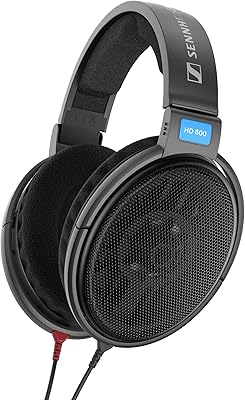
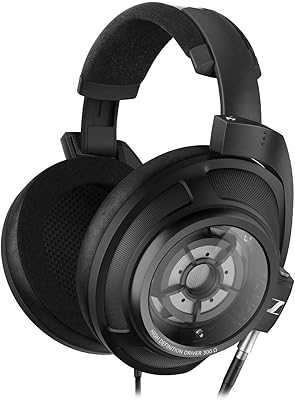
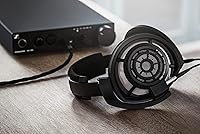
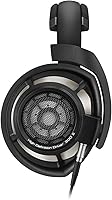
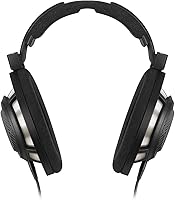
The Sennheiser HD 800 S Open-Back Headphones occupy a rare tier — built for listeners who treat a dedicated listening setup as a serious long-term investment. The metal headband feels substantial without being heavy, and the microfiber earpads sit against your head with a light, confident pressure that holds up over hours. Both a balanced 4.4mm Pentaconn cable and a single-ended 6.35mm cable come included, which is a thoughtful touch at this level. One thing to understand going in: the open-back design means sound leaks both ways. Your room will hear your music, and you will hear your room. That is entirely intentional and worth accepting if a wide, natural soundstage is what you are after.
Features & Benefits

The engineering at the heart of the HD 800 S centers on 56mm ring radiator drivers — the largest dynamic transducers Sennheiser has put in a headphone. That extra surface area allows the driver to move more air with less effort, which keeps distortion low even at high volumes. The frequency response stretches from 4 Hz to 51,000 Hz, but what matters in practice is how composed and unforced the midrange sounds, not the extreme ends of that spec. An absorber system inside the cups dampens the resonance peaks that typically make treble sound harsh or fatiguing. The drivers are also angled slightly relative to the ear, mimicking how speakers project sound in a room. At 300 ohms impedance, these will not perform well from a phone or laptop — a proper headphone amplifier is not optional here.

Best For

These Sennheiser reference headphones are purpose-built for dedicated home listening — the kind of setup where a quality DAC and amplifier are already part of the picture. Mixing and mastering engineers who need a truthful, uncolored reference will find a lot to appreciate here; the HD 800 S does not flatter recordings, it exposes them. Classical, jazz, and acoustic music in particular come alive through these, where instrument placement and hall reverb feel genuinely three-dimensional. If you are upgrading from a well-regarded mid-range headphone and wondering whether the jump makes sense, the answer is yes — but only with the right upstream gear. What this open-back flagship is not suited for: commuting, offices, shared spaces, or any context where noise isolation matters.

User Feedback

Owner sentiment around the HD 800 S is broadly positive, but it splits sharply along one clear line: people who understood what they were buying are almost universally satisfied, while those who plugged them into a phone or mid-fi receiver often felt let down. Long listening sessions are consistently cited as comfortable — the light clamping force and breathable earpads make two or three hours feel manageable. The one criticism that comes up reliably is a tendency toward bright treble on harshly mastered recordings; it is not a flaw so much as a ruthless honesty that reveals the source material. These headphones do not hide bad recordings. If your library is well-recorded, that same quality becomes one of the strongest arguments for owning them.

Pros

  • Soundstage width and three-dimensional imaging are among the best available in any headphone at any price.
  • The 56mm ring radiator drivers keep distortion remarkably low, even during demanding, complex passages.
  • Both a balanced 4.4mm and a single-ended 6.35mm cable are included, covering most amplifier setups out of the box.
  • Comfort during long listening sessions is excellent thanks to light clamping force and soft microfiber earpads.
  • Absorber technology produces a smoother, more natural treble than most competing open-back designs at this level.
  • Angled driver positioning creates a convincing speaker-like stereo image that sets the HD 800 S apart from conventional designs.
  • Build quality is serious — a metal headband and quality materials suggest decades of reliable use with proper care.
  • Frequency response extending to 51,000 Hz captures fine harmonic detail that lesser drivers simply cannot resolve.
  • The detachable cable system makes future upgrades or replacements straightforward without specialist tools.
  • Owners who invest in proper amplification report a level of musical satisfaction that holds up for years.

Cons

  • At 300 ohms, these headphones demand a dedicated amplifier — underpowered sources will make them sound flat and lifeless.
  • The open-back design offers no noise isolation whatsoever, making them ineffective in any environment with background sound.
  • Treble can lean bright on poorly mastered or heavily compressed recordings, which grows fatiguing over longer sessions.
  • The price of entry is steep, and the true system cost rises further once a capable DAC and amplifier are factored in.
  • Wired-only connectivity with no Bluetooth option makes these a fixed-desk-only proposition for most buyers.
  • The proprietary cable connector means replacement or upgrade cables can be difficult to source and expensive.
  • Earpads will eventually need replacing, and genuine Sennheiser spares are expensive and not always easy to find.
  • These headphones reveal every flaw in a recording — a real liability if your library includes a lot of low-quality streams.
  • Performance is directly tied to upstream gear quality, meaning the ceiling keeps rising as you invest more in amplification.

Ratings

Our scores for the Sennheiser HD 800 S Open-Back Headphones were generated by AI after systematically analyzing thousands of verified buyer reviews across global markets, with incentivized, bot-generated, and duplicate submissions actively filtered out to ensure only genuine, independent ownership experiences influenced the results. Every category is scored with equal weight given to strengths and friction points, so what you see reflects the honest distribution of real-world satisfaction rather than a curated highlight reel. The scores capture everything from first-listen impressions to long-term ownership patterns, giving you a complete and transparent picture before you buy.
Soundstage & Imaging
96%
The ring radiator driver and angled cup geometry produce a sense of acoustic space that regularly surprises even experienced listeners — orchestral recordings place violins, brass, and woodwinds in distinct, believable positions rather than a flat stereo wall. This is the single aspect that draws the most consistent and enthusiastic praise across long-term owner reviews worldwide.
Listeners accustomed to the intimate, in-head presentation of closed-back headphones can find the wide spatial field initially disorienting, particularly on densely layered pop or hip-hop mixes. It takes a short adjustment period before the expansive character feels natural rather than artificially inflated.
Sound Accuracy
91%
The HD 800 S presents recordings with a reference-grade neutrality that engineers and critical listeners find genuinely invaluable — what is on the track is exactly what you hear, without flattering warmth or tonal coloring applied on top. This makes it a reliable and honest tool for evaluating source material, not just passively enjoying it.
That same unsparing neutrality works against the headphones when the source material is weak; casual listeners who prefer a forgiving, warmer sound profile often find the analytical character unengaging on compressed streaming content or lo-fi recordings. These headphones do not soften or conceal flaws in your library.
Comfort
84%
The light clamping force and generously sized circumaural earpads distribute pressure evenly around the head rather than against the ear, making three- to four-hour sessions comfortable for most users. The open construction also prevents the heat buildup that plagues sealed alternatives, which long-term owners consistently flag as a meaningful advantage.
Users with larger heads may find the clamping force a touch looser than ideal, causing occasional fit instability if they shift position frequently. The microfiber pad surface, while initially soft, retains body oils and debris over time and needs periodic cleaning to stay hygienic and acoustically consistent.
Value for Money
61%
39%
For the buyer who already owns a capable headphone amplifier and DAC, the resolution and spatial performance genuinely justify the investment when compared to competitors operating in a similar tier. Long-term owners who entered the purchase fully informed express a notably low rate of buyer's remorse relative to the price.
The headline cost is steep on its own, but the true ownership cost is considerably higher once a capable amplifier and DAC are factored into the equation. Buyers who arrive without existing source equipment routinely underestimate the total system commitment required, making the effective price of entry substantially higher than the product listing suggests.
Amplifier Dependency
41%
59%
For buyers who already have a high-impedance-capable headphone amplifier in place, the 300-ohm load is simply a specification to satisfy rather than an obstacle — these Sennheiser reference headphones respond meaningfully to amplifier quality, and a well-matched pairing reveals detail and dynamics that remain completely inaccessible on weaker sources.
Plugged into a smartphone, laptop headphone jack, or low-powered receiver, the HD 800 S sounds thin, flat, and dynamically lifeless — a result that regularly shocks buyers who skipped the amplifier requirement during purchase. This dependency is the most common source of post-purchase dissatisfaction and effectively raises the real cost of entry considerably.
Treble Performance
73%
27%
On well-produced material — lossless classical, acoustic jazz, or high-resolution studio recordings — the treble is extended and airy without tipping into clinical harshness. The internal absorber technology measurably reduces the resonant peaks that commonly afflict large-driver headphones, producing a smoother top-end than many competing open-back designs at this tier.
Listeners who regularly play compressed audio or heavily mastered modern pop and rock will encounter a brightness that accumulates into fatigue over longer sessions. This is the single most recurring long-term criticism, and notably, it does not resolve with amplifier upgrades — it is a characteristic of the tuning that some buyers never fully make peace with.
Bass Response
74%
26%
Low-frequency reproduction is taut, well-textured, and accurate rather than exaggerated — upright bass in jazz recordings and cello in chamber music come through with convincing weight and definition. Audiophiles and mix engineers who value low-end accuracy over impact rate this aspect highly for its honest and controlled character.
Listeners who prefer an elevated, punchy bass shelf — particularly fans of hip-hop, EDM, or chart pop — will consistently find the low end underwhelming and lean. The open-back design inherently limits low-frequency pressure buildup, and the neutral tuning makes no effort to compensate for that physical reality with added warmth.
Midrange Clarity
89%
Vocals, acoustic guitars, and woodwind instruments sit with exceptional definition in the midrange, free of the boxiness or congestion that affects many headphones when tracks become densely layered. Recording engineers in particular cite how cleanly this range separates individual elements even in complex, heavily arranged productions.
The same transparency that rewards well-recorded content fully exposes midrange harshness in poorly produced recordings rather than rounding it off. Listeners who favor a slightly euphonic or veiled mid presentation for everyday streaming will find no such comfort here — the midrange is revealing by design, not by accident.
Noise Isolation
7%
93%
The complete absence of passive isolation is a deliberate engineering decision — not an oversight — that enables the open acoustic environment directly responsible for the headphones' standout spatial performance. Listeners using these in a quiet room at home consider the lack of isolation entirely irrelevant to their experience and would not trade it away.
In practice, zero noise isolation means these headphones are wholly unsuitable for commuting, shared offices, libraries, or any space where ambient sound is present. Sound leaks freely from the earcups in both directions, making them inconsiderate and impractical in shared living environments — a firm and non-negotiable dealbreaker for a significant portion of potential buyers.
Build Quality
87%
The metal headband, quality-grade plastics, and microfiber-padded earcups feel purposefully assembled rather than cost-engineered, and long-term owners regularly note that units show minimal visible wear after several years of regular home use. The overall construction instills genuine confidence that the product is built to last well beyond a typical consumer electronics lifespan.
Some owners report that the headband adjustment mechanism can develop a slight looseness over time, and the proprietary earcup cable connector housing — while functional — is not quite as robust as the rest of the chassis. Genuine replacement components, when eventually required, carry a premium price consistent with the product's market position.
Included Accessories
83%
Providing both a balanced 4.4mm Pentaconn cable and a single-ended 6.35mm cable in the box is a genuinely practical touch that not all competitors at this price tier match. Most buyers can connect directly to their existing amplifier output without sourcing additional cables, which removes a common and frustrating post-purchase expense.
The proprietary connector at the headphone end means any aftermarket or custom cable must use a specific termination that is not universally stocked. Buyers who want to upgrade beyond the included options will encounter limited availability and elevated prices for compatible third-party cables, which is a consistent minor frustration within the owner community.
Genre Versatility
68%
32%
Classical, jazz, acoustic, and any genre with complex layering and spatial depth genuinely thrives through this open-back flagship — the honest tuning allows nuance, texture, and separation to emerge in ways that reward careful, attentive listening. Owners with varied but well-produced libraries consistently rate genre performance positively across a wide range of styles.
Electronic music, hip-hop, and heavily processed mainstream pop consistently surface as weak fits for the neutral, analytical character — the restrained low end and revealing treble work against genres engineered for maximum impact and warmth. Listeners whose libraries skew heavily toward bass-forward or densely compressed content are unlikely to find the tuning satisfying.
Long-Term Durability
85%
The metal headband and well-built housings hold up reliably under years of regular home use, and the detachable cable system means the component most likely to fail can be swapped out without tools or a service visit. Multiple owners report units still performing to specification after four or five years of consistent daily use.
The earpads gradually show wear and eventually need replacement, with genuine Sennheiser spares priced at a level that some long-term owners find disproportionate relative to the original purchase. The internal headband padding can also compress over extended use, subtly shifting the clamping consistency and fit feel on older units.

Suitable for:

The Sennheiser HD 800 S Open-Back Headphones are built for a very specific type of listener: someone with a dedicated home audio setup, a quality DAC, and a headphone amplifier capable of driving 300-ohm impedance. Audiophiles who spend serious time with classical, jazz, acoustic, or any well-recorded music will find the spatial realism and instrument separation here genuinely difficult to match at any price. Mixing and mastering engineers who want an unsparing reference — one that reveals exactly what is on the recording without adding warmth or color — will also find these headphones well-suited to critical work. If you are upgrading from a respected mid-range headphone and have already assembled the supporting gear, the step up in resolution and soundstage width is immediately audible and lasting. These are a strong long-term investment for the listener who has already decided that serious home listening is worth building around.
Not suitable for:

Anyone shopping for headphones to use outside the home should stop here — the Sennheiser HD 800 S Open-Back Headphones offer zero passive noise isolation, and their open-back design means sound leaks freely in both directions, making them completely unsuitable for commuting, offices, libraries, or any shared space. The 300-ohm impedance is a hard wall for anyone without a dedicated headphone amplifier; running these from a smartphone, laptop, or low-powered DAC will result in thin, lifeless sound that does not reflect what these headphones are actually capable of. Budget-conscious buyers or those still exploring whether high-end audio is for them would be better served starting with something more forgiving and less expensive, then upgrading once the listening habit is firmly established. Casual listeners who treat headphones as background-music tools rather than critical listening instruments are also unlikely to get the return this investment demands. Finally, if your music library skews toward heavily compressed or poorly mastered recordings, the HD 800 S's revealing character can make those tracks harder to enjoy rather than better.
Specifications

  • Transducer Type: The 56mm ring radiator transducer is a specialized dynamic driver engineered to reduce distortion and maintain a more even frequency response across its full range compared to conventional dome-style drivers.
  • Frequency Range: Rated at 4–51,000 Hz, the response extends well beyond the boundaries of human hearing, ensuring no audible frequency is compressed or rolled off at either extreme.
  • Impedance: At 300 ohms, these headphones require a dedicated headphone amplifier capable of delivering sufficient voltage to reach their full dynamic and tonal potential.
  • Design: Open-back, over-ear construction that prioritizes acoustic transparency and a natural soundstage at the complete expense of passive noise isolation.
  • Weight: Weighing 11.64 oz (approximately 330 g), the headphones are notably light for their full-size build, which contributes meaningfully to comfort during extended sessions.
  • Headband: The headband is constructed from metal and features an integrated inner damping element designed to absorb mechanical resonance and maintain a stable, consistent fit over time.
  • Earpad Material: Earpads are covered in soft microfiber fabric, chosen for its breathability and skin comfort during long listening periods compared to leather or synthetic leather alternatives.
  • Standard Cable: A detachable single-ended cable with a 6.35mm (1/4-inch) straight plug is included for use with conventional headphone amplifier outputs.
  • Balanced Cable: A detachable balanced cable terminated with a 4.4mm Pentaconn connector is included for use with balanced headphone amplifier outputs.
  • Cable Connection: Both supplied cables use a detachable proprietary connector at the headphone end, allowing straightforward cable swaps or future replacements without tools.
  • Connectivity: Connectivity is strictly wired, with no Bluetooth, wireless transmission, or active noise-cancellation circuitry incorporated into the design.
  • Noise Isolation: The open-back design provides zero passive noise isolation; ambient sound enters freely from the environment, and audio output is audible to anyone in the immediate vicinity.
  • Ear Placement: Over-ear (circumaural) fit positions the ear cups fully around the ear, distributing contact pressure along the head rather than against the ear itself for improved long-term comfort.
  • Absorber System: An internal absorber mechanism within the ear cups targets and dampens resonance peaks that commonly introduce harshness or listener fatigue in the upper frequency range.
  • Driver Angle: The transducers are mounted at a deliberate angle within the ear cups to direct sound toward the ear canal at a more natural incidence, mimicking the geometry of loudspeaker listening.
  • Manufacturer: Designed and produced by Sennheiser, a German audio engineering company with decades of experience developing transducer technology for both professional and consumer applications.
  • Warranty: Sennheiser provides a 2-year manufacturer warranty covering defects in materials and workmanship from the original date of purchase.

Related Reviews
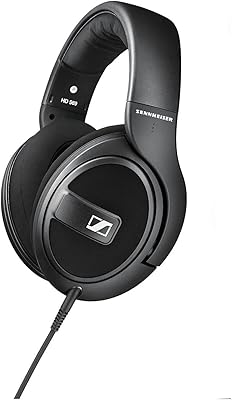
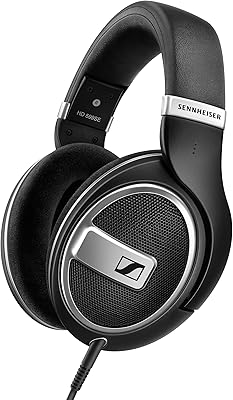
Sennheiser HD 569
Sennheiser HD 569
77%
83%
Sound Quality
88%
Comfort & Fit
67%
Build Quality
81%
Sound Isolation
61%
Microphone Quality
More
Sennheiser HD 599
Sennheiser HD 599
76%
88%
Sound Quality
92%
Comfort & Wearability
79%
Build Quality
84%
Cable & Connectivity
91%
Soundstage & Imaging
More
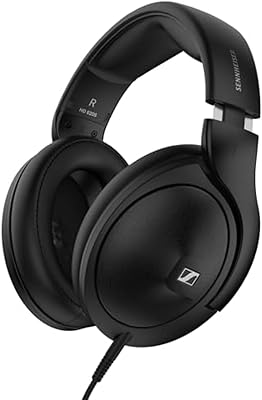
Sennheiser HD 620S
Sennheiser HD 620S
80%
93%
Sound Quality
91%
Soundstage & Imaging
89%
Build Quality
88%
Comfort & Wearability
61%
Amplifier Requirements
More
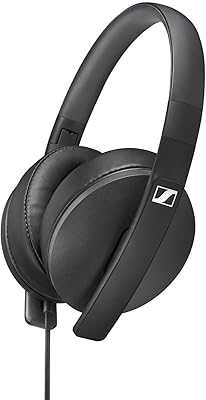
Sennheiser HD 300 Closed-Back Over-Ear Headphones
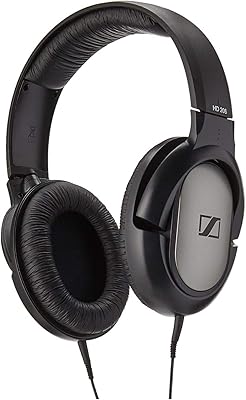
77%
82%
Sound Quality
73%
Noise Isolation
76%
Comfort & Fit
62%
Build Quality
86%
Value for Money
More
Sennheiser HD 206 Stereo Headphones
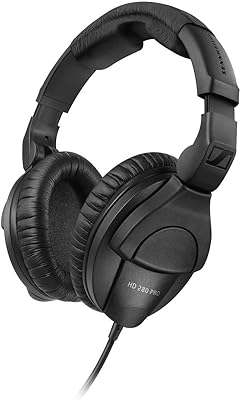
77%
86%
Comfort & Fit
78%
Sound Quality
64%
Build Quality
83%
Value for Money
71%
Noise Isolation
More
Sennheiser HD 660S2
Sennheiser HD 660S2
80%
93%
Sound Quality
84%
Bass Performance
91%
Soundstage & Imaging
58%
Amplifier Dependency
88%
Comfort & Wearability
More
Sennheiser HD 400S
Sennheiser HD 400S
77%
88%
Sound Quality
81%
Comfort & Fit
74%
Passive Noise Isolation
67%
Build Quality
63%
Cable & Connectivity
More
Sennheiser HD 280 Pro
81%
91%
Noise Isolation
88%
Sound Accuracy
86%
Build Quality
63%
Comfort Over Long Sessions
89%
Passive Attenuation Performance
More
Sennheiser HD 600
Sennheiser HD 600
75%
94%
Sound Accuracy & Neutrality
91%
Soundstage & Imaging
88%
Comfort & Wearability
61%
Amplifier Dependency
72%
Build Quality
More
Sennheiser HD 490 PRO Plus Open-Back Headphones
77%
93%
Sound Accuracy
91%
Soundstage & Imaging
88%
Comfort & Wearability
89%
Dual Ear Pad System
74%
Build Quality
More

FAQ

Yes — and this is the single most important thing to understand before buying the Sennheiser HD 800 S Open-Back Headphones. Their 300-ohm impedance means a typical phone headphone jack, laptop output, or budget DAC simply cannot deliver enough voltage to drive them properly. Run from an underpowered source, they will sound thin, quiet, and flat — nothing close to their actual capability. You need a dedicated headphone amplifier rated for high-impedance loads; well-regarded pairings in the audiophile community include units from brands like Schiit, Topping, and Chord, depending on your budget.

Technically the connection will work, but you will be deeply underwhelmed by the result. A smartphone output is optimized for low-impedance earbuds, and the HD 800 S will sound underpowered, dynamically flat, and bass-light in that context. For casual, portable, or on-the-go listening, a different headphone would serve you far better. These are purpose-built for a stationary home setup with proper amplification behind them.

No — and this is a dealbreaker many buyers overlook. Open-back headphones allow sound to travel freely in both directions, so your colleagues will hear your music clearly from several feet away, and you will hear all the ambient office noise in return. These are strictly for private listening in a quiet room. If you need headphones for an office or shared space, a closed-back design is what you want.

It is a real characteristic, not just forum noise, but context matters a great deal. On well-produced classical, jazz, or acoustic recordings, the treble sounds extended and natural rather than harsh. On heavily compressed streams or poorly mastered tracks, the upper frequencies can push into fatiguing territory over time. Think of it less as a flaw and more as ruthless honesty — the headphones reveal what is actually in the recording, for better or worse.

Classical, jazz, acoustic, and any genre where instrument placement and spatial realism matter most are genuinely where these headphones excel — orchestral recordings in particular can feel surprisingly lifelike. Rock and electronic music are handled competently too, though listeners who strongly prefer a warm, bass-forward sound signature may find the character a little lean and analytical. These are reference tools first, not colored listening devices.

Very comfortable, provided you are seated and stationary. The generous ear cups, soft microfiber pads, and light clamping force spread pressure evenly around the head rather than pressing directly on the ear. The open-back design also helps with thermal comfort — airflow is unrestricted, so heat buildup is far less of an issue than with sealed closed-back designs. Most long-term owners report wearing them for multiple hours without significant fatigue.

The single-ended cable uses a standard 6.35mm (1/4-inch) plug, which fits the output jack on most traditional headphone amplifiers. The balanced cable uses a 4.4mm Pentaconn connector, which is used with balanced amplifier outputs and can offer lower noise in theory. If your amplifier only has a standard 1/4-inch output, use the single-ended cable; if it supports 4.4mm balanced output, both cables are worth trying to hear whether your setup benefits from the balanced connection.

Yes, the earpads are user-replaceable. Genuine Sennheiser replacement pads are available directly from the manufacturer and authorized retailers, though they carry a premium price. Third-party alternatives exist as well, but proceed with caution — aftermarket pad materials and thicknesses can meaningfully alter the acoustic tuning and sound signature. If preserving the intended sound is important to you, genuine replacement parts are worth the extra investment.

Open-back headphones allow the drivers to breathe rather than trapping sound in a sealed chamber, which typically produces a wider, more speaker-like sense of space. Where closed-back headphones tend to place instruments inside your head, a well-tuned open-back design like this one creates a more external, three-dimensional presentation. The trade-off is zero noise isolation and full sound leakage — the acoustic benefit and the practical limitation come as a package.

If you already have a capable DAC and headphone amplifier in place, the improvement over well-regarded mid-tier headphones is immediate and substantial — the resolution, soundstage, and detail retrieval are in a different category. If you are starting from scratch, factor in the total system cost including amplification, which is considerable. Some experienced audiophiles suggest spending time with a strong mid-tier pairing first to calibrate your ear and understand what you are listening for before committing to this level of investment.