

Overview

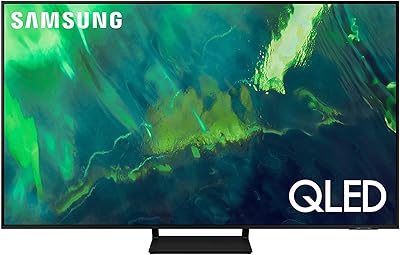
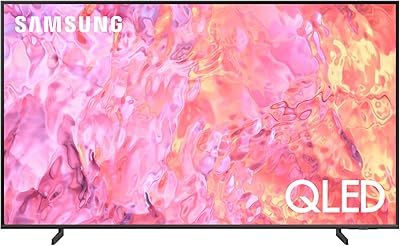
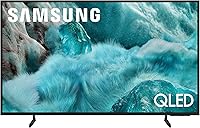
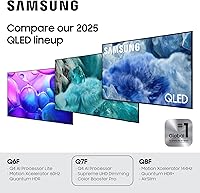
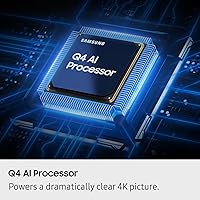
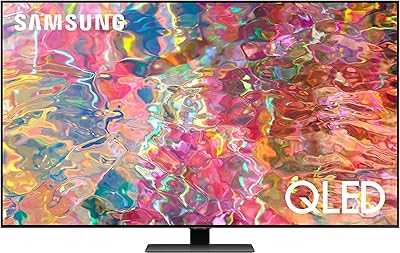
The Samsung 65-inch Q7F QLED 4K Smart TV lands squarely in the mid-range sweet spot — capable enough to outshine budget LED panels, yet priced well below Samsung's own QN85 or QN90 series and far from OLED territory. The Q4 AI Gen1 processor handles picture and audio adjustments automatically, which Samsung markets under its Vision AI umbrella. In plain terms, the TV analyzes what you're watching and tweaks settings accordingly — a useful feature, though not magic. Color performance is genuinely strong for this tier. One honest caveat worth stating upfront: this is a 60Hz panel, and if you're a serious gamer or motion-sensitive viewer, that ceiling will matter.

Features & Benefits

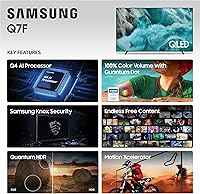
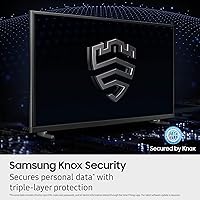
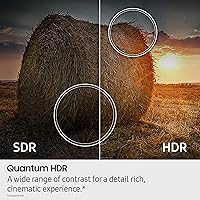
The Quantum Dot layer is what separates this Samsung QLED from a standard 4K LED panel — it sustains rich, accurate colors even when the room is bright, which matters more than spec sheets suggest. HDR10+ content looks noticeably punchy, with dynamic tone mapping working to preserve shadow detail rather than just boosting overall brightness. The Object Tracking Sound Lite system tries to steer audio toward wherever action is happening on screen — subtle, but it adds presence without requiring a soundbar. Samsung Knox quietly handles security in the background, protecting connected devices and stored credentials. And Alexa integration means voice control actually works reliably within a broader smart home setup.

Best For

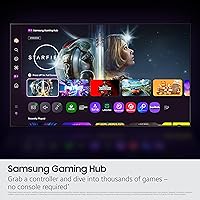
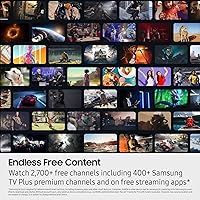
The Q7F is a strong fit for living rooms where color impact and screen size take priority over raw peak brightness. Cord-cutters will appreciate the built-in Samsung TV Plus library — over 2,700 free channels covering news, sports, and movies without adding another monthly bill. If your home already runs on Alexa or Samsung SmartThings, this 65-inch Samsung integrates naturally rather than requiring workarounds. Casual gamers can access titles through the Gaming Hub without a console, though anyone expecting smooth fast-paced gameplay at 120Hz should look elsewhere. It's also a solid pick for households that want a reliable, low-fuss smart TV without managing a complicated subscription stack.

User Feedback

Owners consistently point to vibrant color accuracy and straightforward initial setup as top highlights. The Tizen OS interface gets mostly positive marks for being intuitive, and the free content library draws genuine appreciation. Where criticism surfaces, it tends to cluster around two areas: motion handling in fast sports or action scenes can look soft, and the built-in speakers, while adequate for casual viewing, leave most users reaching for a soundbar eventually. The 60Hz limitation is the most common disappointment among buyers expecting better gaming responsiveness. Compared to similarly priced TCL or Hisense QLED options, Samsung's software ecosystem is often cited as the deciding advantage, though panel-level specs at this tier are genuinely competitive across brands.

Pros

  • Quantum Dot technology delivers genuinely rich, accurate colors that hold up well even in bright rooms.
  • HDR10+ content looks punchy and detailed, with noticeably better shadow preservation than standard HDR.
  • Samsung TV Plus adds over 2,700 free channels right out of the box, no subscription required.
  • Tizen OS is one of the more polished smart TV platforms available, with fast navigation and broad app support.
  • Alexa integration works reliably for voice control and smart home commands without extra hardware.
  • Samsung Knox security runs quietly in the background, protecting passwords and connected IoT devices.
  • Setup is straightforward enough that most users are watching content within 20 minutes of unboxing.
  • The Q7F holds its own against comparably priced TCL and Hisense QLED models, especially on software maturity.
  • Gaming Hub provides casual access to cloud gaming titles without requiring a separate console.
  • At 65 inches, the screen size delivers a strong cinematic presence for living rooms of most standard sizes.

Cons

  • The 60Hz panel is a genuine limitation for gamers — fast motion can look soft compared to 120Hz competitors.
  • No VRR or HDMI 2.1 support means serious console gamers will quickly feel the hardware ceiling.
  • Local dimming performance at this tier is limited, leading to visible blooming in dark high-contrast scenes.
  • Built-in speakers are serviceable but thin for a large screen; most owners end up pairing a soundbar eventually.
  • The Q4 AI Gen1 processor is entry-level within Samsung's lineup, and processing headroom shows during complex scenes.
  • Peak brightness falls short of what premium QLED or mini-LED panels can achieve in HDR highlights.
  • Motion handling in live sports or action sequences can look slightly unnatural without careful settings adjustment.
  • The remote control feels plasticky compared to the TV's overall build quality and lacks a dedicated backlight.
  • Samsung's ad-supported interface can feel cluttered, with promoted content appearing in places users may not expect.

Ratings

The Samsung 65-inch Q7F QLED 4K Smart TV earns a nuanced set of scores below, built by our AI after parsing thousands of verified owner reviews from global markets — with bot activity, incentivized feedback, and duplicate submissions actively filtered out. The results reflect a product that genuinely excels in color performance and smart platform maturity, while carrying real limitations in motion handling and audio output that informed buyers deserve to know about upfront. Strengths and frustrations are weighted equally, so the scores tell the full story.

Color Accuracy
88%
Owners consistently describe the Quantum Dot panel as punchy and rich without looking oversaturated — a balance that is harder to achieve than it sounds. In bright living rooms where many TVs wash out, the Q7F holds its color depth well, which earns it frequent praise from everyday viewers who notice the difference immediately.
Compared to higher-tier QLED panels or OLED displays, color volume at peak brightness can compress slightly in the most demanding HDR scenes. Users with calibration experience note that the default picture modes skew warm, requiring manual adjustment to get the most neutral and accurate result.
Picture Quality
83%
HDR10+ content looks genuinely compelling on the Q7F — dynamic tone mapping does a solid job preserving highlight and shadow detail simultaneously, which makes well-mastered movies and nature documentaries stand out. Most owners coming from older LED sets report an immediate, noticeable upgrade in overall image depth.
Local dimming is limited at this tier, and blooming around bright objects against dark backgrounds is a recurring complaint in night viewing. The panel also lacks the absolute black levels that OLED delivers, which becomes obvious in direct side-by-side comparisons in dim rooms.
Refresh Rate & Motion
54%
46%
For standard broadcast TV, streaming shows, and slower-paced content, 60Hz is entirely workable and the majority of non-gaming owners never feel shortchanged. The motion smoothing options in the settings can help with sports viewing when tuned carefully.
This is the Q7F's most discussed limitation across user feedback. Console gamers and sports enthusiasts who have used 120Hz panels find the motion handling a clear step down, with fast action sequences showing blur that no software setting fully resolves. Buyers cross-shopping with competing 120Hz models at similar prices frequently cite this as their reason for choosing elsewhere.
Gaming Performance
49%
51%
The built-in Gaming Hub is a genuine convenience for casual players who want to stream cloud games without owning a console, and input lag in Game Mode is acceptable for slower-paced or story-driven titles. For someone who games occasionally rather than daily, it covers the basics.
No HDMI 2.1, no VRR, no 4K at 120Hz — for anyone serious about console or PC gaming, these absences are dealbreakers rather than minor inconveniences. Competitive gamers and those with a PS5 or Xbox Series X will quickly feel constrained and are better served by investing in a higher-spec panel.
Smart TV Platform
86%
Tizen OS is one of the more responsive and logically organized smart TV interfaces available, and owners frequently contrast it favorably against the cluttered or sluggish experiences on budget Roku or Android TV sets. App load times are fast, the remote layout makes navigation intuitive, and the overall daily experience feels polished.
Samsung's ad-supported home screen places promoted content and sponsored rows in prominent positions that some users find intrusive and difficult to fully suppress. A small number of owners also report occasional Tizen update-related slowdowns, though these tend to resolve after a restart.
Free Content Value
91%
Samsung TV Plus is one of the strongest free content libraries bundled into any smart TV platform, and cord-cutters in particular highlight it as a major reason they chose this set. Over 2,700 channels covering live news, sports, movies, and niche programming adds real daily-use value with zero ongoing cost.
Channel quality across the Samsung TV Plus library is uneven — premium channels sit alongside low-production filler content, and the interface for browsing free channels can feel less refined than the main app launcher. A reliable broadband connection is required, so households with slower internet may experience buffering on higher-quality streams.
Built-in Audio
61%
39%
For casual TV watching, news, and dialogue-heavy content, the built-in speakers deliver clear, audible sound without requiring immediate supplementation. The Object Tracking Sound Lite feature adds a subtle sense of directionality that modest built-in systems rarely attempt.
Bass response is thin and volume headroom runs out quickly during action scenes or music playback, which is why a majority of long-term owners report eventually adding a soundbar. The speakers handle quiet rooms reasonably well but struggle in larger open-plan spaces where the TV is meant to fill the environment.
Setup & Installation
89%
Unboxing and stand assembly is consistently described as quick and uncomplicated — most users report being up and running within 20 minutes, with the initial software setup wizard walking through Wi-Fi, streaming accounts, and picture preferences in a logical sequence. Wall mounting is equally straightforward with any standard VESA-compatible bracket.
A small number of users report that the initial Tizen setup pushes Samsung account registration quite persistently, which can feel intrusive for those who prefer to skip platform sign-ins. First-time smart TV owners occasionally find the app ecosystem overwhelming without an obvious starting point.
Remote Control
67%
33%
The remote covers all primary functions adequately and dedicated streaming service shortcut buttons are convenient for households that rely on Netflix or Prime Video daily. Voice command activation via Alexa works reliably without needing to navigate menus manually.
The physical build quality of the remote feels noticeably cheaper than the TV itself, with a lightweight plasticky construction that does not inspire confidence. Several users note the lack of a backlit keypad as a frustration in dark rooms, which is an odd omission at this level.
Build Quality & Design
78%
22%
The slim bezel design gives the Q7F a clean, modern look that fits well in contemporary living rooms, and the matte screen finish does a reasonable job of reducing glare compared to glossy alternatives. The overall cabinet construction feels solid enough for everyday household use.
The rear panel and stand materials are visibly cost-reduced compared to Samsung's higher-tier models, which is expected at this price point but worth noting if aesthetics matter to you. The stand footprint is fairly wide, requiring a TV unit with at least 50 inches of usable surface to sit stably.
Connectivity
74%
26%
The mix of HDMI, USB, Ethernet, Wi-Fi, and Bluetooth covers the connectivity needs of most households without requiring adapters or external hubs. Bluetooth pairing with headphones or soundbars is reliable and quick to set up.
The HDMI ports are version 2.0 rather than 2.1, which limits bandwidth for advanced use cases and rules out high-frame-rate gaming as discussed elsewhere. Users with multiple devices sometimes find the number of HDMI inputs just adequate rather than generous.
Security Features
84%
Samsung Knox operates invisibly in the background and provides a level of built-in protection that most competing smart TVs at this tier simply do not offer. Owners who use their TV for banking apps or who have multiple smart home devices connected appreciate knowing there is an active security layer present.
Knox's protections are largely invisible to the average user, making it difficult to verify that it is actively working without digging into settings menus. Some privacy-conscious users also raise questions about Samsung's broader data collection practices, which Knox addresses at the device level but does not resolve at the platform level.
Value for Money
82%
18%
For a 65-inch panel with a mature smart platform, solid color performance, and a robust free content library, the Q7F represents genuinely competitive value in its segment. Buyers who do not need 120Hz or advanced gaming features consistently rate it as a strong purchase relative to what they paid.
The moment you factor in the cost of a soundbar — which most owners eventually add — the total investment climbs noticeably. Competitors like TCL's comparable QLED models sometimes offer higher peak brightness or more local dimming zones at a similar outlay, so value is strong but not uncontested.

Suitable for:

The Samsung 65-inch Q7F QLED 4K Smart TV is a well-rounded choice for households that want a large, colorful screen without venturing into premium pricing territory. It suits living room viewers who watch a mix of streaming content, broadcast TV, and movies, and who value out-of-the-box picture quality without spending hours calibrating settings. Cord-cutters will find particular value here, since Samsung TV Plus delivers a substantial free channel lineup that reduces dependence on paid subscriptions from day one. Smart home users already invested in the Alexa ecosystem or Samsung SmartThings will also find the Q7F integrates smoothly rather than working against their existing setup. Casual gamers who just want to load a title through the Gaming Hub occasionally, without demanding competitive-level responsiveness, will get by fine. Overall, this is a practical pick for families and everyday viewers who prioritize screen size, color vibrancy, and smart platform maturity over raw technical specifications.

Not suitable for:

The Samsung 65-inch Q7F QLED 4K Smart TV has real limitations that make it a poor fit for certain buyers, and it is worth being direct about those. The 60Hz refresh rate is the most significant dealbreaker — console gamers playing fast-action titles or PC users who expect fluid motion will likely feel the constraint within days of setup. Cinephiles who want the deepest blacks and the most precise contrast should look at OLED panels instead, since QLED technology, while vibrant, cannot fully replicate the per-pixel light control that OLED delivers. Buyers in darker viewing environments may also notice the absence of full-array local dimming at this tier, which can cause blooming around bright objects against dark backgrounds. Those who already own a strong soundbar setup will not gain much from the built-in audio, and anyone hoping for future-proof gaming features like VRR or 4K at 120Hz should budget up to a higher-tier panel rather than expecting this Samsung QLED to cover those bases.

Specifications

  • Screen Size: The panel measures 65 inches diagonally, providing a large viewing area suited to living rooms and open-plan spaces.
  • Display Technology: QLED (Quantum Dot LED) technology uses nano-sized quantum dot particles to produce a wide, sustained color spectrum across brightness levels.
  • Resolution: Native 4K UHD resolution (3840 x 2160 pixels) delivers four times the pixel density of a standard 1080p panel.
  • Refresh Rate: The panel runs at a native 60Hz refresh rate, which is adequate for most streaming and broadcast content but below the 120Hz threshold preferred for fast gaming.
  • Processor: The Q4 AI Gen1 chip handles real-time picture and audio optimization, adjusting output based on the detected content type.
  • HDR Support: Compatible with both HDR10+ and Quantum HDR standards, using dynamic tone mapping to adapt contrast and brightness scene by scene.
  • Sound System: Object Tracking Sound Lite directs audio output to follow on-screen movement, distributing sound spatially through the built-in speaker array.
  • Smart Platform: Runs Samsung's Tizen OS, which includes the Samsung Gaming Hub, native streaming apps, and the Samsung TV Plus free channel service.
  • Voice Assistant: Alexa is built directly into the TV, enabling voice commands for content search, smart home control, and general queries without an external device.
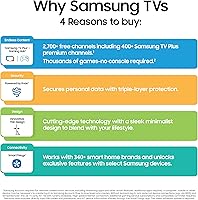
  • Security: Samsung Knox provides triple-layer protection covering app integrity, phishing defense, and encrypted storage of sensitive credentials and IoT device data.
  • Free Content: Samsung TV Plus delivers access to over 2,700 channels, including 400-plus premium channels, at no subscription cost beyond an internet connection.
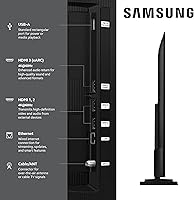
  • Connectivity: Physical and wireless connections include HDMI, USB, Ethernet, Wi-Fi, and Bluetooth for broad device and network compatibility.
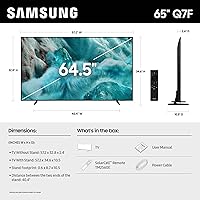
  • Dimensions: With the stand attached, the TV measures 57.2″ wide, 35.6″ tall, and 10.5″ deep, requiring adequate stand surface or wall clearance.
  • Weight: The set weighs 37.7 pounds with the stand, which is manageable for two-person installation but worth noting for wall-mount bracket load ratings.
  • Model Number: The official Samsung model identifier is QN65Q7FAAFXZA, which should be referenced when sourcing compatible mounts, remotes, or accessories.
  • Included Items: The box contains the TV unit, a power cable, remote control, stand hardware, and a printed user manual.
  • Aspect Ratio: Standard 16:9 widescreen aspect ratio, matching the native format of most streaming, broadcast, and physical media content.
  • Color: The cabinet and stand are finished in black, with a slim bezel design intended to reduce visual distraction around the panel.

Related Reviews

Samsung The Frame LS03F 65-inch 4K TV
77%
94%
Aesthetic Design
81%
Art Mode Quality
88%
Matte Screen Performance
76%
Picture Quality
79%
Gaming Performance
More
Samsung Q80B 65-inch QLED 4K TV
78%
88%
Picture Quality
91%
Gaming Performance
83%
HDR Performance
67%
Local Dimming
76%
Smart TV & Interface
More
Samsung 65-Inch Neo QLED QN70F 4K Smart TV
86%
94%
Picture Quality
91%
Gaming Performance (144Hz)
86%
Smart Features & Alexa Integration
89%
Build Quality
88%
Ease of Setup
More
Samsung 50-inch Q7F QLED 4K Smart TV
75%
86%
Picture Quality
78%
HDR Performance
83%
Color Accuracy
61%
Motion Handling
54%
Gaming Performance
More
Samsung 65-Inch Q70A QLED 4K Smart TV
80%
83%
Picture Quality
91%
Gaming Performance
86%
Motion Handling
71%
HDR Performance
74%
Smart TV & Software
More
Samsung 65-Inch QLED 4K TV Q60C
86%
94%
Picture Quality
91%
Gaming Performance
87%
Ease of Setup
88%
Smart Features
72%
Sound Quality
More
iFFALCON 65F75 65-Inch QLED 4K Smart TV
76%
83%
Picture Quality
81%
Gaming Performance
74%
HDR Performance
78%
Design & Build
86%
Smart TV & Software
More
Samsung QN85D 65-inch 4K QLED TV
79%
93%
Picture Brightness
74%
Contrast & Black Levels
88%
Color Accuracy
91%
Motion Handling
82%
Gaming Performance
More
Samsung QN95B 65-Inch Neo QLED 4K TV
75%
93%
Picture Brightness
88%
Color Accuracy
76%
Contrast & Black Levels
89%
Gaming Performance
84%
Anti-Glare Effectiveness
More
Samsung 75-Inch QLED Q80B 4K UHD Smart TV
86%
94%
Picture Quality
91%
Gaming Performance
85%
Smart Features & Voice Control
72%
Sound Quality
88%
Ease of Setup
More

FAQ

No, it does not. The panel is capped at 60Hz, so while you can game on it, you will not get the smoother motion that 120Hz TVs provide. If fast-paced gaming is a priority, you should look at Samsung's QN85 or QN90 series instead.

The Q7F includes multiple HDMI inputs, but they are HDMI 2.0 rather than 2.1, which means no support for 4K at 120Hz or VRR pass-through. For most streaming and casual use this is perfectly fine, but it is a real limitation for next-gen console gaming.

Absolutely. Samsung TV Plus is built right in and gives you access to thousands of free channels covering news, sports, movies, and entertainment without entering a credit card. It works well as a standalone cord-cutting setup, especially paired with a streaming app or antenna.

It has Alexa built in, but native Google Assistant support is not included. You can work around this by connecting a Google Nest or Chromecast device externally, but for built-in voice control, Alexa is what the TV natively supports.

You do not need one to get acceptable audio, but many owners do end up adding one after a few weeks. The built-in speakers handle dialogue and general TV watching reasonably well, but they lack bass depth and volume headroom for movies or music.

Stand setup is quick and most users get it done in under 20 minutes with the included hardware. For wall mounting, the TV uses a standard VESA pattern, so any compatible bracket will work — just confirm the bracket supports at least 37.7 pounds before buying.

Yes, all the major streaming services are available natively through the Tizen app store, including Netflix, Disney Plus, Prime Video, Hulu, and Apple TV. The interface is responsive and app loading times are quick on a decent Wi-Fi connection.

Knox is Samsung's built-in security layer that protects against malicious apps, phishing attempts, and unauthorized access to saved data. It runs automatically in the background and does not require any manual configuration from the user.

At this price tier, TCL and Hisense often match or beat the Q7F on raw panel specs like peak brightness and local dimming zones. Where this 65-inch Samsung tends to pull ahead is software polish — Tizen OS is more refined than Roku TV or Google TV on competing sets, and Samsung TV Plus is one of the better free content platforms available.

Yes, quite easily. Alexa is built in for voice-based smart home control, and the TV supports Samsung SmartThings, which allows it to work with a wide range of compatible bulbs, locks, thermostats, and other IoT devices directly from the TV interface.