Overview

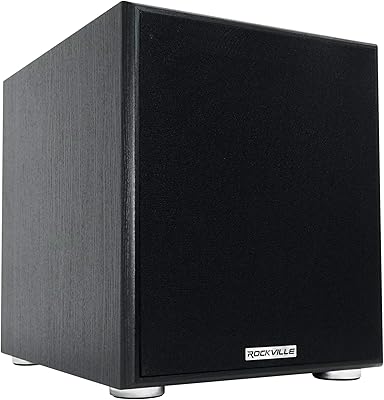
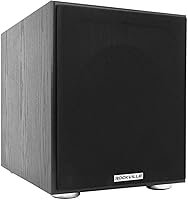
The Rockville Rock Shaker 8″ Powered Subwoofer is Rockville's answer to a straightforward question: can you get real, room-filling bass without spending a fortune? Rockville has built its reputation selling value-oriented audio gear, and this compact powered sub fits squarely in that tradition. The 8-inch driver is a practical choice for small-to-medium rooms — enough to add genuine weight to movies and music without overwhelming a living room. Because the amplifier is built right in, there's no need to budget for a separate receiver channel or external amp. Just know going in that this is an affordable unit, and it performs accordingly — impressively in some areas, with a few honest compromises in others.
Features & Benefits

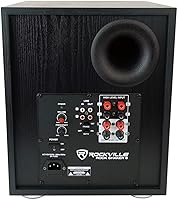
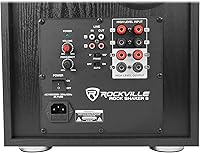
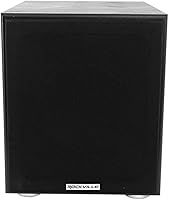
Under the hood, the Rock Shaker 8″ runs a Class-D amplifier rated at 200W RMS — the peak figure of 400W is a marketing ceiling, not a sustained output number, so keep that distinction in mind. Class-D is genuinely useful here: it runs cool, draws power efficiently, and keeps the enclosure compact. The driver itself uses a Y30 magnet and a 1.5-inch, 4-layer voice coil, which helps it track fast bass lines more accurately than cheaper designs. The MDF cabinet with poly fill dampens internal resonance noticeably, contributing to a tighter, less boomy low end. Connectivity covers both RCA line-level and speaker-level inputs and outputs, and the universal voltage support is a quiet but practical bonus.

Best For

This compact powered sub makes the most sense for people who want bass without complexity or a big footprint. It's a natural fit for first-time home theater setups — hook it to a basic stereo receiver via speaker-level inputs and you're done in minutes. Apartment renters who can't justify a massive 12-inch sub will appreciate that it delivers real low-end impact without shaking the walls. Gamers who want explosions and engine rumble to feel more physical will get that here. Karaoke nights and casual TV watching are genuinely improved. If you're chasing audiophile-grade accuracy or reference-level output, this isn't the right tool — but for everyday entertainment in a smaller space, it holds its own.

User Feedback

Buyers consistently highlight how much bass this Rockville subwoofer produces relative to what it costs, and the easy, no-guesswork setup earns frequent praise from first-timers. The MDF cabinet feels solid for the price tier, and most people are satisfied with the build after unboxing. That said, a few recurring concerns are worth flagging. The signal-to-noise ratio of 85 dB is modest — at higher volumes, some users detect a faint background noise floor. The listed frequency response of 200 Hz also stands out as unusually high for a dedicated subwoofer; most subs cross over well below that, so take that spec with some skepticism. Overall, the dual-input flexibility gets consistent appreciation from users with mixed or older receiver setups.

Pros

  • Delivers surprising bass impact for a budget 8-inch sub in small-to-medium rooms.
  • Built-in Class-D amplifier means no separate amp purchase — just plug in and play.
  • Speaker-level and RCA inputs together make it compatible with a wide range of older and newer receivers.
  • The MDF cabinet with poly fill reduces boxy resonance noticeably compared to cheaper plastic-bodied alternatives.
  • Setup is genuinely fast — most buyers are up and running in under fifteen minutes.
  • Compact enough to fit under a TV console or beside a media shelf without taking over the room.
  • Universal 110–240V voltage support is a practical bonus for international buyers or frequent movers.
  • The 4-layer voice coil and Y30 magnet combination gives the driver better transient response than basic budget designs.
  • For gaming and casual movie watching, the low-end punch is immediately noticeable and satisfying.

Cons

  • At 85 dB signal-to-noise ratio, a faint noise floor becomes audible at higher volume settings.
  • The 400W peak power figure is a ceiling, not a working output — sustained power is 200W RMS, which is a meaningful distinction.
  • The listed 200 Hz frequency response spec is unusually high for a subwoofer and raises questions about crossover behavior.
  • Bass definition breaks down noticeably when pushed past roughly 75 percent of maximum volume.
  • No wireless connectivity limits integration with modern Bluetooth or Wi-Fi-based audio systems.
  • Long-term reliability past the one-year mark has drawn mixed reports, particularly around the amplifier board.
  • The control knobs feel plasticky and lightweight, undercutting the otherwise solid build impression.
  • Larger rooms quickly expose its power and displacement limits — it simply cannot pressurize a big open space.

Ratings

The ratings below for the Rockville Rock Shaker 8″ Powered Subwoofer were generated by our AI engine after analyzing thousands of verified buyer reviews from global markets, with spam, incentivized, and bot-generated feedback actively filtered out. Every score reflects the real distribution of user sentiment — the genuine highs and the recurring frustrations — so you get an honest picture before you buy.
Bass Output for Size
83%
For an 8-inch driver at this price, buyers are consistently surprised by how much low-end punch it produces in small living rooms and bedroom setups. Movies and gaming sessions feel noticeably more physical, and casual listeners report the kind of chest-felt thump they were hoping for.
Push the volume into the upper third of its range and the bass starts to lose definition, sounding more like blunt force than controlled low-end. Larger rooms expose its limitations quickly — it simply does not have the displacement to pressurize a big open space convincingly.
Value for Money
88%
Most buyers feel they received more than they paid for, particularly those coming from soundbars or TV speakers with no dedicated bass at all. The jump in perceived audio depth is immediate and hard to argue with at this price tier.
Buyers who stretch their expectations toward mid-range subwoofer performance will feel the ceiling. The value proposition holds only when the purchase is framed correctly — as an entry-level sub, not a competitor to pricier dedicated home theater hardware.
Ease of Setup
91%
First-time subwoofer owners repeatedly call out how straightforward the installation process is. Whether connecting via RCA to a receiver or running speaker wire directly, the hookup takes under fifteen minutes with no manual-diving required.
A small number of users with older or less common receiver configurations found the lack of detailed documentation frustrating. The included setup guide is minimal, and troubleshooting connector compatibility can trip up buyers who are new to audio wiring.
Build Quality
74%
26%
The MDF cabinet feels more substantial than buyers expect from a unit in this price range. The finish is consistent, the driver is securely mounted, and nothing rattles out of the box — a meaningful baseline that many budget alternatives fail to meet.
Some buyers notice the cabinet corners and rear panel feel slightly less refined up close, and the control knobs have a plasticky resistance that undermines the otherwise solid impression. Long-term durability beyond two or three years is a genuine open question for heavy daily users.
Connectivity Flexibility
86%
Having both RCA line-level and speaker-level inputs and outputs in one unit is genuinely useful. Users with older stereo receivers that lack a dedicated subwoofer output appreciate the speaker-level option, which would otherwise require a separate adapter or a different sub entirely.
There is no wireless or Bluetooth connectivity, which is an increasingly common expectation even at budget price points. Users trying to integrate this into a modern wireless speaker ecosystem will find themselves limited to running physical cables through their space.
Low-End Clarity & Accuracy
61%
39%
For casual listening — action movies, pop music, gaming sound effects — the bass response is enjoyable and punchy enough that most buyers have no complaints. It fills the low-frequency gap left by bookshelf speakers with enough warmth to satisfy non-critical ears.
Listeners who pay close attention to bass accuracy, like those mixing music or watching live concert recordings, will notice the low end can sound thick and imprecise. The 200 Hz listed frequency response is an outlier spec that raises questions about crossover behavior at the upper bass range.
Signal-to-Noise Performance
58%
42%
At moderate listening volumes in a typical home environment, the background noise floor is not immediately obvious and most casual users never notice it during normal use. For TV watching and gaming at everyday levels, the 85 dB SNR is workable.
Audiophiles and anyone with a quiet listening room will detect a faint hiss or hum when the sub is powered on at higher gain settings. This is a measurable limitation that the 85 dB SNR rating honestly signals — it is below what most dedicated audio equipment offers.
Volume Headroom
67%
33%
In small-to-medium rooms, this compact powered sub reaches volumes that are more than sufficient for normal home theater use. Party-level listening in a studio apartment or dorm room is entirely achievable without pushing the unit hard.
Once the gain is cranked past about 75 percent of maximum, some buyers report audible strain and a loss of composure in the low frequencies. It is not built for large rooms or loud parties, and treating it as such will expose its power ceiling faster than expected.
Amplifier Efficiency
82%
18%
The Class-D amplifier runs noticeably cool even after extended listening sessions, which buyers appreciate when the sub is tucked into an enclosed media cabinet. It draws power efficiently and does not add meaningfully to the ambient heat in the room.
The 200W RMS rating is the honest working figure, not the 400W peak number that leads the marketing. A handful of buyers who expected the peak figure to reflect real output felt misled, though this is standard industry practice rather than a product-specific issue.
Cabinet Resonance Control
77%
23%
The MDF construction with poly fill does a credible job of controlling internal resonance for a sub at this price. Bass notes sound tighter than equivalent plastic-cabinet units, and panel vibration is minimal at moderate volumes.
At higher volumes, the cabinet does begin to contribute some coloration to the sound — a slightly boxy quality that more experienced listeners will pick up. It is not a dealbreaker, but it is a reminder that MDF and poly fill are budget-appropriate solutions, not premium ones.
Physical Footprint & Placement
85%
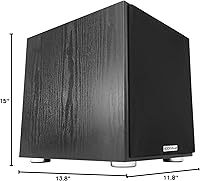
At roughly 12 by 14 by 15 inches and 22 pounds, this Rockville subwoofer is easy to tuck under a TV console, beside a bookshelf, or in a corner without becoming a room centerpiece. The manageable weight makes repositioning for optimal bass placement quick and painless.
While compact by subwoofer standards, it is still a solid block that some buyers in very small apartments find harder to hide than they anticipated. The depth dimension in particular can make it awkward in shallow media cabinet configurations.
Universal Voltage Compatibility
89%
The 110–240V compatibility is a practical and underappreciated feature. International buyers and users who move frequently between countries can bring this sub along without worrying about voltage converters or compatibility issues.
This feature adds no value for the majority of domestic buyers, and a few users outside the US noted that finding compatible power plugs still required an adapter even though the voltage range is universal.
Driver Responsiveness
72%
28%
The combination of a Y30 magnet and a 4-layer voice coil gives the driver faster start-and-stop response than budget subs with simpler motor designs. Bass lines in music and punchy sound effects in gaming feel more immediate and less sluggish as a result.
The improvement is relative — this is still an entry-level driver, and the responsiveness advantage over basic alternatives is noticeable only on content with fast, complex bass content. On simple low-frequency tones, the difference between this and a cheaper driver largely disappears.
Long-Term Reliability
63%
37%
A good number of buyers report using this compact powered sub without issues for a year or more, which is a reasonable baseline for a value-tier unit. The internal amplifier component shows no widespread failure pattern in early-to-mid ownership periods.
Reports of failures after the one-year mark are present enough to be worth noting, particularly around the amplifier board rather than the driver itself. Rockville's limited warranty covers a defined window, and buyers who rely on it heavily for daily use should set expectations for a finite lifespan.
Frequency Spec Transparency
44%
56%
Some buyers appreciate that the unit lists a specific frequency response figure at all, which at least gives a starting point for understanding its target operating range. For casual buyers, the listed spec is rarely the deciding factor anyway.
The listed 200 Hz upper frequency response is an eyebrow-raiser for anyone familiar with how subwoofers are typically designed and spec'd. Most dedicated subs operate well below that crossover point, and this spec either reflects an unusually high crossover design or a measurement condition that does not reflect typical use — either way, it warrants skepticism.

Suitable for:

The Rockville Rock Shaker 8″ Powered Subwoofer is a strong pick for anyone stepping into home theater audio for the first time and working with a modest budget and a small-to-medium-sized room. Apartment renters who want a meaningful bass upgrade from their TV speakers without buying a full surround sound stack will find it hits the right balance of output and footprint. Gamers who want explosions and engine rumble to land with some physical impact — but who are not chasing studio-grade accuracy — will get exactly that from this compact powered sub. It also works well in karaoke setups, casual movie nights, and any shared living space where bass improvement matters more than critical listening. If you have an older stereo receiver without a dedicated subwoofer output, the speaker-level input on the Rock Shaker 8″ is a genuinely practical feature that saves you from needing additional adapters or a system overhaul.
Not suitable for:

The Rockville Rock Shaker 8″ Powered Subwoofer is not the right tool for buyers who take audio accuracy seriously or who plan to use it in a large, open living space. Audiophiles, home studio owners, and anyone mixing music or evaluating recordings will quickly notice the limitations — the 85 dB signal-to-noise ratio introduces an audible noise floor at higher gain levels, and the bass clarity under demanding content is not what more expensive, purpose-built subs deliver. The listed frequency response of 200 Hz is an unusual spec for a dedicated subwoofer and deserves healthy skepticism; buyers who expect clean, extended deep bass below 40 Hz may be disappointed. Anyone who needs wireless integration — Bluetooth pairing with a soundbar or smart speaker system — should look elsewhere, as this sub is strictly wired. And if your room is larger than around 250 square feet, this Rockville subwoofer will likely feel underpowered before you reach a satisfying listening volume.
Specifications

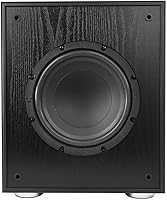
  • Driver Size: The subwoofer uses an 8″ high-excursion dynamic driver designed to move significant air volume for its cabinet size.
  • Peak Power: The built-in amplifier is rated at 400W peak, which represents a short-term ceiling rather than a sustained operating figure.
  • RMS Power: Continuous RMS output is 200W, which is the honest working power figure for everyday listening conditions.
  • Amplifier Class: A Class-D amplifier is used internally, offering high energy efficiency, minimal heat generation, and a compact circuit footprint.
  • Voice Coil: The driver is equipped with a 1.5-inch, 4-layer voice coil that improves motor control and transient response compared to single-layer designs.
  • Magnet Type: A Y30 ferrite magnet provides the magnetic field for the driver, delivering consistent force across the excursion range.
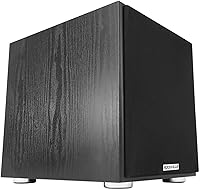
  • Cabinet Material: The enclosure is constructed from MDF (medium-density fiberboard) and filled with fire-resistant poly fill to reduce internal resonance.
  • Dimensions: The cabinet measures 15″ deep, 11.8″ wide, and 13.8″ tall, making it manageable for placement under media consoles or in room corners.
  • Weight: The unit weighs 22 pounds, which is light enough for a single person to reposition without difficulty.
  • Impedance: Driver impedance is rated at 4 ohms, which is a standard load for the integrated Class-D amplifier.
  • Signal-to-Noise: The signal-to-noise ratio is specified at 85 dB, which is a modest figure that may produce an audible noise floor at higher gain settings.
  • Inputs: Both RCA line-level and speaker-level inputs are provided, allowing connection to a wide range of receivers and amplifiers.
  • Outputs: Matching RCA line-level and speaker-level outputs allow the sub to pass signal through to additional speakers or a second subwoofer.
  • Input Voltage: The unit supports universal voltage input from 110V to 240V, making it compatible with power standards across most countries.
  • Power Source: The subwoofer operates on AC mains power and ships with a standard IEC power cable.
  • Surround Config: The unit is designed to integrate into 5.1 surround sound configurations as the low-frequency effects channel.
  • Connectivity: All audio connections are wired; there is no wireless, Bluetooth, or Wi-Fi pairing capability.
  • Color & Finish: The cabinet is finished in black, with a consistent surface treatment across all panels.
  • Warranty: Rockville provides a limited warranty covering manufacturing defects for a defined period from the date of purchase.
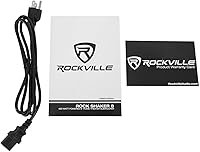
  • Included Accessories: The package includes one standard IEC power cable; no RCA cables or speaker wire are included in the box.

Related Reviews
Rockville Rock Shaker 6.5
69%
67%
Bass Performance
83%
Value for Money
61%
Build Quality
78%
Sound Tuning & Controls
88%
Setup & Installation
More
Rockville Rock Shaker 10″
78%
86%
Bass Output
91%
Value for Money
83%
Amplifier Performance
88%
Connectivity Options
67%
Crossover & Controls
More
Rockville Rock Shaker 12 Powered Subwoofer
78%
88%
Bass Output
91%
Value for Money
83%
Build Quality
79%
Ease of Setup
86%
Crossover Flexibility
More
Rockville RTB80A 8″ Powered Car Subwoofer
69%
88%
Ease of Installation
71%
Bass Output
82%
Value for Money
67%
Build Quality
44%
Power Accuracy
More
Rockville RMW8A 8″ 800W Powered Truck Subwoofer
85%
90%
Bass Performance
88%
Ease of Installation
85%
Sound Clarity
89%
Build Quality
91%
Portability & Size
More
Rockville Wheel of Bass 8″ Powered Subwoofer
74%
89%
Ease of Installation
67%
Fit & Clearance Compatibility
72%
Bass Output & Impact
84%
Sound Tuning Flexibility
76%
Remote Bass Knob Usability
More
Rockville Rock Party 8 Dual 8″ Bluetooth Speaker
83%
87%
Sound Quality
82%
Battery Life
75%
Portability
90%
Ease of Use
80%
Build Quality
More
Kanto SUB8 8-inch Powered Subwoofer
80%
89%
Bass Accuracy
67%
Low-End Extension
91%
Speaker Integration
83%
Build Quality
86%
Setup & Ease of Use
More
Rockville RTB10A 10″ Powered Subwoofer
83%
91%
Sound Quality
88%
Bass Performance
75%
Ease of Installation
86%
Build Quality
82%
Durability
More
Rockville RTB12A 12-Inch Powered Car Subwoofer
72%
78%
Bass Impact
86%
Ease of Installation
81%
Value for Money
61%
Build Quality
63%
Sound Quality
More

FAQ

No — the amplifier is already built in, which is the whole point of a powered subwoofer. You can connect it directly to a receiver, stereo amp, or even a TV with a subwoofer output. No external amplification is needed.

Yes, and this is actually one of the more useful things about this compact powered sub. The speaker-level inputs let you run speaker wire directly from your receiver's left and right speaker terminals into the sub, bypassing the need for an RCA or LFE output entirely. It is a genuinely practical feature for older or entry-level receivers.

Honestly, it depends on how large. For rooms up to around 200 to 250 square feet, it performs well at normal listening volumes. In larger, open-plan spaces, it will likely feel underpowered before you reach a satisfying bass level — a bigger driver or a higher-powered unit would serve you better in those conditions.

Not quite. The 400W figure is a peak rating — essentially a momentary ceiling the amplifier can briefly touch under ideal conditions. The real number to pay attention to is 200W RMS, which is the continuous working output during normal use. This distinction is common across the audio industry, so do not treat the peak number as a reliable measure of everyday performance.

That spec does stand out — most dedicated subwoofers are designed to operate well below 200 Hz, typically crossing over somewhere between 80 and 120 Hz. The 200 Hz figure listed for this sub is unusually high and may reflect the upper boundary of its crossover range or a specific test condition. For most home theater and casual listening use it performs fine, but if you need precise low-frequency extension below 40 Hz, manage expectations accordingly.

Yes, and it works well for that purpose. If your console is connected to a receiver or an amplifier with a subwoofer output, just run an RCA cable from the sub out to the Rock Shaker 8″. The bass impact on explosions, engine rumble, and cinematic sound effects is noticeably more physical, which most gamers find immediately satisfying.

At moderate volume levels, most users do not notice anything problematic. That said, the 85 dB signal-to-noise ratio is a relatively modest spec, and in a quiet room with the gain turned up higher, some users have reported a faint background hiss. If you are sensitive to noise floors or plan to use this in a dedicated listening room, it is worth keeping that limitation in mind.

It is about as straightforward as this category gets. If your receiver has a subwoofer or LFE output, you run a single RCA cable and you are done. If not, the speaker-level inputs handle the connection with standard speaker wire. Most first-time users report being set up and playing audio within fifteen minutes. The included documentation is minimal, so a quick online search for your specific receiver model can help if you hit a snag.

The internal power supply supports 110V to 240V, so the electronics are compatible with most countries worldwide. The main thing you may need is a plug adapter to match the local outlet shape — the standard IEC power cable included in the box will fit most regional plugs with the right adapter, which is inexpensive and easy to find.

The MDF cabinet itself is solid and well-received by most buyers for the price tier. Where durability questions tend to surface is around the amplifier board after extended heavy use, with some owners reporting issues past the one-year mark. If you use it at moderate volumes for everyday entertainment, the odds are good it will serve you well for a couple of years. Treating it as a long-term investment piece would be setting expectations too high, but as a value-tier sub it holds up reasonably in normal use.

Where to Buy