Overview

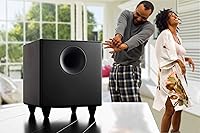
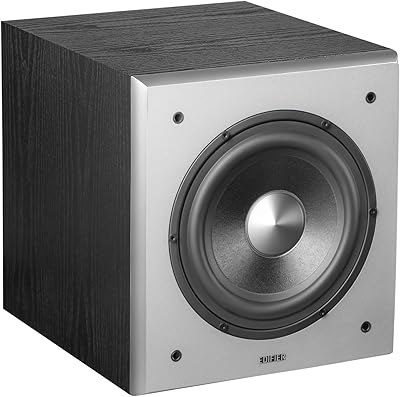
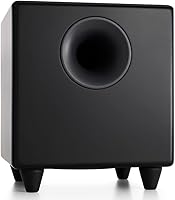
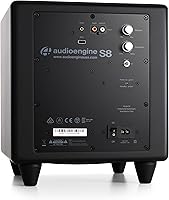
The Audioengine S8 Subwoofer has been quietly earning its place in serious listening rooms since 2008, which says something in a market where products come and go fast. This powered subwoofer was built to drop into an existing setup without fuss — dual RCA inputs, a straightforward gain control, and a hand-finished MDF cabinet that feels far more substantial than anything in its class. It is wired-only, and that is a deliberate choice; the signal stays clean, the setup stays simple. At this price tier, buyers expect build quality that lasts a decade, and the S8 largely delivers on that expectation.
Features & Benefits

The S8 runs a Class D amplifier rated at 250 watts, keeping distortion below 0.05% across all power settings — numbers that matter more than peak wattage claims. Bass extension reaches down to 27Hz, which is genuine sub-bass territory rather than just marketing copy. The adjustable crossover, spanning 50Hz to 130Hz, lets you blend this compact sub naturally with almost any main speakers, and the 0/180-degree phase switch handles the room acoustic variables that trip up lesser units. The SNR exceeds 95dB, so even at low volumes the noise floor stays out of the picture entirely.

Best For

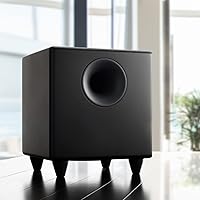
This compact sub is the right call when your bookshelf or desktop speakers are doing everything well except reach the low end. It fits neatly under a desk or beside a sofa without dominating the room — the cube form factor genuinely helps there. Audiophiles who are tired of one-note, boomy bass will appreciate that the S8 prioritizes accuracy over shock value; it adds weight and texture rather than just volume. Gamers and film fans will feel the difference in low-frequency effects, while music listeners will notice how a well-mixed kick drum or bass guitar suddenly makes sense in the mix.

User Feedback

Buyers who pair this powered subwoofer with Audioengine bookshelf speakers consistently report that the integration feels natural right out of the box, with minimal tweaking needed. The build quality draws repeated praise — people notice the cabinet finish and the solid feel of the controls. On the other side, a few users point out that going wireless requires purchasing the W3 adapter kit separately, which feels like an oversight at this price point. The gain knob placement also draws occasional frustration once the unit is tucked into a corner. Minor complaints overall, but worth knowing before you buy.

Pros

  • Bass is tight and musical, blending naturally with main speakers rather than calling attention to itself.
  • Hand-finished MDF cabinet feels genuinely premium and shows no signs of wear after years of use.
  • Adjustable crossover spanning 50Hz to 130Hz makes it compatible with an unusually wide range of speaker pairings.
  • Frequency response reaches down to 27Hz, delivering real sub-bass extension in a compact enclosure.
  • Class D amplifier runs cool and quiet, with a noise floor that stays inaudible even in near-field listening.
  • Cube form factor fits under desks, beside sofas, and into cabinet gaps where rectangular subs cannot go.
  • Setup is straightforward — plug in the RCA cables, dial in the gain, and the S8 is ready within minutes.
  • Phase switch handles room acoustic mismatches that would cause bass cancellation with less flexible subs.
  • Auto-switching power supply works globally without adapters or transformers.
  • Long track record since 2008 gives buyers confidence in real-world durability that newer competitors cannot match.

Cons

  • Wireless connectivity requires purchasing a separate W3 adapter kit — it is not included at any price point.
  • The gain knob sits on the rear panel, making adjustments genuinely awkward once the unit is tucked into position.
  • No LFE input limits compatibility with some AV receiver setups that expect a dedicated subwoofer output channel.
  • At 30 pounds, repositioning this compact sub is more physical effort than its size suggests.
  • No app control, digital EQ, or preset memory means re-tuning by ear every time you change speaker pairings.
  • Only available in black, which restricts matching flexibility for lighter or wood-toned audio setups.
  • Output starts to thin out in rooms larger than roughly 25 square meters, which limits scalability.
  • No auto-EQ or room correction means buyers in acoustically tricky spaces need to tune manually or accept compromises.
  • Official parts and servicing documentation are limited, raising questions about long-term repair options after warranty expires.

Ratings

The Audioengine S8 Subwoofer scores here reflect AI analysis of verified buyer reviews gathered from multiple global markets, with spam, incentivized, and bot-generated feedback actively filtered out before scoring. Ratings cover everything from bass accuracy to long-term reliability, giving you an honest picture of where this compact sub genuinely shines and where a few real-world frustrations persist.
Bass Accuracy & Musicality
93%
Users consistently describe the low-end as tight and controlled rather than loose or overblown — a distinction that matters when listening to jazz, acoustic, or any genre where bass texture counts. Pairing it with quality bookshelf speakers reveals layers in recordings that budget subs simply smear over.
A small number of listeners who prefer exaggerated, cinematic boom find the tuned accuracy less exciting for pure action-movie use. It rewards well-recorded material more than highly compressed streaming audio.
Build Quality
94%
The hand-painted MDF cabinet and anti-resonant steel frame draw genuine admiration from buyers who have owned multiple subs at various price points. It feels like something built to sit in a room for fifteen years without rattling, creaking, or losing structural integrity.
At 30 pounds, the cabinet is heavy for its footprint, which can complicate repositioning once it is tucked under a desk or into a corner. A few users noted the finish, while beautiful, shows fingerprints and light scuffs more readily than matte alternatives.
Integration & Setup Ease
91%
Dual RCA inputs and a straightforward gain dial mean most buyers are up and running within minutes of unboxing. Reviewers pairing it with Audioengine A2+ and A5+ speakers specifically mention how naturally the crossover blends without needing repeated back-and-forth adjustments.
Users coming from receiver-based systems occasionally find the lack of LFE input limiting. The manual crossover dial has no detents or markings beyond the frequency range, so dialing in a precise setting requires a bit of trial and error.
Crossover Flexibility
86%
The 50Hz to 130Hz adjustable crossover handles an unusually wide range of main speaker pairings, from small two-inch desktop drivers up to larger bookshelf units. Combined with the phase switch, most listeners can achieve smooth blending without measurement tools.
The crossover control is a simple analog knob with no digital memory or app integration, so switching between speaker setups means re-tuning by ear each time. Enthusiasts who swap systems frequently may find this tedious compared to AVR-based subwoofer management.
Low-Frequency Extension
89%
Reaching down to 27Hz in a cabinet this size is a legitimate technical achievement, and buyers notice it during film scenes with deep rumble effects or electronic music with sub-bass synth lines. The extension feels honest rather than artificially boosted.
At the very bottom of its range, output levels drop off noticeably in larger rooms above roughly 25 square meters. Users in open-plan living spaces occasionally report that the sub runs out of authority before filling the full space.
Amplifier Performance
91%
The Class D amplifier runs cool and quietly, with a noise floor low enough that even sensitive in-room listeners cannot detect hiss during quiet passages. THD+N figures under 0.05% translate to audibly clean output even when the volume is pushed hard.
A small group of users reported that the amplifier runs warm after extended high-volume sessions, though none described thermal shutdown or distortion. There is no fan, which keeps it silent but means passive cooling has its limits in hot ambient environments.
Placement Versatility
83%
The cube form factor — just over 11 inches on every side — fits under most desks, behind sofas, or in cabinet openings where rectangular subs cannot go. Several reviewers specifically chose it because it disappears into a room rather than demanding visual attention.
Weighing 30 pounds, it is less easy to reposition than its size implies. Corner placement improves bass output but can introduce room modes, and without a wireless option built in, cable management near awkward placements becomes a real practical consideration.
Value for Money
74%
26%
For buyers who keep audio equipment for a decade or more, the combination of build quality, tuning flexibility, and acoustic performance justifies the premium ask. Long-term owners frequently describe it as the last subwoofer they expect to buy for a desktop or small-room setup.
At this price point, the absence of wireless connectivity, auto-EQ, or app control feels like a gap compared to newer competitors offering those features at similar or lower prices. First-time subwoofer buyers may find the cost harder to rationalize without a direct comparison listen.
Wireless Capability
41%
59%
Wireless operation is technically possible via the optional Audioengine W3 kit, which reviewers who purchased it describe as stable and low-latency once configured. For buyers already invested in the Audioengine ecosystem, it is a reasonably clean solution.
Wireless requires a completely separate purchase, which many buyers only discover after unboxing. This feels like an omission rather than a feature, especially given competing powered subs at this tier that include Bluetooth or Wi-Fi natively without add-on cost.
Gain & Volume Control
68%
32%
The gain knob is smooth and responsive, with enough range to match the sub to both low-sensitivity and high-sensitivity main speakers. For a fixed installation, setting it once and leaving it alone works well in practice.
Once the unit is positioned in a corner or under a desk, reaching the rear-panel gain knob becomes genuinely inconvenient. Several reviewers specifically flagged this as a design oversight, noting they have to crouch or move the unit every time they want to adjust output level.
Noise Floor & Hiss
92%
With an SNR exceeding 95dB, the S8 is essentially silent during quiet musical passages and between tracks. This matters particularly for near-field desktop listening, where a noisy sub becomes immediately noticeable and fatiguing over long sessions.
A very small number of reviewers reported a faint mechanical hum when connected to certain budget source components, likely a ground loop issue rather than a flaw in the sub itself. Adding an inexpensive ground loop isolator resolved the issue in all documented cases.
Long-Term Reliability
88%
Having been on the market since 2008 with largely unchanged hardware, the S8 has an unusually long public track record. Multiple reviewers mention owning units for five or more years without any component failures, driver degradation, or amplifier issues.
Replacement parts and driver availability are not well documented through official channels, which is a concern for buyers thinking about very long-term ownership. A unit that develops a fault outside of warranty may be difficult to service economically.
Global Compatibility
96%
Auto-switching 100–240V power supply means buyers can use it anywhere in the world without a transformer or adapter concern. This is a straightforward but genuinely appreciated feature for international buyers or households that move between countries.
There is little to criticize here beyond the fact that the included power cable length is fixed. A handful of international reviewers mentioned needing a local plug adapter, which is standard practice but worth noting for out-of-box readiness.
Aesthetics & Finish
87%
The hand-painted black MDF cabinet has a clean, understated look that blends into most room setups without drawing attention. Buyers consistently describe it as looking more expensive than competing subs at the same price bracket.
Only available in black, which limits matching flexibility for buyers with lighter or wood-toned audio setups. The gloss areas of the finish require regular cleaning to stay looking sharp, particularly in dusty or high-traffic environments.

Suitable for:

The Audioengine S8 Subwoofer is the right pick for anyone who already owns a decent pair of bookshelf or desktop speakers and wants to fill in the low end without rebuilding their whole setup. It fits naturally into small-to-medium rooms where placement space is limited but sound quality expectations are high — think a home office with quality monitors, a compact living room with standmount speakers, or a dedicated two-channel listening corner. Audiophiles who care about bass texture and timing rather than sheer volume will find the S8 genuinely rewarding, because it adds weight to music without muddying the midrange. It also works well for home theatre in smaller spaces, where its discreet cube footprint lets you tuck it under a console or beside a sofa without it dominating the room. Gamers and film fans who want to physically feel low-frequency effects — explosions, engine rumble, cinematic bass drops — will get that experience here without needing a massive cabinet. If you tend to buy audio gear once and keep it for years rather than upgrading constantly, this compact sub is the kind of purchase that holds up both physically and sonically over time.
Not suitable for:

Buyers expecting the Audioengine S8 Subwoofer to fill a large open-plan room or a dedicated home cinema with big output may find it runs out of authority before meeting their expectations. If you want dramatic, exaggerated bass — the kind that rattles furniture and dominates the mix — this is the wrong tool; it is tuned for accuracy and integration, not for shock impact. Anyone who needs built-in wireless should know upfront that wireless operation requires buying a separate W3 adapter kit, which adds cost and a second setup step that competitors at this price tier handle natively. Users who swap between multiple speaker systems regularly may find the manual crossover knob tedious to re-tune each time, especially since there are no digital presets or app control. Budget-conscious buyers who are new to subwoofers and unsure whether they even want one may find it hard to justify the premium outlay without a comparison listen first — this is a product that reveals its value most clearly when you already know what good bass sounds like.
Specifications

  • Amplifier Class: The S8 uses a Class D amplifier, which runs efficiently with minimal heat output and very low distortion across all power settings.
  • Peak Output: The built-in amplifier delivers up to 250 watts of peak power to the 8-inch driver.
  • Frequency Response: The S8 covers a frequency range of 27Hz to 180Hz at ±1.5dB, reaching genuine sub-bass territory in a compact enclosure.
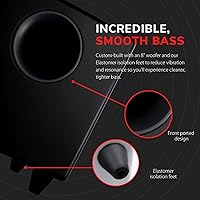
  • Driver Size: A single 8-inch dynamic driver handles all bass reproduction inside the sealed MDF cabinet.
  • Crossover Range: The variable low-pass crossover is continuously adjustable between 50Hz and 130Hz to match a wide variety of main speakers.
  • Phase Control: A rear-panel phase switch toggles between 0 and 180 degrees to correct bass cancellation caused by room placement or speaker positioning.
  • Signal-to-Noise Ratio: The SNR measures above 95dB (A-weighted), keeping the noise floor inaudible even during quiet passages at close listening distances.
  • Distortion (THD+N): Total harmonic distortion plus noise is rated below 0.05% at all power settings, indicating very clean amplifier output.
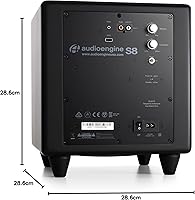
  • Enclosure Dimensions: The cabinet measures 11.26″ on all sides, forming a compact cube that fits under desks or beside furniture with minimal footprint.
  • Cabinet Material: The enclosure is constructed from hand-painted and hand-finished MDF with an anti-resonant steel internal frame to reduce unwanted vibration.
  • Weight: The S8 weighs 30 pounds, which is notable for its size and reflects the density of the MDF cabinet and internal components.
  • Inputs: Two RCA analog inputs allow simultaneous connection to a stereo source or easy switching between two audio devices.
  • Input Impedance: Input impedance is rated at 10,000 ohms, making the S8 compatible with a broad range of source components and amplifier outputs.
  • Power Supply: An auto-switching AC adapter accepts 100–240V at 50/60Hz, making the unit compatible with mains power standards in any country.
  • Connectivity: The S8 is wired-only by default; wireless operation requires the separately purchased Audioengine W3 wireless audio adapter kit.
  • Surround Configuration: The S8 is designed as a mono subwoofer and integrates into 2.1 or 5.1 channel configurations as the dedicated low-frequency element.
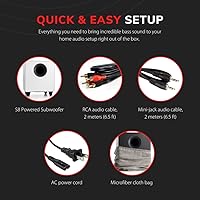
  • Included Accessories: The package includes a power cable, a quick start guide, and a warranty card; audio cables are not included in the box.
  • Warranty: Audioengine covers the S8 with a limited manufacturer warranty; buyers should confirm current terms directly with Audioengine at time of purchase.

Related Reviews
Audioengine S6 210W Subwoofer
89%
96%
Bass Performance
91%
Build Quality
89%
Setup & Installation
85%
Connectivity Options
93%
Sound Clarity
More
Alpine PWE-S8 8″ Amplified Subwoofer
86%
85%
Sound Quality
89%
Bass Performance
91%
Ease of Installation
87%
Build Quality
92%
Value for Money
More
MZEIBO Soundbar with Subwoofer
84%
88%
Sound Quality
91%
Bass Performance
85%
Bluetooth Connectivity
84%
Design Flexibility
90%
Ease of Setup
More
esonstyle S8 Sleep Earbuds
85%
88%
Comfort for Side Sleepers
91%
Bluetooth Connectivity & Pairing
85%
Waterproof Durability
78%
Battery Life
80%
Sound Quality & Noise Cancellation
More
Monoprice SSW-8 Slim Subwoofer 8″
77%
93%
Space-Saving Design
74%
Bass Performance
78%
Low-Frequency Extension
81%
Amplifier & Onboard Controls
84%
Input Flexibility
More
Saiyin DS6541SB Soundbar with Subwoofer
82%
85%
Sound Quality
88%
Bass Performance
65%
Ease of Setup
90%
Connectivity Options
80%
Build Quality
More
Klipsch R-120SW Subwoofer
80%
91%
Bass Performance
88%
Value for Money
84%
Build Quality
92%
Ease of Setup
79%
Room Integration & Tuning
More
Magnadyne 6x9 Woofer Subwoofer
83%
88%
Bass Quality
91%
Ease of Installation
92%
Value for Money
83%
Build Quality
89%
Size and Fit
More
BESTISAN SW65D Powered Subwoofer
85%
88%
Bass Performance
92%
Ease of Setup
85%
Build Quality
90%
Connectivity Options
87%
Design/Appearance
More
SVS 3000 Micro Subwoofer
87%
94%
Bass Performance
92%
Sound Clarity
88%
Size and Portability
90%
Build Quality
85%
Ease of Setup
More

FAQ

Yes, the S8 works with any speakers or amplifiers that have a standard RCA output. The adjustable crossover and phase switch give you enough tuning flexibility to blend it with virtually any main speaker regardless of brand or driver size.

It is fully self-powered. The built-in Class D amplifier handles everything, so you just connect it directly to your source or speaker amplifier via the RCA inputs and it is ready to go. No external amplification is required.

Bluetooth is not built in. Wireless operation is possible but requires separately purchasing the Audioengine W3 wireless audio adapter kit. Once the W3 is connected, you can stream wirelessly, but that additional purchase is worth factoring into your budget upfront.

A good starting point is to set the crossover around the lowest frequency your main speakers comfortably reproduce — typically 80Hz for small bookshelf speakers. From there, adjust by ear while playing familiar music until the bass sounds like a natural extension of your speakers rather than a separate source. There is no single correct setting; it depends on your specific speakers and room.

Unfortunately, the gain control is fixed on the rear panel, which is a legitimate inconvenience once the unit is in a permanent position. The practical workaround most users adopt is to dial in the gain carefully during initial setup and then leave it alone. If you need to adjust it frequently, positioning the sub somewhere with rear access — even just a few inches from a wall — helps considerably.

This compact sub performs best in small-to-medium rooms up to roughly 20 to 25 square meters. In larger open-plan spaces, it can start to feel underpowered at higher volumes. If your living room is large or connects to a dining area, you may want to consider a larger 10-inch or 12-inch subwoofer with higher displacement for consistent output throughout the space.

Yes, the S8 includes a standby mode that activates automatically when no audio signal is detected for a period of time. It powers back on when it senses an incoming signal, so you do not need to manually switch it off between listening sessions.

Ground loop hum is almost always a wiring or grounding issue in the broader audio chain rather than a fault with the sub itself. Try connecting everything to the same power strip first. If the hum persists, an inexpensive ground loop isolator inserted in the RCA signal path will typically eliminate it completely, and this fix works reliably in the vast majority of cases.

The phase switch flips the polarity of the subwoofer driver relative to your main speakers. If your subwoofer sounds thin or lacks punch in its current position, toggling to 180 degrees can restore fullness by correcting acoustic cancellation caused by the sub and mains being out of phase with each other. Simply try both settings with music playing and choose whichever sounds fuller and more integrated — it is that straightforward.

It works perfectly well with turntables, provided your turntable setup includes a phono preamp that outputs a standard line-level RCA signal. The S8 accepts any analog RCA input regardless of source type, so vinyl listeners who want more low-end weight from their records will find it integrates cleanly into a turntable-based system.