
Overview

The Rockville dB25 2-Channel Car Amplifier sits squarely in the value tier of the car audio market, designed primarily for powering subwoofers but capable of handling full-range duties as well. Rockville has carved out a niche by offering feature sets that rival mid-tier names like Kicker and Rockford Fosgate at a fraction of the cost. The Class AB design is worth noting here — it strikes a practical balance between efficiency and audio fidelity that cheaper Class D amps sometimes sacrifice. It's also 2-ohm stable, which matters because most popular aftermarket subs run at that impedance. Just keep expectations grounded: this is a capable, honest amplifier for the money, not a reference-grade unit.

Features & Benefits

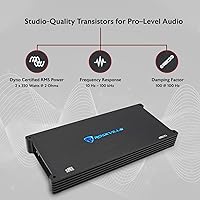
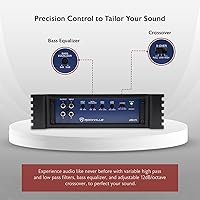
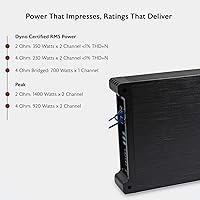
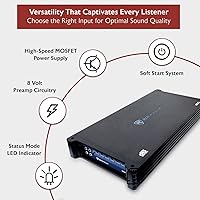
The power ratings on this 2-channel amplifier deserve a straight explanation upfront. The headline 2800W figure is peak — a momentary burst number. What matters day-to-day is the 700W RMS bridged output at 4 ohms, or the CEA-2006 compliant rating, which is the honest comparison point against established brands. Beyond power, the MOSFET power supply keeps heat manageable and efficiency consistent, even during extended listening sessions. The onboard crossover — adjustable at 12dB per octave — plus a subsonic filter and 12dB bass EQ give you real control over how your sub sounds without adding extra hardware. The balanced RCA input is a quiet bonus for noise-sensitive installs.

Best For

The dB25 makes the most sense for someone stepping up from their head unit's built-in amplification for the first time. If you're running a single subwoofer in a bridged mono configuration, this amp is well-suited — the power output and control options align nicely with entry-level sub builds. It also fits well in tighter installs: at just under 19.5 inches long, it won't dominate your trunk. Budget-conscious buyers who'd normally skip tuning features will appreciate having a crossover and EQ onboard — that's hardware you'd otherwise pay extra for. It's less suited to multi-speaker setups or audiophiles chasing flat, reference-quality output.

User Feedback

Owners of this Rockville amp generally report solid satisfaction for the price, with most citing the ease of installation and a real, audible improvement in bass over stock setups. Paired with a mid-range single subwoofer, many buyers describe the low-end output as punchy and well-defined. That said, skepticism around the wattage claims comes up regularly — some buyers feel the real-world output falls short of expectations set by the headline numbers, which is partly why understanding the CEA rating matters. A handful of reviews also note build quality concerns, and Rockville's customer support experience appears to be hit or miss, which is worth factoring in before buying.

Pros

  • Competitive feature set for the price, including onboard crossover, subsonic filter, and bass EQ that rivals pricier options.
  • Class AB design strikes a better balance between sound quality and efficiency than many budget Class D alternatives.
  • 2-ohm stable operation pairs naturally with a wide range of popular aftermarket subwoofers.
  • The dB25 ships ready for a bridged mono sub setup right out of the box, simplifying first-time installs.
  • Balanced RCA input helps reduce electrical noise, which is a practical bonus in vehicles with interference issues.
  • Remote subwoofer control lets you adjust bass level from the dashboard without reaching into the trunk.
  • Compact physical footprint makes it workable in tighter install locations where larger amps simply won't fit.
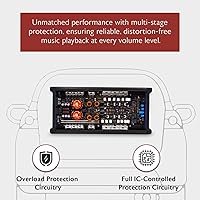
  • IC-controlled protection circuitry adds a meaningful layer of safety against common electrical faults during real-world use.
  • Many buyers report a clear, satisfying improvement in bass output compared to stock or head unit power.
  • Rockville provides multiple power ratings — peak, RMS, and CEA — which shows more transparency than many competitors at this tier.

Cons

  • The headline peak wattage figure is easy to confuse with usable power; real-world output is considerably lower.
  • Build materials feel utilitarian up close and may not hold up well under sustained heat or vibration over years of use.
  • Rockville's customer support is inconsistent, with some buyers reporting slow responses or unhelpful warranty experiences.
  • The amp's power ceiling limits pairing options — higher-sensitivity or more demanding subs may not perform at their best.
  • LED logo illumination adds no functional value and contributes to a somewhat flashy aesthetic that not all buyers appreciate.
  • Some users report ground loop hum in certain vehicles, requiring extra troubleshooting steps during installation.
  • The 11-pound weight and surface mount design can make clean, hidden installs more involved than with lighter alternatives.
  • Power rating transparency, while present, requires buyers to do homework — the CEA rating buried in the description is what actually matters for comparisons.

Ratings

Our scores for the Rockville dB25 2-Channel Car Amplifier were generated by AI after analyzing thousands of verified global buyer reviews, with spam, bot activity, and incentivized feedback actively filtered out. The ratings reflect a balanced picture — where this amp genuinely delivers for budget-focused builds and where real buyers have run into friction. Both the strengths and the recurring pain points are represented honestly.

Value for Money
84%
Most buyers feel they are getting considerably more amplifier than the price suggests, particularly given the onboard crossover, EQ, and subsonic filter that would otherwise require separate purchases. For a first dedicated amp build on a tight budget, the overall package is hard to argue against.
The value perception takes a hit once buyers realize the headline wattage is a peak figure rather than a usable RMS number. Those who bought expecting thunderous output comparable to more expensive amps sometimes feel misled once installed.
Power Output
67%
33%
In bridged mono mode driving a mid-range 10-inch or 12-inch subwoofer, the dB25 produces noticeably stronger, tighter bass than any head unit's built-in amplification. For casual daily listening at moderate volume, most users find it more than adequate.
Enthusiasts who dig into the CEA-2006 rating find the real sustained output more modest than the marketing implies. Buyers pairing it with power-hungry or low-sensitivity subwoofers often hit the amp's ceiling before reaching the listening levels they expected.
Build Quality
58%
42%
The chassis feels sturdy enough at first handling, and the heatsink appears adequately sized for the amp's actual output levels during casual use. Several buyers who installed it and drove daily for a year or more reported no mechanical failures.
Up close, the finish and component quality read as budget-tier — knobs feel loose on some units, and the overall assembly lacks the solidity you get from Kicker or Rockford Fosgate at a similar or slightly higher price. A handful of buyers reported failure within the first few months of installation.
Audio Clarity
73%
27%
For a Class AB amp at this price, the sound character is cleaner and less colored than many competing Class D options. Paired correctly with a matched subwoofer and tuned through the onboard EQ, low-frequency output comes across as relatively controlled rather than boomy.
At higher gain settings or when the bass EQ is pushed aggressively, some distortion creeps in around the upper bass frequencies. Buyers with more discerning ears — especially those coming from a higher-tier amp — tend to notice the ceiling in fidelity more quickly.
Ease of Installation
81%
19%
Buyers consistently call out how approachable the install process is, with clearly labeled terminals and enough input and output flexibility to fit a variety of head unit configurations. The included remote sub control wires in cleanly and reduces the need for additional hardware runs to the dash.
The manual, while functional, leaves some ambiguity around gain structure and crossover calibration for first-time installers who are not already familiar with amp tuning basics. A few buyers also found the wire terminal screws somewhat fiddly with thicker gauge power wire.
Tuning Flexibility
82%
18%
Having a fully adjustable crossover, a 12dB bass EQ, and a subsonic filter all onboard is genuinely useful — most amps at this price strip one or more of these out. Buyers report being able to dial in a satisfying low-end response across several different vehicle cabin types without needing an outboard processor.
The crossover and EQ controls lack detents or marked reference points, which makes repeatable calibration tricky if you ever need to reset after an adjustment. More experienced tuners find the controls functional but imprecise compared to even entry-level DSP units.
Thermal Performance
71%
29%
Under normal daily driving conditions — moderate volume, reasonable ambient temperature — the dB25 stays within acceptable heat ranges and the protection circuitry rarely activates. Buyers in temperate climates running it at conservative gain levels generally report no thermal issues.
In warmer climates or tightly enclosed installs with poor airflow, the amp runs noticeably hot and the thermal protection cuts output more frequently than expected. A few buyers in hotter regions reported the amp going into protect mode during summer drives even at moderate volume.
Protection Circuitry
76%
24%
The IC-controlled protection circuit has legitimately saved installs — several buyers describe the amp detecting a short or voltage spike and shutting down cleanly rather than failing outright, which is exactly what this feature is supposed to do. It adds a real layer of peace of mind for beginner installers who might wire something imperfectly the first time.
The protection system can be overly sensitive in some vehicle electrical environments, triggering shutdowns even under non-damaging conditions. Diagnosing whether a protect-mode event is a real fault or a false trigger requires more troubleshooting know-how than entry-level buyers typically have.
Noise & Interference
69%
31%
The balanced RCA input option is a meaningful advantage for buyers whose vehicles have noisy electrical systems — those who use it in balanced mode often report a noticeably quieter noise floor than they experienced with a previous budget amp. For most standard installs in modern vehicles, hum is manageable.
Ground loop noise is one of the more frequently cited complaints, particularly in older vehicles or those with alternator whine issues. The amp does not include any built-in noise filtering beyond the balanced input, so buyers in electrically noisy cars sometimes need additional isolation components.
Power Rating Transparency
63%
37%
Rockville deserves credit for publishing three separate ratings — peak, non-CEA RMS, and CEA-2006 — alongside each other, which is more disclosure than many competing value brands offer. Informed buyers who understand what those numbers mean can make a genuinely accurate pre-purchase comparison.
The way those ratings are presented still leads many buyers to anchor on the largest number first, and the CEA figure — the only one that matters for cross-brand comparison — is buried rather than featured. Confusion around real output is one of the most common threads in negative reviews for this amp.
Remote Sub Control
78%
22%
The included dashboard remote works reliably for what it is — a simple level knob that lets drivers adjust bass without reaching into the trunk. Buyers who commute with varied content (podcasts vs. bass-heavy music) find it genuinely convenient in everyday use.
The remote control cable is a fixed length, which can be limiting in larger vehicles or custom installs where the amp is mounted far from the dash. The knob itself has a slightly cheap feel and lacks any center-detent or reference marking for a neutral position.
Compatibility
79%
21%
The 2-ohm stability and dual RCA input configuration make this amp broadly compatible with most popular entry-level and mid-range head units and subwoofers. Buyers building their first system rarely run into fundamental incompatibility issues when sticking within common impedance ranges.
The amp is less suited to 1-ohm wiring schemes, which some sub enthusiasts prefer for maximum output. Buyers wanting to run multiple subwoofers in parallel at very low impedance should look elsewhere, as pushing below the 2-ohm rating can trigger protection shutdowns.
Customer Support
47%
53%
A subset of buyers report positive warranty replacement experiences with Rockville, describing responsive email support and replacement units shipped without excessive back-and-forth. When support works, it works reasonably fast given the brand's price tier.
Inconsistency is the dominant theme — many buyers describe slow responses, requests for excessive documentation before any action is taken, or outright difficulty getting a warranty claim honored. For a product in a class where long-term reliability is uncertain, weak after-sale support is a meaningful risk.
Physical Footprint
77%
23%
At just under 19.5 inches long and barely over 2 inches tall, the dB25 fits in spaces where larger amps simply cannot go — under seats, on sidewalls of shallow trunks, or inside smaller hatchback cargo areas. Buyers with limited install real estate consistently highlight this as a deciding factor.
The 11-pound weight and surface-mount design mean you need a solid, flat mounting surface and confident screw placement. In vehicles where the mounting location is irregular or the surface is thin-gauge sheet metal, achieving a rattle-free install takes more effort than expected.

Suitable for:

The Rockville dB25 2-Channel Car Amplifier is a strong fit for budget-conscious car audio fans who want a meaningful upgrade from their factory or head unit amplification without committing to a premium price tag. It's especially well-matched to first-time amp buyers setting up a single subwoofer — the bridged output, built-in crossover, and bass EQ give you a complete tuning toolkit in one box, which simplifies the install considerably. Drivers working with limited trunk or under-seat space will appreciate the relatively lean footprint for an amp in this power class. The 2-ohm stability is a practical advantage too, since most popular entry-level and mid-range subwoofers are wired at that impedance. If your goal is noticeably better bass on a tight budget, this Rockville amp delivers a sensible, honest path to get there.

Not suitable for:

The Rockville dB25 2-Channel Car Amplifier is not the right call for buyers chasing high-fidelity, reference-quality audio or those building more complex multi-speaker systems. The advertised peak wattage figures are easy to misread — if you're sizing this amp against premium brands using CEA-2006 ratings, the real-world output is far more modest than the headline number implies, and experienced builders may find that limiting. Those planning to push demanding, power-hungry subwoofers at sustained high volumes could run into headroom issues. Build quality, while acceptable for casual daily use, doesn't inspire confidence for hard or competitive use cases. And if after-sale support matters to you — warranty claims, troubleshooting help — Rockville's track record there is inconsistent enough to warrant caution.

Specifications

  • Amplifier Class: The dB25 uses a Class AB design, which balances power efficiency with audio fidelity better than pure Class D circuits commonly found at this price point.
  • Channels: This is a 2-channel amplifier that can also be bridged into a single mono channel for dedicated subwoofer use.
  • Peak Output: Total peak power output is rated at 2800W, a figure representing momentary burst capacity rather than sustained listening power.
  • RMS Output: Total RMS output is 1400W across both channels under non-CEA measurement conditions used as a standard by many value-tier brands.
  • CEA-2006 Power: The amp delivers 700W RMS bridged at 4 ohms under the stricter CEA-2006 standard, which is the most accurate figure for cross-brand comparisons.
  • Per-Channel Power: Each channel produces 350W RMS at 2 ohms when running in stereo mode.
  • Impedance Stability: The dB25 is rated as 2-ohm stable, making it compatible with a wide range of common aftermarket subwoofers wired at low impedance.
  • Power Supply: A high-speed MOSFET power supply regulates voltage delivery for consistent performance and reduced heat buildup during extended use.
  • Crossover: An onboard fully adjustable 12dB-per-octave crossover with differential circuitry lets users set frequency filtering without an external processor.
  • Subsonic Filter: A built-in subsonic filter is adjustable between 15Hz and 55Hz, protecting subwoofers from damaging ultra-low frequencies they cannot reproduce cleanly.
  • Bass EQ: A 12dB adjustable bass equalizer is included for fine-tuning low-frequency output to match the acoustic characteristics of different vehicle cabins.
  • Sub Control: A remote dashboard subwoofer level control is included in the box, allowing real-time bass adjustment from the driver seat.
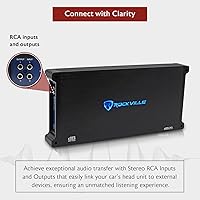
  • Signal Input: RCA line inputs accept both balanced and unbalanced signals, with balanced mode offering better rejection of electrical noise in vehicle environments.
  • Protection: IC-controlled protection circuitry monitors for overheating, short circuits, and voltage fluctuations, shutting down the amp automatically to prevent damage.
  • Dimensions: The unit measures 19.4 x 9 x 2.4 inches (L x W x H), a relatively compact form factor for an amplifier in this power class.
  • Weight: The dB25 weighs 11 pounds, which is typical for a Class AB amp with a metal chassis at this output level.
  • Max Voltage: Maximum supply voltage is 16V DC, covering standard 12V automotive electrical systems with overhead for charging voltage spikes.
  • Mounting Type: The amp is designed for surface mount installation, requiring a flat, secure mounting surface in the trunk or under a seat.
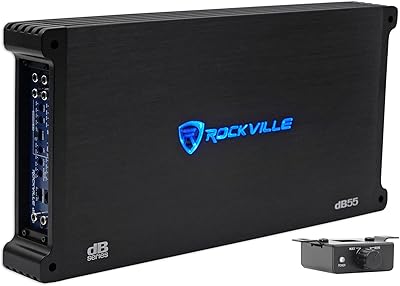
  • LED Feature: An LED-illuminated logo is built into the chassis, providing a visual indicator that the unit is powered on.
  • RCA Output: RCA line outputs are included for daisy-chaining to additional amplifiers if the system is expanded in the future.

Related Reviews
Rockville RVF-2 4-Channel Car Amplifier
84%
88%
Audio Quality
91%
Power Output
85%
Build Quality
72%
Thermals (Heat Management)
80%
Installation Ease
More
Rockville RVT-1 2-Channel Car Amplifier
68%
83%
Value for Money
67%
Power Output
58%
Build Quality
61%
Thermal Management
72%
Audio Clarity
More
Rockville RXA-T1 1500W 2-Channel Car Amplifier
85%
88%
Audio Performance
92%
Bass Response
85%
Build Quality
89%
Compactness/Size
80%
Ease of Installation
More
Rockville RXD-T2 2-Channel Car Amplifier
79%
91%
Power Accuracy
83%
Build Quality
67%
Thermal Management
88%
Ease of Installation
84%
Crossover & EQ Controls
More
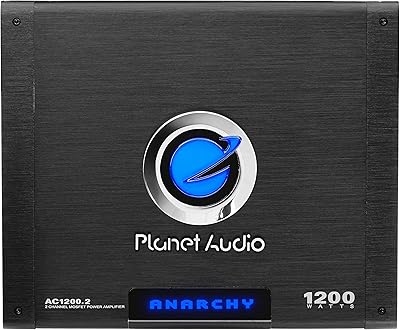
Planet Audio AC1200.2 2-Channel Car Amplifier
72%
84%
Value for Money
67%
Power Output
88%
Ease of Installation
71%
Sound Quality
58%
Thermal Performance
More
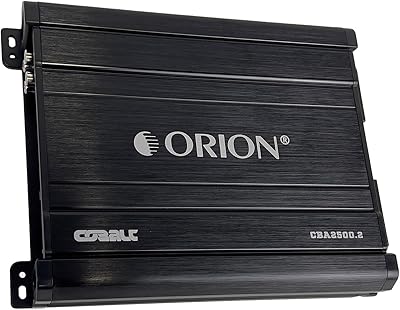
Orion CBA2500.2 2-Channel Car Amplifier
73%
82%
Value for Money
63%
Power Output
67%
Build Quality
88%
Ease of Installation
71%
Sound Quality
More
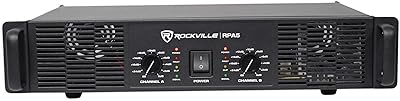
Rockville RPA5 2-Channel Power Amplifier
78%
88%
Value for Money
76%
Power Output & Headroom
67%
Build Quality & Construction
79%
Cooling & Thermal Management
91%
Connectivity & I/O Flexibility
More
Rockville dB55 5-Channel Car Amplifier
75%
91%
Value for Money
83%
Sound Quality at Moderate Volumes
78%
Bass Output & Subwoofer Performance
62%
Power Accuracy & Transparency
58%
Thermal Management & Heat
More
Pyramid PB715X 1000W 2-Channel Car Amplifier
68%
83%
Value for Money
74%
Sound Performance
88%
Ease of Installation
57%
Build Quality
52%
Thermal Management
More
Pyle PLA2378 2-Channel Car Amplifier
72%
83%
Value for Money
51%
Power Output Accuracy
67%
Build Quality
88%
Ease of Installation
58%
Heat Management
More

FAQ

The honest answer depends on which rating you look at. The 2800W figure is peak — a burst number that sounds impressive but isn't what you hear day-to-day. For real-world comparisons, focus on the CEA-2006 rating of 700W bridged at 4 ohms. That is the figure that lines up with what brands like Kicker or Rockford Fosgate publish, and it is a much more accurate picture of sustained output.

Yes, and that is actually one of the most common setups for this unit. You bridge the two channels together into a single mono output and wire your subwoofer to it. Just make sure your sub is rated for 4 ohms in that configuration, since the bridged power spec is measured at 4 ohms.

It is a reasonable starting point. The onboard crossover, bass EQ, and subsonic filter reduce the number of external components you need, which simplifies the wiring job. The included remote sub control is also a nice touch for daily use. That said, you will still need to understand basic amp wiring — power, ground, remote turn-on, and speaker leads — before you start.

Mid-range single subwoofers in the 10-inch to 12-inch range are a natural match, particularly those rated around 300W to 500W RMS at 4 ohms when bridged. Brands like Rockville's own subs, Skar, or Pioneer work well in this pairing. Avoid trying to push extremely high-power or low-sensitivity subs — the amp's headroom has real limits.

Some buyers do report this, particularly in vehicles with noisier electrical systems. The balanced RCA input helps in those cases — if your head unit supports a differential or balanced output, use it. Proper grounding technique matters a lot too; keep the ground wire short and connected to bare metal, not a painted surface.

Under normal listening levels it stays reasonably cool, but like any Class AB amp it does generate heat, especially when pushed hard. Make sure there is adequate airflow around the unit wherever you mount it. Avoid enclosing it completely in a sealed box or pressing it flush against carpet without ventilation clearance.

The subsonic filter cuts frequencies below the range your subwoofer can physically reproduce — typically anything under about 20Hz to 30Hz. Bass at those frequencies just wastes power and can over-excite the woofer's suspension. Turning it on is almost always a good idea; set it just below your sub's lowest usable frequency.

Technically yes, it will drive door speakers in stereo mode. In practice, though, the dB25 is tuned and specced more for low-frequency sub duty than for full-range speaker use. If your main goal is better door or midrange speakers, a 4-channel amp would serve you more appropriately.

Kicker and Rockford Fosgate publish CEA-compliant ratings across the board, which makes comparison straightforward once you know to look at the dB25's CEA figure rather than its peak. In terms of feature count — crossover, EQ, subsonic filter — the Rockville unit often offers more on-paper for the same spend. Build quality and long-term reliability, however, tend to favor the established brands, so it is a trade-off between features now and durability over years.

Yes, Rockville includes the remote dashboard sub control with the amp. It lets you dial the bass level up or down from the front of the vehicle without reaching into the trunk. It is a small convenience that makes a real difference for daily drivers who adjust bass depending on what they are listening to.