Overview

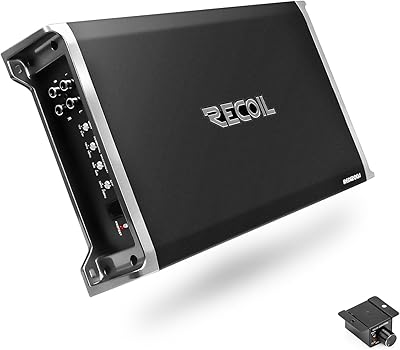
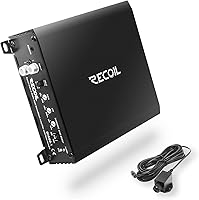
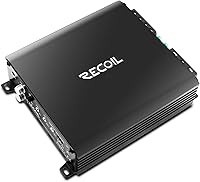
The Recoil DI600.1 Mono-Block Subwoofer Amplifier sits squarely in the budget-friendly corner of the car audio market, targeting DIY enthusiasts who want real bass without emptying their wallet. At roughly the size of a thick paperback, its compact chassis makes it a practical option for under-seat installs or cramped trunk builds. The Class-D topology is a genuine advantage here — it runs cooler and pulls less current than older AB-class designs, which matters when you are working with a small enclosure and limited airflow. Toss in an included remote bass knob and you have a package that punches above its weight for entry-level money. Just keep expectations realistic: this is a capable value amp, not a boutique unit.
Features & Benefits

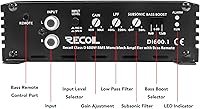
The Class-D mono-block design is the core reason this subwoofer amplifier makes sense at its price point — it converts power efficiently, which means less heat building up inside that small chassis during long listening sessions. A MOSFET power supply keeps current delivery stable even when the sub is working hard on heavy bass lines. The onboard control panel is surprisingly well-stocked: variable gain, a low-pass filter, a subsonic filter, and a bass EQ give you enough flexibility to dial in most single-woofer setups without extra gear. Four-way protection circuitry covers thermal, overload, short circuit, and DC fault scenarios — practical safeguards that help protect both the amp and the subwoofer it is driving.

Best For

This mono-block amp is a natural fit for someone putting together their first car audio build — think a single sub wired to a dual voice coil driver at 1 ohm to get the most out of its output. It also works well for anyone dealing with tight install spaces, since the small form factor slides under most seats without fuss. If you want basic tuning control without buying a separate digital signal processor, the built-in filters handle most of what everyday listeners need. That said, if you are chasing serious output for a large ported enclosure or running a competition-style setup, this subwoofer amplifier will hit its ceiling quickly — it simply is not built for that level of demand.

User Feedback

Buyers consistently point to straightforward installation and strong bass output relative to the cost as the standout positives — most report the amp fires up and performs well right out of the box. The remote bass knob earns solid marks for reliability and makes a noticeable quality-of-life difference during daily commutes. On the flip side, a recurring frustration is the gap between the advertised peak wattage and what the amp delivers in real-world conditions; experienced users know to focus on RMS figures, but first-timers sometimes feel misled. Build quality feedback is mixed: some owners report years of trouble-free use, while others have flagged early failures and found warranty support inconsistent — worth factoring in before committing.

Pros

  • Compact dimensions make it easy to tuck under a seat or fit in tight trunk builds.
  • Class-D design runs efficiently and stays cooler than older amplifier classes during extended listening.
  • The included remote bass knob adds real convenience for daily drivers who adjust bass frequently.
  • Onboard low-pass, subsonic, and bass EQ controls eliminate the need for a separate tuning device.
  • Stable across multiple impedance loads, giving flexibility when wiring different subwoofer configurations.
  • Four-way protection circuitry adds a practical safety net for new installers still learning proper setup.
  • Straightforward wiring layout makes the installation process accessible for first-time DIY builders.
  • Delivers satisfying bass output relative to its cost, outperforming factory amplification by a wide margin.
  • MOSFET power supply helps maintain stable output even when the subwoofer is working hard on low frequencies.

Cons

  • Advertised peak wattage is heavily inflated; real continuous output is significantly lower than the headline figure.
  • Build quality feels adequate but not confidence-inspiring, with some owners reporting early failures under daily use.
  • Warranty support has been described as inconsistent, with some buyers finding resolution difficult to obtain.
  • Not well-suited for high-demand subwoofers or larger ported enclosures that need sustained high power.
  • The remote bass knob, while useful, has attracted occasional reliability complaints over extended use.
  • Internal components are value-grade and may not hold up as well as pricier alternatives over several years.
  • Lacks balanced XLR inputs or advanced signal routing options that more experienced installers often prefer.
  • Thermal management, while improved over AB-class designs, can still be a concern in poorly ventilated installs.

Ratings

The scores below reflect an AI-driven analysis of verified global buyer reviews for the Recoil DI600.1 Mono-Block Subwoofer Amplifier, with spam, bot activity, and incentivized feedback actively filtered out before scoring. Each category was weighted against real ownership patterns — not spec sheets — so both the genuine strengths and the recurring frustrations are captured honestly. Whether this amp earns a spot in your build or gets passed over depends on expectations, and these ratings are designed to help you set the right ones.

Value for Money
83%
For buyers stepping up from a factory head unit for the first time, the price-to-performance ratio is hard to argue with. Getting a Class-D mono amp with onboard tuning controls and a remote bass knob bundled in at this price point is genuinely competitive in the entry-level segment.
The value equation starts to wobble when you factor in the inflated peak wattage marketing, which leaves some buyers feeling misled once they dig into what the amp actually sustains continuously. If longevity becomes an issue within the first year, the savings evaporate quickly.
Real-World Power Output
67%
33%
Running a single subwoofer in a sealed box at moderate volumes, most users report satisfying, punchy bass that clearly outperforms anything a factory system can produce. For daily listening at street-legal volumes, the continuous output is genuinely adequate for the application.
The gap between the advertised peak figure and the actual sustained output is a recurring complaint, particularly among buyers who expected competition-adjacent loudness. Push this subwoofer amplifier hard in a large ported enclosure and it will show its limits fairly quickly.
Build Quality
61%
39%
The heatsink finish feels solid on initial handling, and the terminal connections accept standard gauge wire without issue. Buyers who install it carefully and keep it in a ventilated location tend to report trouble-free operation for a reasonable stretch of ownership.
The internal component quality is visibly value-grade, and a noticeable subset of long-term owners report failures after sustained daily use — particularly in warmer climates or poorly ventilated installs. It does not inspire the confidence of a mid-tier or premium build.
Ease of Installation
88%
The labeled terminal layout and compact chassis make the wiring process approachable even for first-time installers. Most buyers report getting the amp powered up and producing bass within a couple of hours using a basic wiring kit and a video guide.
No wiring kit is included, which means a separate purchase before you can even begin. A small number of users also noted that the manual lacks detail on optimal filter settings, leaving beginners to guess or research independently.
Remote Bass Knob
74%
26%
For daily drivers, the included remote knob is a genuinely useful addition — being able to dial bass up or down from the front seat without touching the head unit makes a real difference when switching between podcasts and bass-heavy music. Most owners use it constantly.
A recurring thread in negative reviews involves the knob becoming intermittent or losing smooth travel after several months of use. It works well out of the box, but long-term reliability is not on par with what dedicated aftermarket remote knobs offer.
Thermal Management
77%
23%
The Class-D topology is a meaningful upgrade over older amplifier classes in this regard — under normal listening conditions the amp stays warm but manageable, and most users in temperate climates report no thermal shutdowns during typical use.
Buyers in hot climates or those mounting the amp in enclosed spaces with limited airflow report more frequent thermal protection triggers. The heatsink is adequate for moderate duty cycles but not designed for sustained high-output sessions in a cramped enclosure.
Onboard Tuning Controls
79%
21%
Having a variable low-pass filter, subsonic filter, gain, and bass EQ all on one panel is a genuine advantage for users who want to dial in their system without buying a separate processor. For a single sub build, this covers the basics well.
The controls lack markings precise enough for methodical tuning, which frustrates buyers who want to replicate a setting or fine-tune by frequency. Experienced installers will feel the limitation compared to even a budget outboard DSP.
Signal Clarity
71%
29%
At moderate gain settings with a clean source signal, the audio output is free from noticeable hiss or distortion, which is an acceptable baseline for the price tier. Most casual listeners will not have complaints about background noise during everyday use.
Gain sensitivity is not particularly precise, and setting it too high introduces audible noise — a common complaint from users pairing this amp with lower-output head units. The signal-to-noise ratio is adequate rather than impressive.
Impedance Flexibility
82%
18%
Supporting 1, 2, and 4 ohm loads gives installers real flexibility when selecting a subwoofer, especially for dual voice coil drivers that can be wired to multiple impedances. This versatility is a genuine selling point for a first-time buyer still deciding on a woofer.
Output at 4 ohms drops off noticeably and leaves some buyers underwhelmed if they did not wire their sub to a lower load. The power scaling between impedance levels is not always intuitive for beginners who pick a 4-ohm single voice coil without realizing the output difference.
Chassis & Form Factor
86%
The sub-8-inch length and slim profile make this one of the more install-friendly mono amps at its output level. Buyers with compact cars or limited trunk space specifically call out the size as a deciding factor, and it genuinely fits where larger amps cannot.
The slim chassis, while convenient for tight installs, also constrains internal component real estate and airflow — which is part of why build quality and thermal performance are less impressive than on physically larger competitors.
Warranty & After-Sale Support
44%
56%
A manufacturer warranty does exist, and some buyers have successfully resolved defective unit issues through the claims process without major hassle. For straightforward DOA cases, resolution is possible.
Buyer feedback on warranty support is consistently one of the weakest areas for this mono-block amp. Slow response times, difficulty reaching support, and unresolved claims are recurring themes — making the warranty feel more like a formality than a reliable safety net.
Protection Circuitry
80%
20%
The four-way protection system does its job reliably in real installs — buyers report the amp recovering cleanly from thermal shutdowns and short circuit events without permanent damage. For a first-time builder who might make a wiring error, this is a practical safeguard.
Some users find the protection circuitry triggers at annoyingly low thresholds during demanding bass peaks, causing momentary dropouts during high-volume listening. It protects the hardware but can interrupt the listening experience.
Packaging & Included Accessories
69%
31%
The remote bass knob inclusion is the standout accessory, and the amp arrives well-packaged with no reported transit damage in the majority of buyer accounts. For an entry-level unit, the unboxing experience is clean and straightforward.
No wiring hardware, no RCA cables, and only a minimal instruction manual are included — meaning new installers need to budget for additional accessories before a single wire gets run. The manual in particular leaves a lot to be desired for beginners.

Suitable for:

The Recoil DI600.1 Mono-Block Subwoofer Amplifier is a smart pick for car audio beginners who want a meaningful bass upgrade without committing to a high-dollar setup. If you are wiring up a single subwoofer for the first time — especially a dual voice coil driver that you plan to run at a low impedance load — this amp delivers enough real-world power to make a noticeable difference over factory audio. Its small chassis is a genuine advantage for anyone dealing with cramped installs, like under a seat in a compact car or in a shallow trunk build where space is at a premium. The onboard tuning controls also make it a reasonable fit for listeners who want to adjust their bass response without purchasing a separate processor or DSP. If your goal is simply to feel your music more and you are working within a tight budget, this mono-block amp hits a practical sweet spot.
Not suitable for:

The Recoil DI600.1 Mono-Block Subwoofer Amplifier is not the right tool for anyone chasing serious output levels or building a system around a high-demand subwoofer in a large ported enclosure. Enthusiasts who understand the difference between peak and RMS wattage will immediately recognize that the real continuous power output is a fraction of the headline number, which can be disappointing if you are planning a loud, competition-style build. This subwoofer amplifier also lacks the refined signal processing and component quality that more experienced listeners tend to expect, so audiophiles or anyone prioritizing long-term reliability over upfront savings should look at a higher-tier option. If you are pairing this with a high-sensitivity subwoofer in a well-tuned sealed box, you might get away with it — but push this amp hard on a daily basis and the build quality may become a concern over time. Buyers who anticipate needing active manufacturer support or a dependable warranty experience should also factor in the inconsistent after-sale service reports before deciding.
Specifications

  • Amplifier Type: Class-D mono-block design optimized for subwoofer duty, offering high efficiency and lower heat output compared to Class-AB alternatives.
  • RMS Power: Delivers 600 watts RMS at 1 ohm, 385 watts RMS at 2 ohms, and 235 watts RMS at 4 ohms under continuous operation.
  • Peak Power: Rated at 1200 watts maximum, a figure representing short-burst headroom rather than sustained continuous output.
  • Channels: Single-channel mono configuration, purpose-built for driving one subwoofer or a wired pair of subwoofers in a bridged load.
  • Impedance: Stable at 1, 2, and 4 ohms, providing flexibility for most single subwoofer wiring configurations including dual voice coil drivers.
  • Power Supply: MOSFET-based internal power supply maintains stable current delivery under heavy bass loads and varying vehicle electrical conditions.
  • Protection: Four-way protection circuitry covers thermal overload, short circuit, DC fault, and general overload scenarios to safeguard both the amp and connected subwoofer.
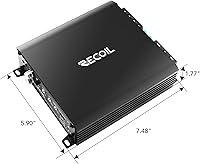
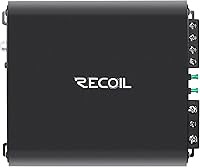
  • Dimensions: The amplifier chassis measures 7.48″ long by 5.90″ wide by 1.77″ tall, making it one of the more compact options in its power class.
  • Weight: The unit weighs 3.62 pounds, light enough for straightforward single-person installation in most vehicle setups.
  • Operating Voltage: Designed to operate at a nominal 14.4 volts DC, consistent with standard automotive electrical systems while the engine is running.
  • Onboard Controls: Features a variable gain control, variable low-pass filter, variable subsonic filter, and a bass EQ adjustment, all accessible on the amplifier panel.
  • Remote Knob: Includes a wired remote bass level knob that allows the driver to adjust bass output on the fly from the front of the vehicle.
  • Mounting Type: Designed for surface mounting, compatible with flat installation surfaces such as trunk floors, side panels, or under-seat boards.
  • Model Number: The official manufacturer model designation is DI600.1, used for identifying firmware, documentation, and warranty registration.
  • Brand: Manufactured and sold under the Recoil brand, a value-segment car audio label focused on entry-level amplifier and subwoofer products.
  • Package Weight: The complete retail package, including accessories and packaging, weighs approximately 3.62 pounds as shipped.

Related Reviews

Recoil RED1200-1 Mono Subwoofer Amplifier
75%
88%
Value for Money
83%
Bass Output
61%
Power Accuracy
91%
1-Ohm Stability
63%
Thermal Management
More
Harmony Audio HA-A400.1 800W Mono Subwoofer Amplifier
86%
91%
Bass Performance
88%
Ease of Use
84%
Build Quality
87%
Reliability
92%
Power Handling
More
Rockford Fosgate R250X1 Prime 1-Channel Mono Block Amplifier
84%
89%
Power Output
91%
Ease of Installation
85%
Sound Clarity
88%
Heat Dissipation
84%
Build Quality
More
Rockville RVA600.1 Mono Car Amplifier
74%
83%
Value for Money
74%
Sound Quality
88%
Ease of Installation
52%
Power Accuracy
67%
Build Quality
More
DR Double Rock DR-2000.1 Monoblock Car Amplifier
74%
83%
Value for Money
71%
Power Output
86%
Installation Ease
62%
Build Quality
74%
Thermal Management
More
Kicker CXA800.1 Mono Subwoofer Amplifier
79%
88%
Power Output
82%
Build Quality
76%
Thermal Management
79%
Ease of Installation
86%
Signal Control & Tuning
More
Harmony Audio HA-A1500.1 Mono Subwoofer Amplifier
74%
86%
Value for Money
72%
Power Output
83%
Installation Ease
91%
1-Ohm Stability
61%
Thermal Management
More
Stetsom Bravo Attack 3000.1 Mono Car Amplifier
86%
92%
Power Output
84%
Thermal Performance
88%
Ease of Installation
85%
Sound Quality
90%
Bass Control
More
OSD Audio SMP500 800W Mono-Channel Subwoofer Amplifier
86%
88%
Performance
90%
Bass Enhancement
81%
Ease of Installation
93%
Heat Management
85%
Power Output
More
MTX Thunder1000.1 Class D 1000W Mono Amplifier
87%
91%
Performance & Power Output
88%
Bass Enhancement
85%
Compact Design & Installation
89%
Heat Dissipation & Durability
87%
Bass Boost Functionality
More

FAQ

The short answer is: focus on the RMS figures, not the peak number. The Recoil DI600.1 Mono-Block Subwoofer Amplifier is rated at 600 watts RMS at 1 ohm, which is the number that reflects real, continuous output. The 1200-watt figure is a peak rating that represents brief burst capacity, not what the amp sustains during a full listening session. This is standard industry practice, but it catches a lot of first-time buyers off guard.
Yes, and that is actually one of the best use cases for this mono-block amp. A dual voice coil subwoofer wired in parallel drops the load to 2 ohms, and wired in series it presents 4 ohms — both of which this amp handles fine. If you wire a 2-ohm DVC sub in parallel to hit 1 ohm, you will get the highest output this amp is capable of delivering.

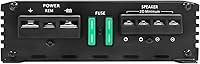
Most first-timers find this subwoofer amplifier pretty approachable. The terminal layout is clearly labeled for power, ground, remote turn-on, RCA inputs, and speaker output. You will need a basic amp wiring kit — power cable, ground cable, inline fuse, and RCA cables — none of which come in the box. Follow a basic wiring guide online and you should be up and running within a couple of hours.

It likely will, especially in mid-size and larger vehicles. The chassis is under 8 inches long and under 6 inches wide, which clears the under-seat space in most sedans and trucks. Just measure your available clearance first, particularly the height — you need a bit of airflow around the amp to keep temperatures in check during extended use.

For the most part, yes. Most buyers find it genuinely useful for adjusting bass on the fly — switching between music genres or dropping the bass at night without touching the head unit. A small number of owners have reported that the knob became intermittent over time, so it is worth keeping that in mind, but the majority of feedback on it is positive.

A 60 to 80 amp inline fuse placed close to the battery is a reasonable starting point for an amplifier in this power range. The exact size depends on your wire gauge and the total current draw of your system, so if you are unsure, consult a basic car audio wiring guide or ask at your local car audio shop to confirm the right spec for your specific setup.

Class-D amps like this one run significantly cooler than older designs, and under normal listening conditions at moderate volumes it should stay warm but not hot. That said, if you mount it in an enclosed space with no airflow and run it hard for extended periods, heat can build up. The onboard thermal protection will shut the amp down before damage occurs, but aim for a ventilated install location to avoid interruptions.

Running at 1 ohm will get you the highest output from this mono-block amp, but 2 ohms is the sweet spot for a balance of power and long-term reliability. At 4 ohms the output drops considerably, which is fine for modest setups but may feel underwhelming if you were expecting significant bass impact. Most users pair it with a single DVC sub wired to 2 or 1 ohm.

The low-pass filter limits the amp to reproducing only the lower frequencies — you dial it in to roll off midrange sounds so your subwoofer only plays bass. The subsonic filter cuts out ultra-low frequencies that your sub physically cannot reproduce anyway, which protects the woofer from over-excursion on those inaudible rumbles. Both filters are variable, so you can tune them to your specific subwoofer and enclosure type.

Recoil does offer a manufacturer warranty, but feedback from buyers suggests that the support experience can be inconsistent. Some owners have resolved issues without trouble, while others have found the process slow or unresponsive. It is worth registering the product after purchase and keeping your receipt. If long-term support reliability is a priority for you, factor that into your decision alongside the price.