Overview

The RCA ANT121Z Indoor TV Antenna is one of those products that has quietly stuck around for over two decades — and in a market that loves to reinvent itself, that kind of staying power means something. In a world where streaming subscriptions keep multiplying, this passive rabbit-ear design offers a refreshingly simple alternative: plug it in, scan for channels, and watch free over-the-air broadcasts without a monthly bill. It covers VHF channels 2 through 13, where most major network affiliates live. Just be clear-eyed about what it is — a no-amplifier, budget-tier device that performs best when the conditions cooperate.
Features & Benefits

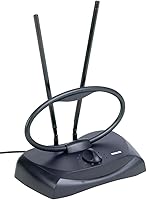
The most practical thing about this passive indoor antenna is how little it demands of you. Adjustable rabbit-ear dipoles let you tilt and spread the arms until you land on the clearest signal for each channel — a minor ritual that genuinely pays off. There is no power brick to deal with and no wall outlet to hunt for; the antenna draws nothing and just works. A built-in coaxial cable is already attached, so you go straight from box to TV. Small non-scuff pads on the base protect your shelf or stand, and the compact 8 x 7 x 9 inch frame tucks away without crowding your setup.

Best For

This dipole TV antenna makes the most sense for people who live reasonably close to broadcast towers — realistically within 20 to 30 miles — and mainly want to catch the big network stations: NBC, CBS, ABC, PBS, and Fox. If you are cutting cable for the first time and want a low-risk starting point, this is a sensible pick. It also fits naturally on a bedroom or kitchen TV that does not justify a larger, pricier setup. Renters who cannot mount anything to a wall will appreciate the no-installation approach. Rural viewers or anyone far from city towers, though, should look at an amplified option instead.

User Feedback

Buyers tend to split pretty cleanly along geography. Those in or near a major city regularly report picking up all their local channels without a hitch and consistently praise how effortless setup is right out of the box. Criticism clusters around UHF performance — since this RCA rabbit-ear antenna is built around VHF, digital subchannels and UHF stations can be hit-or-miss. Build quality draws mixed reactions too; the lightweight plastic feels flimsy to some, yet plenty of long-term owners say theirs has held up for years without issue. Nearly everyone mentions needing to tweak dipole angles at least once before locking in a clean, stable picture.

Pros

  • Zero power required — no outlet, no adapter, no interference from a power supply.
  • Setup takes minutes: connect the built-in coaxial cable, run a channel scan, and you are done.
  • Adjustable rabbit-ear dipoles let you fine-tune reception for each channel without tools.
  • Compact enough to sit discreetly on any shelf or TV stand without dominating the space.
  • Works reliably for the major VHF network affiliates in urban and close-in suburban areas.
  • Non-scuff base pads protect furniture during the frequent repositioning that signal-finding requires.
  • No monthly cost — a one-time purchase that keeps delivering free broadcast TV indefinitely.
  • Standard 50-ohm coaxial connector is compatible with virtually every TV on the market.
  • Many buyers report years of trouble-free use, thanks to the simplicity of having no active components to fail.

Cons

  • UHF performance is weak — digital subchannels are often pixelated or entirely missing.
  • The 40-mile range claim is theoretical; real-world reliable reception is typically closer to 15 to 20 miles.
  • Dipole arms can lose tension over time, making it difficult to hold a precisely tuned position.
  • Signal quality is highly sensitive to placement — moving it even a foot can change results significantly.
  • Thin plastic construction feels inexpensive and inspires little confidence right out of the box.
  • No amplification means there is no workaround for weak signals caused by distance or building materials.
  • Fixed cable length limits where the antenna can be positioned relative to the TV input.
  • Older TVs without a built-in digital tuner require a separate converter box, which the packaging does not make clear.
  • Finding the optimal dipole angle is a purely trial-and-error process with no guidance provided.

Ratings

Our scores for the RCA ANT121Z Indoor TV Antenna were generated by AI after analyzing thousands of verified global user reviews, with spam, bot-submitted, and incentivized feedback actively filtered out before any scoring took place. The result is an honest, well-rounded picture that captures both where this passive dipole antenna genuinely delivers and where real buyers have run into frustration. Strengths and weaknesses are weighted equally so you can make a fully informed call.

Signal Reception (VHF)
78%
22%
In urban and close-in suburban settings, users consistently pull in the major VHF network affiliates — NBC, CBS, ABC, PBS, Fox — with a clear, stable picture after a quick channel scan. Adjusting the dipole arms typically makes a noticeable difference, and many buyers in metro areas report getting everything they need on the first try.
Reception drops off noticeably as you move further from broadcast towers, and even within the claimed range, dense building materials like concrete or metal framing can choke the signal. Users more than 25 miles out regularly describe patchy results that no amount of repositioning fully resolves.
Signal Reception (UHF)
41%
59%
A small number of users in exceptionally strong UHF signal zones report picking up a handful of digital subchannels without much trouble, which is a pleasant bonus given that this antenna was never marketed for UHF performance.
This is the most consistent complaint across the review base. Because the dipole design is tuned for VHF channels 2 through 13, UHF digital stations — which carry a large share of modern over-the-air content — are often weak, pixelated, or entirely absent. Buyers expecting full digital channel lineups are frequently disappointed.
Ease of Setup
94%
Almost universally praised. Buyers describe opening the box, connecting the built-in coaxial cable to the TV, running an auto-scan, and having channels within minutes — no instructions needed. The no-power requirement removes a common setup hurdle entirely, which first-time cord-cutters in particular find reassuring.
A handful of users note that getting the best results requires trial-and-error with dipole arm angles and physical placement, which can feel frustrating if you expected a completely set-and-forget experience. It is quick to set up, but not always quick to optimize.
Build Quality
57%
43%
The antenna is lightweight and unobtrusive, and a meaningful segment of long-term buyers report using the same unit for five or more years without any functional degradation. For a passive device with no electronics to fail, the basic mechanical structure holds up reasonably well over time.
The plastic construction feels thin and inexpensive right out of the box — the dipole arms in particular have a flimsy, loose quality that some buyers find concerning. A few users report the arms losing tension over time, making it harder to hold a precisely angled position for peak reception.
Value for Money
72%
28%
For viewers in strong-signal areas who just need the main network channels, the price-to-performance ratio is hard to argue with. Getting live local news, sports, and primetime programming for free with a one-time purchase resonates strongly with cord-cutters trying to trim monthly bills.
Buyers in weaker signal areas often feel they wasted their money when the antenna underdelivers, and the lack of amplification means there is no easy upgrade path short of buying a different antenna entirely. At this price, expectations should be calibrated carefully against your actual distance from towers.
Range Performance
48%
52%
In flat, open terrain with nearby towers, some users do approach the higher end of the realistic range and pull in signals they did not expect. Under ideal conditions the antenna punches reasonably for a fully passive design.
The 40-mile maximum rating is a theoretical ceiling that most real-world environments will not allow. Hills, trees, tall buildings, and interior walls all cut effective range significantly, and buyers in suburban fringe or rural zones frequently find reliable reception limited to 15 to 20 miles at best.
Placement Flexibility
66%
34%
The compact footprint — roughly 8 by 7 by 9 inches — means it fits on a TV stand, bookshelf, or window ledge without dominating the space. Users appreciate being able to move it around easily during the signal-finding process without dealing with mounting hardware or cables.
Because placement has an outsized impact on performance with a passive design, buyers sometimes find themselves limited by where furniture or cable length allows the antenna to sit. Moving it to the ideal spot near a window is not always practical, especially in furnished apartments.
Dipole Adjustability
69%
31%
The ability to independently angle each rabbit ear gives users a real tool for improving reception, and those who take the time to experiment often land on a configuration that noticeably outperforms the default spread position. It is a simple mechanism that has worked reliably for decades.
The adjustment process is purely trial-and-error, with no guidance on optimal angles for specific channels or directions. Users switching between VHF stations sometimes find that the best position for one channel is not ideal for another, requiring compromise.
Cable Integration
83%
Having a coaxial cable pre-attached is a genuinely useful convenience that removes a small but real friction point from the setup process. Buyers heading home from a store or unboxing a new TV already have everything they need without hunting for a separate cable.
The fixed cable length cannot be extended without an adapter, which limits where the antenna can realistically be positioned relative to the TV. A small number of users also mention the cable connection at the antenna base feeling slightly loose over time.
Power Independence
91%
No power adapter, no USB port needed, no outlet consumed — users consistently mention this as an underrated convenience, especially for secondary TVs in rooms with limited outlets. There is also no concern about interference from the power supply itself, which passive antennas are immune to by design.
The trade-off for zero power draw is zero amplification. In areas where signals need a boost to cross interference or distance, there is simply no mechanism here to help, making this a firm limitation for anyone outside ideal reception conditions.
Aesthetics & Design
61%
39%
The black two-tone finish is inoffensive and blends into most living spaces more easily than older silver or beige rabbit-ear antennas. Several buyers specifically note it does not look out of place on a modern TV stand.
It is still unmistakably a rabbit-ear antenna, and some buyers feel the retro look clashes with sleek flat-screen setups. The lightweight plastic gives it a dated, budget feel that does not match premium entertainment center aesthetics.
Furniture Protection
77%
23%
The non-scuff base pads are a small but appreciated detail. Users with wood furniture or glass shelving are glad they do not have to worry about the antenna scratching or marking the surface, especially during the frequent repositioning that signal-finding requires.
The pads are thin and can shift or detach with repeated movement, reducing their effectiveness over time. This is a minor complaint but shows up consistently enough among active repositioners to be worth noting.
Longevity & Durability
73%
27%
With no active components to fail, this dipole TV antenna has a mechanical simplicity that works in its favor over the long haul. A meaningful portion of reviewers are repeat buyers who used an earlier unit for many years before replacing it with the same model.
The plastic joints connecting the dipole arms to the base show wear over time, particularly if the antenna is adjusted frequently. Some buyers report the arms eventually refusing to stay in position, which undermines the one feature that matters most for optimizing reception.
Compatibility
86%
The standard 50-ohm coaxial connector works with virtually every TV sold in North America, and both analog and digital tuners handle the signal without any configuration. Users switching from cable boxes find the transition seamless on the hardware side.
Compatibility with the TV input itself is never an issue, but users with older televisions lacking a built-in digital tuner will need a separate converter box to decode digital broadcasts — something the product packaging does not make obvious to first-time buyers.

Suitable for:

The RCA ANT121Z Indoor TV Antenna is a solid pick for anyone living in or near a city who wants free over-the-air access to the major network channels — NBC, CBS, ABC, PBS, and Fox — without paying a monthly fee or dealing with installation. If you are renting an apartment and cannot mount anything to a wall, this passive dipole fits neatly on a shelf or TV stand and requires zero drilling, zero adapters, and zero outlets. It also makes a lot of sense as a secondary antenna for a bedroom or kitchen TV that mostly runs background news or primetime network shows. First-time cord-cutters who want to test the over-the-air waters before committing to a more expensive amplified setup will find this a low-stakes entry point. Anyone who values simplicity above all else — just plug in and scan — will appreciate how little this antenna demands of them day to day.

Not suitable for:

If you live more than 20 to 25 miles from your nearest broadcast towers, or in a building with thick concrete walls and few windows, this passive indoor antenna is likely to leave you frustrated rather than satisfied. The RCA ANT121Z Indoor TV Antenna has no amplifier, which means it cannot compensate for weak signals caused by distance, terrain, or structural interference — what you receive is entirely dependent on what the environment gives it. Viewers who rely heavily on UHF digital subchannels, which carry a large portion of modern over-the-air programming, will find coverage inconsistent at best and non-existent at worst. Rural households, those in hilly or heavily wooded areas, and anyone whose primary TV sits in a basement or interior room without window access should skip this and look at an amplified or outdoor antenna instead. Power users who want to pull in 30 or more channels from multiple directions are also going to outgrow this antenna quickly.

Specifications

  • Brand: Manufactured by RCA, a legacy American consumer electronics brand with a long history in broadcast and television technology.
  • Model Number: The exact model designation is ANT121Z, used for identification across retailers and support channels.
  • Antenna Type: Passive indoor dipole (rabbit-ear) antenna with no built-in amplifier or active signal-boosting components.
  • Channel Range: Designed to receive VHF channels 2 through 13, covering major broadcast network affiliates on standard over-the-air television.
  • Signal Compatibility: Compatible with both analog and digital over-the-air broadcast signals, including ATSC digital tuner-equipped televisions.
  • Impedance: Rated at 50 ohms, matching the coaxial input standard used on virtually all consumer televisions sold in North America.
  • Claimed Max Range: The manufacturer specifies a maximum range of 40 miles, though real-world performance depends heavily on terrain, building materials, and proximity to towers.
  • Dimensions: The antenna measures 8 x 7 x 9 inches, providing a compact footprint suitable for placement on a shelf, TV stand, or window ledge.
  • Weight: Extremely lightweight at approximately 0.01 ounces, making it easy to reposition during signal optimization without risking furniture damage.
  • Cable: A coaxial cable is permanently integrated into the antenna base, eliminating the need to purchase or source a separate connection cable.
  • Power Requirement: Requires no external power source — no wall adapter, USB port, or batteries are needed at any point during operation.
  • Base Protection: Non-scuff pads are pre-applied to the base of the antenna to prevent scratching or marking of furniture surfaces during use and repositioning.
  • Color: Available in black with a two-tone finish designed to blend into modern home entertainment setups without drawing attention.
  • Dipole Design: The two adjustable rabbit-ear dipole arms can be independently angled and spread to optimize signal reception for specific channels or directions.
  • Market History: This model has been listed on Amazon since December 2003, reflecting over two decades of continuous availability and market presence.
  • Best Sellers Rank: Ranked #171 in the TV Antennas category on Amazon, indicating sustained and broad consumer demand relative to competing products.
  • Items Included: The package contains one antenna unit with integrated coaxial cable; no additional components, adapters, or mounting hardware are included.
  • Energy Certification: Listed as Energy Star Certified, consistent with its zero-power-draw passive design that consumes no electricity during operation.

Related Reviews
Antennas Direct ClearStream Eclipse Indoor TV Antenna
77%
74%
Signal Reception
67%
Amplifier Performance
93%
Design & Profile
91%
Ease of Setup
62%
Cable Length
More
ANTOP AT-211B Indoor TV Antenna
71%
72%
Signal Reception
67%
Amplifier Performance
91%
Ease of Setup
63%
Build Quality
58%
VHF Channel Support
More
Mohu Gateway Indoor TV Antenna
86%
87%
Signal Reception
92%
Setup and Installation
89%
Design and Aesthetics
90%
Value for Money
84%
Durability and Build Quality
More
RCA ANT1360E Indoor HDTV Antenna
75%
76%
Signal Reception
91%
Ease of Setup
63%
Amplifier Performance
78%
Channel Count
71%
Build Quality
More
UltraPro 47331 Amplified Indoor TV Antenna
77%
74%
Signal Reception Quality
91%
Ease of Setup
88%
Design & Aesthetics
67%
Amplifier Performance
71%
Channel Count
More
Winegard FlatWave FL-5000 Indoor TV Antenna
79%
78%
Reception Quality
93%
Ease of Setup
72%
Signal Stability
84%
Build Quality
88%
Design & Aesthetics
More
YiziAifsion 2024 Upgraded Indoor TV Antenna
84%
88%
Signal Reception
85%
Picture Quality
91%
Setup & Installation
80%
Build Quality
87%
Range & Coverage
More
iGENJUN ANT-CS8218 Amplified Indoor Outdoor TV Antenna
72%
73%
Signal Reception Quality
67%
Amplifier Performance
88%
Ease of Installation
48%
Range Accuracy vs. Claimed Specs
71%
Build Quality & Materials
More
GE Pro Bar Indoor TV Antenna 33683
83%
85%
Reception Performance
92%
Ease of Installation
88%
Value for Money
90%
Design & Aesthetics
87%
Mounting Options
More
Mohu Leaf Plus Amplified Indoor TV Antenna
75%
72%
Signal Reception
54%
Range Accuracy
68%
Amplifier Performance
89%
Design & Aesthetics
91%
Ease of Setup
More

FAQ

It works with digital over-the-air broadcasts, as long as your TV has a built-in ATSC digital tuner — which virtually all televisions sold in the last 15 or so years do. Just run a channel scan after connecting it and your TV will find the available digital stations automatically. If your set is older and lacks a digital tuner, you will need a separate converter box.

Not at all. Plug the built-in coaxial cable into the antenna input on your TV, place the antenna somewhere with a clear line toward your nearest broadcast towers — ideally near a window — and run an automatic channel scan from your TV settings menu. The whole process typically takes under ten minutes. No tools, no outlets, no adapters required.

Treat the 40-mile figure as an absolute best-case ceiling, not a reliable expectation. In practice, most users get dependable reception within 15 to 25 miles of broadcast towers, and that range shrinks further if you are in a building with thick walls, surrounded by trees, or in a hilly area. If you are on the edge of a metro area, it is worth checking a site like AntennaWeb or TVFool first to see what signal strength you can realistically expect at your address.

This passive indoor antenna is specifically designed around VHF channels 2 through 13, so UHF performance is limited and inconsistent. In very strong signal areas you might catch some UHF digital stations, but do not count on it. If a significant portion of your local channels broadcast on UHF — which many do — you would be better served by a broader-spectrum antenna.

Placement matters enormously with a passive antenna — arguably more than the antenna model itself. Higher positions and spots near windows facing broadcast towers consistently outperform low or interior placements. If your signal is weak, try moving the antenna to a different wall, raising it to a higher shelf, or positioning it closer to a window before concluding it does not work. A few inches of repositioning can sometimes make a surprising difference.

Yes, as long as your smart TV has a coaxial antenna input and a built-in over-the-air tuner, it will work the same way it does on any other TV. Most smart TVs include both. Just plug in the cable, run a channel scan, and your free local channels will appear alongside your streaming apps.

There is no single correct angle — it depends on where your broadcast towers are relative to your home. A good starting point is to spread the arms to a wide V shape and run a scan. If some channels are weak or missing, try adjusting one arm at a time, re-scanning after each change. Pointing the arms toward the direction of your local towers generally helps. It is a bit of trial and error, but most people land on a workable configuration fairly quickly.

It can, especially in urban areas where you are likely close to broadcast towers. The main variable is how much the building structure blocks signals — concrete and metal framing can significantly reduce reception compared to a wood-frame house. Placing the antenna near a window on a floor above ground level tends to give the best results in apartment settings.

Because there are no electronic components to fail, the main wear points are the mechanical joints where the dipole arms connect to the base. A number of long-term buyers report using theirs for five or more years without issues. The arms can gradually lose tension and become harder to keep in a fixed position over time, but as a simple passive device, it generally outlasts expectations for the price.

At 35 miles without amplification, reception is likely to be unreliable — you might pick up some channels under ideal conditions but struggle with others. Terrain, surrounding vegetation, and your home's construction will all play a role. For that distance, an amplified indoor antenna or an outdoor/attic-mounted antenna would give you significantly more consistent results. This passive dipole design is best suited to viewers within roughly 20 to 25 miles of their towers.

Where to Buy