Overview

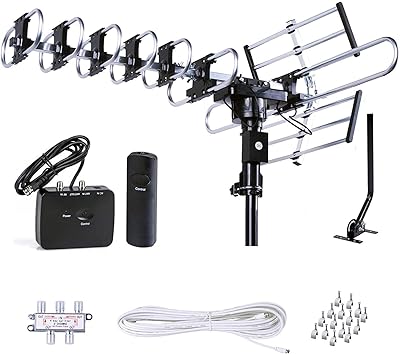
The PBD WA-2608 Motorized Outdoor TV Antenna is one of the more well-rounded options in the mid-range outdoor antenna market, built for households ready to drop the cable bill and pick up free over-the-air HD channels instead. What genuinely sets it apart from static competitors at a similar price is the 360° motorized rotation, which lets you reposition the antenna head from your couch rather than climbing onto the roof. It handles two TVs simultaneously through built-in dual outputs with no separate splitter required, and it carries ATSC 3.0 compatibility for future NextGen broadcasts. For the price, this rooftop antenna covers a lot of practical ground.
Features & Benefits

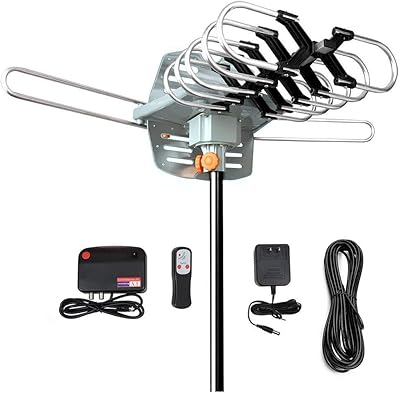
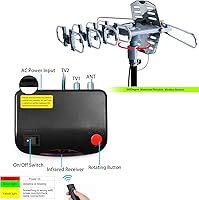
The WA-2608 includes a high-gain, low-noise amplifier that does real work pulling in distant signals, particularly on the UHF band where performance is rated excellent — VHF reception is solid too, though a step below. The wireless remote drives the motor through a full 360° sweep, so chasing a stubborn station no longer means a trip to the roof. The installation kit is genuinely complete: 40 feet of RG6 coaxial cable, mounting hardware, and a grounding block all arrive in the box. It also carries ATSC 3.0 readiness, though NextGen TV broadcasts are still limited in availability, so treat that as a longer-term upside rather than an immediate day-one benefit.

Best For

This motorized outdoor antenna makes the most sense for rural and suburban households that sit well outside the reliable range of any indoor antenna. If your terrain is hilly or dense with trees that knock a fixed antenna off its signal axis, the motorized rotation becomes genuinely useful rather than a novelty. It also suits homes with two TVs in separate rooms, since the built-in dual output handles both without extra hardware — though expect a modest signal dip at each port compared to a single-TV connection. Anyone who wants their antenna install to remain relevant as ATSC 3.0 gradually expands will find the WA-2608 a sensible long-term choice.

User Feedback

Across more than 6,100 ratings, this rooftop antenna holds a 4.3-star average, which is strong for a category where results swing sharply by location. The most consistent praise comes from users upgrading from passive or indoor antennas, who report a noticeable gain in channels and picture stability. Installation feedback is largely positive, with the included hardware cutting down on extra shopping trips. On the critical side, buyers in dense urban environments report that the range figures don't always survive multipath interference. Motor durability surfaces as a recurring concern after extended outdoor exposure, the remote range disappoints some users, and locking onto weaker fringe stations can require real patience with calibration.

Pros

  • Motorized 360° rotation lets you optimize signal direction without touching the antenna after install.
  • Built-in dual output supports two TVs simultaneously with no extra splitter required.
  • The high-gain amplifier meaningfully improves channel count for users upgrading from passive or indoor antennas.
  • A complete installation kit — cable, hardware, and grounding block — arrives in the box.
  • UHF reception performance is rated excellent, covering the majority of broadcast channels in most markets.
  • ATSC 3.0 compatibility protects your investment as NextGen TV broadcasts gradually expand.
  • The weatherproof housing holds up reliably through rain, wind, and seasonal temperature swings.
  • With over 6,100 ratings averaging 4.3 stars, real-world satisfaction is strong for this category.
  • The WA-2608 is a practical cord-cutting tool that pays for itself within a single billing cycle for most households.
  • Setup is manageable without professional help thanks to clear documentation and a logical install sequence.

Cons

  • Motor durability is a recurring concern, with some units showing wear or failure within the first year outdoors.
  • Advertised range figures rarely hold up in terrain with trees, hills, or buildings in the signal path.
  • Wireless remote range is shorter than expected, losing responsiveness beyond a single room in many homes.
  • Splitting the output to two TVs degrades signal strength at each port, which matters in weaker reception areas.
  • Urban buyers face multipath interference that can make the amplifier work against reception rather than for it.
  • VHF band performance lags noticeably behind UHF, which is a problem if major local affiliates broadcast on lower frequencies.
  • Fringe-area users often report a frustrating calibration process to reliably lock onto weaker distant stations.
  • Troubleshooting guidance in the documentation is thin, leaving signal problem-solving largely to trial and error.
  • Remote control units are not easy to replace if the original fails, adding a maintenance risk over time.
  • The value case weakens considerably for buyers who end up in poor signal zones and cannot return the unit easily.

Ratings

The PBD WA-2608 Motorized Outdoor TV Antenna has been scored by our AI system after analyzing thousands of verified buyer reviews worldwide, with spam, bot-generated, and incentivized feedback actively filtered out. The scores below reflect a candid picture of where this rooftop antenna genuinely delivers and where real users have run into friction. Strengths and pain points are weighted equally so you can make a clear-eyed decision before buying.
Signal Reception Quality
82%
18%
Users who switched from passive or indoor antennas consistently report a meaningful jump in the number of receivable channels, particularly on UHF frequencies. In suburban and semi-rural settings, the amplified signal pulls in stations that weaker antennas simply cannot reach, making a real difference for households 30 to 60 miles from major broadcast towers.
Reception in dense urban environments is more hit-or-miss due to multipath interference, and a handful of rural fringe users report that even with optimal motor positioning, certain weaker VHF stations remain unstable or drop out entirely during poor atmospheric conditions.
Motorized Rotation
78%
22%
The ability to reposition the antenna from a remote control rather than climbing onto the roof is a genuine practical advantage, especially in hilly or wooded terrain where a single fixed direction rarely catches every available tower. Users in divided signal markets particularly appreciate being able to sweep between directions without any physical effort.
Some buyers report that the motor feels less robust after a full season of outdoor exposure, with a few noting sluggish rotation or complete motor failure within the first year. The wireless remote also has a shorter effective range than expected, causing frustration when operating from rooms farther from the antenna controller.
Installation Experience
84%
The included kit covers most of what a typical install actually needs: 40 feet of RG6 coaxial cable, mounting hardware, and a grounding block all arrive in the box. Reviewers consistently note that the setup process is manageable without professional help, and the detailed guide keeps first-timers from guessing.
Users mounting on taller or non-standard structures sometimes find the included pole hardware limiting and need supplemental parts. A small number of buyers also report that the coaxial connector fittings require extra attention to get a weathertight seal, which matters more once the antenna has been through a few rain cycles.
Dual TV Output
74%
26%
Having two TV outputs built directly into the unit saves buyers the cost and hassle of sourcing a separate splitter, which is a practical advantage for households with TVs in different rooms. For most users in strong signal areas, both outputs deliver acceptable picture quality simultaneously.
Signal strength does measurably degrade when both outputs are in active use, and users in weaker reception zones often find that the second TV gets a noticeably less stable picture than the first. This is a physics reality of splitting a signal, not a defect, but it catches some buyers off guard who expected full performance on both ports simultaneously.
Build Quality & Durability
71%
29%
The weatherproof housing holds up reasonably well through rain, wind, and temperature swings, and most users report no corrosion or physical degradation to the antenna body itself after extended rooftop exposure. The overall construction feels solid for the price tier and comparable to competing units in the same range.
The motor assembly is the weakest structural point, with enough reports of premature wear or failure to warrant caution. Some buyers also note that the remote control unit itself feels lightweight and less weather-resistant than the antenna body, which becomes an issue if the controller is stored in a garage or shed exposed to humidity.
Amplifier Performance
79%
21%
The built-in low-noise amplifier adds meaningful gain without introducing the signal distortion that cheaper amplified antennas sometimes produce. Users located in genuine fringe reception areas often credit the amplifier with pulling in channels that a passive antenna of similar size would completely miss.
In areas with already-strong broadcast signals, a small number of users report that the amplifier actually causes overload distortion, producing pixelation or dropped channels on stations that a passive antenna would handle cleanly. This is a known phenomenon with amplified antennas and worth checking against your local signal map before buying.
Remote Control Usability
66%
34%
The wireless remote makes directional adjustment straightforward and keeps the process simple enough for non-technical users. Being able to rotate the antenna while watching the channel scan results in real time is a practical workflow that buyers appreciate during initial setup.
Effective remote range is shorter than the packaging implies, and several users find it stops responding reliably beyond a single room. There are also reports of the remote frequency interfering with other household devices, and replacement remotes are not always easy to source if the original unit fails.
ATSC 3.0 Readiness
69%
31%
For buyers thinking ahead, ATSC 3.0 compatibility means the WA-2608 will not need to be replaced when NextGen TV broadcasts begin rolling out more broadly in their market. Early adopters in cities where ATSC 3.0 is already available report cleaner signal acquisition and better picture stability on compatible TVs.
NextGen TV availability remains limited to select markets, so for most buyers today this feature delivers zero immediate value. It should be considered a future hedge rather than a present-day selling point, and buyers who are not in a covered market should weigh it accordingly when comparing against non-ATSC-3.0 alternatives.
Range vs. Advertised Claims
57%
43%
In open, flat terrain with minimal obstructions, the WA-2608 does pull in signals from considerable distances, and buyers in genuinely favorable geography often report results that approach or match the general spirit of the range claims. The amplifier does add measurable range over passive alternatives in those conditions.
The advertised range figures do not hold up in most real-world installs, where trees, buildings, elevation changes, and atmospheric conditions all reduce effective range significantly. A meaningful portion of critical reviews specifically cite the gap between stated and actual range, particularly among buyers in hilly or suburban environments who took the specifications at face value.
Channel Count
76%
24%
Users in metro and near-metro areas regularly report pulling in 40 to 60-plus channels across UHF and VHF bands, covering major networks, PBS subchannels, and local independent stations with no recurring cost. For households primarily watching network TV, sports, and news, the channel selection is more than sufficient.
The maximum channel count is highly geography-dependent, and buyers in rural markets with fewer broadcast towers often see totals well below expectations regardless of antenna performance. VHF channel acquisition is also less consistent than UHF, which affects users in markets where major network affiliates broadcast on lower VHF frequencies.
Weather Resistance
77%
23%
The antenna body itself handles outdoor exposure well across seasons, and most buyers report no functional decline after exposure to rain, snow, or high winds during the first year of use. The weatherproof rating holds up credibly for the price tier.
Long-term durability beyond one to two years is harder to assess from the available feedback pool, and the motor and electronic components appear more vulnerable to moisture ingress over time than the passive structural elements. Buyers in coastal or high-humidity climates should pay particular attention to sealing all cable entry points carefully.
Value for Money
81%
19%
Relative to what it offers — motorized rotation, amplification, dual outputs, a complete install kit, and ATSC 3.0 readiness — the WA-2608 represents a fair trade for the price. Buyers who successfully replace a cable or streaming subscription with free OTA channels typically recover the cost within the first billing cycle.
Buyers who end up in weak signal zones or who experience early motor failure tend to feel the value proposition breaks down quickly. The price is also no longer the clear bargain it once was as the market has grown more competitive, and a few buyers note that similarly priced competitors now offer comparable specs.
Setup Documentation
72%
28%
The included guide walks through the install steps clearly enough for most users to complete the job without outside help, and the logical sequence of the instructions reduces the chance of missteps during mounting and cable routing. Non-technical buyers generally find the documentation adequate.
The guide does not cover troubleshooting scenarios in enough depth, and users who run into signal issues post-install are largely on their own until they contact support. Instructions for motor calibration and channel scanning optimization are particularly thin, which matters most for buyers in fringe reception areas.
Customer Support
67%
33%
A portion of buyers who contacted the support team report receiving useful guidance on signal optimization and motor troubleshooting, and response times are generally described as reasonable. For straightforward setup questions, support appears competent and accessible.
Experiences are inconsistent enough to suggest support quality is not uniform across all inquiries. Users dealing with warranty claims or motor replacement requests describe a more frustrating process, and the resolution path for hardware failures is not as clearly communicated at the point of purchase as buyers would prefer.

Suitable for:

The PBD WA-2608 Motorized Outdoor TV Antenna is a strong fit for suburban and rural households that sit far enough from broadcast towers to make indoor antennas impractical. If you live in hilly or heavily wooded terrain where a single fixed antenna direction rarely captures every available station, the motorized rotation is a practical solution rather than a gimmick — you can sweep through directions from your couch until the picture locks in. It also works well for households with two TVs in separate rooms, since the built-in dual output eliminates the need to buy and install a separate splitter. Cord-cutters replacing a cable subscription with free over-the-air channels for news, sports, and network TV will find the channel yield satisfying in most markets. Buyers who want their antenna hardware to remain relevant as ATSC 3.0 broadcasts gradually expand will also appreciate the forward compatibility, even if that benefit is not yet usable everywhere.
Not suitable for:

The PBD WA-2608 Motorized Outdoor TV Antenna is likely the wrong choice for buyers in dense urban environments where multipath signal interference — caused by signals bouncing off buildings — undermines amplified antennas more than it helps them. If you are already in a strong signal area close to broadcast towers, a simpler passive antenna will often outperform an amplified unit and cost considerably less. Buyers who need reliable, full-strength signal on two TVs simultaneously should also temper their expectations, since splitting the output does measurably reduce signal quality on each port, which becomes a real problem in weaker reception zones. Anyone who needs a truly long-term durable solution and cannot easily access their roof for maintenance or replacement should factor in the motor longevity concerns that appear consistently in real-world user feedback. Finally, buyers whose primary channels broadcast on VHF frequencies may find the reception performance on those bands falls short of what they need compared to the antenna's stronger UHF capability.

Specifications

  • Brand & Model: Manufactured by pingbingding under the PBD brand, model designation WA-2608.
  • Antenna Type: Amplified outdoor television antenna designed for rooftop or elevated exterior mounting.
  • Dimensions: The antenna body measures 17.5 x 13 x 4.5 inches overall.
  • Weight: Complete unit weighs 6.21 pounds including the motor assembly.
  • Rotation: 360° motorized rotation driven by a built-in motor controlled via the included wireless remote.
  • Frequency Bands: Receives UHF signals from 470 to 860 MHz (rated excellent) and VHF signals from 170 to 230 MHz (rated good).
  • Impedance: Standard 75 Ohm impedance, compatible with all modern coaxial cable runs and TV tuner inputs.
  • Outputs: Dual coaxial outputs allow simultaneous connection to two separate televisions without an external splitter.
  • Included Cable: A 40-foot RG6 coaxial cable is included in the installation kit for the primary TV connection run.
  • Grounding Block: A coaxial grounding block is included to provide a safe path for static discharge and lightning protection compliance.
  • Resolution Support: Compatible with 4K Ultra HD and 1080p Full HD over-the-air broadcast signals.
  • ATSC Standard: ATSC 3.0 (NextGen TV) ready, in addition to full backward compatibility with the current ATSC 1.0 standard.
  • Channel Capacity: Capable of receiving up to 69 over-the-air broadcast channels depending on local tower availability and terrain.
  • Weather Resistance: Weatherproof outdoor-rated housing is built to withstand rain, wind, snow, and seasonal temperature variation.
  • Certification: UL listed, meeting the applicable safety standards for outdoor electrical and electronic installations.
  • Remote Control: Wireless remote control is included for directional motor adjustment without requiring physical access to the antenna.
  • Amplifier: Built-in high-gain, low-noise amplifier is integrated into the unit to boost weak incoming broadcast signals.
  • Market Rank: Ranked number 20 in the TV Antennas category on Amazon based on best-seller data at time of review.

Related Reviews
PBD WA-2900-4G Outdoor HDTV Antenna
87%
94%
Signal Reception Quality
91%
Range Performance
88%
Ease of Installation
85%
Build Durability
89%
Weather Resistance
More
iGENJUN ANT-CS8218 Amplified Indoor Outdoor TV Antenna
72%
73%
Signal Reception Quality
67%
Amplifier Performance
88%
Ease of Installation
48%
Range Accuracy vs. Claimed Specs
71%
Build Quality & Materials
More
PIBIDI UHD-8903 Outdoor TV Antenna
77%
73%
Signal Range & Reception
67%
VHF Band Performance
84%
UHF Band Performance
78%
Build Quality & Durability
81%
Lightning & Grounding Protection
More
UltraPro Outdoor 70-Mile HD TV Antenna
76%
73%
Signal Reception
61%
Range Accuracy
82%
Installation Ease
78%
Build Quality
81%
Weather Resistance
More
MATIS FBA08D Outdoor TV Antenna
73%
71%
Signal Reception
88%
Ease of Setup
84%
Dual TV Output
76%
Motorized Rotation
73%
Weather Resistance
More
Antop AT-414BG Omni-Directional Outdoor TV Antenna
85%
90%
Reception Quality
88%
Ease of Installation
86%
Durability in Outdoor Conditions
92%
Value for Money
87%
Signal Range
More
GE 29884 Outdoor Long-Range TV Antenna
79%
83%
Signal Reception Strength
88%
Ease of Installation
86%
Build Quality & Durability
79%
Channel Count & Variety
84%
Value for Money
More
PBD HJK544 Outdoor Yagi TV Antenna
76%
83%
Signal Reception
89%
UHF Performance
61%
VHF Performance
78%
Build Quality
81%
Weather Resistance
More
1byone 360° Omni-Directional Outdoor TV Antenna
73%
74%
Signal Reception
91%
Ease of Installation
72%
Build Quality
68%
Amplifier Performance
63%
4G LTE Filtering
More
BEFORE 150-Mile Motorized Outdoor TV Antenna
70%
71%
Signal Reception
74%
Motorized Rotation
58%
Build Quality & Durability
66%
Ease of Installation
83%
Dual TV Output
More

FAQ

It depends on your specific location and terrain more than any single spec on the box. The WA-2608 is one of the better-equipped options in its price range for rural installs — the amplifier adds real gain and the motorized rotation helps you chase towers in multiple directions. That said, if you are 70 or more miles out with significant hills or tree cover between you and the towers, results will vary. Check antennaweb.org or rabbitears.info with your exact address before buying to set realistic expectations.

Yes, the dual output is built directly into the unit, so no external splitter is needed. Keep in mind that splitting any antenna signal does reduce strength at each port, so if you are already in a marginal reception area, the second TV may get a weaker or less stable picture than the first. In strong signal zones most buyers report both outputs working fine simultaneously.

The included wireless remote sends a signal to the motor inside the antenna, rotating the head in either direction until you stop it. In practice, you run a channel scan, notice which stations are weak, rotate the antenna toward where that station's tower is, and rescan. It sounds like more work than it is — most people find their sweet spot within a few minutes and rarely need to adjust again unless they add new channels to their scan.

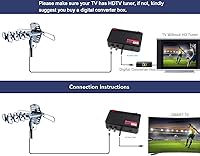
Yes, it connects through a standard coaxial input, which virtually every TV manufactured in the past 30 years has. Smart TVs, older analog-to-digital converter box setups, and everything in between all work the same way. The antenna does not care what brand or model your TV is as long as it has a coaxial input.

This is one of the more honest concerns worth flagging. The antenna body itself tends to hold up well through weather exposure, but the motor is the component most likely to show wear over time. A portion of real buyers report sluggish rotation or full motor failure within one to two years in harsh climates. If you live somewhere with extreme temperature swings, high humidity, or coastal salt air, that timeline may be shorter.

No, the amplifier is already built in, so adding an external booster on top of it would typically cause more harm than good through overload distortion. If you are in a strong signal area and experiencing pixelation, the first thing to try is actually bypassing or reducing the built-in amplification rather than adding more.

Practically speaking, very little in most markets today. ATSC 3.0, also called NextGen TV, is a new broadcast standard that offers better picture quality, audio, and signal robustness — but stations are still rolling it out city by city. If your local broadcasters have not yet launched ATSC 3.0 signals, that feature sits dormant. Think of it as future-proofing rather than a present-day benefit.

For a typical rooftop or attic mount with the TV reasonably close to the entry point, 40 feet covers most single-story and many two-story installs. If your TV is on the opposite side of the house from your roof mount, or you are running cable through walls across a large home, you may need to budget for additional RG6 cable. It is always better to measure your planned run before assuming the included cable will reach.

The housing is weatherproof and designed for year-round outdoor use, and most buyers report the body surviving winter conditions without physical damage. Snow accumulation on the antenna surface can temporarily degrade signal, but it typically recovers once the snow melts or is cleared. The bigger winter concern is ice forming around the motor assembly, which can restrict rotation — something worth keeping in mind if you are in a heavy-freeze climate.

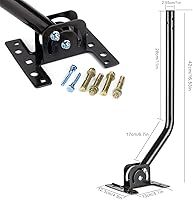
For a standard mount, the included kit is reasonably complete: you get the coaxial cable, mounting hardware, and a grounding block, which covers the basics most installs actually need. Where buyers sometimes get caught short is with non-standard mounting surfaces or longer cable runs. If you are mounting on a chimney, a peaked ridge, or a surface that needs an extended pole, you will likely need supplemental hardware not included in the box.

Where to Buy