
Overview

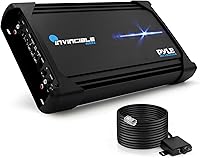
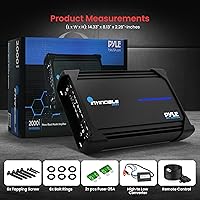
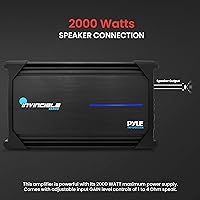
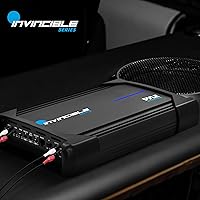
The Pyle INV1000DBA.6 Monoblock Car Amplifier is Pyle's latest entry in the value-oriented Invincible series, aimed at builders who want serious wattage without spending serious money. Before anything else, one number needs clarifying: that advertised 2000W is a peak power figure, not RMS — the continuous output you'll actually hear day to day is lower, as is standard across this price tier. What does impress is the Class D design, which runs notably cooler and more efficiently than older amp topologies. At 14.33″ x 8.13″ x 2.28″ and under 8 pounds, it fits convincingly in tight trunk corners or tucked beneath a rear seat.

Features & Benefits

The MOSFET PWM power supply is one of the more practical inclusions here — it keeps output stable when your car's voltage dips during heavy electrical loads, which is a real-world scenario most amps in this class struggle with. The onboard low-pass filter control means you can dial in the crossover point to suit your specific subwoofer rather than accepting a fixed setting. Five layers of protection circuitry handle thermal overload, short circuits, and voltage spikes, and LED status indicators tell you the amp's health at a glance. The bundled high-to-low converter is a thoughtful touch for anyone running a factory head unit without RCA outputs.

Best For

This monoblock amp is a solid pick if you're adding a subwoofer to a stock or entry-level stereo and don't want to overspend on the amplifier itself. It's particularly well-suited to first-time installers — the protection circuitry is forgiving, and the included accessories reduce the number of separate parts you need to source. Compact dimensions make it a natural fit for smaller vehicles or builds where space is genuinely limited. It also works well as a dedicated bass channel in a more complex audio setup. If you're chasing audiophile-grade signal purity, though, this isn't the amp for that job.

User Feedback

Across more than 1,600 ratings, the Pyle Invincible amplifier holds a 4.2-star average, which is respectable for a budget unit. Buyers consistently highlight easy installation and the value-for-wattage ratio as strong points. The most common criticism involves heat buildup during sustained high-volume use — not unusual at this price bracket, but worth noting if you plan long listening sessions. A few buyers also flag confusion around the peak vs. RMS wattage distinction. Since this unit only launched in mid-2025, long-term reliability data is still limited, so it's worth monitoring how it holds up before committing to a permanent install.

Pros

  • Compact dimensions make it one of the easier monoblocks to fit in tight or awkward install spaces.
  • Class D design runs noticeably cooler than older amp classes, reducing thermal shutdown risk during normal use.
  • The included high-to-low converter is a genuinely useful accessory that saves a separate purchase for factory stereo owners.
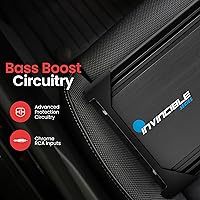
  • Five-way protection circuitry gives first-time installers a meaningful safety buffer against wiring mistakes.
  • LED health indicators let you diagnose basic amp issues at a glance without extra tools.
  • Onboard LPF control allows real crossover tuning rather than locking you into a fixed frequency.
  • MOSFET PWM power supply maintains stable output even when vehicle voltage dips under electrical load.
  • At its price point, the wattage headroom it offers is difficult to match from established brands.
  • A 4.2-star average across over 1,600 ratings suggests most buyers walk away satisfied with what they paid for.
  • The accessory bundle — fuses, spacers, remote, converter — reduces the number of separate parts to source before install.

Cons

  • The 2000W rating is peak power, not RMS — real continuous output is significantly lower than the headline figure suggests.
  • Heat buildup during sustained high-volume sessions is a recurring complaint, particularly in warmer climates.
  • Long-term durability is still an open question given the unit only became available in mid-2025.
  • The bundled high-to-low converter is functional but not high quality — it can introduce noise in sensitive systems.
  • This monoblock amp is not suited to power-hungry or low-impedance subwoofers that demand consistent high-wattage delivery.
  • RMS specifications are not clearly disclosed in marketing materials, which creates realistic expectation gaps for new buyers.
  • Build materials feel cost-appropriate rather than confidence-inspiring — internal components reflect the budget positioning.
  • Limited long-term owner reviews make it harder to assess reliability beyond the first few months of use.

Ratings

Our AI rating system analyzed verified global buyer reviews for the Pyle INV1000DBA.6 Monoblock Car Amplifier, actively filtering out incentivized, bot-generated, and duplicate submissions to surface what real owners actually experience. The scores below reflect a transparent synthesis of both the genuine strengths that keep buyers satisfied and the recurring pain points that show up consistently across independent feedback. Nothing has been smoothed over — the ratings reflect the full picture, good and frustrating alike.

Value for Money
83%
For buyers working with a tight budget, this monoblock amp delivers a wattage ceiling and feature set that would cost significantly more from a premium brand. The inclusion of a high-to-low converter, remote control, and mounting hardware in the box adds real tangible value that budget shoppers notice immediately.
The value perception takes a hit once buyers realize the 2000W claim is peak, not RMS — some feel the marketing overstates what the amp actually delivers in sustained real-world use. For those who did their homework on specs, the value holds up, but uninformed buyers often feel misled.
Ease of Installation
86%
DIY installers consistently praise how straightforward the wiring process is — clearly labeled RCA inputs, accessible screw terminals, and a logical layout reduce the learning curve significantly for first-timers. The bundled high-to-low converter means factory stereo owners can get up and running without sourcing extra parts.
A small but vocal group of buyers report that the included wiring documentation could be more detailed, particularly around gain setting and LPF adjustment for beginners. Those installing in unfamiliar vehicles sometimes struggle with finding suitable mounting points given the chassis dimensions.
Sound Quality
71%
29%
For everyday bass reinforcement — commuting, casual weekend drives, and entry-level subwoofer builds — this Class D car amp delivers a clean enough signal to satisfy most non-audiophile listeners. The LPF control gives users meaningful tuning flexibility that noticeably improves bass definition when dialed in properly.
At higher volumes, some buyers detect a slight muddiness in the low-end that suggests the amp is being pushed toward its practical ceiling. Signal purity is not a strength here — listeners upgrading from a mid-range or high-end amp will immediately notice the step down in clarity and dynamic headroom.
Thermal Management
67%
33%
Under moderate listening conditions — typical daily commutes and mixed-volume driving — the Class D topology keeps operating temperatures reasonable, and most buyers report no issues with the unit running too hot during normal use. The five-way protection system does catch thermal events before they cause damage.
Extended high-volume sessions, particularly in summer heat or enclosed trunk spaces without airflow, push this amp into thermal protection more frequently than buyers expect. Several owners report the protection circuit tripping during long highway drives with the bass cranked, which interrupts listening and points to real thermal management limitations at sustained output.
Build Quality
63%
37%
The chassis feels solid enough for the price tier, and the chrome RCA inputs and speaker terminals have a reassuringly sturdy feel during installation. Most buyers find it holds up fine through the initial months of regular use without any structural complaints.
The overall construction reads as cost-optimized rather than built to last — internal component quality is appropriate for the price but unlikely to survive years of heavy use or extreme temperature swings. A few long-term owners have raised early durability concerns, though the product is too new for definitive conclusions.
Power Output Accuracy
54%
46%
The amp does deliver usable, impactful bass output that suits budget subwoofer builds, and buyers who researched RMS vs. peak ratings beforehand feel the actual output aligns with realistic expectations for this class of amplifier.
The gap between the marketed 2000W peak figure and the real-world continuous RMS output is a consistent source of frustration across buyer reviews — many feel the spec is used deceptively. Pyle does not publish an official RMS rating, which makes accurate subwoofer matching genuinely difficult for less experienced buyers.
Compatibility
78%
22%
The included high-to-low converter dramatically broadens compatibility with factory head units, making this amp accessible to a much wider range of vehicles than most competitors at this price. Standard RCA connectivity ensures it pairs with virtually any aftermarket head unit on the market.
Buyers running low-impedance subwoofer configurations or high-demand dual voice coil setups sometimes find this amp struggles to perform consistently at those loads. Compatibility with the full range of subwoofer types is not universal, and the lack of published impedance specs complicates pre-purchase matching.
Protection Circuitry
81%
19%
The five-layer protection system is a genuine asset for first-time installers — it has saved more than a few setups from wiring errors and short-circuit events that would have destroyed a less protected amp. Buyers credit the protection suite with giving them confidence during install experimentation.
While the protection system works, it can be overly sensitive in some installations, tripping into protection mode under conditions that a more robust amp would handle without issue. Repeated protection events, even if non-damaging, are disruptive and point to the amp operating close to its practical limits.
Size & Fitment
88%
The slim 2.28″ profile and sub-8-pound weight make this one of the more versatile monoblocks for space-constrained installs — owners regularly report fitting it under rear seats or in shallow trunk compartments where bulkier amps simply cannot go. The compact footprint is a genuine differentiator at this wattage tier.
The 14.33″ length, while slim in height, can still be challenging in very tight under-seat applications in smaller vehicles. A handful of buyers in compact cars found the length just barely exceeded their available mounting space, requiring improvised bracket solutions.
Accessories & Contents
76%
24%
The box contents are more generous than typical for this price range — the remote control, hardware kit, fuses, and high-to-low converter collectively save buyers several extra purchases and make the first install much smoother. Most buyers view the accessory bundle as a legitimate value-add.
The high-to-low converter, while useful, is a basic unit that can introduce low-level noise in quieter listening environments or when paired with sensitive subwoofers. It serves its purpose for most buyers but is not a substitute for a properly equipped head unit with clean RCA pre-outs.
LED Status Indicators
79%
21%
Real-time LED feedback on amp status is a practical feature that removes guesswork during troubleshooting — buyers appreciate being able to check at a glance whether the amp is in normal operation, signal standby, or a protection fault state without needing a multimeter.
The LED indicator system is functional but basic, offering limited diagnostic granularity — buyers cannot easily distinguish between different types of protection faults from the indicators alone. More advanced users find the feedback too coarse for meaningful real-time diagnostics.
LPF Control
77%
23%
Having an adjustable low-pass filter onboard rather than a fixed crossover point gives buyers the flexibility to tune bass roll-off to their specific subwoofer — a feature that meaningfully improves the final listening result when set correctly. Most buyers find the control range adequate for typical subwoofer pairings.
The LPF adjustment is not always clearly calibrated on the physical control, making precise frequency targeting a trial-and-error process without a real-time frequency analyzer. Beginners especially find the tuning process frustrating without clearer guidance on where to set the control for common subwoofer configurations.
Long-Term Reliability
58%
42%
Units that have been in use since the product launched in mid-2025 report no widespread early failure patterns, and the protection circuitry does appear to extend component lifespan by preventing the most damaging stress events. Early adopter experiences have been broadly positive.
The product is simply too new to draw reliable conclusions about multi-year durability — there is not yet enough longitudinal owner data to rate this confidently. Buyers making a permanent install in a vehicle they plan to keep long-term should factor in this unknown before committing.
Noise Floor
62%
38%
In properly grounded installations with a quality head unit providing the source signal, the amp operates quietly enough for typical car listening environments without intrusive background hiss or hum. Most everyday buyers do not report audible noise as a primary concern.
Ground loop hum is a recurring complaint in installs where grounding is less than ideal or where the bundled high-to-low converter is in use. Buyers with sensitive subwoofers or who prefer quiet musical passages with strong dynamic range will find the noise floor more noticeable than in higher-end alternatives.

Suitable for:

The Pyle INV1000DBA.6 Monoblock Car Amplifier is a practical fit for budget-conscious car audio builders who want to add real bass to their system without a major financial commitment. It works especially well for anyone upgrading from a factory head unit, since the included high-to-low converter removes one of the most common wiring headaches. First-time installers will appreciate the protection circuitry, which acts as a safety net if something goes sideways during setup. The slim, lightweight chassis opens it up to vehicles where trunk real estate is tight — compact cars, hatchbacks, and smaller SUVs where a bulkier amp simply won't fit cleanly. It also makes sense as a secondary amp in a multi-channel build, handling bass duties while a separate unit powers your mids and highs.

Not suitable for:

The Pyle INV1000DBA.6 Monoblock Car Amplifier is not the right choice for listeners who prioritize signal transparency or low noise floor above all else. Pyle builds for value, not for audiophile benchmarks, and that trade-off shows at high volumes with demanding subwoofers. The 2000W figure is a peak rating, not continuous RMS output — buyers expecting sustained high-power delivery comparable to higher-end monoblocks will likely be disappointed. If you run your system hard for extended periods, heat management at this price tier becomes a genuine concern. Enthusiasts chasing a competition-grade bass setup or those with high-impedance, power-hungry subs should look further up the price ladder for an amp that can reliably deliver where it counts.

Specifications

  • Model Number: The unit carries the official model designation INV1000DBA.6, part of Pyle's Invincible Monoblock series.
  • Amplifier Class: This amplifier operates as a Class D design, prioritizing energy efficiency and reduced heat output compared to Class A/B topologies.
  • Configuration: Single-channel monoblock configuration, dedicated exclusively to powering one subwoofer or a bridged subwoofer load.
  • Peak Power Output: Rated at 2000W maximum peak power, which represents the amp's absolute ceiling under ideal, momentary conditions — not sustained continuous output.
  • Power Supply: MOSFET PWM (Pulse Width Modulation) power supply regulates and stabilizes output voltage even when the vehicle's electrical system fluctuates.
  • Dimensions: The chassis measures 14.33″ in length, 8.13″ in width, and 2.28″ in height, making it one of the slimmer options in its wattage class.
  • Weight: At 7.88 lbs, the unit is light enough for single-person installation without requiring additional mounting support hardware.
  • Low-Pass Filter: An onboard LPF (Low-Pass Filter) control allows the user to adjust the crossover frequency, routing only bass frequencies to the connected subwoofer.
  • Protection System: Five-layer protection circuitry covers thermal overload, short circuits, DC offset, power surge, and load instability to safeguard both the amp and connected speakers.
  • Status Indicators: Built-in LED indicators display real-time operational status, allowing users to identify power, signal, and fault conditions without external diagnostic tools.
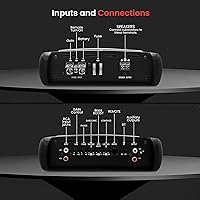
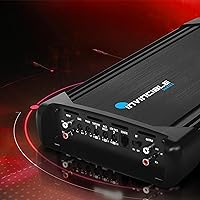
  • Input Connectivity: Chrome RCA inputs accept standard line-level signals from aftermarket head units or the included high-to-low converter for factory stereo integration.
  • Speaker Terminals: Robust screw-type speaker terminals accommodate standard gauge subwoofer wiring and are designed for a secure, vibration-resistant connection.
  • Included Accessories: The box contains two 30A fuses, a remote control, four Φ4.0 spacers, two Φ3.0 spacers, mounting screws in two sizes, a high-to-low converter, and telephone wire.
  • BSR Ranking: At the time of review, this amplifier holds the #73 position in the Car Amplifiers category on Amazon's Best Sellers Rank.
  • User Rating: The unit holds a 4.2 out of 5 star average rating based on 1,624 customer ratings on Amazon.
  • Availability Date: This amplifier became publicly available for purchase on June 12, 2025, making it a relatively recent market entry with limited long-term owner data.
  • Manufacturer: Designed and sold by Pyle, a consumer electronics brand known for offering value-oriented audio equipment across car, home, and professional categories.

Related Reviews
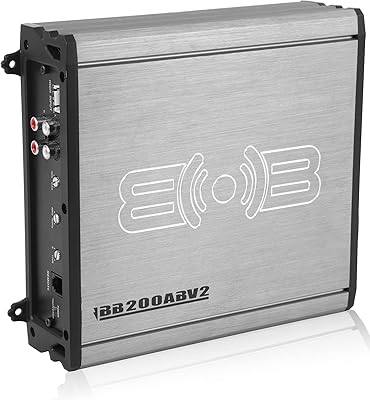
Belva BB200ABv2 Monoblock Car Amplifier
76%
88%
Value for Money
79%
Bass Output Quality
91%
Ease of Installation
61%
Thermal Management
67%
Build Quality
More
Pyle PLAM1600 4-Channel Car Amplifier
69%
74%
Value for Money
67%
Sound Quality
51%
Power Output Accuracy
83%
Ease of Installation
59%
Build Quality
More
LKC PHF450D Car Audio Monoblock Amplifier
88%
91%
Power Output (2 Ohms)
87%
Power Output (4 Ohms)
93%
Heat Dissipation
88%
Build Quality
85%
Ease of Integration
More
Pyle PLMRA630BT 6-Channel Bluetooth Marine Amplifier
83%
88%
Build Quality and Durability
90%
Bluetooth Connectivity
85%
Power Output
91%
Ease of Setup
83%
Sound Performance
More
Blaupunkt AMP1500M Monoblock Car Amplifier
73%
81%
Value for Money
63%
Real-World Power Output
88%
Ease of Installation
77%
Audio Clarity
58%
Build Quality
More
Planet Audio TR1500.1M Monoblock Car Amplifier
70%
88%
Value for Money
79%
Bass Output & Performance
83%
Ease of Installation
63%
Build Quality
57%
Thermal Management
More
BOSS Audio R1600M Monoblock Car Amplifier
72%
83%
Value for Money
88%
Ease of Installation
79%
Bass Output
61%
Build Quality
86%
Signal Flexibility
More
Planet Audio AC1500.1M Monoblock Car Amplifier
75%
91%
Value for Money
78%
Bass Output Quality
86%
Ease of Installation
61%
Thermal Management
67%
Build Quality
More
Planet Audio AC2500.1M Monoblock Car Amplifier
85%
92%
Performance
95%
Bass Output
85%
Ease of Installation
65%
Thermal Performance
88%
Build Quality
More
Pyle PLA2378 2-Channel Car Amplifier
72%
83%
Value for Money
51%
Power Output Accuracy
67%
Build Quality
88%
Ease of Installation
58%
Heat Management
More

FAQ

No, and this is probably the most important thing to understand before buying. The 2000W figure is a peak power rating — it reflects the absolute maximum the amp can theoretically produce for a fraction of a second under ideal conditions. The continuous RMS output, which is what you actually hear during normal listening, will be meaningfully lower. Pyle does not publish an official RMS figure for this unit, so factor that in when matching it to a subwoofer.

Yes, and Pyle actually includes a high-to-low converter in the box specifically for this scenario. You connect the converter to your factory speaker wires and it converts the signal to a line-level RCA output the amp can accept. It works, though audiophiles sometimes find bundled converters introduce a small amount of background noise — for most everyday listeners in a car environment, it's perfectly fine.

It has a good shot. At 14.33″ x 8.13″ x 2.28″, this monoblock amp is noticeably slimmer than many competitors at similar wattage ratings. It can realistically tuck under a rear seat in some vehicles or mount flat in a tight trunk corner. Measure your available space before ordering and leave a couple of inches of clearance on the sides for airflow.

Class D is more efficient than older designs, so it produces less waste heat overall — but it can still warm up noticeably during extended high-volume sessions. Several owners have flagged this, particularly in summer months. Make sure it's mounted somewhere with reasonable airflow and not sealed inside a completely enclosed compartment. The built-in thermal protection will cut power before damage occurs, but you don't want it tripping regularly during a long drive.

Honestly, yes. The five-way protection system is a genuine help for beginners — it acts as a buffer if you make a minor wiring error or overload the amp briefly. The RCA inputs are clearly labeled, the terminals are easy to work with, and the LED indicators give you a simple visual status check. Just follow a solid wiring guide, make sure your power wire is properly fused at the battery, and take your time.

This amp is designed for subwoofer duty, so pairing it with a dedicated sub in the 10- to 12-inch range is a natural fit. For impedance, a 4-ohm or 2-ohm single voice coil sub is a reasonable match. Avoid pushing extremely low impedance loads (like a 1-ohm setup) on a budget amp — that tends to generate excessive heat and can stress the power supply in units at this price point.

Technically the amp needs a 12V DC power source, so you could run it with a suitable power supply in a non-vehicle setting. That said, it's designed and optimized for automotive electrical systems, and using it outside that context adds complexity. If you're building a dedicated home bass setup, there are purpose-built home audio options better suited to that environment.

For an amp in this power range, a 4-gauge power and ground wire is a commonly recommended starting point. Going to 0-gauge is generally overkill at these power levels unless you're running multiple amps off the same run. Always fuse the power wire as close to the battery as possible — the included 30A fuses are a starting reference, but verify the correct fuse rating for your specific wiring gauge and run length.

The LED indicators on the unit will flag this. Under normal operation the power LED should be solid. If the amp enters protection mode due to heat, a short, or a signal issue, the indicator will typically change state — either switching color or turning off depending on the fault type. If it keeps tripping into protection, check your wiring, confirm the sub's impedance is within spec, and ensure the amp has adequate ventilation.

Pyle typically offers a limited manufacturer warranty on their amplifiers, though the exact terms should be confirmed directly with Pyle or the retailer at purchase since warranty policies can vary by product and region. Their customer support has a mixed reputation — straightforward issues tend to get resolved, but complex technical problems can require persistence. Keep your purchase receipt and register the product if Pyle offers that option, as it simplifies any future support interactions.