Overview

The Pro-Ject Tube Box S2 Phono Preamplifier comes from a brand with deep roots in Austrian hi-fi engineering, and it shows. This tube phono stage sits at a tier where buyers are serious about their vinyl rigs — well past plug-and-play territory, but not yet into the kind of excess that fills dedicated listening rooms. What makes it stand out at this price point is the dual ECC83 tube design packed into a genuinely compact chassis. It handles both MM and MC cartridges, which keeps your options open as your setup evolves. The aluminum and metal sandwich housing feels engineered with intent — solid, interference-resistant, and far from the hollow units that clutter the budget segment.
Features & Benefits

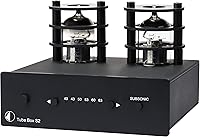
The double-mono circuit layout runs each channel through its own independent signal path — a design choice that pays off in stereo separation and precise imaging. Five gain settings spanning 40 to 63 dB let you dial in the preamp exactly to your cartridge, and the MC impedance options (10, 100, 1k, and 2k ohms) eliminate the need for a separate step-up transformer, which is a genuine cost saving at this tier. MM users get six capacitance loading options, which is unusually generous for something this compact. The front-panel subsonic filter handles warp-induced rumble cleanly, while the fully op-amp-free circuit with polystyrene capacitors supports the impressively low 80 dB noise floor specification.

Best For

The Tube Box S2 makes the most sense for someone stepping up from the built-in phono stage on an amplifier or a budget standalone box — the improvement in resolution and tonal character tends to be immediately apparent. If you are running a low-output MC cartridge, the onboard impedance loading removes the need for a step-up transformer that many rivals in this range still require. The compact footprint — 103 x 73 x 131 mm — fits cleanly on a desk or shelf without consuming much space. Experienced listeners interested in tube rolling will find ECC83s among the most widely available and affordable tubes on the market, making personal tuning an accessible, low-cost exercise.

User Feedback

Owners of Pro-Ject's compact valve preamp consistently point to a wider, more natural soundstage versus whatever they were using before — tonal warmth, particularly through the midrange, comes up often in discussion. That said, some users running high-gain MC settings report a mild tube hiss; it is not unusual for a valve circuit, but worth considering if your listening room is very quiet. Setup complexity is the most honest caveat: the array of impedance and capacitance options is a genuine strength for experienced users and a legitimate source of confusion for newcomers. Build quality earns consistent praise, though strong competition from iFi, Graham Slee, and Lehmann means the Tube Box S2 has to justify itself on performance, not reputation alone.

Pros

  • Genuine, audible sound quality improvement over built-in or budget phono stages.
  • Supports both MM and MC cartridges with onboard impedance loading — no step-up transformer needed.
  • Five gain settings give precise matching across a wide range of cartridge outputs.
  • Six MM capacitance options offer rare fine-tuning flexibility in a unit this compact.
  • Double-mono circuit layout produces noticeably better stereo channel separation.
  • Front-panel subsonic filter handles warped records without any cable changes.
  • ECC83 tubes are inexpensive and widely available, keeping long-term costs low.
  • Aluminum and metal sandwich housing feels genuinely solid and resists interference.
  • The compact footprint — 103 x 73 x 131 mm — fits tight desks and equipment racks without issue.
  • Fully discrete, op-amp-free circuit appeals to listeners who care about signal path purity.

Cons

  • Internal DIP switches for loading settings make cartridge changes more involved than turning a dial.
  • Tube hiss becomes audible at high MC gain settings in quiet listening environments.
  • The external power supply adds cable clutter that the compact chassis itself avoids.
  • Included documentation is thin and assumes prior knowledge most newcomers simply do not have.
  • Setup complexity can mean first-time users never land on the optimal configuration.
  • Tubes are consumable — performance subtly degrades over time in ways that may catch new tube owners off guard.
  • The tonal warmth of the valve circuit may feel like unwanted coloration to listeners used to solid-state accuracy.
  • Strong competition from iFi, Graham Slee, and Lehmann means it cannot rely on brand name alone to justify its price.

Ratings

The Pro-Ject Tube Box S2 Phono Preamplifier scores here are generated by AI after analyzing verified buyer reviews from global sources, with spam, bot activity, and incentivized feedback actively filtered out. Across thousands of real-world impressions — from casual vinyl listeners to dedicated audiophiles — both the genuine strengths and the honest frustrations are reflected in every score below. Nothing is rounded up to look flattering, and nothing is downplayed to seem neutral.
Sound Quality
91%
Users upgrading from built-in or entry-level solid-state stages consistently describe an immediate and meaningful improvement — wider soundstage, more natural midrange texture, and better separation between instruments. The tube-based signal path adds a warmth that many listeners find more engaging for extended vinyl sessions.
A small number of listeners feel the tonal character leans slightly soft in the upper frequencies, which can mask fine detail on some recordings. Those coming from a clinical solid-state reference may find the coloration noticeable rather than purely flattering.
Build Quality
88%
The aluminum and metal sandwich housing feels meaningfully more solid than most rivals at this tier. Buyers frequently note that it sits on a shelf or desk without any flex or rattle, and the gold-plated RCA connectors give a reassuring sense of durability when swapping cartridges or cables.
A few users point out that the external power supply brick adds desk clutter that the compact chassis itself avoids. The front-panel controls, while functional, feel slightly stiff and lack the tactile refinement found on units from Lehmann or Graham Slee at similar price points.
Cartridge Compatibility
93%
Supporting both MM and MC cartridges with onboard impedance loading — covering 10, 100, 1k, and 2k ohms — removes the need for a separate step-up transformer that comparable competitors still require. This makes the Tube Box S2 genuinely future-proof as cartridge preferences evolve.
The impedance and capacitance settings are accessed via internal DIP switches on most configurations rather than external dials, which means matching a new cartridge requires opening the unit or consulting the manual. For casual listeners swapping cartridges infrequently, this is a minor but real inconvenience.
Gain & Loading Flexibility
89%
Five gain steps from 40 to 63 dB give genuine coverage from high-output MM cartridges down to low-output MC models, and the six MM capacitance options are unusually thorough for a unit this compact. Experienced users treat these adjustments as a meaningful fine-tuning tool rather than a set-and-forget switch.
The sheer number of configuration options can overwhelm buyers who are new to phono stage setup. Without a basic understanding of cartridge loading principles, choosing the wrong settings is easy — and the sonic consequences are real enough that some users never find the optimal combination.
Noise Performance
82%
18%
At lower gain settings — particularly the 40 dB MM range — the noise floor is genuinely low and the background is clean during quiet passages. The discrete, op-amp-free circuit and polystyrene capacitors contribute to a composed, hiss-free presentation that many users specifically praise.
At higher MC gain settings (60 dB and above), a modest tube hiss becomes audible in quiet rooms, which is not unusual for a valve circuit but is worth knowing before purchase. Listeners with very sensitive speakers or a very low-output MC cartridge in a quiet listening environment may find this more noticeable than expected.
Ease of Setup
63%
37%
For experienced audiophiles, the setup process is logical and well-documented. The front-panel subsonic filter switch is a convenient touch, and users familiar with cartridge loading report that getting the unit dialed in takes less than an hour once you understand the principles.
Newcomers frequently report frustration navigating the impedance and capacitance combinations without prior knowledge. The manual is functional but not especially beginner-friendly, and the lack of clearly labeled external controls means first-time setup can feel more like a technical exercise than a plug-and-play experience.
Subsonic Filter Effectiveness
84%
The 18 dB-per-octave subsonic filter at 20 Hz is a practical and appreciated feature for anyone playing older or warped records. Users running it report noticeably less woofer pumping and a tighter bass response, and the front-panel placement means toggling it requires no cable changes.
Some listeners feel the filter slightly softens the lowest bass frequencies even on clean, flat records when left engaged. It is best treated as a contextual tool rather than a permanent setting, but not all users realize this from the outset.
Tube Rolling Potential
86%
ECC83 and 12AX7A variants are among the most plentiful and affordable tubes on the used and new-old-stock market, which makes this one of the more accessible platforms for personal sound shaping. Users report genuine and audible differences between tube brands, which adds a layer of long-term engagement to the unit.
Rolling tubes requires some confidence handling electronics and basic knowledge of which variants are electrically compatible. Budget-focused buyers may not anticipate this optional extra cost, and sourcing quality used tubes from trustworthy suppliers takes more effort than simply buying a replacement.
RIAA Accuracy
87%
A maximum deviation of 0.4 dB across the full 20 Hz to 20 kHz range is a tight specification for a tube-based unit, and experienced listeners note that records sound tonally balanced and true to their source — not warm in a way that compromises accuracy.
At the frequency extremes — particularly the deep bass — a small number of technically trained users detect a barely perceptible rolloff compared to measurements from solid-state alternatives. In real-world listening this is unlikely to be an issue, but it is a fair data point for precision-focused buyers.
Value for Money
78%
22%
For what you get — tube amplification, MC compatibility, extensive loading options, and solid construction — the asking price sits at a point that most serious vinyl listeners consider fair. Avoiding a separate step-up transformer saves a tangible amount over comparable configurations from competitors.
Alternatives from iFi and Graham Slee offer strong competition at overlapping prices, and some buyers feel the Tube Box S2 requires a more committed setup investment to realize its full potential. Casual listeners who just want a no-fuss improvement may find better value in a simpler solid-state unit at a lower price.
Chassis Size & Desk Fit
91%
At 103 x 73 x 131 mm, this is one of the most compact tube phono stages available, and users in apartment setups or tight equipment racks specifically call this out as a decisive factor. It sits neatly beside a turntable without dominating the surface.
The external power supply is a separate unit, so the real desk footprint is larger than the main chassis dimensions suggest. A handful of users wish the total solution were more self-contained, particularly in cable-managed minimalist setups.
Channel Separation
88%
The double-mono construction — where each channel runs through its own independent circuit path — produces a noticeably precise stereo image that users upgrading from shared-board designs immediately appreciate. Orchestral recordings and jazz albums with wide stereo mixing are cited as particular beneficiaries.
The benefit is most apparent on high-quality pressings and recordings with deliberate stereo width. On mono or narrowly recorded sources, the advantage over a well-implemented standard circuit may be negligible — so its value depends entirely on your record collection.
Long-Term Reliability
79%
21%
Pro-Ject has a long track record in the turntable and phono stage market, and buyers who have owned the Tube Box S2 for several years generally report no significant issues beyond normal tube wear. Replacement ECC83s are inexpensive and easy to source, keeping long-term maintenance costs low.
Tubes are consumable components, and some users unfamiliar with valve equipment are surprised when performance subtly degrades over time — a natural part of tube aging. The external power supply has generated a few isolated long-term failure reports, though this appears to be uncommon rather than systemic.
Documentation & Support
61%
39%
Pro-Ject's customer support is generally considered responsive, and the wider audiophile community — particularly on dedicated forums — has produced a substantial body of guidance for Tube Box S2 setup questions. Finding real-world configuration advice is not difficult with a basic search.
The included documentation is minimal and assumes a level of prior knowledge that many buyers simply do not have. For a unit with this many adjustable parameters, a more thorough setup guide with cartridge-matching examples would significantly reduce the frustration reported by less experienced users.

Suitable for:

The Pro-Ject Tube Box S2 Phono Preamplifier is a strong match for vinyl listeners who have outgrown the phono stage built into their amplifier or receiver and want a meaningful, audible upgrade without entering full-scale audiophile excess. It particularly suits anyone running a low-output MC cartridge, since the onboard impedance loading options cover the range most serious cartridges demand — removing the need and cost of a separate step-up transformer. Buyers with limited shelf or desk space will also appreciate the genuinely compact chassis, which fits neatly into tight setups without sacrificing anything functionally. If you are curious about tube sound but hesitant to commit to a large or maintenance-heavy valve system, this is one of the most practical entry points into that territory. Experienced listeners who enjoy tube rolling will find the ECC83 format ideal — affordable, widely available, and capable of meaningfully shifting the unit's sonic character with a simple swap.

Not suitable for:

The Pro-Ject Tube Box S2 Phono Preamplifier is not the right tool for someone who wants a truly plug-and-play experience — the array of gain, impedance, and capacitance settings demands at least a working knowledge of cartridge loading to configure correctly. Beginners who have never matched a phono stage to a cartridge before may find the setup process frustrating, and the included documentation does little to close that knowledge gap. Listeners using sensitive speakers in a very quiet room should be aware that tube hiss becomes noticeable at higher MC gain settings — this is a property of valve circuits generally, not a defect, but it is a real consideration. If your priority is a completely neutral, clinically accurate signal with zero coloration, a well-implemented solid-state alternative from iFi or Lehmann may align better with that goal. Budget-conscious buyers who only need basic MM support and do not care about MC flexibility or tube character will likely find the asking price difficult to justify against simpler, less expensive options.

Specifications

  • Tube Complement: Two user-replaceable ECC83 (12AX7A) tubes, running in a double-mono configuration for independent left and right channel amplification.
  • Cartridge Support: Compatible with both Moving Magnet (MM) and Moving Coil (MC) cartridges, covering the full range of typical phono setups.
  • Gain Settings: Five selectable gain levels — 40, 43, 50, 60, and 63 dB — accommodate everything from high-output MM to low-output MC cartridges.
  • MC Input Impedance: Four MC loading options are available: 10, 100, 1k, and 2k ohms, allowing precise matching to most MC cartridge specifications.
  • MM Input Impedance: Fixed MM input impedance is set at 47k ohms, which is the industry-standard loading for Moving Magnet cartridges.
  • MM Capacitance Loading: Six input capacitance settings — 47, 147, 267, 367, 487, and 587 pF — enable fine-tuned MM cartridge matching beyond what most competitors offer.
  • Noise Floor: Rated at 80 dB A-weighted at 40 dB gain, dropping to 75 dB A-weighted at 50 dB and 63 dB gain settings.
  • Distortion (THD): Total harmonic distortion is specified at under 0.02% at 40 dB gain, and under 0.05% at 50 dB and 63 dB gain.
  • RIAA Accuracy: RIAA equalization deviation is held to a maximum of 0.4 dB across the full 20 Hz to 20 kHz audio bandwidth.
  • Subsonic Filter: A front-panel switchable subsonic filter operates at 20 Hz with an 18 dB-per-octave slope to suppress warp-induced low-frequency noise.
  • Circuit Design: Fully discrete construction with no operational amplifiers; polystyrene audiophile-grade capacitors are used throughout the signal path.
  • Connectors: One pair of gold-plated RCA input sockets and one pair of gold-plated RCA line-level output sockets are provided.
  • Power Supply: An external outboard linear power supply delivers 18V DC at 1,000 mA; the unit draws 470 mA DC in operation and under 1W in standby.
  • Dimensions: The main chassis measures 103 x 73 x 131 mm (W x H x D) including sockets, keeping the physical footprint genuinely compact.
  • Weight: The main unit weighs 410 g without the external power supply, making it easy to position or reposition on any shelf or desk.
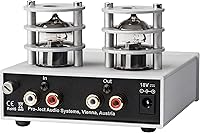
  • Housing Material: The enclosure uses an aluminum and metal sandwich construction designed to resist mechanical vibration and electromagnetic interference.
  • Channel Configuration: Double-mono layout separates the signal paths for left and right channels to minimize crosstalk and improve stereo imaging.
  • Manufacturer: Designed and manufactured by Pro-Ject Audio Systems, an Austrian company with a longstanding focus on turntables and phono-stage engineering.

Related Reviews
Pro-Ject Phono Box S2 MM/MC Phono Preamp
86%
94%
Sound Quality
92%
Adjustability (Gain & Impedance)
65%
Build Quality
88%
Ease of Use
89%
Value for Money
More
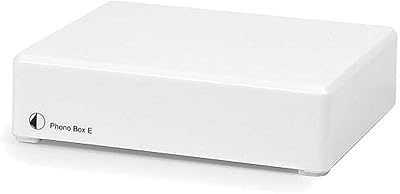
Pro-Ject Phono Box E Phono Preamplifier
79%
83%
Sound Quality
88%
Noise Floor
74%
Build Quality
91%
Ease of Setup
86%
Value for Money
More
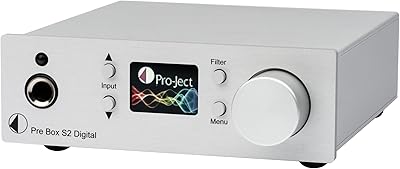
Pro-Ject Pre Box S2 Digital Preamplifier
77%
91%
Sound Quality
84%
Build Quality
58%
Windows Compatibility
93%
macOS Compatibility
88%
High-Res Format Support
More
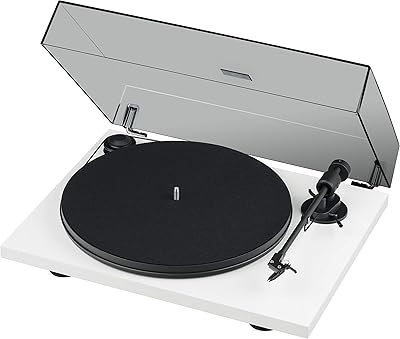
Pro-Ject Primary E Phono Turntable
85%
88%
Sound Quality
91%
Ease of Setup
85%
Design & Aesthetics
84%
Build Quality
89%
Performance for Price
More
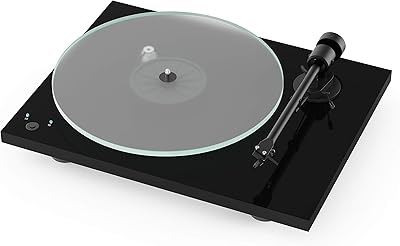
Pro-Ject T1 Phono SB Turntable
86%
88%
Sound Quality
91%
Ease of Setup
86%
Build Quality
89%
Design & Aesthetics
90%
Speed Control Precision
More
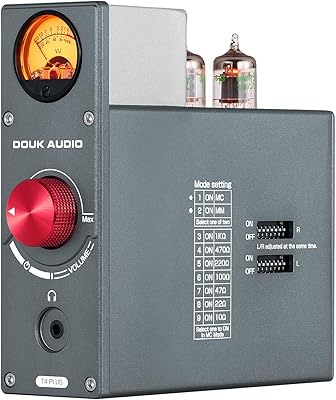
Douk Audio T4 Plus
Douk Audio T4 Plus
78%
78%
Sound Quality
81%
Phono Stage Performance
74%
Headphone Amplifier
88%
Value for Money
76%
Build Quality & Construction
More
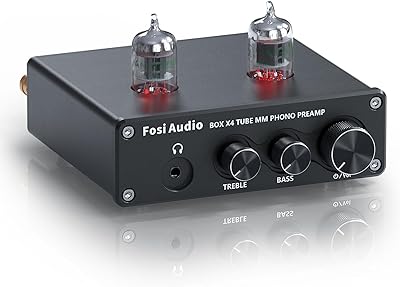
Fosi Audio BOX X4 Tube Phono Preamp
78%
81%
Sound Quality
67%
Noise Floor & Hiss
84%
Build Quality
89%
Value for Money
63%
Tube Quality (Stock)
More
NAD PP 2e Phono Preamplifier
84%
88%
Sound Quality
86%
Noise Floor
84%
MM Cartridge Performance
91%
MC Cartridge Performance
77%
Build Quality
More
AIYIMA T3 Pro MM/MC Phono Preamp
81%
93%
Cartridge Compatibility
91%
Front Panel Usability
88%
MC Impedance Adjustment
86%
Build Quality & Housing
84%
Op-Amp Upgradability
More
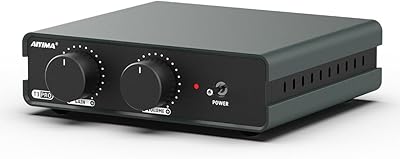
AIYIMA T1 Pro Tube Preamplifier
78%
83%
Sound Warmth & Tube Character
67%
Bluetooth Reliability
78%
Build Quality & Fit/Finish
81%
12V Trigger Functionality
72%
Tone Control Usefulness
More

FAQ

No special tools are required, but you do need a basic understanding of cartridge loading to get the most out of it. The gain and impedance settings are adjusted via internal switches, so you will need to open the unit and consult the manual to match it to your cartridge. If you are new to phono stages, spending twenty minutes reading about MC impedance loading before you start will save a lot of trial and error.

Almost certainly yes, provided your turntable has a standard RCA output and is not already equipped with a built-in phono stage set to line level. The Tube Box S2 accepts both MM and MC cartridges, so compatibility is broad. If your turntable has a dedicated phono output — or a switch to toggle between phono and line — you are ready to connect directly.

At the standard 40 dB MM gain setting, the background is very quiet and most listeners will not notice any tube noise in normal use. At higher MC gain settings — particularly 60 dB and above — a mild hiss is audible if you put your ear near the speaker during a quiet passage. It is a normal characteristic of valve amplification at high gain, not a defect, but it is worth knowing if your speakers are unusually sensitive or your room is very quiet.

Tube rolling simply means swapping the stock tubes for alternative ECC83 or 12AX7A variants from different manufacturers. Different tubes have subtly different sonic characters — some are warmer, some slightly more detailed — and many listeners find it a rewarding way to tune the sound to their taste. The ECC83 format is one of the most produced tube types ever made, so sourcing alternatives is easy and relatively inexpensive compared to rarer formats.

Yes, and this is one of the practical advantages of the Tube Box S2. The onboard MC gain settings reach up to 63 dB, and the four impedance options — 10, 100, 1k, and 2k ohms — cover the loading requirements of most low-output MC cartridges on the market. For the majority of MC users, a step-up transformer is simply not needed.

The subsonic filter cuts very low-frequency noise — typically below 20 Hz — that is generated by record warps or pressing imperfections. Without it, these frequencies can cause your woofers to pump visibly without producing any audible sound, which wastes amplifier power and can stress speakers. It is worth leaving on for most records, but some listeners prefer to disable it on flat, well-pressed pressings since the filter can marginally affect the deepest bass frequencies.

The primary difference is tonal character: this tube phono stage tends to produce a warmer, more organic midrange that many vinyl listeners prefer for extended listening sessions. Solid-state rivals from brands like iFi or Lehmann often measure slightly cleaner and may offer a more neutral, analytical presentation. Neither approach is objectively better — it comes down to whether you want the coloration of tubes or a more transparent signal.

ECC83 tubes in a low-stress phono application like this generally last several thousand hours of use — often five to ten years for typical listeners. You will likely notice a gradual softening of dynamics or a slight increase in noise before total failure. Replacement tubes are inexpensive and widely available from specialist suppliers, so running costs over the unit's lifetime are low.

Yes, a short warm-up is recommended — most tube phono stages settle into their optimal operating state within five to fifteen minutes of being switched on. You may notice the sound is slightly harsher or thinner in the first few minutes; this is completely normal for valve equipment. Leaving it on for a quarter of an hour before critical listening is a good habit to develop.

Yes, the external 18V DC linear power supply is included in the box and is specified to be suitable for your country's mains supply at the time of purchase. If you are buying from an international seller or relocating to a different region, it is worth confirming the supply voltage matches your local standard. The power supply is a separate unit connected by a DC cable, so it can be replaced independently if needed.

Where to Buy