Overview

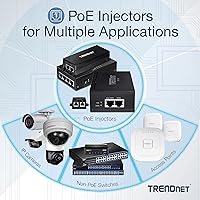
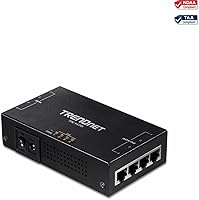
The TRENDnet TPE-147GI 4-Port Gigabit PoE+ Injector is the kind of device that solves a specific problem cleanly: you already own a decent non-PoE switch, and you need to power a handful of IP cameras or access points without scrapping your existing hardware. TRENDnet has built a reputation around practical, no-frills networking gear, and this multi-port injector fits that mold well. It sits in a useful middle ground — more capable than a single-port injector, yet far cheaper than replacing your core switch entirely. The fanless passive design makes it a natural fit for enclosed spaces where fan noise is unwelcome, and for government or enterprise purchasers, NDAA and TAA compliance is a built-in checkbox that many competing options simply cannot offer.
Features & Benefits

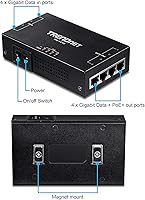
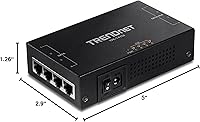
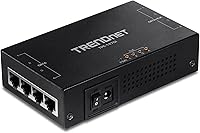
The topology is straightforward: four Ethernet cables come in carrying data, and four go out carrying both data and power. Each output port supports up to 30W under the IEEE 802.3at standard, covering the vast majority of powered devices — cameras, access points, VoIP phones. The catch worth flagging upfront is the shared 65W budget across all four ports combined; running four high-draw devices simultaneously will exceed that ceiling, so some planning is required. On the positive side, all ports operate at full gigabit speeds with no throughput penalty, the standard 100m cable run applies, and setup requires absolutely zero configuration — no browser interface, no software, no drivers.

Best For

This 4-port PoE+ injector makes the most sense for small businesses or home office setups that already have a capable non-PoE switch and need to add a few powered devices — a couple of IP cameras and a wireless AP, for example — without a full infrastructure overhaul. It is also a practical choice for government and public-sector IT teams where NDAA and TAA compliance is a hard purchasing requirement rather than a preference. Network installers will appreciate the fanless build for tight wiring closets or low-ventilation back-office installations. One honest caveat: anyone needing to power more than four PoE devices should look at a managed PoE switch as the more scalable path.

User Feedback

With a 4.6-star average across more than 450 verified reviews, the TRENDnet injector earns its standing primarily on ease of installation and long-term reliability — buyers frequently describe deploying it for IP cameras and wireless access points without any issues. Build quality draws consistent praise; the unit runs warm under load but not alarmingly so, and passive cooling holds up in real-world installations. The most recurring complaint involves the shared power budget: users who did not calculate their total draw upfront ran into problems with high-draw devices. A smaller number flagged thin documentation, specifically around budget planning guidance. Compatibility issues are infrequent but occasionally surface with older or off-brand PoE hardware.

Pros

  • Completely plug-and-play — no configuration, software, or browser interface required at any point.
  • Adds PoE+ to an existing non-PoE switch, avoiding the cost and hassle of a full hardware replacement.
  • All eight ports operate at full gigabit speeds, so bandwidth is never a bottleneck for cameras or APs.
  • The fanless design runs silently, making it a practical choice for offices, closets, and quiet environments.
  • NDAA and TAA compliance opens the door for government and public-sector procurement without extra steps.
  • Each port supports up to 30W under IEEE 802.3at, covering the vast majority of real-world PoE+ devices.
  • The standard 100m cable distance applies on every port — no range sacrifice compared to a regular switch.
  • A 3-year manufacturer warranty and US-based English-speaking support add meaningful long-term reassurance.
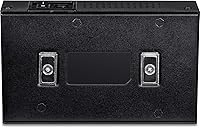
  • Compact and light enough to mount or tuck away without consuming significant rack or shelf space.
  • Strong community track record with a 4.6-star average rating across hundreds of verified purchases.

Cons

  • The 65W shared power budget is easy to miscalculate — four high-draw devices can exceed it quickly.
  • Hard-capped at four PoE ports with no expansion path if your device count grows even slightly.
  • No per-port power monitoring or management interface of any kind, which limits visibility into actual draw.
  • Included documentation provides minimal guidance on power budgeting, which trips up less experienced buyers.
  • Passive cooling means the unit runs noticeably warm under sustained full load — placement matters.
  • Occasional compatibility hiccups reported with older or non-standard PoE devices from off-brand manufacturers.
  • No remote reboot or power-cycling capability per port, which can be inconvenient for unmanned installations.
  • Buyers needing five or more powered ports must purchase additional hardware regardless of remaining budget.
  • The power brick adds a secondary cable run that can feel cluttered in tight installations.
  • No visual indication of per-port power status beyond basic link LEDs, making troubleshooting less straightforward.

Ratings

The scores below reflect an AI-driven analysis of verified global buyer reviews for the TRENDnet TPE-147GI 4-Port Gigabit PoE+ Injector, with spam, bot-generated, and incentivized feedback actively filtered out to ensure accuracy. Each category is scored on a 0–100 scale, drawing directly from patterns in real user experiences — both the consistent praise and the recurring frustrations. Nothing has been softened or glossed over; the results reflect what actual buyers encountered in the field.

Ease of Setup
96%
Buyers across skill levels consistently describe installation as taking under five minutes — plug the data lines in from the switch, connect the powered devices, attach the power brick, and the unit is live. No firmware, no browser interface, no learning curve whatsoever. IT professionals and first-time network builders alike singled this out as the device's single strongest quality.
A small number of users noted that the quick installation guide, while sufficient for the hardware side, offers almost no guidance on calculating the shared power budget — leaving less experienced buyers to figure that part out on their own or risk an underperforming setup.
Reliability
93%
Long-term reliability is where this multi-port injector earns the bulk of its strong rating. Buyers running it continuously for one to three years report zero dropouts, no port failures, and no unexpected reboots — a track record that holds across IP camera setups, small office access points, and VoIP installations alike.
A handful of reviewers reported early failures within the first few months, which is consistent with a small percentage of any hardware batch. TRENDnet's warranty process resolved most of these cases, but the initial failure experience was understandably frustrating for those affected.
Power Budget Adequacy
61%
39%
For lighter deployments — a couple of IP cameras plus a low-power access point — the 65W shared budget is genuinely sufficient, and buyers in those scenarios report no issues at all. Users who did their wattage math upfront consistently landed in a comfortable range and had no complaints about power delivery.
The shared 65W ceiling is the most cited limitation across all negative reviews. Anyone running four PoE+ devices with moderate-to-high draw simultaneously finds the budget exhausted quickly, causing devices to receive insufficient power or fail to come online altogether. The per-port 30W rating creates a false impression of total capacity for buyers who do not read the fine print.
Build Quality
82%
18%
The chassis feels solid for its size and price tier — reviewers describe it as noticeably more substantial than cheaper single-port injectors. The port connectors seat firmly, and the unit does not flex or creak when cables are plugged in under normal conditions.
The plastic enclosure, while adequate, does not inspire the same confidence as metal-housed competitors at a higher price point. A few buyers noted the power brick connector felt slightly loose over time with repeated disconnection cycles, though no functional failures were attributed to this.
Thermal Management
74%
26%
The completely fanless design is a genuine advantage for quiet environments — office spaces, reception areas, and wiring closets where fan hum accumulates across multiple devices all benefit from the zero-noise operation. Buyers in those settings consistently praise the silence.
Running warm is an unavoidable trade-off of passive cooling, and users who mounted the unit in tight, poorly ventilated spots reported it getting quite hot to the touch under sustained load. A couple of reviewers noted they had to relocate the unit after noticing heat buildup in enclosed enclosures.
Port Count & Scalability
58%
42%
Four ports is the right count for the specific problem this injector solves — small-scale additions to an existing non-PoE switch. Buyers deploying two to four devices in a fixed, stable setup found the port count perfectly matched their needs without paying for excess capacity.
Four ports is also a hard ceiling with no workaround. Buyers whose deployments grew from two cameras to six found themselves needing to purchase additional hardware rather than expanding this unit. Several reviewers wished TRENDnet offered an eight-port version in the same passive, compliance-certified format.
Gigabit Throughput
91%
Full gigabit speeds on all eight ports — data in and PoE out — means there is no bandwidth penalty for routing traffic through this injector. High-resolution IP camera streams, dual-band access points, and voice traffic all pass through without any perceptible degradation compared to a direct switch connection.
A very small number of users reported occasional link negotiation delays when first connecting certain devices, though this resolved itself without intervention in all reported cases. There were no sustained throughput complaints.
NDAA & TAA Compliance
88%
For buyers in government, defense, education, and public-sector IT, NDAA and TAA certification is not a marketing checkbox — it is a hard procurement requirement that disqualifies most of the competition at this price tier. Reviewers in those roles specifically called out compliance as the deciding factor in their purchase.
For general consumers and small business buyers without compliance requirements, this attribute adds no practical value and contributes to a slightly higher price compared to non-certified alternatives that perform identically in non-regulated environments.
Cable Distance Performance
89%
The full 100m (328 ft.) PoE reach per port matches standard Ethernet specifications exactly, which means installers do not need to rethink cable runs or add intermediate hardware when deploying cameras or APs at the far edges of a building.
There is nothing proprietary or extended about the distance performance — it simply meets the industry standard rather than exceeding it. Buyers hoping for any extended-range PoE capability beyond 100m will need purpose-built long-range injectors instead.
Value for Money
84%
Compared to the cost of replacing a functional non-PoE switch with a full PoE model, the TRENDnet injector represents a meaningful saving when a small deployment is the goal. Buyers who needed exactly four PoE ports consistently rated it as cost-effective relative to the alternatives they evaluated.
Buyers who needed more than four ports and purchased this unit before realizing the limitation ended up spending twice — once on this injector and again on additional hardware. In those cases, the value calculation shifted significantly, making a managed PoE switch the smarter initial investment in hindsight.
Documentation Quality
53%
47%
The physical quick installation guide covers the hardware connections clearly enough that most users get up and running without confusion. The visual port labeling on the unit itself also helps reduce wiring mistakes during initial setup.
Multiple reviewers flagged the near-total absence of power budgeting guidance as a real omission. There is no chart, formula, or worked example explaining how the 65W budget distributes across ports — a gap that leads predictably to underperforming deployments and unnecessary support calls.
Compatibility
78%
22%
The dual-standard PoE support (802.3af and 802.3at) covers the overwhelming majority of powered devices on the market today, and most buyers report clean plug-and-play compatibility with cameras, APs, and VoIP equipment from major brands.
Off-brand or older PoE devices with non-standard power negotiation behavior caused compatibility hiccups for a small but consistent group of reviewers. The injector has no manual override or fallback mode, so if a device does not negotiate correctly, there is limited recourse short of replacing the device.
Warranty & Support
86%
A three-year warranty backed by English-speaking, US-based support staff stands out positively compared to many networking accessories that offer only one year. Buyers who needed warranty service generally reported the process was handled without excessive friction.
Support hours are limited to normal business hours, which can be inconvenient for IT administrators dealing with deployment issues outside a standard 9-to-5 window. There is no 24-hour support line or live chat option for urgent situations.

Suitable for:

The TRENDnet TPE-147GI 4-Port Gigabit PoE+ Injector is a strong fit for anyone who already owns a capable non-PoE switch and wants to add powered devices without buying entirely new infrastructure. Small business owners and home office users who need to run two to four IP security cameras, a wireless access point, or a handful of VoIP handsets will find it covers exactly that use case cleanly and affordably. Network installers working in wiring closets, back offices, or any space where fan noise is a concern will appreciate the completely silent passive-cooling design. For government agencies and public-sector IT departments, the built-in NDAA and TAA compliance removes a procurement hurdle that disqualifies many competing products outright. If your deployment falls within four PoE devices and you have already done the math on your total power draw, this multi-port injector punches well above its price point.

Not suitable for:

The TRENDnet TPE-147GI 4-Port Gigabit PoE+ Injector is not the right call for anyone who needs to power more than four PoE devices, or who expects to run all four ports at or near their 30W maximum simultaneously — the shared 65W total budget simply does not allow it. Buyers planning a larger deployment, or one that is likely to grow over the next year or two, would be better served by a managed PoE switch with a higher aggregate power budget and the flexibility to add ports. This multi-port injector also lacks any management interface, so network administrators who need per-port power monitoring, scheduling, or remote reboot capabilities will find it frustrating. Users with older or non-standard PoE devices should verify compatibility beforehand, as a small number of reported edge cases involve off-brand hardware that does not negotiate cleanly. Finally, anyone already shopping for a new switch should seriously compare the total cost against a purpose-built PoE switch before committing to this approach.
Specifications

  • Model: The unit is manufactured by TRENDnet under the model designation TPE-147GI.
  • Data Ports: Four Gigabit Ethernet ports accept incoming data connections from an existing non-PoE switch.
  • PoE Output Ports: Four Gigabit Ethernet ports deliver both data passthrough and PoE+ power to connected devices.
  • PoE Standard: All output ports comply with IEEE 802.3af (PoE) and IEEE 802.3at (PoE+) for broad device compatibility.
  • Power Per Port: Each PoE output port can supply a maximum of 30W to a single connected powered device.
  • Total PoE Budget: The injector provides a shared power pool of 65W distributed across all four active PoE output ports.
  • Port Speed: All eight ports — data in and PoE out — operate at full Gigabit (1000 Mbps) throughput.
  • Cable Distance: Each PoE output port supports a maximum cable run of 100m (328 ft.) per standard Ethernet specifications.
  • Cooling: The device uses a fully passive, fanless thermal design with no moving parts and zero operating noise.
  • Dimensions: The unit measures 5 x 2.9 x 1.26 inches, making it compact enough for shelf or wall placement.
  • Weight: The injector weighs 2 pounds including the attached power brick assembly.
  • NDAA Compliance: The TPE-147GI is fully compliant with the National Defense Authorization Act requirements applicable in the U.S. and Canada.
  • TAA Compliance: The unit meets Trade Agreements Act standards, qualifying it for U.S. federal government procurement.
  • Configuration: No setup, software, web interface, or driver installation is required — the device operates immediately upon connection.
  • Warranty: TRENDnet backs the unit with a 3-year manufacturer protection policy covering defects in materials and workmanship.
  • Tech Support: English-speaking support staff are available by phone and online during normal U.S. business hours.
  • In the Box: The package includes the TPE-147GI injector, a power brick, a power cord, and a quick installation guide.

Related Reviews
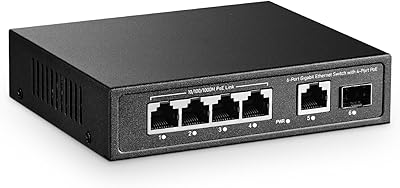
YuLinca 6-Port Gigabit PoE Switch with 4 PoE+ Ports
87%
95%
Ease of Installation
88%
PoE Functionality
91%
Build Quality
87%
Performance and Speed
94%
Fanless Operation (Noise)
More
TRENDnet TPE-TG80G 8-Port Gigabit PoE+ Switch
87%
88%
Performance
93%
Ease of Setup
91%
PoE Power Delivery
87%
Build Quality
90%
Fanless Operation
More
TRENDnet TPE-TG44G 8-Port Gigabit PoE+ Switch
86%
91%
Value for Money
88%
Ease of Use
87%
Power Over Ethernet (PoE) Performance
85%
Build Quality
93%
Quiet Operation
More
TRENDnet TPE-TG82G 8-Port Gigabit PoE+ Switch
86%
88%
Performance and Reliability
91%
Ease of Setup
83%
Power Efficiency
85%
Build Quality
89%
Compatibility with PoE Devices
More
TRENDnet TPE-TG82ES 8-Port Gigabit PoE+ Switch
79%
83%
Value for Money
81%
Ease of Setup
67%
PoE Power Delivery
88%
Build Quality
72%
Management Interface
More
TRENDnet TPE-P521ES 5-Port Gigabit PoE+ Powered EdgeSmart Switch
87%
92%
Ease of Installation
88%
Performance
90%
Reliability
85%
Build Quality
74%
PoE Power Budget
More
TRENDnet TPE-LG50 5-Port Gigabit Long Range PoE+ Switch
86%
91%
PoE+ Performance
88%
Range/Distance
94%
Ease of Setup
85%
Build Quality
90%
Reliability
More
PoE Texas 4 Port in-Wall Gigabit PoE Extender Switch
87%
92%
Installation Ease
88%
Power Output & Range
90%
Aesthetic & Design
89%
Reliability & Stability
84%
Compatibility with Devices
More
PoE Texas 12-Port Gigabit Passive PoE Injector
84%
88%
Ease of Installation
61%
Power Budget Clarity
91%
Device Compatibility
84%
Build Quality
96%
Noise Level
More
Closs 1-In-4-Out 4-Port Gigabit PoE Splitter
81%
93%
Ease of Setup
88%
PoE Compatibility
84%
Power Delivery Accuracy
91%
Gigabit Throughput
78%
Build Quality
More

FAQ

No, there is nothing to configure at all. Plug the data-in ports into your existing switch, connect your PoE devices to the output ports, and power it on. That is the entire setup process.

Not safely. The total power available across all four ports is 65W shared, meaning if you divide that evenly it works out to about 16W per port under full load. Four 30W devices would require 120W, which far exceeds what the injector can supply. Add up the actual power draw of your specific devices before committing to this unit.

Yes, that is exactly the scenario this device is designed for. It sits between your switch and your powered devices, injecting power onto the line without requiring anything special from the switch itself.

It supports both. The output ports comply with IEEE 802.3af (the original PoE standard, up to 15.4W) and IEEE 802.3at (PoE+, up to 30W), so older cameras or phones that use the earlier standard will work fine alongside newer PoE+ devices.

Yes. It carries both NDAA and TAA compliance certifications, which are the two most commonly required standards for federal, state, and local government procurement in the United States and Canada. If those certifications are a hard requirement for your project, this injector qualifies.

The fanless design means all heat dissipates passively through the chassis, and users report it runs noticeably warm to the touch under sustained load — which is expected and normal for this type of device. It is not a problem as long as you give it reasonable airflow and do not enclose it completely in an airtight space. Avoid stacking other hot equipment directly on top of it.

Absolutely — that is one of the most common real-world uses for this multi-port injector. Just verify the combined wattage of your AP and cameras falls within the 65W shared budget, and you will have no issues.

The injector negotiates power delivery according to IEEE standards, so devices that exceed the available budget should simply not receive enough power to function at full capacity rather than causing hardware damage. That said, it is always best practice to know your devices' actual power requirements before deployment.

No. This is an unmanaged injector with no management interface, so there is no per-port power monitoring, status dashboard, or remote reboot capability. If per-port visibility is important for your network, you would need a managed PoE switch instead.

Only if you exceed 100m (328 ft.), which is the standard Ethernet limit. Within that distance, both data throughput and PoE delivery perform normally. There is no additional range penalty introduced by using the injector versus a direct connection from a PoE switch.

Where to Buy