Overview

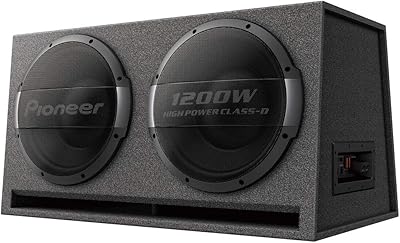
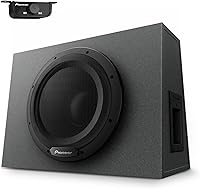
The Pioneer TS-WX1210A 12-inch Powered Subwoofer takes the guesswork out of adding real bass to your car — no separate amp, no custom enclosure, no compatibility puzzle to solve. Pioneer has been a fixture in car audio for decades, and this unit leans into that credibility with an all-inclusive package aimed squarely at everyday drivers rather than enthusiasts building competition systems. The trapezoid sealed enclosure is genuinely useful: it reduces internal resonance while giving real placement flexibility — trunk floor, cargo area, or tucked under rear seats in some vehicles. It is not a system for audiophiles chasing perfection, but that was never the point.
Features & Benefits

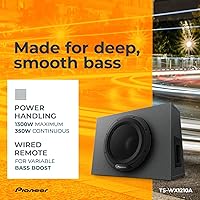
What sets this all-in-one sub apart from a bare driver is everything bundled around it. The Class D amplifier runs cool and efficiently, which matters in a car where heat buildup can stress electrical systems over time — it draws less from your alternator than older amp designs without sacrificing output. Three tuning controls — low-pass filter, phase adjustment, and a variable bass boost reaching up to 12 dB — let you dial in the sound for hip-hop, rock, or anything with a heavy low end. The high-level inputs are the real practical win: they tap directly into existing speaker wires, so no aftermarket head unit is required. The included wired remote knob lets you tweak bass level from the driver's seat.

Best For

This powered subwoofer makes the most sense for drivers who are done with their factory audio's thin low end but don't want to commit to a full custom build. If the plan involves keeping the stock head unit, this is one of the few packaged solutions that handles that without requiring extra signal processors. Compact SUV and hatchback owners tend to find the trapezoid shape particularly accommodating — it slides into corners a rectangular box simply won't fit. Where it falls short is for buyers wanting serious output levels or deeper tuning control. Experienced builders who already own enclosures and amps will likely find better value going component-by-component, but for anyone stepping into car audio for the first time, the learning curve here is refreshingly short.

User Feedback

Buyers generally land at a positive verdict, with the most consistent praise going to installation simplicity and the immediate, tangible improvement in bass response over stock audio. Those who kept their factory radios tend to report the smoothest experience — high-level input wiring is straightforward when the existing harness is already accessible. Complaints cluster around two areas: the instruction manual leaves something to be desired for first-timers, and some users report the built-in amp plateauing at higher volumes rather than pushing through cleanly. Long-term reliability feedback is largely positive, though a handful of owners note the amp running warm after extended sessions. Realistic expectations make a significant difference — buyers treating this as a convenience upgrade rather than a high-output solution tend to come away satisfied.

Pros

  • Amp, enclosure, and subwoofer arrive together — no hunting for compatible separate components.
  • High-level inputs make installation possible with most factory head units, no aftermarket radio needed.
  • The Class D amplifier runs efficiently and cool, reducing strain on the vehicle's electrical system.
  • Trapezoid enclosure shape fits into angled trunk corners where rectangular boxes simply will not go.
  • The wired remote bass knob lets you adjust low-end output from the driver's seat without reaching back.
  • Tuning controls — low-pass filter, phase, and variable bass boost — give genuine sound customization for casual users.
  • At just over 23 pounds, this all-in-one sub is manageable to move and position during a solo install.
  • Pioneer's long-standing reputation in car audio provides reasonable confidence in component quality and parts support.
  • Sealed enclosure design produces tight, accurate bass that suits a wide range of music genres.
  • Strong buyer satisfaction rate reflects a consistent real-world performance match with its stated purpose.

Cons

  • Output noticeably plateaus at higher volumes rather than scaling up cleanly under sustained demand.
  • The included instruction manual is sparse and can leave first-timers guessing at wiring steps.
  • Some users report the built-in amp running warm during long listening sessions, which may concern buyers in hot climates.
  • High-level input compatibility, while broad, is not guaranteed with every factory stereo configuration.
  • Limited tuning depth compared to a standalone amp-and-sub setup — power users will quickly outgrow the options.
  • The sealed enclosure, while space-efficient, cannot match the low-frequency extension of a well-tuned ported box.
  • At roughly 23 pounds, the unit can be awkward to secure firmly in smaller cargo areas without additional mounting hardware.
  • No built-in protection indicator or status LED makes it harder to diagnose issues if the unit goes into safe mode.
  • Upgrading individual components later is not possible — when the amp or driver fails, the whole unit needs replacing.

Ratings

The scores below were generated by AI after analyzing thousands of verified global buyer reviews for the Pioneer TS-WX1210A 12-inch Powered Subwoofer, with automated filtering applied to remove incentivized, bot-generated, and outlier feedback. The result is a balanced, data-driven snapshot that reflects both where this all-in-one sub genuinely delivers and where real buyers have run into frustration.

Ease of Installation
88%
The self-contained design — amp, driver, and enclosure already assembled — removes the most intimidating steps for first-time installers. Buyers with factory radios consistently highlight how the high-level inputs simplified wiring to just four connections, with many reporting a complete install in under two hours.
The included instruction manual draws repeated criticism for being too sparse, particularly around the turn-on wire and bass knob routing. Users without prior car audio experience often had to supplement with online tutorials to get through the install confidently.
Bass Output Quality
79%
21%
For everyday listening across pop, hip-hop, and rock, the improvement over a factory speaker setup is immediately noticeable and satisfying. The sealed enclosure keeps bass tight and controlled rather than loose or boomy, which commuters and casual listeners tend to prefer on daily drives.
At higher volume levels the output starts to compress, and dedicated bass enthusiasts find the ceiling lower than expected for a 12-inch driver. Users who predominantly listen to bass-heavy electronic or rap at high volumes are the most likely to feel underwhelmed compared to a custom-built setup.
Factory Stereo Compatibility
84%
High-level speaker inputs are a genuine advantage in a market where many powered subs still require an aftermarket head unit or a separate line output converter. The vast majority of buyers with stock radios report a clean, functional connection without additional hardware.
A small but consistent subset of buyers encounter compatibility issues with certain non-standard factory amplified systems — typically found in vehicles with Bose, Harman, or similar OEM audio packages. In those cases, additional signal processing is required, which significantly complicates what should be a simple install.
Value for Money
83%
When buyers calculate the combined cost of a separate amplifier, enclosure, and driver at comparable quality, the bundled price point of this all-in-one sub tends to look favorable. Buyers who prioritize convenience and a reputable brand name consistently cite strong satisfaction relative to what they paid.
Those who compare it strictly on output performance per dollar — rather than convenience — find the value proposition less compelling. Experienced builders point out that a component setup at a similar price can deliver noticeably more headroom and tuning flexibility.
Tuning & Sound Customization
72%
28%
Having an adjustable low-pass filter, phase control, and variable bass boost on a self-contained unit is more than most comparable all-in-one packages offer. Casual users find these three controls sufficient to get a sound they are happy with across a variety of genres without deep technical knowledge.
For anyone accustomed to a full-featured standalone amplifier, the tuning range feels limited — particularly the lack of a subsonic filter and the relatively narrow crossover adjustment range. Power users quickly hit the ceiling of what these controls can do, especially when trying to integrate the sub cleanly with upgraded component speakers.
Enclosure Build Quality
68%
32%
The sealed trapezoid enclosure is rigid enough for everyday use and does its job of containing the driver without noticeable rattles or panel flex under normal listening conditions. Most buyers find the construction acceptable for the price and product category.
Up close, the enclosure finish and material thickness reveal that cost compromises were made — particularly around the corners and terminal plate area. A handful of long-term owners report minor cosmetic degradation and one or two cases of panel separation after extended use in hot vehicle environments.
Thermal Management
66%
34%
Under typical daily commute conditions — moderate volume, moderate ambient temperature — the unit stays at a manageable warmth and does not trigger thermal protection. The Class D amplifier architecture is legitimately more efficient than older topologies, which helps in most standard use scenarios.
Extended high-volume sessions, particularly in vehicles parked in direct sun or with poor cargo area ventilation, push the enclosure to noticeably hot temperatures. Some users in warmer climates report the amp entering protection mode during long drives, which disrupts the listening experience unexpectedly.
Placement Flexibility
81%
19%
The trapezoid shape is one of the more practical design decisions on this unit — it fits flush against angled trunk walls and in corners that eliminate rectangular boxes as an option. Hatchback and compact sedan owners in particular report being able to reclaim usable trunk space compared to traditional enclosure shapes.
At just over 23 pounds and with a width exceeding 20 inches, it is not a genuinely compact unit despite the shape advantage. Under-seat installation, as suggested in the marketing, is only realistic in full-size trucks or large SUVs — most standard passenger car seats do not have adequate clearance.
Remote Bass Control
77%
23%
The included wired bass boost knob is a small but genuinely useful inclusion — being able to dial back the low end for podcasts or spoken word content and boost it for music without stopping the car is something buyers quickly take for granted and then miss when it is absent on other units.
The cable length on the remote knob is adequate for most installs but has caught out buyers in larger vehicles like trucks where the run from trunk to dash is longer than expected. The mounting hardware for the knob is also minimal, leaving some users improvising a clean dash or console mount.
Long-Term Reliability
71%
29%
A substantial portion of buyers report trouble-free operation over one to three years of regular daily use, which for a mid-range all-in-one sub is a reasonable track record. Pioneer's brand support infrastructure provides at least a baseline of confidence for warranty-period issues.
Because the amplifier and driver are integrated into one non-serviceable unit, any component failure — particularly amp board issues that surface after the warranty period — means replacing the entire assembly rather than a single part. A minority of long-term owners cite this as a significant downside when something eventually goes wrong.
Output at High Volume
61%
39%
At moderate to upper-moderate listening levels the Pioneer TS-WX1210A delivers clean, punchy bass that exceeds what the stock system could produce. For the majority of everyday listeners who do not push their audio to maximum, performance in this range is consistently satisfying.
The built-in amplifier visibly runs out of headroom before many buyers expect it to, and distortion becomes audible before the main stereo volume is maxed out. This is arguably the unit's most common genuine complaint — not installation frustration or user error — and it is worth weighing seriously for anyone who regularly listens loud.
Instruction Clarity
53%
47%
The wiring diagram included in the box covers the basic connection points clearly enough for buyers with some prior experience to get started quickly. Those who have installed car audio before generally find the documentation sufficient for the task.
For buyers with no prior installation experience, the manual's brevity is a recurring pain point — particularly around remote turn-on wiring and bass knob cable routing. The absence of vehicle-specific guidance means many buyers end up searching online forums to fill in the gaps before they feel confident proceeding.
Driver Cone & Surround Quality
74%
26%
The cellulose fiber cone strikes a good balance between stiffness and weight for bass reproduction, contributing to the tight, controlled character that buyers notice over cheaper alternatives. The urethane surround holds up well under normal temperature variations and extended use.
At the extreme low-frequency end the cone has a limited excursion ceiling that restricts deep sub-bass extension below roughly 40Hz, which is a function of both the sealed design and the driver material. Buyers chasing genuinely deep bass response will need a ported enclosure with a different driver to achieve it.

Suitable for:

The Pioneer TS-WX1210A 12-inch Powered Subwoofer is built for drivers who want a meaningful bass upgrade without tearing apart their entire audio setup. It hits the sweet spot for people keeping their factory head unit — the high-level speaker inputs mean you can wire directly into what is already there, skipping the need for an aftermarket radio or line output converter in most cases. Compact SUV, sedan, and hatchback owners who cannot dedicate half a trunk to a traditional ported box will appreciate the trapezoid enclosure's ability to fit into corners and tighter spaces. It also suits first-time installers well: the self-contained design removes most of the decision-making that trips up newcomers to car audio. If the goal is simply more body and warmth in the low end without a steep learning curve or a complex parts list, this all-in-one sub delivers that convincingly.
Not suitable for:

Buyers chasing serious volume or competition-level output will likely find this powered subwoofer underwhelming at higher playback levels, where the built-in amp can start to compress rather than push harder. Dedicated car audio enthusiasts who already own a quality amplifier and know their way around a custom enclosure will find that going component-by-component yields better output, tuning depth, and long-term flexibility for similar or less money. The Pioneer TS-WX1210A 12-inch Powered Subwoofer is also not the right fit for vehicles with unusually tight wiring access or non-standard factory harnesses, since high-level input compatibility — while broad — is not universal. Those who want truly deep sub-bass extension below 35Hz will find a ported or bandpass enclosure design more capable. And if raw loudness for large vehicles like full-size trucks or vans is the priority, a standalone amplifier paired with a dedicated driver will outperform this unit by a noticeable margin.

Specifications

  • Driver Size: The subwoofer uses a 12-inch dynamic driver for broad low-frequency coverage.
  • Built-in Amp: A 300W Class D amplifier is integrated directly into the enclosure, eliminating the need for an external amp.
  • Max Power: The unit is rated to handle up to 1200W peak power across the full system.
  • Enclosure Type: The driver sits in a sealed trapezoid enclosure designed to reduce internal standing waves and improve placement flexibility.
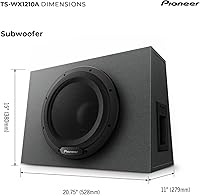
  • Dimensions: The enclosure measures 11″ deep, 20.75″ wide, and 15″ tall.
  • Weight: The complete unit weighs 23.4 pounds, including the enclosure and built-in amplifier.
  • Input Type: High-level (speaker-level) inputs allow direct connection to factory or aftermarket head units without a line output converter.
  • Bass Boost: Variable bass boost ranges from 0 to +12 dB across a 40Hz to 100Hz frequency band.
  • Low-Pass Filter: An adjustable low-pass filter lets users set the crossover point to blend the subwoofer naturally with full-range speakers.
  • Phase Control: Built-in phase adjustment helps align the subwoofer's output with the rest of the speaker system to avoid cancellation.
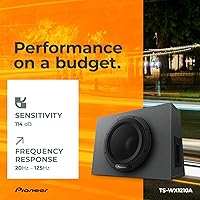
  • Sensitivity: A sensitivity rating of 114 dB means the driver produces strong output even when the amplifier is not pushed hard.
  • Impedance: The driver operates at 1 Ohm, matched to the integrated Class D amplifier for optimal efficiency.
  • Cone Material: The driver cone is made from cellulose fiber, which balances rigidity and light weight for accurate bass reproduction.
  • Surround Material: A urethane surround provides long-term durability and consistent cone excursion across extended use.
  • Output Mode: Audio output is mono, as expected for a dedicated subwoofer channel in a car audio system.
  • Remote Knob: A wired bass boost remote knob is included, allowing volume-level bass adjustments from the driver's seat.
  • Power Source: The unit draws power via corded electric connection to the vehicle's 12V electrical system.
  • Included Items: The package includes the subwoofer in its sealed enclosure, a wired bass boost knob with cable, two metal mounting brackets, and eight mounting screws.

Related Reviews
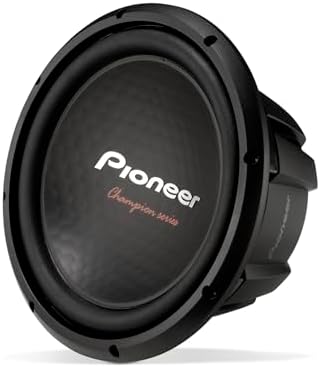
Pioneer TS-A301D4 12-inch Car Subwoofer
75%
83%
Bass Output
79%
Build Quality
88%
Value for Money
81%
Amplifier Compatibility
63%
Installation Ease
More
Audiopipe TS-PP2-12-D4 12-inch Car Subwoofer
70%
74%
Value for Money
71%
Bass Output
67%
Build Quality
58%
Power Handling
73%
Voice Coil Quality
More
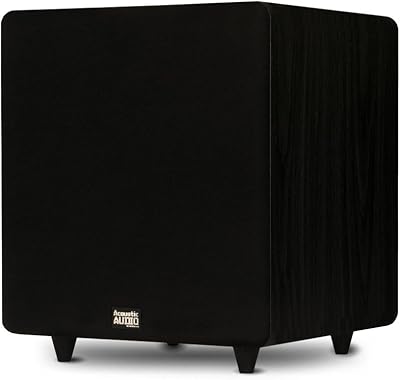
Acoustic Audio PSW500-12 Powered 12-Inch LFE Subwoofer
82%
92%
Value for Money
88%
Bass Performance
85%
Ease of Setup
80%
Sound Quality
77%
Build Quality
More
Pioneer TS-A30S4 12″ Component Subwoofer
84%
91%
Bass Performance
88%
Value for Money
82%
Ease of Installation
85%
Durability
87%
Sound Clarity
More
Pioneer TS-WX1220AH Dual 12″ Subwoofer Enclosure
77%
91%
Bass Output & SPL
88%
Ease of Installation
84%
Amplifier Performance
79%
Build Quality
62%
Physical Fit & Trunk Compatibility
More
Pioneer TS-A3000LS4 12″ Shallow-Mount Subwoofer
78%
82%
Bass Output vs. Profile Tradeoff
88%
Installation & Fit
74%
Power Handling (Real-World RMS)
83%
Amplifier Compatibility & Wiring
79%
Sound Quality & Clarity
More
Klipsch SPL-120 Powered Subwoofer 12-inch
87%
92%
Bass Performance
89%
Sound Clarity
87%
Ease of Setup
91%
Value for Money
88%
Build Quality
More
Monoprice 109723 12-inch Powered Subwoofer
73%
83%
Bass Output
88%
Value for Money
67%
Sound Clarity
71%
Build Quality
91%
Ease of Setup
More
BIC America V-1220 12-Inch Powered Subwoofer
85%
88%
Bass Performance
90%
Ease of Integration
85%
Build Quality
92%
Value for Money
86%
Frequency Response
More
BOSS Audio B12ES 12-Inch Powered Car Subwoofer
72%
88%
Ease of Installation
79%
Bass Output & Impact
83%
Value for Money
63%
Build Quality & Materials
81%
Remote Bass Control Usability
More

FAQ

Yes, in most cases you can. The high-level inputs on this all-in-one sub are designed to tap into existing speaker wires coming from the factory head unit. That said, compatibility is not universal — a small number of factory systems use non-standard wiring configurations, so it is worth checking your specific vehicle before buying.

No — that is the main selling point of this powered subwoofer. The amplifier is already built into the enclosure, so you only need to run a power wire, a ground wire, a remote turn-on wire, and the speaker-level signal wires from your existing stereo.

It is one of the more approachable installs in this category, but it is not entirely plug-and-play. Running the power cable from the battery and grounding the unit properly takes some basic knowledge. The included manual is fairly minimal, so watching a vehicle-specific install video beforehand will save a lot of time and frustration.

The trapezoid shape genuinely helps here. At roughly 11 inches deep and just over 20 inches wide, it can tuck into angled corners that a traditional rectangular box cannot. Hatchback and compact SUV owners have had good results, though measuring your available space before ordering is always a smart move.

The wired remote knob lets you increase the low-end output up to 12 dB above the baseline, which can add noticeable punch for bass-heavy music. Running it at maximum continuously is not recommended — pushing the boost hard for long periods can stress the driver and amp. Most users find a modest boost setting sounds better and puts less strain on the system.

The Class D amplifier is more thermally efficient than older amp designs, but the enclosure will get warm during extended listening at higher volumes. Users in hot climates or vehicles without good air circulation have occasionally noted the unit running warmer than expected. Keeping the enclosure in a ventilated spot and avoiding continuous high-volume sessions helps.

The low-pass filter limits the frequency range the subwoofer reproduces, ensuring it only handles bass rather than trying to play midrange or vocals. A good starting point for most setups is rolling off somewhere between 80Hz and 100Hz, then adjusting by ear until the bass blends naturally with your main speakers without sounding disconnected or boomy.

For smaller and mid-size vehicles it performs well, but in a larger cabin — like a full-size pickup or a three-row SUV — the output can feel limited, especially at higher volumes where the built-in amp begins to compress. Buyers with larger vehicles and louder listening habits would get more from a higher-powered standalone amplifier paired with a dedicated subwoofer.

Unfortunately, no. Because the amplifier, driver, and enclosure are all integrated into one sealed unit, there is no straightforward way to replace individual components if one fails. If the amp gives out after the warranty period, the practical outcome is replacing the entire unit rather than a component-level repair.

This all-in-one sub comes with a limited manufacturer warranty from Pioneer. Coverage details can vary by region, so it is worth registering the product directly with Pioneer after purchase and reviewing the warranty card included in the box. Pioneer's customer support is generally considered accessible for warranty claims on their car audio products.

Where to Buy