Overview

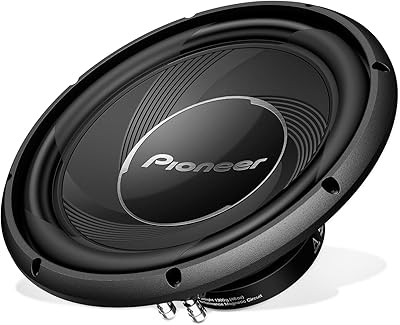
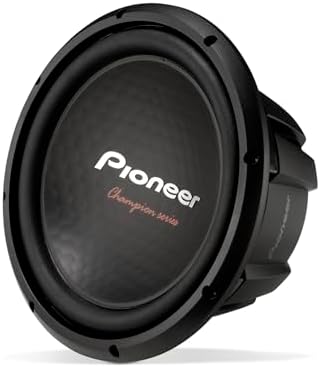
The Pioneer TS-A3000LS4 12″ Shallow-Mount Subwoofer was built for one specific problem: getting real bass into vehicles where a traditional deep-mount sub simply won't fit. With a 3.5-inch mounting depth, it slides into spaces that would reject a conventional woofer outright — behind the rear seat in a crew cab, under a bench in a compact SUV, or tucked into a custom panel. It sits within Pioneer's A-series lineup, designed to complement their full-range speakers tonally. At its mid-range price point, it offers a solid spec sheet from a brand with genuine credibility in car audio, without asking you to spend like you're building a competition rig.
Features & Benefits

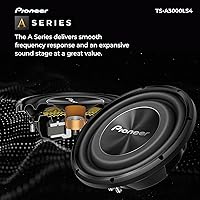
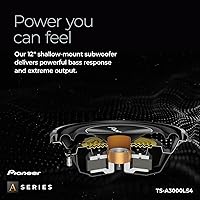
The cone uses an IMPP composite construction — glass fiber and mica reinforced to stay rigid without adding weight, which matters when you're pushing it at 400W RMS continuously. That 400W figure is the one to focus on; the 1500W max rating represents a brief peak, not sustained output. The single 4-ohm voice coil keeps amplifier pairing simple, and the passive design lets you choose your own amp for full control over tuning. An 88 dB sensitivity rating means this slim car subwoofer doesn't need massive amplifier headroom to sound full and present at normal listening levels.

Best For

This shallow-mount subwoofer makes the most sense for truck and SUV owners who've accepted that a large ported box simply isn't an option. Think a double-cab pickup with only the slim cavity beneath the rear bench, or a crossover with a cargo floor too shallow for a standard enclosure. It also suits anyone already running Pioneer A-series speakers who wants consistent tonal character across the system. DIY installers will appreciate the clean 4-ohm wiring, though they should plan for a compatible sealed box around 0.8 cu. ft. and a separate amplifier. If clean, punchy bass for daily listening matters more than raw SPL numbers, this fits that brief well.

User Feedback

Buyers consistently note how well the Pioneer 12-inch sub fits in spaces where they expected to compromise, and most are genuinely surprised by the bass output relative to the slim profile. The most common sticking point is the amplifier requirement — a fair number of buyers didn't realize upfront that an external amp is mandatory, which is worth understanding before purchase. At moderate volumes, the consensus is positive: tight, controlled, and well-defined. At higher volumes, some buyers observe the bass can feel slightly thin versus a deeper conventional sub — a real tradeoff of shallow-mount design. Build quality and mounting hardware generally receive solid marks with few durability complaints.

Pros

  • A 3.5-inch mounting depth opens up install locations that standard subwoofers physically cannot reach.
  • The reinforced IMPP cone delivers tight, defined bass rather than the bloated low-end common in budget subs.
  • Single 4-ohm voice coil keeps amplifier matching simple and compatible with most entry-level mono amps.
  • Tonal integration with Pioneer A-series speakers is noticeably cohesive for buyers building a full system.
  • At 88 dB sensitivity, this slim car subwoofer performs well even when paired with a modest amplifier.
  • The 0.8 cu. ft. sealed enclosure recommendation is practical — prefab boxes at that volume are widely available.
  • Sound quality at moderate volumes is consistently described as clean, musical, and well-balanced.
  • The included hardware kit covers the install basics, reducing the number of additional parts you need to source.
  • Pioneer brand reliability and a recognizable model line offer reasonable confidence for a mid-tier investment.
  • Passive design gives you full amplifier flexibility, including the option to upgrade your amp later without replacing the driver.

Cons

  • No amplifier is included — first-time buyers often underestimate this as an additional required purchase.
  • The 1500W max power figure on the box misleads buyers; the usable continuous rating is 400W RMS.
  • Instruction documentation is thin and provides almost no practical guidance on amplifier selection or crossover setup.
  • Low-frequency extension starts rolling off earlier than a full-depth driver in a ported enclosure would.
  • Some buyers report minor cosmetic inconsistencies on the cone surround straight out of the box.
  • Mounting hardware has generated scattered complaints about screw sizing not matching common enclosure materials.
  • The 1-year limited warranty feels short given the total system investment once amplifier and enclosure are included.
  • Performance at high volumes can feel compressed compared to what a deeper, larger-format sub would produce.
  • No built-in bass boost or signal processing means tuning relies entirely on your amplifier's controls.
  • Buyers who skip the sealed enclosure recommendation and improvise often report noticeably muddier bass output.

Ratings

The Pioneer TS-A3000LS4 12″ Shallow-Mount Subwoofer scores below were generated by an AI system trained to analyze verified global buyer reviews, actively filtering out incentivized, bot-generated, and duplicate feedback to surface genuine user sentiment. Ratings reflect real-world installation experiences and listening impressions across a wide range of vehicles and setups — strengths and frustrations are both represented without softening either side.
Bass Output vs. Profile Tradeoff
82%
18%
For a sub that sits only 3.5 inches deep, the low-end presence genuinely surprises most buyers. Daily commuters running it under a truck bench seat consistently describe the output as punchy and full enough for street listening at moderate to high volumes.
Push it hard in an open cabin and the shallow-mount design starts to show its limits — the very low frequencies that a deeper ported sub would handle start to roll off noticeably. Buyers chasing true sub-bass rumble below 35 Hz will hear the tradeoff clearly.
Installation & Fit
88%
The slim 3.5-inch mounting depth is the whole reason most people buy this, and it delivers on that promise consistently. Owners of crew cab trucks and compact crossovers report clean installs in cavities that would have been physically impossible with a standard-depth driver.
A small but recurring group of buyers found the included mounting screws slightly mismatched for certain enclosure materials, requiring a hardware store run. Fitment in unusually tight or irregularly shaped factory cavities can also demand custom trimming of the gasket.
Power Handling (Real-World RMS)
74%
26%
Paired with an amplifier delivering a clean 300 to 400W RMS, this slim car subwoofer performs confidently without any signs of thermal stress during normal use. The IMPP cone holds up well across extended listening sessions at moderate output.
The 1500W max figure printed on the box causes persistent confusion — a meaningful number of buyers pair it with underpowered amps expecting that peak figure to be achievable in practice. The real ceiling of 400W RMS is the only number that matters for daily use, and mismatched setups leave buyers underwhelmed.
Amplifier Compatibility & Wiring
83%
The single 4-ohm voice coil is about as plug-friendly as passive subs get — most entry to mid-level mono amplifiers are designed around this exact impedance, making impedance matching a non-issue for the majority of installs.
This is a passive subwoofer with no built-in amplification, which catches a portion of buyers off guard expecting a powered unit at this price tier. The amplifier purchase adds to the total system cost, and first-time builders sometimes underestimate this step.
Sound Quality & Clarity
79%
21%
The reinforced IMPP cone keeps bass notes defined rather than bloated — a quality that stands out on tracks with fast bass lines where cheaper subs tend to smear the detail. For everyday genres like hip-hop, rock, and pop, the output sounds controlled and musical.
Audiophile-oriented buyers note that the sub prioritizes impact over texture, meaning fine bass detail and layering can sound slightly compressed at higher volumes. It is tuned for broad appeal rather than critical listening, which suits most buyers but not all.
Enclosure Compatibility
77%
23%
The 0.8 cu. ft. sealed recommendation is practical and realistically achievable in most vehicles — a prefab sealed box at that volume is widely available and affordable. Buyers who follow the spec report tight, accurate bass that suits the driver well.
Buyers who experiment with larger or ported enclosures tend to get inconsistent results, and Pioneer does not provide alternative tuning guidance in the documentation. Those who deviate from the sealed recommendation without audio experience often report muddier bass response.
Build Quality & Materials
81%
19%
The physical construction feels consistent with a mid-tier Pioneer product — the cone is firm without feeling brittle, and the basket has no meaningful flex when handled. Most buyers note it looks and feels well-made for its price class.
A small percentage of buyers have flagged minor cosmetic inconsistencies on the surround or cone edge out of the box, though functional defects appear rare. The overall build does not quite match the premium feel of higher-tier competitors at roughly double the price.
Value for Money
84%
For buyers who know exactly what a shallow-mount passive sub can and cannot do, the price-to-performance ratio here is genuinely strong. Getting Pioneer brand quality, a 12-inch driver, and a credible spec sheet at this price tier is a reasonable deal.
Once you factor in a compatible amplifier and a proper sealed enclosure, the total system cost climbs considerably. Buyers who compare this sub in isolation rather than as part of a full budget may feel the cumulative investment crept past their expectations.
Ease of Setup for Beginners
61%
39%
The included hardware kit — trim ring, gasket, and mounting screws — covers the basics, and the 4-ohm single voice coil wiring is about as uncomplicated as car audio connections get. Buyers with basic DIY confidence generally report a smooth install.
The instruction manual is thin on practical guidance, particularly around amplifier selection, gain settings, and crossover configuration. Buyers who are new to car audio frequently turn to forums or YouTube to fill in the gaps the documentation leaves open.
A-Series System Matching
86%
Buyers running Pioneer A-series full-range speakers consistently describe the tonal blend as cohesive — the sub slots into the system without creating an obvious gap or frequency mismatch in the crossover region. It is one of the more compelling reasons to stay within the A-series ecosystem.
Outside of the Pioneer A-series context, the sub competes in a crowded field where the brand-matching argument disappears. Buyers pairing it with non-Pioneer speakers do not report any problems, but the specific synergy advantage becomes less relevant.
Low-Frequency Extension
67%
33%
For the genres most car audio buyers listen to daily — hip-hop, EDM, and bass-forward pop — the Pioneer 12-inch sub reaches deep enough to add genuine weight and body to the music without sounding thin or lacking presence.
Purists who measure or listen critically will observe the sub rolling off earlier than a full-depth driver in a ported enclosure would. This is a fundamental shallow-mount constraint, not a defect, but buyers expecting reference-level extension should set expectations accordingly.
Durability Over Time
78%
22%
The majority of longer-term owners report no degradation in performance over 12 to 24 months of regular use, which is a reasonable indicator of consistent build quality. The cone material shows no reported issues with delamination or edge creep under normal operating conditions.
Reports of voice coil issues do exist, typically from buyers who ran the sub underpowered with heavy clipping over extended periods — a risk common to any passive sub. The 1-year limited warranty offers some coverage but feels lean for a component at this investment level.
Packaging & Unboxing
72%
28%
The sub arrives in protective flat-pack packaging that does its job — most buyers report the driver reaching them without damage, and the included accessories are organized and accounted for.
The packaging itself is utilitarian rather than premium, which does not reflect badly on the product but does contrast with the boxed presentation some competing brands offer at similar price points. A few buyers noted the manual was barely more than a folded sheet.

Suitable for:

The Pioneer TS-A3000LS4 12″ Shallow-Mount Subwoofer was designed for a very specific type of buyer, and for that buyer it makes a lot of sense. If you own a crew cab truck, a mid-size SUV, or a compact car where a standard-depth subwoofer box simply has no home, this sub solves the space problem without asking you to give up meaningful bass output. It is equally well-suited for daily drivers who want a clean, punchy upgrade over their factory audio without committing to a full custom install — the 3.5-inch mounting depth means you can tuck it behind a rear bench or under a seat and still have usable cargo space. Buyers already invested in Pioneer's A-series speakers will find the tonal pairing particularly coherent, making this a logical system-completion purchase. DIY-friendly installers who understand they need to budget for a compatible external amplifier and a small sealed enclosure will get the most from this setup, as the 4-ohm single voice coil keeps the wiring side of the project genuinely straightforward.
Not suitable for:

If you are expecting to unbox this sub, connect it to your head unit, and hear bass immediately, this is not the right purchase — the Pioneer TS-A3000LS4 12″ Shallow-Mount Subwoofer is a passive component that requires a dedicated external amplifier to function at all. Buyers chasing serious sub-bass extension below 35 Hz or competition-level SPL output will also be disappointed; shallow-mount designs make a physical tradeoff, and no amount of power changes the fact that cone excursion and enclosure volume are inherently limited by the slim profile. This sub is also not the right fit for anyone planning to run it in a large ported box hoping to maximize low-end reach — it is optimized for a sealed 0.8 cu. ft. enclosure, and deviating significantly from that tends to produce muddier, less controlled results. Finally, buyers on a strict all-in budget should map out the full system cost before committing: the sub, amplifier, enclosure, and wiring together can add up to considerably more than the driver's sticker price alone.
Specifications

  • Driver Diameter: The woofer uses a 12-inch driver, providing a broad radiating surface capable of moving substantial air for low-frequency output.
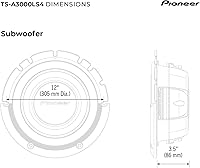
  • Mounting Depth: At just 3.5 inches deep, this sub fits in under-seat and behind-seat cavities that would reject any standard full-depth driver.
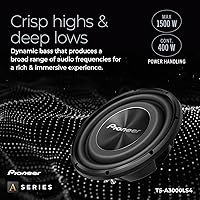
  • Max Power: The driver is rated at 1500W maximum, representing a brief peak tolerance rather than a continuous operating level.
  • RMS Power: Continuous rated power handling is 400W RMS, which is the figure to match when selecting a compatible amplifier.
  • Impedance: The single voice coil is wound to a 4-ohm impedance, the most common load for mono car audio amplifiers.
  • Cone Material: The cone is constructed from an IMPP composite reinforced with glass fiber and mica, balancing rigidity with low mass for accurate bass reproduction.
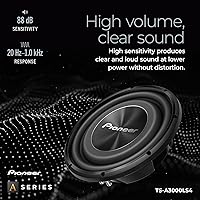
  • Sensitivity: Rated at 88 dB efficiency, meaning this slim car subwoofer produces solid output without requiring excessive amplifier wattage.
  • Enclosure Type: Pioneer recommends a sealed enclosure of 0.8 cu. ft. for optimal performance, favoring tight and accurate bass over maximum low-frequency extension.
  • Voice Coil Type: The sub uses a single voice coil configuration, simplifying wiring and making it straightforward to connect to a standard mono amplifier.
  • Wiring Type: This is a passive subwoofer with no onboard amplification; a dedicated external amplifier is required for operation.
  • Dimensions: Overall product dimensions are 3.5 inches in depth by 12 inches in diameter, with the outer frame measuring 12 inches by 12 inches.
  • Weight: The unit weighs approximately 13 lbs, manageable for a single installer during fitment into most vehicle enclosures.
  • Series: This driver is part of Pioneer's A-series lineup, designed to complement A-series full-range coaxial and component speakers in tonal character.
  • In the Box: The package includes the 12-inch driver, a trim ring, a gasket, eight mounting screws, an instruction manual, and a one-year warranty sheet.
  • Warranty: Pioneer covers this subwoofer with a one-year limited warranty against manufacturing defects from the date of purchase.
  • Surround Material: The driver uses a rubber surround construction, which contributes to long-term durability and consistent cone travel under repeated use.
  • Connectivity: Connection is made via standard wired speaker terminals, compatible with conventional amplifier speaker output wiring methods.
  • Water Resistance: This subwoofer is not water resistant and is intended strictly for enclosed, dry in-vehicle installation environments.

Related Reviews

Rockford Fosgate R2SD4-12 12″ 500W Car Shallow Mount Subwoofer
84%
88%
Bass Performance
85%
Build Quality
91%
Value for Money
80%
Ease of Installation
90%
Size & Space Efficiency
More
Pioneer TS-WX1210A 12-inch Powered Subwoofer
74%
88%
Ease of Installation
79%
Bass Output Quality
84%
Factory Stereo Compatibility
83%
Value for Money
72%
Tuning & Sound Customization
More
Pioneer TS-A30S4 12″ Component Subwoofer
84%
91%
Bass Performance
88%
Value for Money
82%
Ease of Installation
85%
Durability
87%
Sound Clarity
More
Pioneer TS-A301D4 12-inch Car Subwoofer
75%
83%
Bass Output
79%
Build Quality
88%
Value for Money
81%
Amplifier Compatibility
63%
Installation Ease
More
Pioneer TS-WX1220AH Dual 12″ Subwoofer Enclosure
77%
91%
Bass Output & SPL
88%
Ease of Installation
84%
Amplifier Performance
79%
Build Quality
62%
Physical Fit & Trunk Compatibility
More
Alphasonik AS120A 12″ Active Shallow Mount Subwoofer
85%
89%
Bass Performance
92%
Build Quality
78%
Ease of Installation
85%
Sound Customization
90%
Durability
More
CT Sounds Hydro 12″ Car Subwoofer
80%
91%
Ease of Installation
88%
Enclosure Versatility
83%
Bass Quality & Accuracy
86%
Value for Money
67%
Low-Frequency Extension
More
CT Sounds Hydro 12″ Dual 2-Ohm Shallow-Mount Car Subwoofer
85%
88%
Sound Performance
91%
Bass Quality
75%
Installation Ease
84%
Build Quality
89%
Power Handling
More
MB Quart DS1-304 12-Inch 400-Watt Shallow Mount Subwoofer
87%
87%
Bass Performance
91%
Value for Money
93%
Shallow Mount Design
89%
Installation Ease
88%
Durability & Build Quality
More
Audiopipe TS-PP2-12-D4 12-inch Car Subwoofer
70%
74%
Value for Money
71%
Bass Output
67%
Build Quality
58%
Power Handling
73%
Voice Coil Quality
More

FAQ

You will need a separate external amplifier — the Pioneer TS-A3000LS4 12″ Shallow-Mount Subwoofer is a passive driver with no built-in power source. Budget for a mono amplifier rated around 300 to 400W RMS into 4 ohms to get the best out of it. This is actually an advantage if you want control over your system tuning, but it is an extra cost and step that first-time buyers sometimes miss.
The 3.5-inch mounting depth is specifically why most truck owners choose this sub, and it does fit in the majority of crew cab and double cab under-seat cavities. That said, exact clearance varies by vehicle model and year, so measure your available depth carefully before ordering. Most standard half-ton and three-quarter-ton trucks accommodate it without modification.

No — the 1500W figure is a peak tolerance number that describes a brief, momentary limit, not a continuous operating level. The number you should focus on when choosing an amp is the 400W RMS rating, which represents sustained power handling during normal listening. Running a clean 300 to 400W RMS amp into this sub is the sweet spot; chasing the max number with an oversized amp is more likely to damage the driver than improve the sound.

Pioneer recommends a sealed enclosure of 0.8 cubic feet for this driver. Sealed boxes produce tighter, more controlled bass, which suits the shallow-mount design well. You can find prefab sealed boxes at that volume from several manufacturers without needing to custom-build anything. Ported enclosures are generally not recommended for this driver — they tend to produce looser, less accurate results outside the intended tuning.

It works with any amplifier — Pioneer or otherwise — as long as the amp is stable at 4 ohms and can deliver clean power in the 300 to 400W RMS range. The single 4-ohm voice coil is the standard impedance for mono car amps, so compatibility is rarely an issue. No brand matching is required beyond ensuring your amp's output specs line up with the sub's RMS rating.

Honestly, a full-depth sub in a properly tuned ported box will reach lower frequencies and move more air. The tradeoff with a shallow-mount design is reduced cone excursion and a smaller recommended enclosure volume, which means the very deepest bass (below roughly 35 Hz) is less pronounced. For daily listening across most genres, the Pioneer 12-inch sub sounds full and impactful enough that most people are more than satisfied — but if chasing competition-grade sub-bass is your goal, a deeper driver is a better fit.

You can use it with a factory head unit, but you will still need a standalone amplifier between the head unit and the sub. Some factory head units have a dedicated subwoofer RCA output, while others may require a line output converter to tap a speaker-level signal. Neither option is complicated, but it does add a small amount of wiring work beyond just the amp and sub themselves.

The tonal pairing is genuine — both the A-series full-range speakers and this shallow-mount sub are voiced to blend naturally together, which means the transition across the crossover point sounds cohesive rather than mismatched. If you are already running A-series coaxials or component sets, adding this sub completes the system in a way that feels intentional. That said, it pairs perfectly fine with non-Pioneer speakers too; the A-series matching is a bonus, not a requirement.

If you are comfortable with basic car audio work — running power and ground wires, connecting RCA cables to an amp, and fitting a driver into an enclosure — this is a manageable DIY project. The 4-ohm single voice coil wiring is about as simple as car audio gets. Where people tend to hit snags is on the amplifier setup side: setting gain levels, configuring the low-pass crossover, and tuning the subsonic filter correctly. If those concepts are unfamiliar, a quick shop visit or a good online tutorial will save you a lot of trial and error.

Pioneer provides a one-year limited warranty covering manufacturing defects in materials and workmanship. It does not cover damage from improper installation, overpowering, or normal wear. For a subwoofer at this price tier, one year is somewhat standard though on the shorter side — keep your proof of purchase handy, and if you buy from an authorized retailer, the claims process is generally straightforward.

Where to Buy