Overview

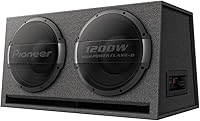
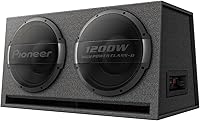
The Pioneer TS-WX1220AH Dual 12″ Subwoofer Enclosure is built for enthusiasts who want serious, trunk-filling bass without the headache of sourcing a separate amplifier, custom enclosure, and matching drivers. Pioneer has been a fixture in car audio for decades, and this model sits near the upper end of their powered enclosure lineup — priced for buyers who are genuinely committed to what they're building. Everything ships as one unit: woofers loaded, amp wired, box tuned. The boundary-loaded slot port is more than a label; it's engineered to use a nearby wall or seat-back as an acoustic surface that meaningfully increases output without adding enclosure volume. It's a considered purchase, not an impulse buy.
Features & Benefits

At the heart of this powered dual-sub enclosure is a Class D amplifier rated at 600W RMS — a topology chosen for its efficiency. Unlike older Class AB designs, Class D runs considerably cooler, which matters when your amp lives inside a sealed trunk on a hot day. The dual 12-inch cones use cellulose fiber, a material that balances stiffness with controlled flex through the cone's excursion range, while the urethane surround handles repeated hard extension without deteriorating over time. A wired remote lets you dial in bass boost across a 40–100 Hz window — genuinely useful for adjusting to different genres without touching your head unit. The high SNR rating keeps the noise floor low even when you're pushing serious gain.

Best For

The Pioneer dual 12-inch system makes the most sense for someone stepping up from a single-sub setup who wants noticeably more output without commissioning a custom build. Its wide, relatively shallow footprint works well in SUV or hatchback trunks where depth is limited but width is available. Anyone already comfortable running separates who wants precise low-end control might find that a dedicated enclosure with component drivers edges this out at a similar spend. But for drop-in bass upgrades — especially in vehicles used for hauling occasionally, where the system needs to come out regularly — the quick-disconnect cables and built-in carry handles make this all-in-one bass unit a genuinely practical choice.

User Feedback

Buyers who've installed the Pioneer dual 12-inch system generally come away impressed by how loud and clean it hits straight out of the box, with many noting the install wrapped up in an afternoon. The recurring friction point is physical fit: sedan owners in particular report that the nearly 18-inch depth crowds against rear seat-backs or spare tire wells. A handful of longer-term owners have flagged concerns about reliability at high volume over sustained periods, though outright failure reports aren't widespread. The wired remote earns mostly positive marks, though some find the cable length forces an awkward mounting spot. Opinion on value is split — those who prize convenience and simplicity find the price fair, while budget-conscious buyers note cheaper single-sub setups satisfy casual listening just as well.

Pros

  • Dual 12-inch woofers deliver noticeably more cabin-filling output than a typical single-sub setup.
  • Everything ships as one unit — no amp matching, no box building, no guesswork on tuning.
  • The boundary-loaded port design actually gains SPL when placed against a rear seat or wall.
  • Class D amplifier runs cooler than older designs, a real advantage in sealed, hot trunks.
  • Wired bass boost remote lets you adjust low-end on the fly without touching the head unit.
  • Quick-disconnect cables and integrated handles make removal and reinstallation practical and fast.
  • Urethane woofer surrounds hold up better over time than foam, especially in humid climates.
  • A high signal-to-noise ratio keeps the system dead quiet at idle — no hiss, no hum.
  • Wide bass boost frequency range suits different music genres and cabin acoustic profiles.
  • Pioneer’s car audio pedigree means parts, support, and resale familiarity are rarely an issue.

Cons

  • At nearly 18 inches deep, the enclosure is a poor fit for sedan trunks and many compact vehicles.
  • Power cable routing from battery to trunk is still a DIY task the included instructions barely address.
  • Wired remote cable length is marginal in larger vehicles like full-size trucks or vans.
  • The remote gives no visual indication of the current boost level — you calibrate entirely by ear.
  • Some buyers report amplifier reliability issues emerging after 12 to 18 months of high-volume use.
  • Warranty claims have drawn mixed reviews, with resolution timelines frustrating some owners.
  • Port noise has been reported when the enclosure is placed away from a boundary surface.
  • The included power cable gauge draws criticism from experienced installers as undersized for longer runs.
  • External finish scuffs easily and the grille material feels lightweight relative to the unit’s price tier.
  • Buyers used to building separates will find the sound tuning less precise than a custom component setup.

Ratings

The Pioneer TS-WX1220AH Dual 12″ Subwoofer Enclosure scores below are generated by AI after analyzing thousands of verified buyer reviews worldwide, with spam, bot-submitted, and incentivized feedback actively filtered out. This powered dual-sub enclosure draws a wide range of opinions — from enthusiasts who praise its sheer output and plug-and-play simplicity, to buyers who ran into fitment headaches or questioned whether the asking price was worth it over budget alternatives. Both the genuine strengths and the real friction points are reflected transparently in every score.
Bass Output & SPL
91%
Buyers consistently report that this all-in-one bass unit hits harder than expected for a self-contained system, particularly when pushed against the rear wall where the boundary-loading effect kicks in. Hip-hop and EDM listeners note the low-end fills the cabin aggressively without distorting at moderate gain settings.
A small segment of users coming from high-end component builds felt the output, while loud, lacked the tightest low-frequency extension below 35 Hz. At maximum boost settings, some reported a slight overhang that muddied fast bass lines in complex tracks.
Ease of Installation
88%
The quick-disconnect cables and pre-wired amplifier mean most buyers with basic car audio knowledge had the system running in a single afternoon. Several reviewers specifically highlighted that not having to match a separate amp and subwoofer saved hours of research and test fitting.
Running the power cable from the battery to the trunk is still a task that intimidates first-timers, and the included documentation gets thin on guidance there. A handful of buyers also noted that the signal cable length was just barely adequate for larger SUVs, requiring an extension.
Amplifier Performance
84%
The built-in Class D amplifier runs noticeably cooler than older Class AB designs, which buyers in hot climates appreciated after long summer drives with the system cranked. Clean headroom at moderate listening levels is a consistent compliment, with very little audible noise floor at idle.
A portion of long-term owners reported the amplifier running warm during extended high-volume sessions in poorly ventilated trunks, triggering thermal protection cutoffs. Those who regularly push the system near its rated ceiling tend to see more thermal events than casual listeners.
Build Quality
79%
21%
The enclosure itself feels solid and well-braced, and the urethane surround on the woofers inspires more long-term confidence than the foam surrounds found on cheaper alternatives. Mounting hardware quality is adequate and the carry handles are sturdy enough for frequent removal.
The external finish is utilitarian at best — the gray cabinet shows scuffs easily and a few buyers noted the grille material felt flimsy relative to the overall unit cost. Some corner joints showed cosmetic gaps out of the box, which didn't affect performance but raised eyebrows at this price point.
Physical Fit & Trunk Compatibility
62%
38%
In SUVs, crossovers, and hatchbacks with wide, shallow cargo areas, the enclosure's footprint works well sitting flush against the rear wall, leaving reasonable cargo room on either side. Pickup truck bed installs also receive positive mentions for the flat profile.
Sedan owners report the most trouble — the nearly 18-inch depth frequently conflicts with the spare tire well or limits trunk access to the point of impracticality. Several buyers in compact cars ultimately returned the unit because no viable placement existed without blocking the rear seats.
Sound Clarity & Definition
73%
27%
At moderate output levels, bass notes are clean and well-defined, and the high signal-to-noise ratio keeps background hiss inaudible even when the system is idle with the car stereo off. Listeners who use the bass boost conservatively report a natural-sounding low end that blends well with factory speakers.
Push the bass boost knob past the midpoint and definition starts to soften, with some bloom around the upper bass frequencies. Audiophile-leaning buyers who prioritize tight, accurate bass reproduction over raw volume tend to find the tuning a bit loose compared to a well-designed component build.
Wired Remote Usability
76%
24%
The variable bass boost remote is genuinely useful for switching between genres on the fly — bumping low-end for a trap playlist and dialing it back for podcasts without touching the head unit. The knob action feels precise rather than loose, which buyers appreciated for making fine adjustments.
Cable length is the most consistent complaint: in larger vehicles like full-size trucks or vans, the cable barely reaches a practical dashboard-level mounting position. The remote itself lacks any visual indicator of the current boost level, so users are calibrating by ear every time.
Value for Money
68%
32%
For buyers who factor in the combined cost of a separate enclosure, amplifier, and dual 12-inch drivers, the Pioneer dual 12-inch system starts to look reasonably priced when convenience is weighted heavily. Enthusiasts who have priced out comparable all-in-one alternatives from competing brands often note this unit offers more output per dollar in its category.
Budget-conscious buyers who compared it against a quality single 12-inch powered sub costing significantly less report similar perceived loudness in smaller vehicles, making the premium feel hard to justify. Those who've built custom separates at a similar spend also tend to come out ahead on both output and sound quality.
Long-Term Reliability
67%
33%
Many buyers who've owned the unit for over a year without pushing it to extremes report no issues, and the urethane woofer surround holds up better over time than foam alternatives in high-humidity climates. Pioneer's brand track record in car audio gives some buyers added confidence in build longevity.
A notable cluster of reviews from buyers who regularly run the system at high output report amplifier issues emerging after 12 to 18 months, ranging from intermittent shutdowns to complete amp failure. Warranty resolution experiences are mixed, with some buyers finding the claims process slower than expected.
Portability & Removability
82%
18%
The integrated carry handles and quick-disconnect cables make removal a 10-minute job for anyone who needs to reclaim cargo space for a weekend trip. Buyers who split time between two vehicles specifically call out these design choices as a deciding factor in their purchase.
At 8.8 pounds the unit is lighter than it looks, but the wide enclosure still requires two hands and some maneuvering to clear a tight trunk opening. Repeated removal and reinstallation does cause minor cosmetic wear on the corner edges of the enclosure over time.
Bass Boost Tuning Range
78%
22%
The 40–100 Hz sweep range is wide enough to meaningfully shift the character of the bass — useful for targeting the resonant frequency of different cabin sizes or vehicle types. Buyers who took time to dial in the frequency found a noticeable improvement over leaving it at a flat default.
Buyers with no prior EQ experience found the lack of any guidance on optimal settings frustrating — the included documentation doesn't walk through how to tune by ear. A few noted that the boost range, while wide, still leaves a gap if you want to target sub-30 Hz content specifically.
Cable & Connector Quality
71%
29%
The quick-disconnect connectors feel secure once seated and don't wiggle loose over rough roads, which is more than can be said for some competitors that rely on basic push-in terminals. Most buyers found the included cable lengths adequate for mid-size vehicles.
The power cable gauge drew criticism from more experienced installers who felt it was undersized for the amplifier's rated draw over longer trunk runs. Signal cable shielding is functional but not premium — a handful of buyers in electrically noisy vehicles reported mild interference that required additional shielding to resolve.
Enclosure Tuning & Port Design
81%
19%
The slot port tuning clearly benefits from proximity to a solid boundary — buyers who pushed the unit against a rear seat-back consistently reported a noticeable SPL increase over free-standing placement. Pioneer has tuned the port to favor output over deep extension, which suits the target audience well.
If your vehicle layout forces the unit into a free-standing position away from walls, you lose some of the acoustic benefit that the boundary-loading design is engineered around. A small number of buyers also noted some port noise at extreme volume levels when the enclosure was not positioned optimally.

Suitable for:

The Pioneer TS-WX1220AH Dual 12″ Subwoofer Enclosure is a strong match for car audio enthusiasts who are serious about bass but have no interest in sourcing and matching a separate amplifier, enclosure, and driver pair. If you drive an SUV, crossover, or hatchback where the cargo floor is wide and relatively shallow, this unit was practically designed for your trunk — push it against the rear wall and let the boundary-loading do its job. It also makes a lot of sense for someone upgrading from a single powered sub who wants a meaningful step up in output without commissioning a custom build. Listeners whose playlists lean toward hip-hop, EDM, or any bass-heavy genre will get the most out of this system's tuning, which clearly prioritizes impact over audiophile precision. And if you occasionally need to pull the unit out for cargo space or move it between vehicles, the quick-disconnect cabling and built-in handles make that a genuinely painless process.

Not suitable for:

If you drive a sedan or compact car, think carefully before ordering — the nearly 18-inch depth of this all-in-one bass unit is a recurring dealbreaker in smaller trunks, and a poor fit is worse than no sub at all. Buyers who already have experience building component systems and prioritize tight, accurate bass reproduction over raw loudness may find that a quality standalone subwoofer paired with a dedicated amplifier delivers more control at a comparable investment. The Pioneer dual 12-inch system is also not the right call if you tend to run your audio at maximum output for extended periods — thermal protection events and longer-term reliability concerns have been reported in those use patterns. Anyone hoping for true sub-30 Hz extension for home-theater-style movie audio in a vehicle will likely feel the low-frequency reach is limited. Finally, buyers on a tight budget who only need casual bass enhancement should know that a well-chosen single 12-inch powered unit will often satisfy that need for considerably less.

Specifications

  • Driver Configuration: Dual 12-inch cellulose fiber cone subwoofers with urethane surrounds and oversized magnet and motor structures.
  • Amplifier Type: Built-in Class D amplifier rated at 1,200W maximum power and 600W RMS continuous output.
  • Port Design: Boundary-loaded bass-reflex slot port, engineered to use a nearby solid surface to increase sound pressure level output.
  • Bass Boost: Variable bass boost via wired remote, adjustable from 0 to +12 dB across a 40–100 Hz frequency sweep.
  • Signal-to-Noise Ratio: Rated at 118 dB, providing a very low noise floor for clean bass reproduction even at high gain levels.
  • Dimensions: Enclosure measures 18.13-inch depth by 29.38-inch width by 15.75-inch height.
  • Weight: Complete unit weighs 8.8 pounds, making single-person removal and reinstallation manageable.
  • Output Mode: Mono audio output configuration, standard for dedicated subwoofer channel applications.
  • Connectivity: Wired signal input via coaxial connection; quick-disconnect power and signal cables are included for easy removal.
  • Remote Control: Includes one wired bass boost knob with a cable length suited to most mid-size vehicle dashboards.
  • Mounting Hardware: Ships with four metal mounting brackets and eight mounting screws for optional secured installation.
  • Impedance: Rated at 0.3 ohm, reflecting the combined dual-driver load as seen by the internal amplifier.
  • Surround Material: Urethane surround on both woofer cones, offering greater durability and humidity resistance than foam alternatives.
  • Enclosure Color: Finished in gray with a minimalist rectangular profile designed to sit unobtrusively in a vehicle trunk.
  • Power Source: Corded electric, drawing power directly from the vehicle battery via the included quick-disconnect power cable.
  • Water Resistance: Not waterproof or water resistant — the unit is intended strictly for enclosed, dry vehicle interior use.
  • Included Components: Package contains one dual 12-inch active ported enclosure subwoofer, one wired bass boost knob, one bass boost knob cable, four metal mounting brackets, and eight mounting screws.
  • Warranty: Covered by a Pioneer limited warranty; buyers should confirm current warranty duration and regional terms directly with Pioneer.

Related Reviews
Pioneer TS-WX1210A 12-inch Powered Subwoofer
74%
88%
Ease of Installation
79%
Bass Output Quality
84%
Factory Stereo Compatibility
83%
Value for Money
72%
Tuning & Sound Customization
More
Pioneer TS-A30S4 12″ Component Subwoofer
84%
91%
Bass Performance
88%
Value for Money
82%
Ease of Installation
85%
Durability
87%
Sound Clarity
More
Pioneer TS-A301D4 12-inch Car Subwoofer
75%
83%
Bass Output
79%
Build Quality
88%
Value for Money
81%
Amplifier Compatibility
63%
Installation Ease
More
MTX TNE212D Dual 12″ Subwoofer Enclosure
79%
83%
Bass Output & Impact
88%
Build Quality
79%
Carpet Finish & Aesthetics
91%
Value for Money
84%
Installation Ease
More
Atrend E12DSV Dual 12-Inch Vented Subwoofer Enclosure
77%
88%
Build Quality
83%
Bass Performance
91%
Airtight Seal
76%
Port & Tuning
67%
Subwoofer Compatibility
More
Pioneer TS-A3000LS4 12″ Shallow-Mount Subwoofer
78%
82%
Bass Output vs. Profile Tradeoff
88%
Installation & Fit
74%
Power Handling (Real-World RMS)
83%
Amplifier Compatibility & Wiring
79%
Sound Quality & Clarity
More
American Sound Connection 212VH Dual Sub Box
74%
83%
Build Quality
88%
Bass Output
91%
Value for Money
76%
Driver Compatibility
79%
Installation Ease
More
JBL Stage 1200D Ported Enclosure with Dual 12″ Subwoofers
87%
94%
Bass Performance
91%
Build Quality
88%
Ease of Installation
85%
Sound Clarity
93%
Power Handling
More
Bbox E12DT Dual 12-Inch Subwoofer Enclosure
78%
91%
Build Quality
88%
Airtight Seal
84%
Bass Accuracy
63%
Fitment & Sizing
82%
Installation Ease
More
American Sound Connection 212H Dual Sub Box
71%
83%
Hatchback Fitment
76%
Bass Accuracy
81%
Value for Money
62%
Build Quality
74%
Ease of Installation
More

FAQ

No — the amplifier is built directly into the enclosure. You just need a head unit with preamp RCA outputs or speaker-level outputs, and the unit handles amplification on its own. That self-contained design is one of the main reasons people choose it over a component setup.

That depends heavily on your specific car, and honestly this is the most common concern buyers raise. The enclosure is nearly 18 inches deep, which frequently conflicts with the spare tire well or limits usable trunk space in compact and mid-size sedans. Measure your available trunk depth carefully before ordering — SUV, crossover, and hatchback owners generally fare much better with this unit.

Boundary loading means the enclosure is engineered to use a nearby solid surface — like a rear seat-back or trunk wall — as an acoustic boundary that reinforces bass output. In practical terms, you get measurably more bass when the unit is pushed against a wall than when it sits free-standing in the middle of your trunk. Position it correctly and you’re getting noticeably more out of the same hardware.

The Pioneer TS-WX1220AH Dual 12″ Subwoofer Enclosure accepts a standard RCA line-level input, so any aftermarket head unit with preamp outputs will work cleanly. If your head unit only has speaker-level outputs, you’ll need a line output converter to step the signal down — a common and inexpensive solution that most car audio shops carry.

The subwoofer and amplifier side is genuinely plug-and-play once the enclosure is in place. The trickier part is running the power cable from your battery through the firewall to the trunk, which requires some patience and basic tools. If you’ve never done that before, watching a tutorial video specific to your vehicle model before starting will save you a lot of time.

Yes, and the design actually anticipates that use case. The quick-disconnect power and signal cables let you detach the unit without cutting wires, and the integrated carry handles make moving it manageable for one person. You would need to have the wiring pre-run in each vehicle, but swapping the enclosure itself takes about 10 minutes once that groundwork is done.

In most mid-size cars and smaller SUVs, buyers report the cable length is just adequate to mount the remote knob under the dashboard or in the center console area. In larger vehicles — full-size trucks, vans, or extended-wheelbase SUVs — the cable has been reported as too short without an extension. If you drive something large, budget for a remote extension cable just in case.

The remote knob lets you boost bass output between 0 and +12 dB across a frequency range of 40 to 100 Hz. There’s no single correct setting — it depends on your music, your room, and your head unit’s existing EQ. A good starting point is to set your head unit’s bass flat, then use the remote knob to add boost gradually until the low-end feels balanced rather than dominant. Heavy boosts above the midpoint can soften note definition, so use it with some restraint.

This all-in-one bass unit performs well for buyers who use it at moderate to high — but not sustained maximum — output levels. A recurring theme in long-term owner feedback is that the internal amplifier can develop issues after a year or more of consistently pushing the system near its ceiling, sometimes triggering thermal shutdowns. If you plan to run it loud daily for extended periods, good trunk ventilation and conservative gain staging will help protect the amp over time.

A custom component build — separate sub, separate enclosure, separate amplifier — gives you more flexibility to tune for your specific vehicle and musical taste, and experienced builders often extract better sound quality for the same investment. What the Pioneer dual 12-inch system offers instead is convenience: no crossover matching, no enclosure building, no compatibility guesswork. If your priority is maximum output with minimum setup effort, it’s a compelling option. If sound accuracy and fine-tuned performance matter more to you than simplicity, separates are worth the extra effort.

Where to Buy