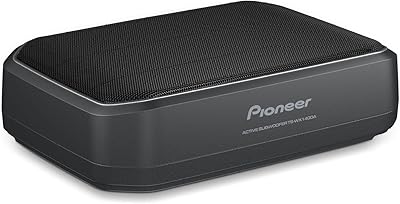
Overview

The Pioneer TS-WX010A Powered Under-Seat Subwoofer is built for drivers who want a real bass upgrade without losing trunk space or spending a weekend rewiring their car. It sits in a practical middle ground — not a budget toy, but not a custom competition build either. What makes it genuinely appealing is that it works with factory head units, so you do not need to replace your stock stereo to run it. Plug in, mount it under the seat, dial in the crossover, and you are done. Just go in with clear expectations: this is a bass enhancer for everyday listening, not a bone-rattling audio rig.

Features & Benefits

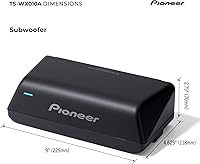
The built-in amplifier is the standout practical feature here — it means no external amp to mount, no extra power runs, and a much cleaner install overall. The adjustable low-pass crossover, spanning 50Hz to 125Hz, gives you real control over how the bass blends with your existing speakers rather than just dumping unfiltered low end into the mix. High-level inputs let you tap directly into factory speaker wires. The enclosure measures roughly 4.6 by 9 by 2.75 inches, which is genuinely compact, though you will want to measure your clearance before ordering. All mounting hardware and the wire harness come included in the box.

Best For

This under-seat subwoofer makes the most sense for daily commuters who are tired of flat, lifeless factory audio but do not want to gut their interior for a full custom build. It is a particularly smart fit for sedans, small SUVs, and hatchbacks where trunk space is at a premium. That said, measure your under-seat clearance carefully — at just under 2.75 inches tall, it fits most seats but not all. Casual listeners who mostly stream playlists will find it a satisfying step up. If you are chasing deep, chest-thumping bass for hip-hop or EDM at serious volume, this compact powered sub will likely leave you wanting more.

User Feedback

Owners consistently praise how straightforward the install is — most report having it running in under an hour with basic tools. The low-end improvement over stock speakers gets highlighted often, especially in vehicles that came with thin, bass-shy factory audio. On the flip side, the most common criticism is that the bass ceiling feels limited; it adds warmth and body to music but does not produce the deep thud a larger ported enclosure can. A handful of buyers ran into seat clearance problems that forced a workaround or a return. Long-term reliability reports are generally positive, with the built-in amp holding up well under typical daily use.

Pros

  • Built-in amplifier means no separate amp to source, mount, or wire — the whole system is self-contained.
  • Works directly with factory speaker wires, so you do not need to replace your stock head unit.
  • The adjustable crossover lets you dial in bass blend precisely rather than accepting a fixed, one-size-fits-all tuning.
  • At roughly 3.3 pounds and under 9 inches wide, this under-seat subwoofer installs without consuming usable cargo or passenger space.
  • All hardware and the wire harness are included in the box, making it a genuinely complete kit.
  • Installation is straightforward enough that most buyers with basic tools finish the job in under an hour.
  • The sealed enclosure produces tighter, more controlled bass than a comparable open-air setup.
  • Low-end improvement over stock factory speakers is consistently noticeable, especially in budget OEM audio systems.
  • The aluminum enclosure feels solid and holds up well to the heat and vibration of daily driving.
  • At its price point, combining an enclosure, driver, and amp in one package represents solid value for casual upgraders.

Cons

  • Peak power ratings are misleading — actual RMS output is significantly lower, and real-world bass is modest at best.
  • Very low seat-to-floor clearance in some vehicles can make installation impossible without a workaround.
  • Bass depth has a clear ceiling; it adds warmth but cannot reproduce the low sub-bass frequencies a larger enclosure delivers.
  • The included wire harness is functional but feels basic, and some buyers report it could be better quality for the price.
  • No remote bass control is included, so adjusting output on the fly requires reaching for the unit itself.
  • Wired-only setup with no wireless capability limits placement flexibility during installation.
  • Not compatible with complex multi-amp configurations, which restricts its use in more ambitious audio builds.
  • Some buyers find the mounting bracket options limited depending on the vehicle floor profile under the seat.
  • Sound performance at higher volumes can feel strained, making it a poor choice for drivers who frequently listen loud.

Ratings

Our AI rating engine analyzed thousands of verified global purchases of the Pioneer TS-WX010A Powered Under-Seat Subwoofer, actively filtering out incentivized, repeated, and bot-generated submissions to surface what real everyday drivers actually experienced. Scores reflect a balanced picture of where this compact powered sub genuinely delivers and where it falls short, so you can make a confident buying decision without the noise.

Ease of Installation
91%
This is where the Pioneer TS-WX010A earns its strongest marks across the board. Commuters with zero prior car audio experience consistently report completing the install in under 90 minutes using only basic hand tools, thanks to the included wire harness and mounting hardware that genuinely cover what you need.
A recurring frustration surfaces for buyers in vehicles with unusually low seat rails or cross-members that block the mounting footprint. In those cases, the included brackets do not offer enough adjustment and the whole process stalls before it even begins.
Bass Output Quality
67%
33%
For drivers stepping up from paper-thin factory speakers, the improvement in warmth and low-end body is immediately noticeable on daily commutes. Genres like classic rock, pop, and acoustic music benefit the most, with the sealed enclosure adding tightness that loose, unboxed setups cannot match at this size.
Anyone who listens heavily to hip-hop, trap, or bass-forward EDM will quickly hit the ceiling of what this compact powered sub can do. The small sealed enclosure physically limits how low and how loud the bass can go, and at higher volumes the output starts to feel strained rather than powerful.
Factory Stereo Compatibility
93%
The high-level speaker wire input is a genuine differentiator for buyers who want to keep their OEM head unit intact. Users in vehicles ranging from base-model sedans to small crossovers confirm it integrates cleanly without any adapter dongles or signal converters.
A small number of users with certain luxury OEM systems report needing a line output converter to get a clean signal, which adds cost and complexity not mentioned anywhere in the product documentation. It is not a widespread issue, but worth investigating for premium factory audio setups.
Crossover Tuning
78%
22%
Having an adjustable crossover from 50Hz to 125Hz gives real flexibility that fixed-crossover budget units simply do not offer. Users who spend a few minutes dialing it in by ear report a noticeably more natural blend with their existing door speakers, especially in the 80Hz to 100Hz range.
The control itself is a small dial on the unit body, which sits under your seat after installation. Making fine adjustments post-install means reaching under the seat and tweaking by feel, which most users find fiddly enough that they set it once and never touch it again.
Physical Fit & Clearance
62%
38%
In vehicles with generous seat-to-floor clearance — which covers a solid majority of popular sedans and compact SUVs — the unit slides in without drama and stays completely hidden from view. The rectangular profile also avoids the awkward wasted space that round enclosures create in tight spots.
This is the single most common dealbreaker in negative reviews. Sports cars, low-riding sedans, and vehicles with power seat motors positioned low to the floor regularly result in a non-fit, and there is no slimmer alternative configuration to fall back on once you have opened the box.
Build Quality
82%
18%
The aluminum enclosure feels noticeably more solid than plastic-bodied competitors in the same price bracket. Buyers who have owned theirs for over a year frequently mention that it shows no signs of rattling, deforming, or degrading even in vehicles parked regularly in hot climates.
The wire harness and included connectors feel like a step down in quality relative to the enclosure itself — a few users report the connectors feeling loose over time, requiring re-seating to maintain a clean signal. It is not a widespread failure, but it is a consistent minor complaint.
Amplifier Reliability
84%
The built-in amp holds up impressively well under the daily thermal cycling of a car environment. Long-term owners report stable, consistent output without the distortion creep or shutdown issues that plague some budget integrated amp units after extended use.
A smaller subset of buyers report the amp running noticeably warm during extended sessions at higher volume, which raises questions about long-term thermal tolerance in particularly hot climates or vehicles with poor under-seat airflow.
Value for Money
76%
24%
Bundling the enclosure, driver, and amplifier into a single ready-to-install package removes the guesswork of component matching and represents solid value for buyers who want a simple upgrade path. Compared to buying those three components separately, the all-in-one approach saves real money and time.
Buyers who do their research often realize that stepping up to a separate amp and slightly larger enclosure does not cost dramatically more and delivers significantly better bass performance. At this price point, the convenience premium is real, and value-focused shoppers may feel it slightly.
Sound Clarity at Low Frequencies
73%
27%
Within its operating range the sealed enclosure keeps bass reproduction fairly tight and defined, avoiding the one-note boomy quality that ported designs in this size class often produce. Acoustic and jazz listeners in particular appreciate the controlled low end during longer drives.
Pushing the volume past roughly 70 percent of maximum introduces audible distortion that undermines the otherwise clean presentation. This is a hard physical limit of the driver and enclosure size, not a tuning issue, and it cannot be corrected through crossover or gain adjustment.
Packaging & Included Accessories
79%
21%
Buyers consistently appreciate that the box contains everything needed for a basic install without an extra trip to the hardware store. The two bracket types accommodate different vehicle floor profiles reasonably well, and the screws are appropriately sized for the job.
The wire harness length is just barely adequate for under-seat routing in some vehicles, with a handful of buyers needing a short extension to reach their speaker taps cleanly. More pre-terminated wire length would have eliminated this entirely.
Size & Footprint
86%
The rectangular form factor is genuinely practical for under-seat installation compared to cylindrical alternatives that waste corner space. At 3.31 pounds it is light enough to reposition or remove without effort, which matters when buyers want to clean under the seat or lend the car.
While the footprint is compact, the 9-inch width does conflict with under-seat storage trays or OEM floor-mounted seat controls in certain trim levels, which forces an awkward compromise between sub placement and losing a storage convenience.
Low-Volume Listening Performance
81%
19%
At moderate listening volumes typical of city driving or a highway commute, this under-seat subwoofer performs well above its size class expectations. The bass stays present and musical without overpowering the midrange, which is a common failure point in small powered subs.
At very low background volumes — think late-night quiet listening or a sleeping passenger scenario — the sub can feel slightly disconnected from the rest of the soundstage, requiring the crossover to be nudged upward to maintain blend at reduced gain levels.
Aesthetic & Install Cleanliness
88%
Buyers who prioritize a stock-looking interior specifically seek out under-seat designs like this one, and the Pioneer TS-WX010A delivers on that front reliably. Once mounted and tucked under the seat with wires routed along the sill, most passengers have no idea any audio hardware has been added.
The wire harness has no protective sleeve or braiding included, so buyers who care about a truly clean engine-bay-level install often spend extra time and materials sleeving the wires themselves before routing them through the cabin.

Suitable for:

The Pioneer TS-WX010A Powered Under-Seat Subwoofer is the right call for drivers who want a meaningful bass upgrade without committing to a full custom audio installation. It hits its stride in compact vehicles like sedans, hatchbacks, and smaller SUVs where under-seat space exists but trunk space is too valuable to sacrifice to a speaker box. Commuters who stream music daily and feel their factory speakers sound thin or flat will notice a genuine improvement in warmth and low-end presence. Because it accepts a direct connection to factory speaker wires, it is also ideal for anyone who wants to keep their stock head unit and avoid the hassle of replacing it. If your goal is a clean, hidden install you can handle yourself on a Saturday morning with basic tools, this compact powered sub is genuinely well-suited to that use case.

Not suitable for:

The Pioneer TS-WX010A Powered Under-Seat Subwoofer is not the right fit for serious audio enthusiasts who want deep, room-filling bass or who regularly push their system at high volume. The 160W figure on the spec sheet is peak power, and real-world output from a small sealed enclosure is noticeably modest compared to a dedicated trunk-mounted subwoofer setup. If your music taste runs heavily toward bass-forward genres like hard EDM or trap and you want to actually feel the low end, this compact powered sub will disappoint. Vehicles with very low seat-to-floor clearance are also a practical problem since the enclosure sits just under 2.75 inches tall and simply will not fit without a riser or workaround. Anyone planning a multi-amp build or a system with a dedicated external amplifier should also look elsewhere, as this unit is optimized for simplicity rather than integration into a complex audio chain.
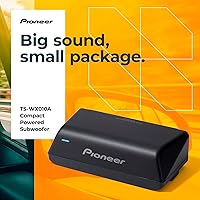
Specifications

  • Dimensions: The enclosure measures 4.63″ deep by 9″ wide by 2.75″ tall, designed to slip under most standard car seats.
  • Weight: The unit weighs 3.31 pounds, light enough to handle solo during installation.
  • Peak Power: Maximum output is rated at 160W peak, though real-world continuous (RMS) output is considerably lower as is typical for this class of compact powered sub.
  • Driver Size: The dynamic audio driver measures 6.58 inches, housed inside a sealed pre-loaded enclosure for tighter, more controlled bass reproduction.
  • Subwoofer Diameter: The subwoofer cone diameter is 17 cm (approximately 6.7 inches), optimized for compact sealed enclosure performance.
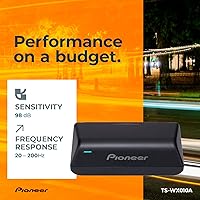
  • Frequency Response: The unit reproduces frequencies from 20Hz upward, covering the full low-frequency bass range useful for music playback.
  • Crossover Range: The built-in low-pass crossover is adjustable between 50Hz and 125Hz, allowing the user to tune how bass blends with existing door or dash speakers.
  • Input Types: Accepts both high-level speaker wire inputs and RCA line-level inputs, making it compatible with factory stereos and aftermarket head units alike.
  • Amplifier: A dedicated amplifier is built directly into the enclosure, eliminating the need to source, mount, or wire a separate external amp.
  • Output Mode: Audio output is mono, which is standard and appropriate for a single dedicated bass channel in a car audio system.
  • Enclosure Type: The subwoofer comes pre-loaded inside a sealed aluminum enclosure, which produces tighter and more accurate bass compared to ported designs at this size.
  • Material: The outer enclosure is constructed from aluminum, providing durability and some resistance to the heat and vibration common in vehicle environments.
  • Connectivity: Connection is entirely wired via the included wire harness; there is no Bluetooth or wireless capability of any kind.
  • Power Source: The unit draws power directly from the vehicle electrical system via a corded wired connection, as is standard for all permanently installed car audio components.
  • Included Accessories: The package includes one wire harness, two floor mounting brackets, two additional mounting brackets, and four screws for a complete out-of-the-box installation.
  • Compatible Devices: Works with factory OEM radios, aftermarket head units, and any audio source with an RCA output or accessible speaker-level outputs.
  • Warranty: Pioneer covers this unit with a limited warranty; buyers should check current terms directly with Pioneer or the retailer at time of purchase.
  • Waterproofing: This subwoofer is not waterproof or water resistant and is intended strictly for indoor vehicle cabin installation only.

Related Reviews
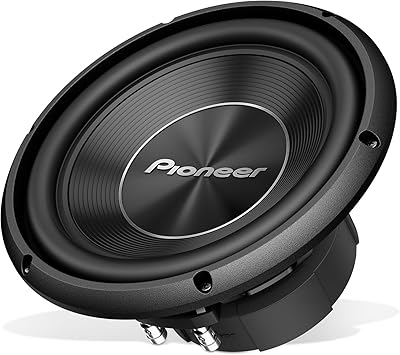
Pioneer TS-A250D4 10-inch Car Subwoofer
81%
88%
Bass Performance
91%
Value for Money
83%
Build Quality
92%
Amplifier Compatibility
79%
Installation Experience
More
Pioneer TS-A2000LD2 8″ Shallow-Mount Subwoofer
77%
81%
Bass Output for Size
89%
Fitment & Installation Ease
76%
Sound Clarity & Definition
72%
Amplifier Compatibility
83%
Build Quality & Durability
More
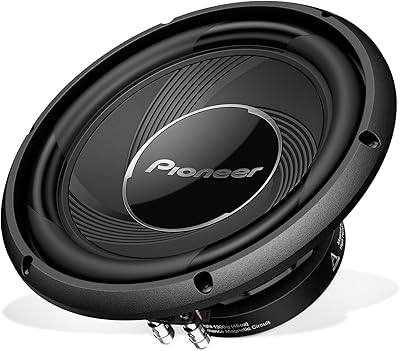
Pioneer TS-A25S4 10-inch Car Subwoofer
79%
84%
Bass Accuracy
88%
Value for Money
81%
Build Quality
83%
Installation Ease
79%
Amplifier Compatibility
More
Pioneer TS-A2000LB 8-inch Subwoofer
79%
74%
Bass Output Quality
91%
Installation Ease
78%
Enclosure & Build Quality
86%
Vehicle Fitment Versatility
81%
Power Handling & Efficiency
More
Pioneer TS-WX1210A 12-inch Powered Subwoofer
74%
88%
Ease of Installation
79%
Bass Output Quality
84%
Factory Stereo Compatibility
83%
Value for Money
72%
Tuning & Sound Customization
More
Pioneer TS-WX140DA
Pioneer TS-WX140DA
78%
88%
Ease of Installation
71%
Bass Output & Performance
91%
EV Compatibility & Power Efficiency
79%
Listening Mode Versatility
83%
Remote Bass Control
More
Pioneer TS-A301D4 12-inch Car Subwoofer
75%
83%
Bass Output
79%
Build Quality
88%
Value for Money
81%
Amplifier Compatibility
63%
Installation Ease
More
Pioneer TS-A2500LS4 10″ Shallow-Mount Subwoofer
81%
83%
Bass Quality
79%
Sound Clarity
91%
Installation Ease
94%
Fit for Tight Spaces
86%
Value for Money
More
Pioneer TS-A30S4 12″ Component Subwoofer
84%
91%
Bass Performance
88%
Value for Money
82%
Ease of Installation
85%
Durability
87%
Sound Clarity
More
Pioneer TS-WX400DA 10″ Slim Subwoofer
87%
88%
Bass Performance
93%
Ease of Installation
85%
Build Quality
91%
Size & Portability
89%
Bass Customization (Deep vs. Dynamic Modes)
More

FAQ

It depends on your specific vehicle. The enclosure stands just 2.75 inches tall, which clears most standard car and SUV seats, but some vehicles with low-slung sport seats or limited floor-to-seat-rail clearance will be too tight. Before ordering, physically measure the clearance under your seat from the floor to the lowest point of the seat rail on both sides.

No, and that is one of the more practical things about this unit. The high-level inputs let you tap directly into the speaker wires coming from your factory head unit, so you can keep your stock stereo completely intact. No adapter or aftermarket radio is required.

Most people with basic DIY comfort handle this themselves in an hour or so. You are essentially running the wire harness to your speaker wires or RCA outputs, connecting a power wire, and bolting the bracket to the floor. The included hardware covers the basics. If you have never done any car audio work before, watching a couple of installation videos for this specific model beforehand will make the process much smoother.

You will notice an improvement, but keep in mind that 160W is the peak figure, not the continuous RMS power the unit actually runs at. Real-world output is moderate rather than powerful. Most users upgrading from thin factory speakers find the bass noticeably fuller and warmer, but if you are expecting to feel the bass physically or play at high volume consistently, this compact powered sub is not sized for that.

No, this is a fully wired unit with no wireless capability. It connects to your audio system via speaker-level wires or RCA cables. If you are using a Bluetooth receiver plugged into your head unit, the signal still routes through wired connections before reaching the subwoofer.

Yes, you can tap into either front or rear speaker outputs depending on what is most accessible under your seat. Most installers use the rear speaker outputs since they are typically closer to the under-seat area, but either will work.

Not if you set the crossover correctly. The adjustable low-pass crossover is specifically there to prevent that overlap. Start around 80Hz and adjust by ear from there. Setting it too high will cause muddiness where the sub and door speakers compete; dialing it to match your speakers takes only a few minutes of listening.

The aluminum enclosure is fairly robust for its size and class, and long-term durability reports from users are generally positive. It holds up well under normal daily driving conditions. The built-in amplifier also appears reliable based on user feedback, with few reports of premature failure.

It works in any vehicle where you have enough floor-to-seat clearance to fit it. SUVs and trucks often have more under-seat space than sedans, which can actually make installation easier. Just confirm the clearance measurement before purchasing, as body-on-frame trucks sometimes have cross-members or brackets that reduce usable depth.

No dedicated remote knob is included in the box, which is worth knowing if you like adjusting bass levels on the fly. To change the output level, you need to reach for the controls on the unit itself. Some buyers find this inconvenient; others do not bother adjusting it once it is dialed in during installation.

Where to Buy