Overview

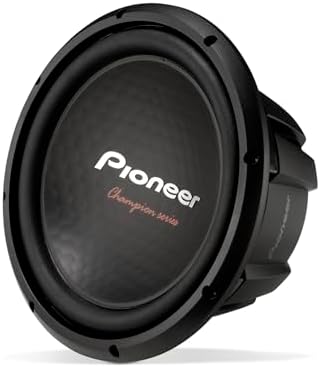
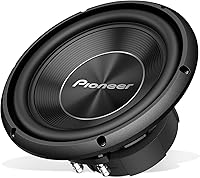
The Pioneer TS-A250D4 10-inch Car Subwoofer is a component sub built for car audio enthusiasts who want real bass performance without spending flagship money. It belongs to Pioneer's A-series family, designed to pair naturally with the brand's full-range coaxial speakers for a cohesive sound. One thing to know upfront: this is a passive subwoofer, meaning you'll need an external amplifier to run it — that's not a flaw, just a requirement worth knowing before you buy. The dual 4Ω voice coil design is what really sets it apart at this price, giving you wiring options most competitors in this range skip. On sale since 2018 with consistently strong rankings, it has a track record that speaks for itself.
Features & Benefits

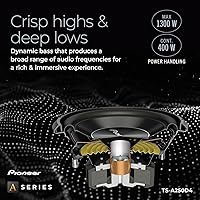
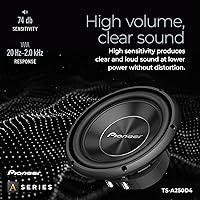
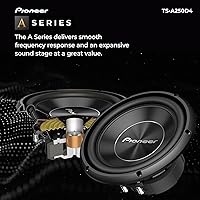
The cone is where this Pioneer subwoofer earns its reputation. It uses a glass-fiber and mica reinforced IMPP composite — stiffer and more flex-resistant than standard paper cones, which translates to cleaner bass and better durability. On power: the 1,300W figure is a peak rating; the 400W RMS is what matters for real-world amplifier matching. The dual voice coil opens up 2Ω, 4Ω, or 8Ω wiring options, making it compatible with a wide range of amps. At 74 dB sensitivity, it won't demand an overpowered amplifier to perform. For installation, plan around a 1.0 cu. ft. vented or 0.7 cu. ft. sealed enclosure — the box you choose will heavily influence the final output.

Best For

This 10-inch sub is a natural fit for anyone building a custom system from scratch — someone who already has or is shopping for a separate amplifier and wants a reliable driver to anchor the low end. It pairs especially well if you're already running Pioneer's A-series coaxial speakers, since the drivers are tuned to complement each other tonally. Truck and SUV owners will appreciate the straightforward enclosure sizing; there's enough cabin space in most of those vehicles to accommodate the recommended box without creative carpentry. For first-time sub upgraders, the included mounting hardware and clear instruction manual lower the barrier to entry. It's not for plug-and-play head unit setups or anyone expecting to skip the amplifier step.

User Feedback

With over 2,200 ratings averaging 4.5 stars, the TS-A250D4 holds up well under real-world scrutiny. Buyers consistently highlight the bass output quality for the price, noting that it outperforms what you'd typically expect from a sub in this range. Amplifier compatibility is another common praise point — the wiring flexibility pays off in practice, with users reporting successful pairings across multiple brands. On the critical side, a recurring theme is that the sub underdelivers when placed in a poorly built or mismatched enclosure. Box tuning matters here more than most, and buyers who skipped that step were disappointed. Build quality feedback is generally positive, with cone durability holding up over extended use — though a few note the surround can show wear if pushed hard for prolonged periods.

Pros

  • Dual voice coil offers genuine wiring flexibility, letting you match impedance to almost any amplifier you already own.
  • The reinforced IMPP cone delivers noticeably cleaner bass than standard paper-cone subs in the same price range.
  • Over 2,200 ratings averaging 4.5 stars indicates consistent real-world satisfaction, not just a handful of enthusiastic reviews.
  • Pairs naturally with Pioneer A-series coaxial speakers for buyers building a full Pioneer system.
  • Enclosure size recommendations are practical and achievable in most trucks and SUVs without custom fabrication.
  • Mounting hardware and instruction manual are included, which is genuinely helpful for first-time installers.
  • At 9.5 pounds, it is manageable to handle and position during a solo install.
  • The TS-A250D4 has been on the market since 2018 with no discontinuation — a sign of a product that earns repeat confidence.
  • 74 dB sensitivity means you do not need an overpowered amplifier to get solid output from this driver.

Cons

  • Requires a separate external amplifier — a cost and complexity many buyers overlook when pricing out this sub.
  • The 1,300W peak power figure is misleading; real-world continuous handling is 400W RMS, which is far more modest.
  • Performance drops off significantly in a poorly matched or loosely built enclosure, punishing buyers who skip that step.
  • No built-in low-pass filter or bass control — all tuning relies entirely on the amplifier you pair it with.
  • Rubber surround can show wear under sustained high-power use, particularly if the sub is regularly pushed near its limits.
  • At 5.875 inches of mounting depth, tight installations in compact sedans can require careful planning or custom woodwork.
  • Only one subwoofer is included per purchase, so stereo bass setups require buying two units and budgeting accordingly.
  • No active or powered version exists in this product line for buyers who want a simpler all-in-one solution.

Ratings

The scores below were produced by our AI rating engine after analyzing thousands of verified global buyer reviews for the Pioneer TS-A250D4 10-inch Car Subwoofer, with automated filtering applied to remove incentivized, bot-generated, and duplicate submissions. The result is an honest, data-driven breakdown that reflects both what real users love and where genuine frustrations emerged — nothing is glossed over.

Bass Performance
88%
For a mid-range component sub, the low-end output consistently impressed buyers across music genres — from hip-hop to EDM to classic rock. Drivers running it in properly built enclosures reported a punchy, full-bodied bass response that felt notably stronger than expected at this price tier.
A handful of users noted that very deep sub-bass extension falls slightly short compared to higher-end drivers when pushed at high volumes. The sub performs best in the 40–80Hz range; below that, output rolls off more noticeably than premium alternatives.
Value for Money
91%
Buyers repeatedly called out the price-to-performance ratio as the single biggest reason they chose this driver. Getting a dual voice coil sub with a reinforced composite cone from a name-brand manufacturer at this price point is genuinely hard to beat in the current market.
The total cost of ownership is higher than the sticker price suggests, since a separate amplifier is mandatory. First-time buyers who didn't account for amp costs felt the overall spend crept well above their initial expectations.
Build Quality
83%
The reinforced IMPP cone and rubber surround give this sub a noticeably solid feel compared to paper-cone competitors. Users who had been running the driver for one to two years generally reported no cone delamination, surround cracking, or visible wear under normal use conditions.
A small number of buyers who consistently drove the sub near its power limits reported minor surround fatigue over extended periods. The terminal connections, while functional, feel slightly lightweight for a driver that can handle 400W RMS continuously.
Amplifier Compatibility
92%
The dual voice coil design giving 2Ω, 4Ω, and 8Ω wiring options translates directly to real-world flexibility — users successfully paired this sub with entry-level amps, mid-range mono blocks, and even older two-channel units they already owned. Very few compatibility issues were reported across the review base.
Because this is a passive driver with no onboard filtering, buyers without prior amplifier tuning experience sometimes struggled to dial in the low-pass crossover correctly. Without proper amp settings, the sub can sound muddy or boomy, which a few users mistakenly attributed to the driver itself.
Installation Experience
79%
21%
The included mounting hardware and a clearly written instruction manual made the physical installation process approachable even for first-timers. The 10-inch format is a well-documented size, and online resources for building matching enclosures are widely available and easy to find.
The 5.875-inch mounting depth creates real fitment challenges in compact vehicles with shallow trunk floors or limited cavity depth. Several buyers had to modify their enclosure plans or switch to a custom build after their initial prefab box turned out to be a poor match.
Enclosure Sensitivity
62%
38%
When correctly matched to the recommended enclosure volumes — 1.0 cu. ft. vented or 0.7 cu. ft. sealed — the TS-A250D4 performs noticeably well and reaches its full potential. Users who invested time in a proper box build were consistently the most satisfied reviewers in the dataset.
This is one of the most enclosure-sensitive drivers in its class, and buyers who used ill-fitting prefab boxes reported underwhelming output and a thin, lifeless bass response. The sub's reputation for inconsistent performance largely traces back to improper box matching rather than driver defects.
Sound Clarity
81%
19%
The reinforced cone material suppresses flex-induced distortion better than softer cone alternatives, which is audible on complex bass lines where lesser drivers tend to smear detail. Buyers playing music with intricate low-end arrangements — jazz bass, progressive rock, acoustic-heavy tracks — appreciated the cleaner transient reproduction.
At the upper end of its frequency range, around 80–120Hz, some users noticed a slight coloration that could occasionally bleed into midrange territory without careful crossover tuning. This is manageable with a quality amplifier but can be noticeable with entry-level amps that lack precise crossover control.
Power Handling
77%
23%
At 400W RMS, the sub handles a solid range of amplifier outputs without complaint during extended daily listening sessions. Drivers running it at 250–350W RMS — a common real-world pairing — reported reliable operation over months of regular use with no thermal or mechanical issues.
The gap between the 1,300W peak and 400W RMS figures caused confusion for a notable number of buyers who over-specified their amplifiers expecting higher continuous output. Running the sub above its RMS rating for extended periods led to occasional voice coil stress reports from users who misread the spec sheet.
Low-Frequency Extension
74%
26%
In a properly tuned vented enclosure, this 10-inch sub reaches low enough to satisfy most casual and enthusiast listeners looking for authoritative bass in daily driving conditions. Genre versatility is solid across mainstream music formats where deep bass is more about feel than extreme sub-30Hz extension.
Audiophiles chasing very deep infrasonic extension below 30Hz will find this driver limiting — it is not engineered for that territory. In a sealed box especially, rolloff below 40Hz is steeper than users accustomed to larger 12-inch or 15-inch drivers might expect.
Packaging & Unboxing
84%
Multiple buyers noted that the subwoofer arrived well-protected with no damage in transit, and the inclusion of mounting screws and documentation inside the box was a small but appreciated detail. The unboxing experience felt consistent with a reputable, established brand rather than a budget import.
The packaging, while protective, is utilitarian — no accessories like wiring harnesses or grille covers are included. Buyers who wanted a more complete kit needed to source additional components separately, which added steps to the purchasing process.
Durability Over Time
82%
18%
Buyers who had been running the TS-A250D4 for one to three years under regular daily use conditions generally reported no significant degradation in output or physical condition. The rubber surround in particular held up well in vehicles exposed to temperature fluctuations common in hot and cold climates.
A minority of long-term users reported voice coil fatigue symptoms — reduced output and occasional distortion at moderate volumes — after two or more years of high-volume daily use. These cases appeared more frequently when the sub had been regularly driven at or near its peak power limits.
Ecosystem Integration
86%
Pairing the TS-A250D4 with Pioneer's A-series coaxial speakers produced a notably cohesive soundstage according to buyers who had built full Pioneer front-stage setups. The tonal tuning between the A-series components translated to a natural handoff between the full-range drivers and the sub.
Buyers using non-Pioneer head units or amplifiers reported no technical issues, but the ecosystem benefit is only realized when the full A-series chain is in place — which requires additional investment that not all buyers are willing to make.
Sensitivity & Efficiency
72%
28%
At 74 dB sensitivity, this sub does not demand an exceptionally powerful amplifier to produce listenable output, which works in favor of budget builders pairing it with entry to mid-range mono amps in the 200–400W range. It runs efficiently enough for most practical car audio configurations.
Compared to higher-sensitivity drivers in the 85–88 dB range, the TS-A250D4 requires a meaningfully more capable amplifier to achieve the same volume levels. Buyers running underpowered amps found themselves disappointed with output levels that did not match their expectations from the wattage ratings.

Suitable for:

The Pioneer TS-A250D4 10-inch Car Subwoofer is a strong pick for anyone actively building or upgrading a custom car audio system who already owns — or is budgeting for — a dedicated external amplifier. It works particularly well for drivers who want to stay within the Pioneer ecosystem, since the A-series tuning pairs naturally with Pioneer's full-range coaxial speakers for a cohesive, balanced sound. Truck and SUV owners are a natural fit here: the recommended enclosure sizes are manageable in larger cabins without major custom fabrication work. First-time subwoofer builders will appreciate the included hardware and clear documentation, which lower the installation learning curve. And for anyone who's wrestled with mismatched impedance before, the dual voice coil's ability to run at 2Ω, 4Ω, or 8Ω makes amplifier matching far less of a headache than it is with single-coil alternatives at this price.
Not suitable for:

The Pioneer TS-A250D4 10-inch Car Subwoofer is a poor match for buyers expecting a plug-and-play bass upgrade straight out of the box — there is no built-in amplifier, and without one, this driver simply will not work. Compact car owners with limited trunk space may also struggle, since getting the best performance requires building or buying a properly sized enclosure, which takes real estate. Buyers who want to skip the enclosure altogether and drop this into a generic prefab box should temper their expectations; the sub's output is noticeably dependent on the box being tuned correctly. It's also not the right choice for anyone chasing extreme SPL competition-level output — the 400W RMS rating and 74 dB sensitivity are solid for casual and enthusiast listening, but fall short of what dedicated competition drivers demand. If your budget doesn't account for an amplifier purchase on top of the driver itself, this is not the right starting point.
Specifications

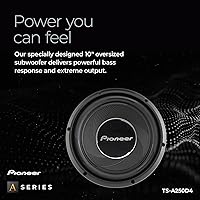
  • Driver Size: The subwoofer features a 10-inch (25.4 cm) cone driver designed for deep, low-frequency car audio reproduction.
  • Peak Power: Maximum peak power handling is rated at 1,300W, which represents the absolute short-term ceiling, not continuous operating capacity.
  • RMS Power: Continuous (RMS) power handling is 400W, which is the figure you should use when selecting and sizing a matching amplifier.
  • Voice Coil: The dual 4Ω voice coil configuration allows wiring at 2Ω, 4Ω, or 8Ω to suit a wide range of external amplifiers.
  • Cone Material: The cone is constructed from Glass-Fiber and Mica Reinforced IMPP composite for improved rigidity, reduced flex, and better long-term durability.
  • Surround Material: A rubber surround is used around the cone perimeter, offering greater environmental resilience than foam surrounds.
  • Sensitivity: The driver's sensitivity rating is 74 dB, which indicates how efficiently it converts amplifier power into acoustic output.
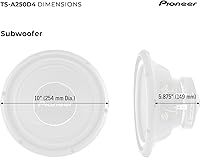
  • Mounting Depth: The required mounting depth is 5.875 inches, which must be accounted for when designing or purchasing a compatible enclosure or baffle.
  • Outer Diameter: The overall driver diameter is 10 inches, requiring an appropriate cutout in any custom baffle or enclosure.
  • Enclosure (Vented): Pioneer recommends a vented (ported) enclosure of 1.0 cubic foot for maximum bass extension and output.
  • Enclosure (Sealed): A sealed enclosure of 0.7 cubic feet is recommended for tighter, more controlled bass with better transient response.
  • Connectivity: This is a passive wired subwoofer with no built-in amplification; it must be connected to a separate external amplifier to operate.
  • Product Dimensions: The unit measures 5.88″ deep by 10″ wide by 10″ tall in its packaged driver form.
  • Item Weight: The subwoofer weighs 9.5 pounds, which is typical for a 10-inch component driver of this construction.
  • Warranty: Pioneer includes a 1-year limited warranty, with documentation shipped inside the box with the unit.
  • In the Box: Each purchase includes the 10-inch subwoofer driver, 8 mounting screws, an instruction manual, and a warranty information sheet.
  • Waterproofing: This driver is not waterproof and is intended strictly for enclosed in-vehicle installations, not exposed or marine environments.
  • Brand Series: The TS-A250D4 belongs to Pioneer's A-series product family, which is designed to pair cohesively with A-series full-range coaxial speakers.

Related Reviews
CT Sounds OZONE-10-D4 10-inch Car Subwoofer
84%
91%
Bass Performance
88%
Power Handling
92%
Value for Money
85%
Sound Clarity
86%
Build Quality
More
CT Sounds STRATO-10-D2 10 Inch Dual 2 Ohm Car Subwoofer
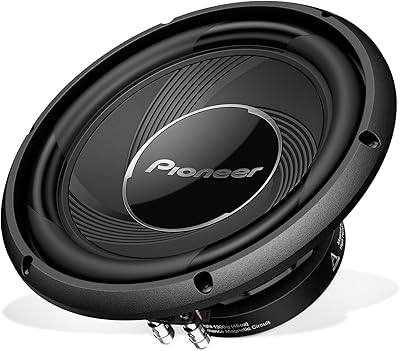
87%
91%
Bass Performance
89%
Build Quality & Durability
92%
Power Handling
88%
Sound Clarity
83%
Ease of Installation
More
Pioneer TS-A25S4 10-inch Car Subwoofer
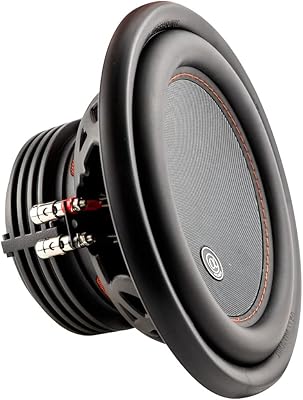
79%
84%
Bass Accuracy
88%
Value for Money
81%
Build Quality
83%
Installation Ease
79%
Amplifier Compatibility
More
Pioneer TS-A2500LS4 10″ Shallow-Mount Subwoofer
81%
83%
Bass Quality
79%
Sound Clarity
91%
Installation Ease
94%
Fit for Tight Spaces
86%
Value for Money
More
Pioneer TS-WX400DA 10″ Slim Subwoofer
87%
88%
Bass Performance
93%
Ease of Installation
85%
Build Quality
91%
Size & Portability
89%
Bass Customization (Deep vs. Dynamic Modes)
More
Alphasonik NSW410 10-inch Car Subwoofer
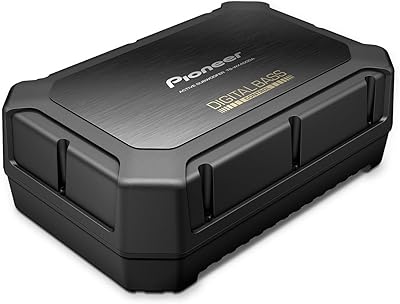
84%
88%
Bass Performance
92%
Value for Money
85%
Ease of Installation
90%
Build Quality
87%
Durability
More
Orion XTR104D 10-Inch Car Subwoofer
75%
83%
Bass Output Quality
81%
Build Quality
78%
Value for Money
61%
Power Handling Accuracy
58%
Enclosure Sensitivity
More
Pioneer TS-A301D4 12-inch Car Subwoofer
75%
83%
Bass Output
79%
Build Quality
88%
Value for Money
81%
Amplifier Compatibility
63%
Installation Ease
More
DS18 SLC-10S 10-Inch Car Subwoofer
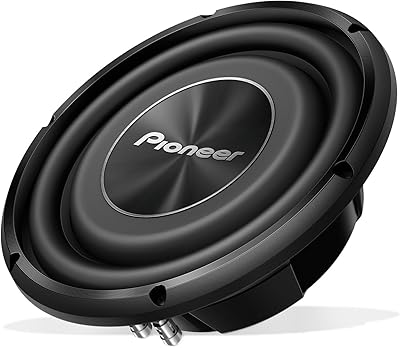
78%
88%
Value for Money
79%
Bass Output & Impact
83%
Build Quality
67%
Power Handling (RMS)
86%
Ease of Installation
More
Pyramid PW1048USX 10-Inch 500W Car Subwoofer
83%
88%
Bass Performance
92%
Value for Money
85%
Build Quality
90%
Ease of Installation
82%
Sound Clarity
More

FAQ

No, it does not. This is a passive driver, meaning it requires a separate external amplifier to function. If you don't already have an amp, make sure to budget for one before purchasing — it's a required component, not an optional add-on.

You want an amplifier that can deliver around 400W RMS at your chosen wiring impedance. The 1,300W figure on the box is a peak rating and not what the sub runs on continuously. Matching your amp's RMS output to the driver's 400W RMS rating is the right approach for reliable performance and long driver life.

Yes. The dual 4Ω voice coil gives you the option to wire both coils in parallel for a 2Ω load, in series for an 8Ω load, or connect a single coil for 4Ω. Just confirm your amplifier is rated stable at whichever impedance you choose before wiring it up.

You can use a prefab box, but make sure it closely matches the recommended specs: 1.0 cubic foot for a vented setup or 0.7 cubic feet for a sealed one. A box that's too large or too small will noticeably reduce output and bass quality, so it's worth checking internal volume before you buy an off-the-shelf enclosure.

It can, but it takes some planning. The driver needs 5.875 inches of mounting depth, and you'll still need an enclosure that meets the volume recommendation. Compact sedans and hatchbacks with limited trunk space can make this tricky, though not impossible with a custom shallow or wedge-style box.

It's very much a daily listening driver. The 400W RMS rating and 74 dB sensitivity are well-suited for enjoying music at high volume in an everyday setting. It's not built for SPL competition, but for street use and enthusiast listening, it performs well above its price class.

The install is manageable for a first-timer as long as you're comfortable with basic wiring. The box includes mounting screws and an instruction manual, which helps. The bigger challenge is usually the amplifier wiring and enclosure build, not the sub installation itself. There are plenty of online guides that walk through the full process.

Generally, yes. Rubber surrounds outlast foam alternatives and hold up well under normal use. Some users who consistently push the driver near its power limits over long periods have reported minor wear, but for typical daily use at reasonable volumes, the surround should last for years.

Yes, that's a common setup. With the wiring flexibility the dual voice coils offer, you can run two of these drivers off one stereo amplifier or a mono amp, depending on your preferred impedance and the amp's stability. Just make sure your amplifier can deliver adequate RMS power to both drivers at the final impedance you wire them to.

Absolutely. The wiring flexibility and standard impedance options mean this 10-inch sub is compatible with amplifiers from virtually any brand. Pioneer ecosystem pairing is a nice bonus if you're already in that lineup, but the driver itself has no brand-specific dependencies on the amplifier side.

Where to Buy