Overview

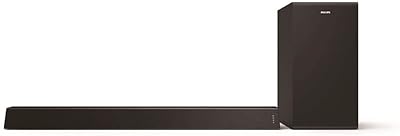
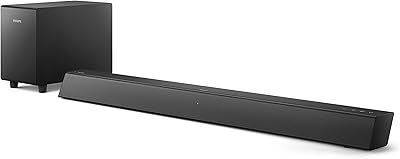
The Philips TAB8405 2.1-Channel Soundbar sits in a sweet spot for anyone tired of flat TV audio but not ready to commit to a full surround system. Philips has a long-standing reputation in consumer electronics, and this model reflects that reliability — notably by bundling a wireless subwoofer at a price tier where most competitors skip it entirely. Smart integrations like AirPlay 2, Amazon Echo, and DTS Play-Fi add genuine utility beyond basic TV audio. That said, keep expectations grounded: this is a solid casual home theater upgrade, not a reference-grade listening system. For what it costs, the overall feature set is genuinely difficult to beat.
Features & Benefits

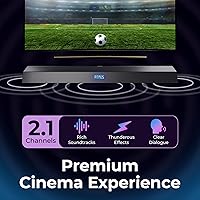
The wireless subwoofer does real work here — its 5.25-inch driver adds bass weight to action scenes and music without a single cable crossing your floor. Dolby Atmos is included, though it functions as a virtual surround effect rather than true overhead channel playback; it still noticeably opens up the soundstage for a system this compact. The Stadium EQ Mode is a fun, practical touch for sports fans, layering in ambient crowd atmosphere around commentary. DTS Play-Fi lets you pull in other compatible speakers for whole-home audio, while AirPlay 2 keeps Apple device users comfortable. At 240W total output across a 2.1-channel setup, the system handles both dialogue clarity and low-end punch reasonably well.

Best For

This Philips soundbar makes the most sense in apartments or mid-sized living rooms where running rear speaker cables is simply not practical. First-time soundbar buyers stepping up from built-in TV speakers will notice an immediate and satisfying difference. Sports fans get real value from the Stadium EQ feature, and anyone already embedded in Alexa or Apple ecosystems will find the TAB8405 integrates without fuss. It also suits buyers who want multi-room audio reach without committing to a Sonos-level investment. If discrete surround channels or audiophile detail matter to you, look at higher-end options — but for everyday TV and streaming use, this 2.1-channel system consistently overdelivers for its category.

User Feedback

Sitting at 4.1 stars across around 130 ratings, the TAB8405 has collected cautiously positive feedback — though the review pool is still modest, so take broader patterns with some skepticism. Wireless subwoofer convenience and quick setup are the most frequently praised aspects, with several buyers noting they were surprised by the bass output relative to the system size. On the critical side, some users have reported occasional app connectivity issues with Play-Fi, and a handful felt the Dolby Atmos effect was subtle enough to be barely perceptible. Dialogue clarity at higher volumes drew a few complaints as well. The overall picture is fair: strong value for casual listeners, with some minor software rough edges worth knowing about.

Pros

  • The included wireless subwoofer is a genuine advantage — most competitors at this price make you add one separately.
  • AirPlay 2 support lets Apple users stream directly from any device without extra setup or Bluetooth pairing.
  • Setup is fast and genuinely low-friction, especially for households with a Roku TV already in use.
  • The TAB8405 produces enough clean output at 240W to comfortably fill a standard-sized living room.
  • Stadium EQ Mode adds real atmosphere to live sports viewing without requiring any external accessories.
  • DTS Play-Fi opens the door to whole-home audio expansion as your setup grows over time.
  • Dialogue clarity for TV shows and news is noticeably better than what flat-panel speakers deliver.
  • The 35-inch bar proportions well under most mid-to-large TVs without visually dominating the setup.
  • Amazon Echo compatibility means hands-free volume and input control for Alexa-connected households.

Cons

  • The Philips Sound app has a documented track record of inconsistent reliability, particularly on Android devices.
  • Dolby Atmos processing is virtual only — do not expect any real sense of overhead audio directionality.
  • No optical input means buyers with older TVs lacking HDMI ARC are left without a clean connection option.
  • The wireless sub connection can occasionally drop or lag when waking from standby, which is noticeable mid-content.
  • High-frequency detail thins out at louder volumes, limiting the system for anything beyond background or casual listening.
  • The value proposition weakens if you have no interest in smart features — pure audio rivals exist at similar prices.
  • Multi-room audio via Play-Fi requires troubleshooting effort that undermines the plug-and-play expectation it sets.
  • The subwoofer enclosure feels noticeably cheaper in hand than the soundbar itself, which creates a slight mismatch in build feel.

Ratings

The Philips TAB8405 2.1-Channel Soundbar was evaluated by our AI rating engine after processing verified buyer reviews from global markets, with spam, bot activity, and incentivized feedback actively filtered out. Scores reflect a balanced synthesis of real-world praise and recurring frustrations — nothing is glossed over. From first-time soundbar buyers to smart home enthusiasts, the feedback reveals a consistent picture of where this 2.1-channel system delivers and where it falls short.
Sound Quality
74%
26%
For a 2.1-channel system at this price, the overall sound output impressed a notable share of buyers — particularly for dialogue clarity during TV shows and the added warmth the wireless subwoofer brings to movies. Casual listeners switching from built-in TV speakers found the jump in audio richness immediately satisfying.
Discerning listeners noted that the high-frequency detail thins out at higher volumes, and the soundstage, while improved by virtual processing, still lacks the separation you get from a discrete multi-speaker setup. It is not a system that holds up well under critical music listening.
Bass Performance
81%
19%
The wireless subwoofer is genuinely the standout element here. The 5.25-inch driver punches with enough authority to make action sequences and bass-heavy music feel physically engaging in a small to mid-sized room, without any of the muddy one-note bass common in cheaper systems.
In larger rooms or open-plan spaces, the subwoofer starts to feel underpowered, lacking the low-end extension needed to fill the space convincingly. A few buyers also noted the sub can occasionally sound slightly detached from the soundbar at lower bass frequencies.
Dolby Atmos Experience
62%
38%
Having any form of Atmos processing at this price tier is genuinely useful for buyers who primarily watch streaming content on Netflix or Disney+, where Atmos tracks are common. The virtual height effect adds a noticeable sense of openness to movie soundtracks that plain stereo simply cannot replicate.
It is critical to understand this is simulated Atmos — there are no upward-firing drivers, and the height effect is created through psychoacoustic processing. Buyers who expected a true overhead audio experience were visibly disappointed, and the effect can feel gimmicky on non-optimized content.
Wireless Subwoofer Convenience
88%
The wire-free subwoofer pairing was one of the most consistently praised aspects across reviews. Buyers in apartments and rented spaces especially appreciated being able to position it wherever sounded best without routing cables around furniture or under rugs.
A small number of users reported that the wireless connection between the soundbar and sub occasionally dropped or took a moment to re-sync after the system woke from standby. It is infrequent, but enough of a pattern to be worth noting.
Smart Home Integration
77%
23%
AirPlay 2 support is a genuine convenience for Apple users — being able to throw audio directly from an iPhone or Mac without pairing friction is something buyers highlighted as a daily-use advantage. Amazon Echo compatibility also makes voice control feel natural for Alexa households.
DTS Play-Fi, while powerful on paper, requires the Philips Sound app to function, and several reviewers found the app experience inconsistent — particularly on Android. Multi-room sync worked well for some but required troubleshooting for others, which undercuts the plug-and-play promise.
Setup & Ease of Use
86%
Getting the system running takes very little time — the HDMI connection is straightforward, the wireless sub pairs automatically, and Roku TV remote compatibility means many buyers did not even need to dig out an extra remote. Non-technical users specifically called out how painless the initial setup was.
The Philips Sound app, needed for accessing Play-Fi and some EQ settings, added an extra layer of friction for buyers who simply wanted a plug-in-and-done experience. A few users found navigating app-based controls less intuitive than a traditional remote.
DTS Play-Fi Multi-Room Audio
66%
34%
For buyers already invested in the Play-Fi ecosystem or willing to build one, having whole-home audio coordination through the Philips Sound app works well when it works. Syncing the TAB8405 with compatible speakers for background music throughout a home is a feature usually reserved for pricier systems.
App stability issues surfaced consistently enough in reviews to temper enthusiasm. Dropouts, delayed response, and occasional failure to detect devices on the network were recurring complaints. It works reliably for many users, but the experience is not consistent enough to be called rock-solid.
Dialogue Clarity
72%
28%
For standard TV viewing — news, talk shows, drama — vocal reproduction is noticeably cleaner than built-in TV speakers. The system does a reasonable job separating voices from background music and effects, which matters most during fast-paced scenes or content with complex mixes.
At higher volume levels, some users noted that dialogue intelligibility degraded slightly, with voices taking on a slightly compressed or strained quality. Those who are particularly sensitive to vocal clarity during late-night viewing may want to experiment with EQ settings to compensate.
Stadium EQ Mode
69%
31%
Sports fans who tested this feature during live football or basketball games found it genuinely added to the at-home viewing experience. The ambient crowd simulation creates a sense of arena space around commentary that makes live sports feel more immersive than a flat stereo mix.
The effect is clearly processed and synthetic — it adds atmosphere rather than realism, and on some content it can feel like a layer of noise rather than meaningful ambience. Non-sports users found little practical use for this mode and largely ignored it after initial experimentation.
Build Quality & Design
78%
22%
The TAB8405 has a clean, understated aesthetic that fits naturally under most TVs without drawing attention to itself. At 35 inches wide, it proportions well with screens up to around 65 inches, and the build feels solid rather than hollow or cheap for its price bracket.
The subwoofer enclosure feels slightly plasticky on close inspection, and the overall material quality does not quite match what you might expect from the Philips branding. It looks fine in a living room but is unlikely to impress anyone who handles it up close.
Remote & Controls
75%
25%
Roku TV remote compatibility is a thoughtful inclusion that many buyers appreciated — it means one fewer device on the coffee table for those with a Roku-based TV. The included remote covers core functions cleanly, with quick-access buttons for common sound modes.
The remote does not provide access to all settings, and some finer adjustments require falling back to the app. For buyers who prefer a fully hardware-driven experience, the dependency on the app for deeper control is a minor but real annoyance.
Value for Money
83%
Considering it includes a wireless subwoofer, Dolby Atmos processing, DTS Play-Fi, AirPlay 2, and 240W of output, the TAB8405 packs a feature list that is hard to match at this price point. Buyers who evaluated it against competitors in the same range consistently called it strong value.
The value equation holds only if you actually use the smart features. Buyers who wanted purely a better TV speaker and did not care about Play-Fi or AirPlay found similarly priced competitors offering more refined pure audio performance without the ecosystem overhead.
Connectivity Options
79%
21%
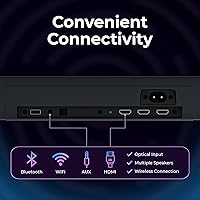
HDMI, Wi-Fi, and Bluetooth together cover most connection scenarios buyers actually encounter — plugging into a TV via HDMI ARC, streaming wirelessly from a phone, or using Bluetooth as a fallback all work without extra adapters or dongles.
There is no optical input, which matters to buyers with older TVs that lack HDMI ARC. A small but vocal subset of reviewers flagged this as a dealbreaker for their specific setup, so it is worth confirming TV compatibility before purchasing.
Volume & Room Coverage
71%
29%
In rooms up to roughly 300 square feet, the system produces enough volume to fill the space comfortably for TV and movie content. The 240W rating translates to convincing output for everyday listening levels without obvious distortion creeping in.
Larger rooms and open-plan layouts exposed the system's limits fairly quickly. Several buyers in bigger spaces noted the sound did not carry evenly across the room, with the sweet spot feeling narrow and the overall presence thinning out toward the edges.

Suitable for:

The Philips TAB8405 2.1-Channel Soundbar is a natural fit for anyone making their first serious upgrade from built-in TV speakers — particularly in apartments, condos, or living rooms where stringing rear speaker cables simply is not practical. If you primarily watch streaming content, live sports, or action-heavy movies and want noticeably better audio without the complexity of a full home theater build, this system delivers a meaningful step up. Smart home users already operating within an Alexa or Apple ecosystem will find the AirPlay 2 and Echo compatibility slots in naturally without extra configuration headaches. The wireless subwoofer is especially well-suited to renters who cannot permanently route cables through their space but still want genuine bass impact. Buyers who want a toe in the water of multi-room audio — without committing to a Sonos-level investment — will also find the DTS Play-Fi integration a useful, if occasionally imperfect, starting point.
Not suitable for:

The Philips TAB8405 2.1-Channel Soundbar is not the right call for buyers who prioritize pure, refined audio performance above all else — at this price tier, the sound quality is solid for casual use but will not satisfy anyone accustomed to higher-grade listening equipment. If your TV lacks HDMI ARC, be aware there is no optical input as a fallback, which is a real compatibility gap that some older setups cannot work around. The Dolby Atmos label here should be taken with a clear head: there are no physical upward-firing drivers, and buyers expecting a genuine overhead surround experience will be disappointed by what is essentially a virtual processing effect. Those who prefer managing everything through a physical remote, with no reliance on smartphone apps, will find the dependency on the Philips Sound app for deeper settings frustrating. Larger rooms above roughly 350 square feet will likely expose the system's limits in both volume coverage and bass extension, making it a poor match for open-plan spaces or dedicated home theater rooms.
Specifications

  • Channel Config: The system operates in a 2.1-channel configuration, pairing the soundbar with a dedicated wireless subwoofer for a combined output.
  • Total Output: Maximum power output is rated at 240W across the full system, covering both the soundbar channels and the subwoofer driver.
  • Woofer Driver: The wireless subwoofer houses a 5.25-inch dynamic driver designed to reproduce low-frequency content down to 40 Hz.
  • Frequency Response: The system's frequency response starts at 40 Hz on the low end, covering the range needed for typical TV, movie, and music content.
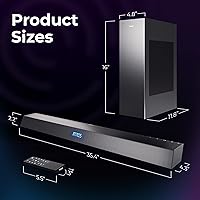
  • Soundbar Width: The soundbar unit measures 35 inches in width, making it proportionally suited to TVs ranging from approximately 45 to 65 inches.
  • Product Dimensions: Full product dimensions are listed as 35″ deep by 7″ wide by 12″ high, inclusive of the subwoofer unit in the package.
  • System Weight: The combined system weight is 21.8 pounds, accounting for both the soundbar bar and the wireless subwoofer enclosure.
  • HDMI Connectivity: The soundbar connects to compatible TVs via HDMI, supporting ARC functionality for single-cable audio and control integration.
  • Wireless Tech: Both Bluetooth and Wi-Fi are supported, allowing flexible streaming from phones, tablets, and smart home devices without physical cables.
  • Subwoofer Link: The subwoofer connects to the soundbar wirelessly, eliminating the need for a dedicated subwoofer cable between the two units.
  • Dolby Atmos: The TAB8405 is Dolby Atmos compatible, processing Atmos-encoded audio tracks into a virtual three-dimensional surround effect without upward-firing drivers.
  • DTS Play-Fi: DTS Play-Fi support allows the soundbar to participate in multi-room audio setups managed through the Philips Sound app or the dedicated Play-Fi app.
  • AirPlay 2: AirPlay 2 integration enables direct wireless audio streaming from Apple devices including iPhone, iPad, and Mac without Bluetooth pairing.
  • Voice Assistant: The system is compatible with Amazon Echo devices, enabling voice-based playback control and volume adjustment through Alexa.
  • EQ Modes: Onboard sound modes include Bass Boost and Stadium EQ, with the latter designed to simulate ambient crowd atmosphere during live sports content.
  • Remote Compat: The soundbar is compatible with Roku TV remotes, allowing users with Roku-based televisions to manage volume and inputs without an additional remote.
  • App Control: Full settings access and Play-Fi multi-room configuration are managed through the Philips Sound app, available for both iOS and Android devices.
  • Power Source: The system is powered via a corded electric connection and is not designed for battery or portable operation.
  • Mounting Type: The soundbar supports bar mount installation, allowing it to be wall-mounted beneath a TV using an appropriate bracket accessory.
  • Warranty: Philips provides a limited warranty with this product; buyers should confirm the specific duration and terms through the retailer or Philips support at time of purchase.

Related Reviews

Philips TAB7305 2.1 Soundbar with Wireless Subwoofer
69%
81%
Bass Performance
67%
Dialogue Clarity
89%
Setup & Installation
62%
Wireless Subwoofer Reliability
78%
Value for Money
More
Philips B5306 2.1-Channel Soundbar with Subwoofer
74%
91%
Ease of Setup
88%
Roku TV Integration
83%
Bass Performance
66%
Dialogue Clarity
61%
Wireless Subwoofer Reliability
More
Philips B4208 2.0 Channel Soundbar
84%
85%
Sound Quality
92%
Ease of Setup
91%
Value for Money
70%
Bass Performance
88%
EQ Customization
More
Hisense HS214 2.1 Channel Soundbar
86%
84%
Sound Quality
88%
Bass Performance
91%
Setup and Installation
92%
Roku TV Integration
83%
Build Quality
More
TCL Q75H 5.1.2 Channel Soundbar
85%
91%
Sound Quality
88%
Ease of Setup
92%
Bass Performance
89%
Dialogue Clarity
84%
Build Quality
More
Creative Stage 2.1 Soundbar
78%
84%
Bass & Low-End Performance
73%
Audio Clarity & Midrange
91%
Connectivity & Input Range
86%
TV ARC Reliability
67%
Bluetooth Performance
More
PyleUsa PSBV28HB 2.1 Channel Soundbar with Wireless Subwoofer
84%
85%
Sound Quality
76%
Bass Performance
90%
Connectivity Options
88%
Ease of Setup
92%
Value for Money
More
LG S70TY 3.1.1-Channel QNED TV Matching Soundbar
88%
91%
Sound Quality
93%
Ease of Setup
96%
Compatibility with LG QNED TVs
88%
Dialogue Clarity
84%
Bass Performance
More
Hosyond TDA7498E 2.1 Channel Bluetooth Amplifier Board 160W×2+220W
73%
88%
Value for Money
76%
Power Output & Headroom
83%
Bluetooth Connectivity
79%
Build & Component Quality
62%
Thermal Management
More
Puxinat 2-in-1 Separable Soundbar
85%
85%
Sound Quality
91%
Ease of Setup
89%
Value for Money
88%
Bass Performance
90%
Design Flexibility
More

FAQ

The TAB8405 connects via HDMI ARC, which is a standard port found on most modern TVs regardless of brand. As long as your TV has an HDMI ARC port, it should work fine. Roku TV users get the added convenience of direct remote compatibility, but that is a bonus rather than a requirement.

Not quite. The Philips TAB8405 2.1-Channel Soundbar uses virtual Dolby Atmos processing, which means it simulates height and spatial effects through psychoacoustic tricks rather than actual overhead speakers. You will notice a wider, more open soundstage compared to stereo, but it is not the same as a true object-based Atmos system with ceiling or upward-firing drivers. For this price range, it is a reasonable approximation — just go in with realistic expectations.

Philips does not publish a specific maximum range, but practically speaking most users position the sub within the same room — typically within 10 to 15 feet of the soundbar. Walls and furniture can interfere with the wireless signal, so keeping it in the same open space as the soundbar is the safest approach for reliable connectivity.

You can absolutely use the core functions — TV audio, volume control, and basic EQ modes — without ever opening the app. The Philips Sound app becomes necessary if you want to use DTS Play-Fi for multi-room audio or access deeper sound customization settings. For straightforward TV listening, the included remote or your Roku TV remote is all you need.

Unfortunately, no — the TAB8405 does not include an optical input, only HDMI. If your TV lacks an HDMI ARC port, you would need a separate HDMI ARC adapter or an alternative connection path such as Bluetooth, which the soundbar does support as a fallback option.

Yes, Bluetooth is fully supported and works independently of the TV connection. You can pair your phone directly and use the system as a standalone speaker for music, podcasts, or any other audio. AirPlay 2 is also available if you are on an Apple device, which tends to provide a more stable and higher-quality wireless connection than Bluetooth.

At 240W total output, the system handles rooms up to roughly 300 to 350 square feet comfortably at solid listening volumes. In larger open-plan spaces, you may find it starts to feel underpowered before reaching the upper volume range — the sound does not carry evenly across bigger areas. For a standard apartment or mid-sized living room, it is more than capable.

Setup is one of this system's genuine strengths. HDMI cable in, subwoofer pairs automatically, and you are essentially ready to go. If you have a Roku TV, you can manage volume right from your existing remote without any additional configuration. The app is only needed for the more advanced features.

Yes, DTS Play-Fi allows you to add compatible speakers to the setup and create a multi-room or even a more immersive home theater configuration over time through the Philips Sound or Play-Fi app. It is not a traditional surround system in the sense of discrete rear channels, but it does give you a path to expand if you want to grow beyond the basic 2.1 setup.

For most users, the sub connects automatically and stays locked in without issues. A minority of reviewers have reported occasional dropouts or a brief re-sync delay when the system wakes from standby mode. It is not a widespread persistent problem, but it is documented enough that it is worth knowing about — particularly if you plan to use the system frequently throughout the day.

Where to Buy