Overview

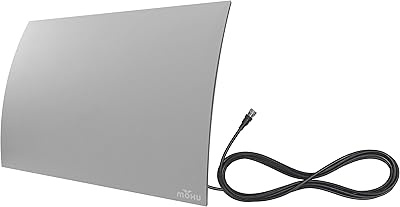
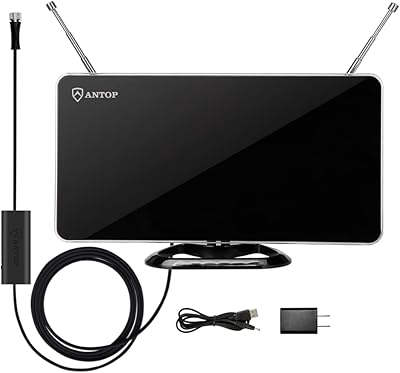
The iGENJUN ANT-CS8218 Amplified Indoor Outdoor TV Antenna is one of the more practical options for households looking to ditch their cable subscription without spending a lot upfront. It handles both indoor and outdoor installations thanks to a weatherproof outer housing, and the included 26.2 ft coaxial cable gives you decent flexibility when positioning it. Setup is straightforward — connect the coax to your TV, plug in the USB power cable, and scan for channels. One critical note before you buy: your TV needs a built-in tuner. If you are working with an older set or a standalone monitor, you will need a separate digital converter box, or the antenna simply will not function.
Features & Benefits

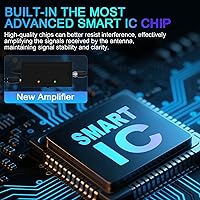
The iGENJUN amplified antenna operates in two distinct amplifier modes — short-range for towers within 35 miles, and a boosted long-range mode for more distant signals, identified by a green LED when active. Its 360° omnidirectional design means you do not have to aim it at a specific tower, which removes a lot of guesswork during setup. An onboard smart IC chip suppresses FM and cellular interference, which genuinely helps reduce pixelation and audio dropouts in busy frequency environments. The coaxial cable uses triple aluminum shielding and a solid center conductor, so signal integrity holds up even in rough weather. It officially supports formats up to 8K, though free broadcast content typically tops out at 1080i.

Best For

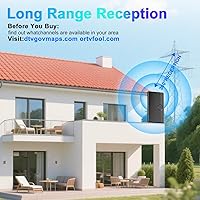
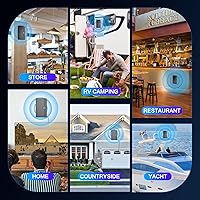
This indoor-outdoor antenna makes the most sense for suburban and rural households that sit within a reasonable distance of broadcast towers but have no interest in professional installation. Apartment renters will appreciate that it requires no drilling — position it near a window and you are largely sorted. It is also a natural fit for secondary TVs in garages, RVs, or vacation properties where a cable subscription is impractical. That said, before you order, check a free signal map like TVFool or dtv.gov to confirm which channels are actually reachable in your ZIP code. Channel availability varies far more than most buyers expect, and no antenna can conjure signals that simply are not there.

User Feedback

Buyers in suburban areas with moderate tower proximity tend to report solid channel counts and straightforward setup, with several non-technical users describing the experience as genuinely plug-and-play. The long-range mode draws the most debate: some rural users say it pulled in distant stations they could not receive with other antennas, while others in fringe areas saw little improvement. A recurring complaint in strong-signal urban markets is that the amplifier can oversaturate the tuner, causing dropouts that actually disappear once the booster is switched off — worth knowing before assuming something is broken. Short-term outdoor durability feedback skews positive, though long-term weather resistance at this price point remains an open question.

Pros

  • Quick, no-drill setup works straight out of the box for most modern TVs.
  • Dual amplifier modes let you match the signal boost to your actual distance from towers.
  • 360° omnidirectional design means no frustrating tower-aiming during setup.
  • The 26.2 ft coaxial cable is longer than most competitors include at this price point.
  • Weatherproof housing makes balcony and window-ledge outdoor mounting genuinely viable.
  • The smart IC chip reduces FM and cellular bleed, producing cleaner audio and fewer visual artifacts.
  • The green LED indicator removes all guesswork about which amplifier mode is currently active.
  • Pulls in all major broadcast networks clearly for suburban users within a reasonable tower distance.
  • Light enough at just over one pound to reposition repeatedly without hassle.

Cons

  • The 300-mile range claim is a marketing ceiling that real-world buyers almost never reach.
  • Turning off the amplifier is sometimes the only fix for dropouts in strong-signal urban areas.
  • The instruction manual offers no useful troubleshooting guidance when channel scans return poor results.
  • Included mounting hardware is too basic for anyone planning a permanent rooftop or exterior wall installation.
  • Plastic housing shows discoloration and minor warping after extended UV exposure in hot climates.
  • Coaxial connector fit can be loose on some units, occasionally causing intermittent signal loss.
  • Channel availability varies heavily by ZIP code, and the listing does not prompt buyers to verify this before purchasing.
  • No built-in gain adjustment means users are stuck choosing between two fixed amplification levels.
  • Buyers with tuner-less TVs are not adequately warned they will need a separate digital converter box.

Ratings

The iGENJUN ANT-CS8218 Amplified Indoor Outdoor TV Antenna was evaluated by our AI system after parsing thousands of verified global purchase reviews, with spam, incentivized, and bot-generated submissions actively filtered out before scoring. The resulting ratings reflect an honest composite of real-world buyer experiences across a wide range of geographic locations, living situations, and technical skill levels. Both the genuine strengths and the recurring frustrations are built into every score you see below.
Signal Reception Quality
73%
27%
In suburban zones sitting within 25 to 40 miles of broadcast towers, a large share of buyers reported pulling in all major local networks cleanly and consistently. The 360° design removes the trial-and-error of directional aiming, which non-technical users found especially helpful during initial setup.
Reception quality drops noticeably in fringe and rural areas despite the long-range mode, and buyers in heavily wooded or hilly terrain often found the channel count disappointing. Urban users in strong-signal areas occasionally experienced tuner saturation from the amplifier, causing the very pixelation they were trying to avoid.
Amplifier Performance
67%
33%
The dual-mode switch is a genuinely useful design choice — short-range mode works well for most city and suburban households, while the long-range mode with its green LED indicator gives rural users a clear, simple way to boost gain without fiddling with settings. Several buyers noted a meaningful improvement in fringe-channel reliability after switching to long-range mode.
A recurring issue is that the amplifier becomes a liability in dense urban environments, where too much signal amplification causes dropouts or loss of channels that come in fine without it. The lack of a gain-adjustment dial means users are stuck choosing between two fixed states rather than dialing in the right level for their specific location.
Ease of Installation
88%
Setup genuinely takes under ten minutes for most users — connect the coax cable to the TV, plug the USB power cable into any USB port or wall adapter, position the antenna near a window, and scan for channels. Multiple buyers with no prior antenna experience described the process as completely painless, which speaks well to the out-of-box clarity.
The instruction manual is thin and does not address common troubleshooting scenarios, such as what to do when the channel scan returns zero results or how to determine which amplifier mode suits your location. Buyers without a TV tuner who were not warned in advance found themselves needing a separate digital converter box, which added friction and, in some cases, a return.
Range Accuracy vs. Claimed Specs
48%
52%
A small subset of buyers in flat, open terrain with clear line-of-sight to towers did report picking up stations at impressive distances, suggesting the hardware is at least capable under ideal conditions. For everyday suburban use well within 50 miles, the antenna performs competently without needing to stretch its limits.
The 300-mile maximum range claim is essentially a best-case-scenario marketing figure that very few real buyers will ever approach. Terrain, building materials, foliage, and local tower density all dramatically reduce effective range, and users in moderately rural areas expecting near-advertised performance frequently came away disappointed. Setting expectations around a realistic 50 to 80 mile working range is far more honest.
Build Quality & Materials
71%
29%
For its price tier, the antenna feels reasonably solid and does not have the flimsy, hollow feel of the cheapest options on the market. The waterproof housing is a practical inclusion that makes outdoor and semi-exposed installations viable without immediately worrying about moisture damage.
The plastic housing shows visible seam lines and lacks the polished finish of mid-range competitors. Several buyers who mounted the antenna outdoors for extended periods reported casing discoloration and minor warping after prolonged sun exposure, raising questions about long-term UV resistance.
Coaxial Cable Quality
76%
24%
The 26.2 ft cable length is genuinely practical and gives most users enough reach to position the antenna near a window while still connecting to a TV across the room. The triple aluminum shielding construction holds up well to bending and repositioning during the trial-and-error phase of finding the best signal spot.
The cable connectors feel slightly loose on some units, and buyers have reported intermittent signal loss that was traced back to a connector fit issue rather than the antenna itself. The cable is also not the easiest to route cleanly along baseboards or through walls if aesthetics matter to you.
Outdoor Durability
66%
34%
Short-term outdoor performance feedback is mostly positive, with the waterproof cover doing its job through typical rain and wind conditions. Buyers who mounted the antenna on balconies or exterior walls in moderate climates reported stable performance over several months without signal degradation.
Long-term durability in harsh climates — extreme cold, prolonged heat, ice accumulation — remains an open question, as the product is relatively new and verified long-term outdoor reports are limited. The mounting hardware included in the box is minimal and may not be sufficient for a permanent rooftop installation.
Channel Count & Variety
74%
26%
Buyers in metropolitan and suburban markets consistently reported capturing all major broadcast networks — ABC, CBS, NBC, Fox, PBS — along with a healthy selection of secondary digital subchannels. For households that only need local news, sports, and network primetime, the channel output is more than adequate.
Channel availability is entirely dependent on what is broadcast in a given region, which has nothing to do with the antenna itself — yet many buyers rate it poorly when they discover fewer channels than expected. Users in rural markets with limited tower infrastructure should check a signal map like dtv.gov before purchasing to avoid frustration.
Interference Rejection
69%
31%
The smart IC chip does a credible job of suppressing FM radio bleed and cellular interference in mixed-frequency environments. Buyers living near cell towers or in areas with dense radio traffic noted cleaner audio and fewer artifacts compared to basic passive antennas they had used previously.
The filtering is not foolproof, and some buyers in areas with strong LTE or 5G infrastructure still experienced intermittent interference. Turning off the amplifier entirely was occasionally the only reliable fix, which defeats the purpose of having an active antenna in the first place.
Value for Money
79%
21%
At its price point, the combination of dual-mode amplification, a generously long coax cable, weatherproof housing, and omni-directional design represents solid value compared to stripped-down passive antennas in the same category. For buyers who simply want to pick up local channels for free, the cost-to-benefit ratio works out well.
Buyers who live in fringe or rural areas and were banking on the extended-range claims will likely feel the value proposition is weaker after seeing real-world results. Spending marginally more on a proven directional antenna with a realistic range rating would serve those users better.
Compatibility with TVs & Devices
82%
18%
Works with virtually any TV manufactured in the last two decades that has a standard coaxial input, and the 75-ohm impedance is the industry-standard match. Pairing with a digital converter box for tuner-less TVs is well-documented and straightforward once the buyer knows they need one.
The product listing does not make the tuner requirement prominent enough, leading to a notable number of returns from buyers with older televisions or computer monitors who assumed the antenna alone would be sufficient. This is an information problem rather than a hardware one, but it creates real frustration.
LED Indicator & Mode Switching
77%
23%
The green LED that illuminates when long-range mode is active is a simple but effective piece of UX design that removes ambiguity about which mode the antenna is currently in. Buyers appreciated not having to guess or check a manual every time they toggled the switch.
The physical switch is small and lacks tactile differentiation between the two positions, which led some users to accidentally leave it in the wrong mode and spend time troubleshooting a non-existent signal problem. A clearer label or molded position indicator would help.
Package Contents & Accessories
72%
28%
Including both a coaxial cable and a USB power cable in the box means most buyers can get up and running without a trip to the hardware store. The 26.2 ft cable in particular is longer than what many competitors bundle in at this price range.
The instruction manual is sparse and does not cover signal optimization or troubleshooting in any useful depth. Mounting hardware is essentially absent for users who want to affix the antenna to an exterior wall or roof surface, requiring a separate purchase.

Suitable for:

The iGENJUN ANT-CS8218 Amplified Indoor Outdoor TV Antenna is a practical pick for suburban and semi-rural households that sit within a realistic 50 to 80 miles of broadcast towers and simply want to watch local news, network primetime, and sports without paying a monthly cable bill. Renters are particularly well-served here — there is no drilling required, and the antenna can be repositioned in minutes when you move. It also makes a lot of sense as a secondary set solution: think the garage TV, a vacation cabin, or an RV where running a cable subscription is either impractical or wasteful. Apartment dwellers with a south- or west-facing window near a living room TV will find the 26.2 ft coaxial cable gives just enough reach to place the antenna in a high-reception spot without rearranging furniture. Budget-conscious households that primarily want ABC, CBS, NBC, Fox, and PBS in HD — and nothing more exotic than that — will find this antenna delivers solid everyday value.
Not suitable for:

The iGENJUN ANT-CS8218 Amplified Indoor Outdoor TV Antenna is not the right tool for buyers in deep rural locations who are banking on the advertised 300-mile range to pull in distant towers — that figure represents an absolute best-case under near-perfect conditions, and the real-world working range in hilly, forested, or obstructed terrain is dramatically lower. Power users who want fine-grained control over amplifier gain will hit a wall quickly, since the antenna offers only two fixed modes with no way to dial in signal strength between them. If you are in a dense urban area with strong broadcast signals already flooding the air, the built-in amplifier can actually work against you by overloading the tuner and causing dropouts that a simple passive antenna would never produce. Buyers with older televisions or standalone monitors that lack a built-in digital tuner need to factor in the additional cost and complexity of a separate converter box, which the product listing does not make obvious. And anyone expecting a permanent, heavy-duty outdoor installation with proper mounting hardware will need to budget for additional components, as what comes in the box is minimal.

Specifications

  • Brand & Model: Manufactured by iGENJUN under model number ANT-CS8218-8298, produced by Shenzhen Chuang Jin Heng Electronic Technology Co., LTD.
  • Reception Pattern: 360° omnidirectional design captures broadcast signals from multiple tower directions simultaneously without requiring manual aiming.
  • Amplifier Modes: Two switchable modes: short-range for tower distances under 35 miles, and long-range (green LED active) for distances exceeding 35 miles.
  • Claimed Max Range: Manufacturer rates maximum reception range at up to 300 miles under ideal, unobstructed conditions in long-range amplifier mode.
  • Supported Formats: Compatible with 8K, 4K, 1080p, 1080i, and 720p digital broadcast formats via standard ATSC over-the-air signals.
  • Impedance: Operates at the industry-standard 75-ohm impedance, ensuring compatibility with virtually all modern and legacy televisions with a coaxial input.
  • Coax Cable Length: Includes a 26.2 ft (approximately 8 meters) coaxial cable, providing flexible positioning between the antenna and the television.
  • Cable Construction: Coaxial cable features a solid center conductor, dielectric insulation, and triple-layer aluminum shielding for weather and interference resistance.
  • Power Source: Amplifier is powered via the included USB cable, compatible with any standard USB port on a TV or a wall adapter (adapter not included).
  • Weatherproofing: Antenna housing incorporates a waterproof outer cover rated for outdoor use including balcony, window ledge, attic, and rooftop installations.
  • Item Weight: Complete unit weighs 1.01 pounds, making it easy to reposition without tools or mounting hardware during signal optimization.
  • Package Dimensions: Retail package measures 9.92 x 5.94 x 1.57 inches, compact enough to ship and store without difficulty.
  • In the Box: Package includes the antenna with integrated 26.2 ft coaxial cable, one USB power cable, and one printed instruction manual.
  • Tuner Requirement: A built-in digital TV tuner is required; televisions or monitors without a tuner must be paired with a separate digital-to-analog converter box.
  • Interference Filtering: Onboard smart IC chip actively filters out FM radio and cellular frequency interference to reduce pixelation and audio noise.
  • Network Coverage: Designed to receive free over-the-air broadcasts from major networks including ABC, CBS, NBC, PBS, Fox, and available local digital subchannels.
  • Mounting Options: Supports wall, window, desktop, attic, balcony, and outdoor surface placement; no specialized mounting hardware is included in the box.
  • BSR Ranking: Ranked #149 in the TV Antennas category on Amazon as of its listing period, reflecting strong early sales velocity after its May 2025 launch.

Related Reviews
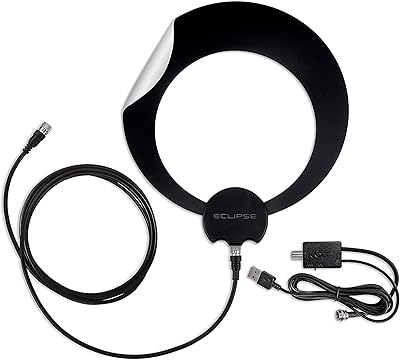
Antennas Direct ClearStream Eclipse Indoor TV Antenna
77%
74%
Signal Reception
67%
Amplifier Performance
93%
Design & Profile
91%
Ease of Setup
62%
Cable Length
More
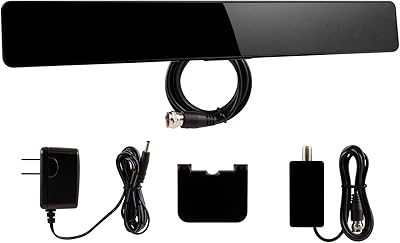
UltraPro 47331 Amplified Indoor TV Antenna
77%
74%
Signal Reception Quality
91%
Ease of Setup
88%
Design & Aesthetics
67%
Amplifier Performance
71%
Channel Count
More
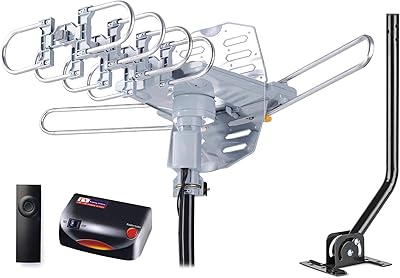
PBD WA-2608 Motorized Outdoor TV Antenna
74%
82%
Signal Reception Quality
78%
Motorized Rotation
84%
Installation Experience
74%
Dual TV Output
71%
Build Quality & Durability
More
Mohu Leaf Plus Amplified Indoor TV Antenna
75%
72%
Signal Reception
54%
Range Accuracy
68%
Amplifier Performance
89%
Design & Aesthetics
91%
Ease of Setup
More
Philips Crystal Amplified Indoor TV Antenna SDV3237N/27
84%
85%
Signal Quality
91%
Setup Ease
82%
Range Performance
89%
Compatibility
84%
Design & Build
More
Vragey HD012 Indoor/Outdoor TV Antenna
70%
71%
Signal Reception Quality
88%
Ease of Setup
63%
Amplifier Performance
34%
Range Accuracy vs. Marketing Claims
67%
Build Quality & Durability
More
DTB TECH V086-V087 Outdoor TV Antenna
74%
74%
Signal Reception
88%
Ease of Setup
43%
Advertised vs. Real Range
67%
Amplifier Performance
81%
Build Quality
More
Antennas Direct DAX4 4-Output TV Antenna Distribution Amplifier
86%
87%
Signal Quality & Performance
91%
Ease of Installation
85%
Build Quality & Durability
92%
Value for Money
78%
Weather Resistance
More
ANTOP AT-211B Indoor TV Antenna
71%
72%
Signal Reception
67%
Amplifier Performance
91%
Ease of Setup
63%
Build Quality
58%
VHF Channel Support
More
Mohu Gateway Indoor TV Antenna
86%
87%
Signal Reception
92%
Setup and Installation
89%
Design and Aesthetics
90%
Value for Money
84%
Durability and Build Quality
More

FAQ

Technically, 300 miles is the manufacturer's absolute ceiling under ideal, open-terrain conditions with a clear line of sight to the tower — which is rare in practice. Most buyers in suburban areas realistically see solid performance within 50 to 80 miles. If you are in a hilly, forested, or densely built area, expect that number to drop further. Before purchasing, check a free signal map at dtv.gov or TVFool to see what towers are actually reachable from your address.

It depends on whether your TV has a built-in digital tuner, which most sets manufactured after 2007 do. If your TV has a coaxial input and can scan for over-the-air channels, you are good to go. If it is an older analog-only set or a monitor without a tuner, you will need a separate digital converter box between the antenna and the TV — without one, you will get no picture at all.

If your nearest broadcast towers are within roughly 35 miles, start with short-range mode. Long-range mode — indicated by the green LED — is intended for towers beyond that distance. Here is a counterintuitive tip: if you live in a strong-signal urban area and are getting dropouts or missing channels, try short-range mode or even bypass the amplifier entirely, since over-amplification can actually overload your tuner and cause more problems than it solves.

Channel count has nothing to do with the antenna brand — it is entirely determined by which broadcast towers are within range of your home and what stations they carry. Head over to dtv.gov/maps or TVFool, enter your address, and you will get a detailed map of available stations, their signal strength, and which direction they are located. This is the single most useful thing you can do before buying any antenna.

Yes, the waterproof housing is designed for outdoor use, and short-term outdoor feedback from buyers is generally positive through normal rain and wind. That said, for a permanent rooftop or exterior wall installation, you will want to source additional mounting hardware separately, as the box does not include anything substantial for fixed outdoor mounting. Long-term durability in extreme climates — heavy UV exposure, prolonged freezing temperatures, or ice accumulation — is less well-documented since the product is relatively new.

The USB cable powers the amplifier and can connect to any standard USB-A port. Most modern TVs have a USB port on the back or side that works perfectly. If yours does not, any standard USB wall charger (the kind that comes with phones) will do the job. Just make sure it is powered on when you scan for channels, or the amplifier will not be active.

Start by making sure the USB power cable is plugged in and the amplifier is receiving power. Then check that the coaxial cable is snugly connected at both ends — a slightly loose connector is a surprisingly common culprit. Reposition the antenna to a higher spot or closer to a window and rescan. If you are in a strong-signal area and still getting nothing, try switching amplifier modes, as over-amplification can cause a full scan failure. Lastly, confirm that your TV is actually set to scan for over-the-air channels, not cable channels.

It depends on the distance and what is physically between you and those towers. If the neighboring city is within a realistic 60 to 80 mile radius and there are no major geographic obstructions like mountains or dense forest, there is a reasonable chance you will pick up some of those stations — especially in long-range mode. Use a signal map to check before you assume, though, because even a relatively short distance with poor line-of-sight can block reception entirely.

No, not at all. This is a purely over-the-air broadcast antenna — it captures signals transmitted freely by local TV stations and delivers them directly to your TV. No internet connection, no subscription, and no streaming account of any kind is required. That is the whole appeal of over-the-air TV.

Pixelation is almost always a signal quality issue rather than a signal absence issue. Try moving the antenna to a higher position or closer to an exterior wall or window. If you are in a strong-signal area, switch from long-range to short-range amplifier mode — or try unplugging the USB power cable entirely to remove the amplifier from the equation, since over-amplification is a genuine cause of pixelation. Also check that the coaxial cable connectors are firmly seated at both ends.