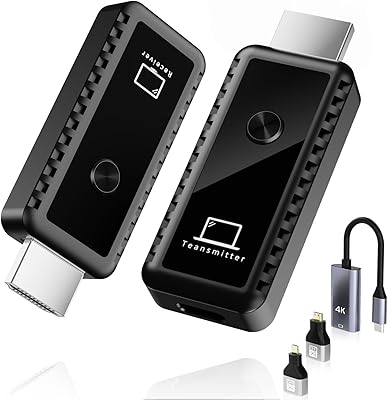
Overview

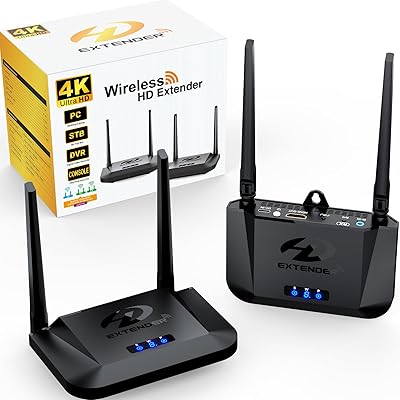
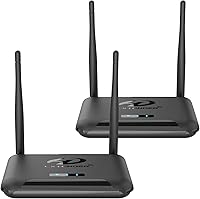
The PAKITE BIN-850 Wireless HDMI Transmitter Receiver is a mid-range kit built around one practical idea: broadcast a single video source to up to four screens in different rooms without running a single cable. Unlike the compact USB-dongle senders that flood the budget market, this wireless HDMI kit uses a proper set-top-box-style chassis with two external antennas and a dual-band 2.4/5.8GHz radio, which makes a real difference for signal consistency. A built-in HDMI loop-out port lets the source room keep its own connected display — no splitter required. One important caveat up front: range drops sharply through walls, and the device tops out at 1080p 60Hz, not 4K.
Features & Benefits

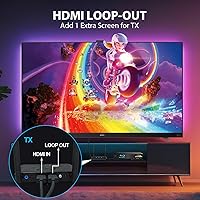
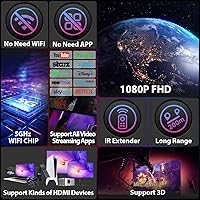
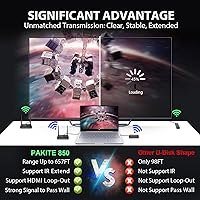
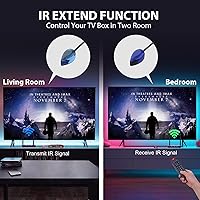
The dual external antennas and dual-band chip are what separate this multi-room HDMI sender from cheaper dongle-style alternatives — sustained playback stays stable where a single-band stick would stutter. The HDMI loop-out on the transmitter is genuinely useful: plug in your cable box, keep one display locally connected, and push the signal to up to three additional receivers at the same time. The IR remote extender is a quiet but practical touch — point your original remote at the bedroom receiver and it controls the set-top box sitting in the living room. One compatibility note worth knowing before buying: the device only supports progressive-scan signals, so if your cable box outputs 1080i, you will need to change that setting first.

Best For

This wireless HDMI kit makes the most sense for households wanting to share a single cable or satellite box across multiple rooms without calling an electrician. It also suits small offices or retail environments where a laptop or PC needs to mirror to several displays at once. The loop-out port makes it especially practical for anyone who needs a working screen at the source while simultaneously feeding remote TVs. Outbuildings, workshops, and farm setups where cable runs are impractical are another strong use case, provided walls between transmitter and receiver are minimal. Anyone relying on IR remote passthrough from a distant room will find genuine everyday value here as well.

User Feedback

Buyers consistently highlight how straightforward the initial setup is, with most reporting they were up and running within minutes. Open-plan installs earn particularly strong marks for reliability, and the 365-day replacement policy comes up often as a confidence-builder for a lesser-known brand. On the downside, through-wall range is a recurring complaint — real-world performance lands well short of the open-field maximum, so buyers in multi-story homes should temper expectations. A handful of users also note a slight latency, making this a poor fit for gaming or fast-action sports viewing. The 1080i incompatibility catches people off guard too, especially those with older satellite or cable boxes lacking a simple output format toggle.

Pros

  • Setup takes minutes — most users are up and running without any technical background or manual digging.
  • The dual-band radio noticeably outperforms cheaper single-antenna dongle senders in busy wireless environments.
  • One source feeds up to four TVs simultaneously, covering a whole home without a single cable run.
  • The HDMI loop-out keeps the source room's display fully functional while broadcasting wirelessly to other rooms.
  • IR remote passthrough lets you control your living room STB from another room using the original remote.
  • The set-top-box chassis dissipates heat effectively, making long daily viewing sessions reliable and stable.
  • A 365-day free replacement policy adds meaningful confidence when buying from a lesser-known brand.
  • Open-plan and single-story installs consistently earn high marks for signal consistency and picture clarity.
  • All receivers stay in sync with no perceptible desync between screens during simultaneous playback.
  • Outbuildings, garages, and workshops benefit from the wireless range where cabling is simply not an option.

Cons

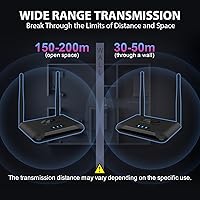
  • Through-wall range drops sharply — expect roughly 40 to 50 feet through standard drywall, not hundreds.
  • Older cable or satellite boxes that output 1080i by default will produce a black screen out of the box.
  • Latency is noticeable enough to make gaming and fast-action live sports a frustrating experience.
  • The IR extender is useless if your provider has already transitioned to Bluetooth-based remote controls.
  • No independent channel control per receiver — every connected screen mirrors the exact same content.
  • Printed documentation is thin and skips key setup details, particularly around IR extender installation.
  • Customer support response times appear inconsistent, making the warranty feel less reliable in practice.
  • The receiver units feel noticeably lighter and cheaper than the transmitter, raising long-term durability questions.
  • Four-receiver simultaneous pairing occasionally requires a transmitter restart to stabilize on first connection.
  • Buyers future-proofing for 4K content will outgrow this kit sooner than the price point might suggest.

Ratings

The scores below reflect an AI-driven analysis of verified buyer reviews collected worldwide for the PAKITE BIN-850 Wireless HDMI Transmitter Receiver, with spam, incentivized, and bot-generated submissions actively filtered out before scoring. Each category captures what real users praised and what genuinely frustrated them, so the numbers tell an honest story rather than a polished one. Strengths like multi-room flexibility and setup simplicity score alongside harder truths about wall penetration and compatibility gaps.

Ease of Setup
88%
Most buyers report being fully operational within five to ten minutes of unboxing — just plug the transmitter into the source, connect receivers to each TV, and the signal pairs automatically. Users with no technical background specifically called out how little guesswork was involved compared to network-based streaming alternatives.
A small portion of users encountered pairing issues when all four receivers were connected simultaneously, requiring a transmitter restart to stabilize. The included instruction sheet is sparse, which caused brief confusion for those unfamiliar with IR extender wiring.
Signal Stability
79%
21%
In open-plan living spaces — a large lounge feeding a kitchen island display, for example — users consistently describe the signal as rock-solid with no stuttering during multi-hour viewing sessions. The dual-band radio does appear to reduce the dropouts that plague cheaper single-antenna senders in congested Wi-Fi environments.
Stability drops noticeably once a solid wall sits between transmitter and receiver, with some users reporting occasional freezes at distances beyond roughly 40 feet through standard drywall. Homes with concrete or brick internal walls present an even steeper challenge, and a handful of buyers felt the marketing range figures set unrealistic expectations.
Through-Wall Range
58%
42%
For single-story homes with one partition wall between the transmitter and a receiver, most users report workable performance — adequate for a bedroom TV fed from a living room cable box, which is exactly the primary use case. Positioning the receiver near the doorway rather than against the far wall makes a measurable difference.
The 200-meter open-field figure is essentially a laboratory best case that has little bearing on real home installations. Through a single standard wall, effective range narrows to around 50 feet for most buyers, and multi-wall or multi-floor setups regularly disappointed users who took the headline number at face value.
Video Quality
83%
At 1080p 60Hz in a clean line-of-sight setup, users describe the picture as crisp and color-accurate with no visible compression artifacts during normal TV viewing or laptop presentations. For the intended use case of sharing cable TV or mirroring a PC screen, the output quality consistently meets expectations.
The hard ceiling of 1080p rules this kit out for anyone with a 4K source and 4K displays, which is a legitimate gap as 4K content becomes the norm. A few users also noticed very slight softening compared to a direct HDMI cable connection, though most considered it negligible for non-critical viewing.
1080i Compatibility
41%
59%
Users who caught the progressive-scan-only limitation before purchasing had no complaints — simply switching their cable or satellite box output to 1080p resolved the issue entirely, and the picture performed as expected afterward. The workaround is straightforward when you know it is needed.
This is the single most common source of negative reviews. Many buyers with legacy satellite or cable boxes discovered their hardware outputs 1080i by default, resulting in a black screen on arrival. The incompatibility is not prominently flagged during purchase, and older STBs sometimes lack the output format option to switch, making the kit entirely unusable for that setup.
HDMI Loop-Out
91%
The loop-out port on the transmitter is a genuinely practical design decision that users appreciate once they realize what it enables — the TV in the room where the cable box lives continues working normally while the wireless signal simultaneously feeds other rooms. No splitter purchase, no extra adapter, no signal degradation on the local screen.
The loop-out output is limited to the same 1080p ceiling as the wireless feed, so users hoping to keep a 4K-capable local display running at full resolution while broadcasting wirelessly will be disappointed. It is also easy to overlook during setup, meaning some buyers initially left the local TV disconnected unnecessarily.
IR Remote Extender
82%
18%
For the specific problem it solves — controlling a set-top box in the lounge from a bedroom remote — the IR extender works reliably and feels natural in daily use. Users in multi-room setups particularly appreciated not needing a separate IR blaster kit or smart-home workaround to change channels from another room.
The extender only works with standard infrared remotes, so anyone whose cable provider has migrated to Bluetooth-based remotes will find this feature completely non-functional. A few users also reported needing careful aiming alignment when the receiver IR emitter was not perfectly positioned near the source device's sensor window.
Multi-Room Flexibility
86%
The ability to push one source to up to four independent receivers is a strong differentiator for the price tier, and users running three or four screens simultaneously — living room, bedroom, kitchen, and a home gym — report that all displays stay in sync without any perceptible desync between screens.
All receivers show the same content at all times; there is no independent channel control per screen, which is an important limitation for households where different family members want to watch different content in different rooms. This is fundamentally a signal distribution tool, not a multi-zone independent streaming system.
Build Quality & Heat Management
74%
26%
The set-top-box form factor feels meaningfully more substantial than the USB-dongle alternatives, and the larger chassis gives the internals enough surface area to dissipate heat passively during extended use. Users running the kit for four or more consecutive hours noted it gets warm but never alarmingly hot.
The plastic housing feels mid-grade rather than premium, and a few buyers questioned long-term durability given how warm the unit runs in poorly ventilated media cabinet setups. The receiver units in particular feel lighter and flimsier than the transmitter, which some users found underwhelming for the overall kit price.
Latency
63%
37%
For passive content like streaming video, cable TV, or static presentations, the latency is low enough that most users never notice it. In a straightforward living-room-to-bedroom cable TV distribution setup, the slight delay is comparable to what you would experience switching inputs on a smart TV.
Anyone hoping to use this kit for gaming or fast-paced live sports will likely notice the lag. Multiple buyers flagged it as too pronounced for interactive gaming, and even live sports viewers occasionally noted a distracting offset when audio from a nearby room bled in. This is not the right tool for latency-sensitive applications.
Value for Money
77%
23%
For the specific task of wirelessly distributing a single HDMI source to multiple rooms without cabling work, the kit offers a reasonable return on investment compared to hiring an installer or buying a purpose-built AV distribution system. The HDMI loop-out and IR extender add genuine utility that comparable cheaper kits omit.
Buyers who encountered the 1080i incompatibility or overestimated the wall-penetration range felt the price was hard to justify after the fact. Compared to newer wireless HDMI options creeping into the same price bracket with 4K support, this kit starts to look like a compromise, particularly for buyers future-proofing their home setup.
Warranty & Customer Support
84%
The 365-day free replacement policy resonated strongly with buyers who were taking a chance on a less established brand. Several users specifically mentioned that a hassle-free replacement process following an early defect restored their confidence and resulted in an updated positive review.
Customer support responsiveness appears inconsistent based on user accounts, with some reporting swift resolution and others describing delayed or template-style replies. The support experience seems to vary significantly depending on region and purchase channel, which makes the warranty strength feel less predictable than the policy language implies.
Package Contents & Documentation
66%
34%
The kit ships with all the physical hardware needed to get started — transmitter, receivers, antennas, and power adapters — so most buyers do not need to source additional accessories for a basic installation. Users who read the documentation carefully before connecting reported a smooth experience.
The printed documentation is thin and omits several useful setup details, particularly around the IR extender wiring and the 1080i incompatibility. Buyers who rely on quick-start guides rather than online research are more likely to hit avoidable setup errors, and there is no QR code or link to a detailed online manual in the box.

Suitable for:

The PAKITE BIN-850 Wireless HDMI Transmitter Receiver is a strong fit for households that want to share a single cable or satellite box across multiple rooms without touching a wall or hiring an installer. If your setup involves a 1080p source device outputting a progressive-scan signal and you need that content to reach two, three, or four TVs simultaneously, this kit handles the job cleanly. The HDMI loop-out is a particular advantage for anyone who wants the source room's TV to keep working normally while the signal broadcasts elsewhere — no splitter, no extra hardware. Small offices and retail environments where a laptop or presentation PC needs to feed several displays at once will also find this multi-room HDMI sender practical and easy to deploy. It works well in single-story open-plan spaces, outbuildings, workshops, or any environment where running a physical cable is genuinely impractical. Users who rely on a standard infrared remote and need to control their source device from a different room will appreciate the built-in IR extender working quietly in the background.

Not suitable for:

Buyers with 4K displays and 4K source content should look elsewhere — the PAKITE BIN-850 Wireless HDMI Transmitter Receiver tops out at 1080p 60Hz, and that ceiling is fixed regardless of what you plug into it. If your cable or satellite box outputs 1080i by default and lacks a setting to switch to 1080p progressive scan, this kit will not display a picture at all, which is a hard dealbreaker for a segment of legacy STB users. Anyone expecting to use this wireless HDMI kit for gaming or live interactive content should also reconsider, as the latency is noticeable enough to undermine those use cases meaningfully. Multi-floor homes with concrete or brick walls between floors will likely see signal quality fall well below what the headline range figure suggests — real-world through-wall performance is considerably more limited than open-field testing implies. If each room in your home needs independent channel control rather than a mirror of the same source, this distribution-style system is fundamentally the wrong tool. Finally, users whose cable providers have switched entirely to Bluetooth-based remotes will get no benefit from the IR extender feature.
Specifications

  • Brand: Manufactured by PAKITE under the model designation BIN-850-Global.
  • Form Factor: Set-top-box style chassis for both transmitter and receiver units, not a USB dongle design.
  • Dimensions: Each unit measures approximately 3.19 x 4.72 x 3.94 inches, providing a compact desktop footprint.
  • Weight: The kit weighs 7 ounces, making individual units light enough to mount or reposition easily.
  • Resolution: Supports 1080p at 60Hz progressive scan only; interlaced resolutions such as 1080i are not supported.
  • Wireless Bands: Uses a dual-band 2.4GHz and 5.8GHz Wi-Fi chip to reduce interference and improve signal consistency.
  • Antennas: The transmitter is equipped with two external antennas to extend range and strengthen signal stability.
  • TX to RX Config: One transmitter can connect to and distribute a signal to up to four receivers simultaneously.
  • Open-Field Range: Maximum transmission distance is approximately 200 meters in open, unobstructed environments.
  • Through-Wall Range: Effective range drops to approximately 50 meters when one standard wall separates the transmitter and receiver.
  • HDMI Loop-Out: The transmitter includes a dedicated HDMI loop-out port allowing a local display to remain connected at the source.
  • IR Extender: An infrared remote extender is included, enabling control of a source device from a remote room using a standard IR remote.
  • Remote Type: The IR extender is compatible with standard infrared remotes only; Bluetooth-based remotes are not supported.
  • Output Wattage: Each unit operates at 5 watts, keeping power consumption low during extended use.
  • Connectivity: All connections use standard HDMI ports; no proprietary cable types or adapters are required for basic installation.
  • Heat Dissipation: The larger chassis surface area enables passive cooling, reducing the risk of thermal throttling during prolonged sessions.
  • Warranty: PAKITE backs this kit with a 365-day free replacement policy for non-artificial damage and a 30-day no-questions return window.
  • Availability Date: This product was first made available for purchase in May 2024.

Related Reviews

Graige BIN-952 Wireless HDMI Transmitter Receiver

78%
88%
Ease of Setup
84%
Signal Stability
79%
Video Quality
81%
Transmission Range
86%
Multi-Room Distribution
More
DxInvb Wireless HDMI Transmitter and Receiver Kit
75%
91%
Ease of Setup
58%
Device Compatibility
74%
Wireless Range & Stability
69%
Video Quality
83%
Build Quality & Portability
More
TTQ TR60 Wireless HDMI Transmitter and Receiver
79%
93%
Ease of Setup
78%
Signal Stability
86%
Video & Image Quality
81%
Latency Performance
88%
Build Quality & Materials
More
BRAIDOL TR50 Wireless HDMI Transmitter and Receiver
85%
91%
Performance & Connectivity
89%
Video Quality (4K/1080P)
95%
Ease of Use & Setup
88%
Signal Range (30m)
86%
Portability & Design
More
LZLOO Wireless HDMI Transmitter and Receiver
77%
91%
Ease of Setup
74%
Signal Stability
68%
Wireless Range
77%
Video Output Quality
71%
Latency Performance
More
MpioLife Wireless HDMI Kit V6
74%
91%
Ease of Setup
78%
Wireless Range (Open Space)
47%
Through-Wall Performance
83%
Video Quality
69%
Latency & Responsiveness
More
Weeryyi Wireless HDMI Transmitter and Receiver 1080p
84%
92%
Value for Money
88%
Transmission Range
91%
Ease of Setup
89%
Video Quality
85%
Multi-Screen Support
More
WELUSOPU 1TX+2RX Wireless HDMI Extender Kit
74%
88%
Ease of Setup
74%
Wireless Range
67%
Video Output Quality
79%
Multi-Receiver Sync
81%
Latency Performance
More
TPUFO G02 Wireless HDMI Transmitter and Receiver
77%
91%
Ease of Setup
78%
Signal Stability
83%
Video & Image Quality
74%
Transmission Range
87%
Latency Performance
More
IOGEAR GWHD11
IOGEAR GWHD11
75%
72%
Signal Stability
84%
Video Quality
61%
Wireless Range
91%
Setup & Ease of Use
83%
Audio Performance
More

FAQ

Unfortunately, no. This wireless HDMI kit only supports progressive-scan signals, so a cable or satellite box locked to 1080i output will result in a blank screen. Before buying, check your set-top box settings menu — many modern boxes let you manually switch the output to 1080p. If yours does not have that option, this kit will not be compatible with your setup.

No, that is not how this system works. Every receiver mirrors the exact same content from the single transmitter source simultaneously. If you need different rooms to watch different channels independently, you would need a separate source device per room — this kit is designed for signal distribution, not multi-zone independent streaming.

Yes, exactly. The HDMI loop-out port on the transmitter lets you keep a display connected right at the source, so your living room TV continues working exactly as before. Meanwhile, the wireless signal broadcasts to receivers in other rooms at the same time, with no splitter or extra equipment needed.

In a completely open outdoor space with no obstructions, yes — but inside a home, expect significantly less. Through a single standard drywall partition, practical range is closer to 40 to 50 feet for most users. Concrete, brick, or multiple walls between the transmitter and a receiver will reduce that further. Position receivers as close to a direct line-of-sight path as your home layout allows.

Yes, as long as your laptop or PC has an HDMI output port, you can connect it to the transmitter and broadcast the display wirelessly to up to four screens. This makes it practical for office presentations or mirroring a workstation to displays in multiple areas of a room or building.

Not exactly — the IR extender is designed to pass your remote signal back to the source device, not to control the TV itself. Point your standard infrared remote at the receiver unit in the remote room, and the extender relays that signal to the set-top box at the transmitter end. Just keep in mind this only works with traditional infrared remotes, not Bluetooth ones.

Yes, all connected receivers stay in sync with each other during normal operation. The slight latency inherent in the wireless transmission affects all screens equally, so you will not notice one room being ahead of another — they all mirror the source with the same minimal delay.

There is a small but perceptible latency in the wireless transmission. For passive viewing like movies or cable TV, most users find it acceptable. However, for gaming or fast-moving live sports — especially if sound from a nearby room bleeds in — the delay is noticeable enough to be bothersome. This kit is better suited for non-interactive viewing scenarios.

You can absolutely use just one receiver if that is all you need — the kit works fine in a simple one-transmitter-to-one-receiver configuration. You can add receivers later up to the four-unit maximum without any special reconfiguration, so starting small and expanding is a practical option.

The units do get noticeably warm after a few hours, which is expected given that passive cooling relies on the chassis surface rather than a fan. Most users report the heat stays within a safe, manageable range during all-day use, but placing the units in an enclosed media cabinet with poor airflow is not recommended. Keeping them in an open, ventilated spot helps maintain consistent performance over time.