Overview

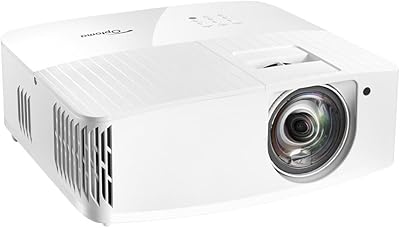
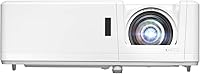
The Optoma GT1090HDR Short Throw Laser Projector arrived in 2020 as a serious option for home theater fans who don't have the luxury of a dedicated screening room. Unlike ultra-short-throw models that sit inches from the wall, or conventional long-throw projectors that need twelve-plus feet of clearance, this short-throw laser projector lands in a practical middle ground that suits real homes. It outputs native 1080p — critical to understand upfront — while accepting 4K HDR input from modern players and consoles. What truly sets this Optoma unit apart from bulb-based competitors is its laser light source, which quietly rewrites the long-term cost-of-ownership story.
Features & Benefits

The throw distance alone is enough to grab attention: the GT1090HDR can fill a 120-inch screen from roughly 4.3 feet away, meaning it can sit on a coffee table, a shelf, or just behind a couch without crowding the space. Paired with 4,200 lumens of output, it handles ambient light far better than most projectors in this category — you're not hunting for blackout curtains just to watch a movie. HDR10 and HLG support via HDMI 2.0 adds visible depth to contrast and color in compatible content. The auto keystone and four-corner correction make installation forgiving and fast, and the IPX6-rated optical engine adds genuine durability for less-than-ideal environments.

Best For

This short-throw laser projector makes most sense for people who want a cinematic image without rearranging their home around it. Apartment renters, living-room viewers, and anyone putting a projector in a spare bedroom will appreciate that placement is flexible in a way that long-throw units simply aren't. Gamers benefit from the same short-throw advantage — no need for a specially designed room or a ceiling mount. It holds up well outdoors too, whether that means a backyard screen setup or packing it for a camping trip. And for buyers still dealing with lamp burnouts in an older unit, the maintenance-free laser design is a genuine reason to upgrade.

User Feedback

Owners consistently highlight the brightness as a standout real-world strength — many report it holds up in rooms with open blinds, which is genuinely unusual at this throw distance. The placement flexibility also draws frequent praise, particularly from buyers who tried and abandoned long-throw setups. That said, the fan noise at full brightness is a legitimate gripe worth knowing about in advance; it's not distracting during loud action sequences, but quieter scenes can expose it. The native 1080p reality also needs spelling out: the image is crisp and detailed, but buyers expecting true 4K output will be let down. On price, opinions split — those who've replaced projector bulbs before tend to see the long-term value clearly; newcomers sometimes balk at the upfront cost.

Pros

  • Projects a 120-inch image from around 4 feet away, making large-screen viewing practical in genuinely small rooms.
  • At 4,200 lumens, it holds its own in lit rooms where most projectors visibly wash out.
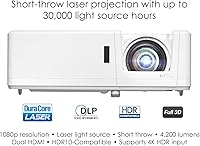
  • The laser light source is rated for 30,000 hours — no bulbs to track down, no unplanned mid-movie replacements.
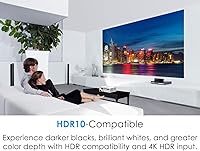
  • HDR10 and HLG support via HDMI 2.0 produces noticeably richer contrast and color from compatible sources.
  • Auto keystone and four-corner correction make first-time setup fast, even for non-technical users.
  • IPX6-rated optical engine provides dust resistance that conventional lamp-based projectors simply don't offer.
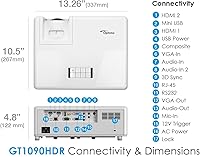
  • Broad connectivity — including dual HDMI, VGA, Composite, USB-A, and audio I/O — covers virtually any source device.
  • Handles outdoor use well; brightness and a reasonably compact build suit backyard and on-the-go setups.

Cons

  • Fan noise at high brightness settings is audible enough to surface during quiet scenes or late-night viewing.
  • Native output is 1080p, not true 4K — buyers expecting genuine 4K sharpness will be let down.
  • The upfront cost is steep; buyers who only watch in darkened rooms may struggle to justify the laser premium.
  • No built-in smart TV platform means a separate streaming dongle is required to access Netflix, Disney+, or similar services.
  • At 10 pounds, it is portable but not ultralight — frequent travelers and backpackers will feel the difference.
  • Color accuracy may not satisfy critical or calibrated viewing compared to dedicated high-end home cinema projectors.
  • No lens shift restricts image positioning flexibility compared to projectors with full optical adjustment options.

Ratings

The Optoma GT1090HDR Short Throw Laser Projector has been evaluated by verified owners across global markets, and the category scores below are AI-generated from that worldwide review data — with spam, detected bot activity, and incentivized submissions actively filtered out before scoring. The results represent the honest consensus of real buyers, with genuine strengths and recurring pain points both weighted into the final numbers.
Brightness & Ambient Light Performance
89%
With 4,200 lumens, this short-throw laser projector genuinely delivers in rooms that never go fully dark — something most projector owners never experience. Families watching with afternoon light through the blinds report a visible, vibrant image without needing blackout curtains. It outperforms nearly every lamp-based rival at this throw distance in real-world lit conditions.
In a fully sunlit room with direct window glare, the image does wash out noticeably, as it would with any non-laser-TV display. At peak brightness, the fan noise increases alongside the output, which creates a minor trade-off between maximum visibility and acoustic comfort. Buyers expecting cinema-dark performance in bright midday conditions will be disappointed.
Image Quality
82%
18%
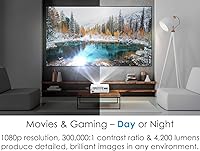
At 1080p native resolution with a 300,000:1 contrast ratio, the GT1090HDR produces genuinely sharp, detailed images from HD and Blu-ray sources. HDR10 processing adds visible depth to highlights and shadows, making streaming content look noticeably more dimensional than on a standard-lamp projector. For most living-room viewing distances, the picture holds up exceptionally well.
This is native 1080p, not true 4K — a distinction that becomes visible when sitting close to a large screen and comparing directly against a genuine 4K source. Buyers who have invested in a 4K media library will notice the downscaling. Color volume also does not reach the level of dedicated home cinema projectors at a higher price tier.
Short-Throw Convenience
93%
The ability to project a 120-inch image from roughly 4 feet is the single most praised feature in owner reviews. Apartment dwellers report placing the unit on a coffee table or bookshelf and getting a screen that fills an entire wall — something that was simply impossible with their previous long-throw setup. This is where the GT1090HDR earns its strongest marks.
At 4.3 feet, the short-throw design still requires more clearance than ultra-short-throw models, which can be placed within inches of the wall. Users in very tight studio apartments occasionally report that even this distance requires creative furniture arrangement. It is not an issue for most rooms, but it is not the most space-efficient option available in this category.
Laser Longevity & Maintenance
91%
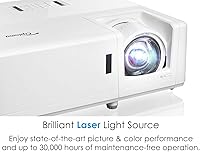
Owners who previously dealt with lamp projectors consistently cite the zero-maintenance laser as one of the GT1090HDR's most underrated advantages. No scheduled bulb replacements, no sudden mid-movie failures from a burned-out lamp, and no compatibility hunting for a discontinued part years down the line. The laser also maintains consistent brightness over time, unlike lamps that dim gradually before failing.
The 30,000-hour rating is theoretical under optimal conditions; real-world longevity may vary depending on operating environment, brightness mode settings, and ambient temperatures. If the laser module ever does degrade beyond expected timelines, repair or replacement is a specialized and potentially costly service rather than a simple self-service bulb swap. For most buyers this is a distant concern, but it exists.
Value for Money
73%
27%
Buyers who factor in the avoided cost of lamp replacements over a 7 to 10 year ownership cycle frequently conclude that the laser premium pays for itself. The combination of brightness, short-throw flexibility, and zero maintenance in a single package is difficult to replicate with cheaper alternatives that require more space or ongoing upkeep.
The upfront price is steep enough to give many buyers pause, particularly when comparable-resolution lamp projectors are available at a fraction of the cost. Shoppers who watch primarily in a dark, dedicated room — where the brightness advantage disappears — will find the value proposition harder to justify. Price-sensitive buyers and first-time projector owners frequently struggle with this trade-off.
Setup & Installation
86%
The auto keystone feature draws consistent praise from non-technical owners who expected a frustrating calibration process and found it surprisingly fast. Having both automatic correction and manual four-corner adjustment means the projector adapts to imperfect room geometry — an uneven shelf, a slightly angled table — without requiring a carpenter's level or an AV technician.
The lack of optical lens shift means physical positioning carries more weight than in projectors that can correct image position optically, so finding the right placement spot requires some experimentation upfront. Users who want to ceiling-mount the unit report that the throw angle demands more precise bracket positioning than typical long-throw installations.
Fan Noise & Acoustics
61%
39%
At lower brightness modes, the fan noise recedes to a level most users describe as barely noticeable — similar to a quiet desktop PC running in the background. For action-heavy content, gaming sessions, or any viewing with a reasonable audio system, the fan blends into the ambient sound and rarely surfaces as a practical issue.
At maximum brightness, the cooling fan is the most consistently mentioned complaint in owner reviews — audible enough to surface during quiet indoor scenes or late-night viewing in a small room. Users who place the unit close to their seating position, as the short-throw design encourages, find it more disruptive than owners who keep the projector further back.
Connectivity & Compatibility
88%
The port selection is broad enough to cover virtually every modern and legacy source device without needing an adapter. Dual HDMI inputs let users keep a gaming console and a streaming dongle connected simultaneously, while the USB-A port handles power for smaller sticks so you avoid extra cables cluttering the setup.
There is no built-in smart TV platform, which some buyers discover after purchase and find genuinely inconvenient. The MHL function on HDMI 2.0, while listed in the spec sheet, has limited practical relevance as MHL-compatible devices have become increasingly rare since this projector launched in 2020.
Build Quality & Durability
84%
The IPX6-rated optical engine is a real differentiator that most projectors at this price point do not offer — it adds meaningful protection against dust ingress that matters for living rooms, outdoor setups, and storage in less-than-pristine conditions. Owners report the chassis feels solid and well-assembled, with no complaints about premature physical wear surfacing in long-term reviews.
At 10 pounds, the unit is heavier than some buyers expect from a projector marketed partly for portable and outdoor use. The glossy finish on parts of the chassis shows fingerprints and light scratches during regular handling, and the rubber feet provide only modest grip on smooth surfaces when repositioning.
Gaming Performance
79%
21%
Gamers using consoles or PC setups with standard 1080p output get a visually immersive big-screen experience that a traditional TV simply cannot replicate in a similar price bracket. The short-throw placement means the projector can sit on a gaming desk or nearby shelf without awkward cabling runs, making it genuinely practical for bedroom or living-room gaming setups.
Input lag is not officially specified in the product documentation, and competitive gamers note that the GT1090HDR was not engineered with low-latency gaming as a primary design goal. Native 4K gaming output is unsupported, meaning next-gen console owners playing in 4K will see that content scaled down to 1080p — a limitation worth knowing before purchase.
Outdoor Versatility
83%
The combination of 4,200 lumens and an IPX6-rated optical engine makes this a strong choice for backyard screenings — it holds its own at dusk without requiring pitch-dark conditions, and the dust protection gives owners confidence when setting up on grass or at dusty campsites. Several owners specifically cite it as their go-to projector for summer outdoor movie events.
At 10 pounds, it requires noticeably more effort to carry than lightweight battery-powered projectors designed for travel. There is no built-in battery, so outdoor use depends entirely on access to a power outlet or generator — a real logistical limitation for remote locations like off-grid campsites.
HDR & Color Accuracy
77%
23%
HDR10 and HLG support meaningfully improves the viewing experience for compatible streaming and disc content — the wider contrast range makes highlights feel more punchy and shadows more distinct than standard dynamic range material. Owners watching HDR content from a 4K source report a clear visual improvement in sky scenes, fire, and bright lighting effects.
Color accuracy out of the box does not reach the calibrated standard expected by enthusiasts who own dedicated home cinema projectors with ISF-certified profiles. The laser light source can produce a slightly cooler color temperature by default, and achieving accurate skin tones requires manual adjustment that most casual users will never perform.
Keystone & Image Adjustment
87%
The combination of automatic keystone and manual four-corner correction is more flexible than what most competitors at this price point offer. Owners who set the projector up on an improvised shelf or angled surface praise the four-corner system for eliminating trapezoidal distortion without requiring a full repositioning of the entire unit.
Digital keystone correction, while convenient, introduces a small degree of image softening at corrected edges compared to a projector that uses optical lens shift for the same purpose. Users who require perfect geometric accuracy across the full image area — for presentations or detailed technical content — may notice this subtle sharpness loss at the corners.
Portability
72%
28%
Compared to fixed home theater installations or large lamp-based projectors, the GT1090HDR is genuinely moveable — compact enough to shift between a living room and a backyard setup on the same evening, and the broad connectivity options mean reconnecting to different source devices takes under a minute with the right cables on hand.
At 10 pounds with dimensions of 10.5 × 13.26 × 4.25 inches, it is not a projector you would casually slip into a backpack. No carrying case is included in the box, and the lack of a built-in battery rules out truly wireless, off-grid use. Buyers who need genuine travel-grade portability are better served by a dedicated portable projector.

Suitable for:

The Optoma GT1090HDR Short Throw Laser Projector is an excellent fit for anyone who wants a genuinely large-screen experience but can't dedicate a room — or even wall space — to achieving it. If your living room, spare bedroom, or open-plan apartment is the only canvas you have, the ability to project a 120-inch image from roughly 4 to 5 feet away is a real practical advantage over anything requiring ten or twelve feet of throw distance. It also works well for families who watch together in rooms that never get fully dark, since 4,200 lumens is enough output to stay visible with a lamp on nearby. Outdoor enthusiasts will find it portable and rugged enough for backyard setups, camping, or tailgating. Gamers who want a big-screen setup without a dedicated gaming den will appreciate both the short-throw flexibility and the broad connectivity options. And anyone who has ever dealt with a projector lamp burning out mid-season — or paid to replace one — will immediately understand why the laser engine's 30,000-hour rated lifespan changes the calculus on long-term ownership.
Not suitable for:

The Optoma GT1090HDR Short Throw Laser Projector is not the right pick for anyone who needs genuinely native 4K resolution; it accepts 4K HDR signals but renders them at 1080p, and buyers who do careful side-by-side comparisons will notice that difference, particularly on large screens at close viewing distances. If you already have a quiet, dedicated home theater with proper light control and sufficient throw distance, the short-throw design offers no real advantage — and a comparable lamp-based long-throw projector could deliver more resolution for less money. The fan noise at higher brightness modes is worth factoring in if your viewing habits lean toward quiet, dialogue-heavy films in a small enclosed room where the unit sits nearby. Budget-focused shoppers who primarily watch in a fully darkened space may find that a conventional lamp projector better matches their actual habits without the premium that laser technology adds. Finally, anyone expecting a built-in streaming platform should know this is a display device at heart — you will need a separate dongle or media player to access any streaming service.
Specifications

  • Native Resolution: Native panel resolution is 1080p (1920×1080); accepts 4K HDR input via HDR10 and HLG but renders output at 1080p.
  • Brightness: Rated at 4,200 lumens, supporting confident use in rooms with ambient or partial daylight lighting conditions.
  • Contrast Ratio: Dynamic contrast ratio of 300,000:1 renders deep blacks alongside bright highlights across HD content.
  • Light Source: DuraCore solid-state laser engine eliminates the traditional user-replaceable projection lamp entirely.
  • Laser Lifespan: Laser light source rated for up to 30,000 hours of operation under standard usage conditions.
  • Throw Distance: Short-throw lens projects a 120″ diagonal image from approximately 4.3 feet away from the screen surface.
  • Dimensions: Unit body measures 10.5 × 13.26 × 4.25 inches.
  • Weight: Unit weighs 10 pounds.
  • Connectivity: Ports include HDMI 2.0 (HDCP 2.2, MHL), HDMI 1.4, VGA, Composite, USB-A (5V/1.5A), 3.5mm audio in/out, mic in, VGA out, 12V trigger, 3D sync, and mini USB.
  • Keystone Correction: Supports automatic keystone correction and manual four-corner image adjustment for flexible placement and alignment.
  • Dust Resistance: Optical engine carries an IPX6 dust-resistance rating for long-term durability in varied indoor and outdoor environments.
  • HDR Formats: Compatible with HDR10 and HLG high dynamic range formats for enhanced contrast range and color gradation.
  • 3D Support: 3D content playback is supported via the dedicated 3D sync port included on the unit.
  • Built-in Features: Includes a built-in speaker, built-in media player, and short-throw lens ratio for versatile room placement options.

Related Reviews

Optoma ML1080ST Ultra-Portable Short Throw Full HD Laser Projector
84%
91%
Display Quality
94%
Portability
88%
Ease of Setup
85%
Connectivity Options
92%
Gaming Performance
More
Optoma EH412ST Short Throw 1080P Projector
86%
88%
Brightness in Well-Lit Environments
91%
Setup and Installation Ease
84%
Image Quality and Clarity
89%
Portability and Weight
72%
Sound Quality (Built-In Speaker)
More
Formovie Theater Ultra Short Throw 4K Laser Projector
86%
94%
Picture Quality
88%
Ease of Setup
85%
Audio Performance
77%
Brightness
90%
Connectivity
More
Optoma UHD35STX Short Throw 4K Projector
72%
88%
Short Throw Performance
83%
Image Sharpness & 4K Detail
84%
Gaming Responsiveness
61%
Brightness & Ambient Light Handling
67%
Color Accuracy
More
NOMVDIC P2000 Ultra Short Throw Projector
75%
91%
Image Quality
73%
Brightness Performance
89%
Color Accuracy
93%
Ultra Short Throw Placement
77%
Built-in Audio
More
Epson LS800 Ultra Short Throw Laser Projector
79%
88%
Picture Quality
83%
Brightness & Ambient Light
91%
Ultra Short Throw Design
84%
Gaming Performance
67%
Built-in Audio
More
Hisense L9Q Ultra Short Throw Laser Projector
80%
93%
Image Brightness
91%
Color Accuracy
67%
Black Level & Contrast
74%
Setup & Installation
82%
Smart Platform (Google TV)
More
Hisense PX3-PRO Ultra Short Throw Projector
79%
93%
Picture Quality
94%
Color Accuracy
49%
Ambient Light Handling
88%
Gaming Performance
71%
Value for Money
More
Epson EpiqVision Ultra Short Throw LS300 3LCD Smart Laser Projector
84%
93%
Brightness
89%
Picture Quality
85%
Setup & Installation
82%
Sound Quality
90%
Connectivity & Smart Features
More
Samsung The Premiere LSP7T 120″ Laser Projector
75%
83%
Picture Quality
61%
Brightness Performance
93%
Ultra-Short Throw Design
81%
Smart TV Platform
67%
Built-In Audio
More

FAQ

It genuinely holds up in lit environments. With 4,200 lumens of output, the GT1090HDR performs well in rooms with standard ambient lighting — a floor lamp on, partially open blinds, that sort of thing. A fully sunlit room will still cause some wash-out, as it would with any projector, but compared to most short-throw units in this category, the brightness headroom is real and makes a noticeable practical difference.

No, and this is worth being clear about before you buy. The Optoma GT1090HDR Short Throw Laser Projector accepts 4K HDR signals from your source device, but its native panel resolution is 1080p (1920×1080), so 4K content is downscaled for display. The image is still sharp and detailed at 1080p, and HDR processing does improve contrast visibly, but if true 4K pixel-level output is a hard requirement, this projector will not meet it.
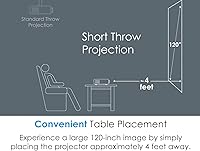
At roughly 4.3 feet from your screen or wall, this short-throw laser projector fills a 120-inch diagonal image. For context, that is about the distance from the back of a typical sofa to the wall — so it can sit on a coffee table, a shelf, or an AV cabinet without dominating the room. With less distance available the image scales down proportionally, but most standard living-room arrangements can still reach 90 to 100 inches without any tricky positioning.

It is a real consideration, not just an isolated complaint. At lower brightness modes the fan is barely noticeable. At full brightness it becomes clearly audible — roughly comparable to a laptop running under moderate load. During action films or gaming it tends to blend into the surrounding sound, but during quiet dialogue scenes or late-night viewing in a small enclosed room some users do find it distracting. Knowing this in advance helps you decide whether it fits your primary use case.

You will need an external streaming device. This Optoma unit has no built-in smart TV platform or app store, so streaming services are not accessible natively. The practical fix is straightforward — a Fire TV Stick, Chromecast with Google TV, or Apple TV plugs directly into the HDMI port and gets you up and running quickly. Many buyers already own one of these.

In practical terms, watching four hours of content every day would take over 20 years to reach 30,000 hours. Compare that with a lamp-based projector, where bulb replacements are typically needed every 3,000 to 5,000 hours of use — roughly every two to four years with regular viewing. With the laser engine in this unit, that maintenance cycle disappears entirely: no sourcing compatible replacement bulbs, no unexpected downtime, and consistent brightness that holds up far better over time than a lamp gradually dimming toward end-of-life.

Yes, and it suits outdoor use well. The 4,200 lumens gives a workable image even when conditions are not perfectly dark, and the IPX6-rated optical engine offers a level of dust resistance that most standard projectors simply do not have — which matters when setting up on a patio or at a campsite. Bring an extension cord and a portable screen or a light-colored wall, and you are in reasonable shape.

It is quite approachable for most people. The automatic keystone feature corrects the image angle when you power it on, and the four-corner adjustment lets you fine-tune each corner independently if needed. Most owners report having a clean, calibrated image within 15 to 20 minutes of unboxing. Getting the physical placement right at the correct distance is the main variable — once that is sorted, the software adjustments handle the rest without much hassle.

Ultra-short-throw projectors are designed to sit just a few inches from the wall — often under 12 inches — and project upward onto the screen, letting them function almost like a piece of furniture. They typically cost considerably more, especially laser versions. This short-throw unit sits around 4 feet back, giving more flexibility in placement (table, shelf, ceiling mount) without the precise installation requirements that ultra-short-throw models demand. If your room genuinely cannot accommodate 4 feet of clearance, an ultra-short-throw is the better fit; for most standard apartments and living rooms, that distance is not a practical obstacle.

It depends largely on your time horizon and tolerance for hardware maintenance. Lamp projectors generally offer more features per dollar at the point of purchase, but factor in bulb replacements over five to ten years and the ownership cost gap narrows meaningfully. Beyond the numbers, the laser engine starts up instantly without a warm-up period, maintains consistent brightness as it ages rather than gradually dimming, and eliminates the inconvenience of tracking down a compatible replacement bulb mid-ownership. For buyers planning to keep a projector for many years who dislike dealing with hardware upkeep, the premium is generally well-justified.

Where to Buy