Overview

The Neewer CM28 Pro Wireless Lavalier Microphone System arrived in early 2025 as a genuinely capable option in a crowded sub-$100 wireless mic market. What separates this wireless lav kit from basic Bluetooth alternatives is its commitment to uncompressed audio — full 48KHz/16-bit WAV files rather than the compressed formats many cheaper rivals rely on. The two-transmitter configuration means you get a ready-made setup for two speakers or a built-in backup without buying anything extra. Hitting the top five in its Amazon category within weeks of launch suggests it found its audience quickly, and the specs back up that reception.
Features & Benefits

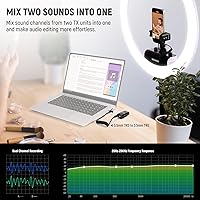
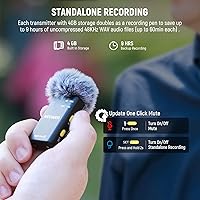
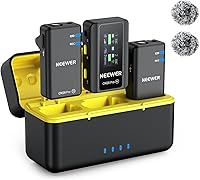
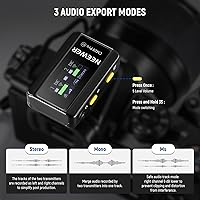
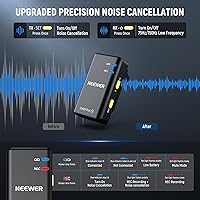
The CM28 Pro's standout trick is that each transmitter functions as an independent recorder. Clip one on, hit record, and it captures roughly nine hours of WAV audio entirely on its own — no camera, no receiver needed. That is a genuine safety net on a busy shoot. The one-click noise cancellation helps reduce steady background hum like HVAC or wind noise, though it won't perform miracles in a loud crowd. An LCD screen on each transmitter keeps settings visible at a glance, and three export modes — Mono, Stereo, and Mid-Side — give editors meaningful flexibility without post-production headaches. The charging case adds two full recharge cycles on the road.

Best For

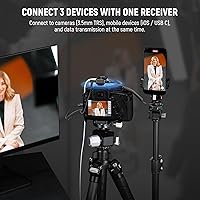
This dual-mic system is a natural fit for solo content creators who shoot YouTube or social media videos without a crew. If you regularly interview a guest on camera, having two transmitters already in the kit removes a logistical headache. Travel vloggers will appreciate the portable charging case — it keeps all three units charged through a full day of shooting without hunting for outlets. Run-and-gun documentary shooters get real peace of mind from the standalone recording fallback when wireless signals get unpredictable. Mobile shooters on iPhone or Android will find it connects cleanly via the 3.5mm jack or an OTG adapter, making it practical across most devices without extra fuss.

User Feedback

Buyers consistently point to audio clarity as a standout at this price level, with many noting the recording quality punches above what the cost suggests. The magnetic clip also earns regular praise for staying in place during movement — a small detail that matters a lot mid-shoot. That said, the stated wireless range is a sunny-day, open-field figure; expect noticeably shorter distances indoors with walls and interference in play. A handful of users found switching between export modes less intuitive than expected, and there are isolated reports of sync dropouts during longer sessions. Neither issue appears widespread, but worth knowing before you rely on this wireless lav kit for a critical shoot.

Pros

  • Uncompressed WAV recording on each transmitter works as a true standalone backup, independent of any camera.
  • Two transmitters included at this price tier eliminates the need to buy a second mic for interview setups.
  • Audio clarity consistently impresses buyers who compare it against other options in the same budget range.
  • The magnetic clothing clip holds securely through movement without damaging fabric or popping loose mid-take.
  • A charging case that recharges the full kit twice over is genuinely practical for full-day location shoots.
  • LCD screen on each transmitter puts battery, gain, and connection status in plain sight during active recording.
  • Mono, Stereo, and Mid-Side export modes give editors more post-production flexibility than most rivals at this price.
  • One-click mute and noise cancellation keep on-set adjustments fast without interrupting the subject or moment.
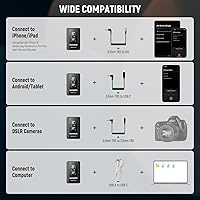
  • Compatible with iPhone, iPad, Android, cameras, and PC, covering most shooting setups without special accessories.

Cons

  • Stated wireless range is an open-field figure — indoor real-world performance is noticeably and consistently shorter.
  • Switching between export modes has a learning curve that trips up new users more than it should.
  • Occasional sync dropouts reported after extended use, which is a concern on long or critical recording sessions.
  • Plastic housing feels adequate but lacks durability confidence for rough daily professional use.
  • Noise cancellation handles steady hum but loses effectiveness quickly in complex or loud acoustic environments.
  • Transmitters sit loosely inside the charging case, raising minor long-term connector wear concerns during travel.
  • Android users with non-standard OTG setups may encounter device recognition issues that require troubleshooting.
  • No dedicated carrying protection beyond the case itself — the plastic shell offers limited drop resistance.
  • Users without a Lightning or USB-C to 3.5mm adapter on hand will hit an unexpected wall when pairing with iPhones.

Ratings

Our AI rating engine analyzed verified global buyer reviews for the Neewer CM28 Pro Wireless Lavalier Microphone System, actively filtering out incentivized, duplicate, and bot-generated feedback to surface what real users actually experience. The scores below reflect a balanced picture — genuine strengths are recognized alongside the friction points that show up consistently across independent reviewers. Nothing is glossed over.

Audio Clarity
88%
Buyers repeatedly single out the recorded voice quality as a step above what you'd expect at this price tier. In typical interview and vlogging conditions — office setups, outdoor street shoots, casual studio recordings — the audio comes through clean, warm, and natural without heavy post-processing needed.
In louder environments like busy cafes or event floors, some users noticed the audio picks up more ambient texture than anticipated. It is a capable mic, but anyone expecting broadcast-level isolation in challenging acoustic spaces may find it falls short.
Standalone Recording
91%
This is the feature that genuinely separates the CM28 Pro from many competitors in its class. The ability to record directly onto each transmitter — independent of any camera or receiver — gives run-and-gun shooters a reliable safety copy without any extra gear or workflow changes.
A handful of users found managing and exporting files from the transmitter slightly fiddly the first few times, particularly on Windows. Once the workflow clicks it becomes second nature, but expect a short learning curve before it feels effortless.
Wireless Range & Stability
67%
33%
For outdoor shoots in open spaces — weddings in gardens, street interviews, sports sidelines — the wireless connection holds up well at distances that would challenge cheaper Bluetooth-based systems. Users working in uncluttered environments praised the reliability.
The manufacturer's stated range is an open-field best case, and many indoor users found real-world performance noticeably shorter. Walls, competing Wi-Fi networks, and dense crowds reduce effective range significantly, and a minority of long-session users reported occasional dropouts that required re-pairing.
Battery Life
86%
The receiver lasting through a full shooting day and transmitters not far behind means most creators can get through an entire event or content day on a single charge. The charging case adding two extra full cycles on the road is genuinely practical for travel shoots.
Battery life is solid rather than exceptional — power-hungry users doing back-to-back all-day shoots will eventually hit limits. A few reviewers noted that battery drain felt slightly faster than spec when noise cancellation was kept active continuously.
Charging Case Design
83%
The compact case keeps all three units organized, protected, and charged simultaneously, which simplifies packing for location shoots. Travel vloggers in particular appreciated having a single object to grab rather than hunting for individual cables and pouches.
The case itself is plastic and feels moderately durable rather than premium. A few users flagged that the fit of the transmitters inside the case could be snugger — they feel slightly loose during transport, raising minor concerns about long-term connector wear.
Noise Cancellation
72%
28%
The one-click toggle is fast and practical during live shoots where you need to respond quickly to changing sound conditions. It does a decent job reducing steady-state background noise like HVAC hum, fans, or light wind, which is exactly what most vloggers and interviewers need.
It is not a substitute for proper acoustic treatment or a directional mic in genuinely noisy spaces. Users who expected it to handle crowd noise, loud music, or complex environments were disappointed — the cancellation works best on consistent, low-level background sounds.
Ease of Use
74%
26%
Initial pairing is straightforward and most users were up and running within a few minutes of unboxing. The LCD screen on each transmitter provides enough at-a-glance information that you rarely need to dig into menus during an active shoot.
Switching between the three export modes — Mono, Stereo, and Mid-Side — tripped up a recurring number of buyers who found the process less intuitive than expected. The manual helps, but the UI logic is not immediately obvious and takes a session or two to fully internalize.
Build Quality
69%
31%
For a kit in this price range, the physical construction is acceptable. The transmitters feel solid enough in hand and the clip mechanisms work consistently, which matters when you are attaching them to talent quickly between takes.
The plastic housing telegraphs the price tier. It does not feel fragile exactly, but it lacks the reassuring density of more expensive wireless systems. Users who have handled higher-end gear will notice the difference, and rough-handling on set is a risk.
Magnetic Clip
84%
The magnetic attachment gets consistently positive mentions from buyers who have used traditional spring clips that pop off mid-recording. The magnet holds securely through movement, gestures, and even light physical activity without leaving visible marks on fabric.
On very thick or structured garments — heavy denim, layered jackets, some suit lapels — the magnetic hold is less confident and a few users reported repositioning needed. It works best on lighter fabrics typical in everyday content creation scenarios.
Compatibility
81%
19%
The 3.5mm receiver output means this dual-mic system connects directly to cameras and laptops without adapters, and it pairs with iPhones and Android devices cleanly using widely available OTG or Lightning adapters. Most mobile shooters found setup fuss-free.
Android users with older or non-standard OTG implementations occasionally reported recognition issues. iPhone users without a Lightning or USB-C to 3.5mm adapter on hand hit an unexpected wall — it is a common enough scenario that it is worth planning for before a shoot.
Value for Money
87%
A two-transmitter wireless system with uncompressed onboard recording, a charging case, and a functioning noise cancellation toggle at this price point represents strong value for independent creators. Most buyers felt the feature-to-cost ratio was genuinely competitive.
Buyers comparing it directly against well-established rivals may find those alternatives offer more polished software ecosystems or better long-term brand support. The CM28 Pro wins on specs-per-dollar, but ecosystem maturity is an area where newer brands still have ground to cover.
LCD Display & Controls
76%
24%
Having a live readout of gain level, battery status, and connection mode on the transmitter body is more useful than it sounds mid-shoot. It removes guesswork and means you can do a fast status check without pulling out your phone or interrupting the subject.
The display is small and the text can be hard to read in bright outdoor light. A few users also noted the button feedback is not especially tactile, making it easy to mis-press a setting when operating quickly or with cold hands.
Wind Noise Handling
71%
29%
The included windshields do a reasonable job of reducing the low rumble and flutter that outdoor shoots typically introduce. For calm-day exterior recordings — park interviews, walking vlogs on quiet streets — they perform well enough without additional accessories.
In stronger or gusty wind conditions the foam windshields reach their limits quickly. Users shooting at beaches, near highways, or in exposed locations found they needed aftermarket deadcat-style covers to get clean audio, which adds cost and bulk.
Export Mode Flexibility
78%
22%
Having Mono, Stereo, and Mid-Side output options from a compact wireless kit is a meaningful advantage for editors. The Mid-Side mode in particular is a feature more commonly found in higher-price gear, giving more experienced post-production users real mixing flexibility.
The export mode switching process was one of the most frequently cited usability frustrations in user feedback. It is powerful when understood, but the implementation could be more intuitive — a clearer on-device indicator of the active mode would help significantly.

Suitable for:

The Neewer CM28 Pro Wireless Lavalier Microphone System is a practical choice for independent content creators who shoot without a dedicated sound person and need a two-mic setup that just works out of the box. Solo YouTubers and podcasters conducting on-camera interviews will appreciate having both transmitters ready to go in a single kit, removing the need to source a second mic separately. Travel vloggers benefit from the charging case handling all-day power needs without requiring a wall outlet between shoots. Run-and-gun documentary shooters and event videographers get real operational security from the standalone recording capability on each transmitter — if the wireless connection falters, the audio is still being captured locally. Mobile creators shooting on iPhone or Android will find the connection straightforward with widely available adapters, making this dual-mic system a genuinely versatile everyday tool for social media-focused video work.
Not suitable for:

The Neewer CM28 Pro Wireless Lavalier Microphone System is not the right tool for anyone who needs broadcast-grade audio reliability in demanding professional environments. Sound designers, broadcast journalists, or corporate AV teams working in RF-congested venues — conference halls, stadiums, multi-camera productions — will find the wireless performance and build quality fall short of pro-tier expectations. The noise cancellation, while useful for steady background hum, is not a substitute for proper acoustic treatment in loud or complex sound environments, so musicians, live event recordists, or anyone recording in acoustically challenging spaces should look elsewhere. Buyers expecting the stated wireless range to hold up indoors will likely be frustrated — walls and competing signals cut effective distance considerably. If you need a kit that can take daily physical punishment on professional sets, the plastic construction may not inspire long-term confidence either.
Specifications

  • Kit Contents: Each package includes one receiver (RX), two transmitters (TX), a charging case, two windshields, and necessary connection cables.
  • Audio Format: Both transmitters record uncompressed 48KHz/16-bit WAV audio, preserving full audio fidelity without lossy compression.
  • Onboard Storage: Each transmitter carries 4GB of built-in storage, capable of holding roughly nine hours of continuous WAV recordings.
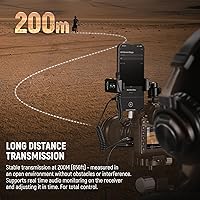
  • Wireless Range: Rated up to 656ft (200m) in unobstructed line-of-sight conditions; real-world indoor range will vary based on walls and RF interference.
  • Battery Life: The receiver runs up to nine hours per charge; each transmitter runs up to eight hours per charge under typical operating conditions.
  • Charging Case: The included charging case stores all three units simultaneously and provides two full recharge cycles before the case itself needs recharging.
  • Export Modes: Three audio export modes are available — Mono, Stereo, and Mid-Side (MS) — selectable directly from the transmitter.
  • Noise Cancellation: Each transmitter features a one-click noise cancellation toggle designed to reduce steady ambient background noise such as HVAC hum or light wind.
  • Display: An LCD screen on each transmitter shows gain level, battery status, connection state, noise cancellation status, and active export mode.
  • Connectivity: The receiver outputs audio via a 3.5mm jack and also includes a 3.5mm monitoring port for real-time audio checking.
  • Compatibility: Compatible with iPhone, iPad, Android devices (via OTG adapter), DSLR and mirrorless cameras, and PC/Mac computers.
  • Signal-to-Noise: The system delivers a 60dB signal-to-noise ratio, which is adequate for controlled recording environments and typical content creation scenarios.
  • Channels: The system operates on two independent channels, allowing both transmitters to stream simultaneously to a single receiver without cross-interference.
  • Form Factor: Both transmitters function as wearable clip-on lavalier units, attachable via a magnetic clip or usable handheld in a pinch.
  • Material: All three units — receiver and both transmitters — are constructed from plastic housing, keeping overall system weight low.
  • Package Dimensions: The retail package measures approximately 7.68 x 5.39 x 2.24 inches and weighs 1.12 lbs including all accessories.
  • Release Date: The CM28 Pro was first made available in January 2025, making it one of Neewer's more recent wireless audio releases.
  • Power Source: All units are powered by built-in rechargeable lithium-ion batteries; no disposable batteries are required for operation.

Related Reviews

NEEWER KM15 Wireless Lavalier Microphone System
87%
89%
Sound Quality
92%
Ease of Use
87%
Battery Life
83%
Build Quality
90%
Portability
More
BOYA BY-WM4 PRO-K2 Wireless Lavalier Microphone System
82%
92%
Value for Money
89%
Ease of Use
88%
Portability
84%
Sound Quality
74%
Signal Range
More
Azden WMS-PRO Wireless Microphone System
85%
88%
Sound Quality
94%
Portability
91%
Ease of Setup
72%
Range Performance
85%
Battery Life
More
Saramonic UwMIC9 Wireless Lavalier Microphone System
85%
90%
Audio Quality
89%
Ease of Setup
92%
Range and Signal Stability
65%
Battery Life
87%
Portability and Weight
More
Comica CVM-WM100 PLUS
83%
92%
Signal Stability
86%
Audio Quality & Clarity
94%
Post-Production Flexibility
61%
Portability & Form Factor
68%
Power Management & Battery Life
More
Azden PRO-XR Digital Wireless Microphone System
86%
94%
Wireless Range
89%
Sound Quality
87%
Battery Life
92%
Ease of Setup
85%
Connectivity Stability
More
Rode Wireless GO Compact Lavalier Microphone System
87%
89%
Audio Quality
94%
Portability
88%
Battery Life
75%
Wireless Range
92%
Ease of Use
More
7RYMS iRay DW40 Wireless Lavalier Microphone System
85%
90%
Audio Quality
88%
Ease of Use
85%
Battery Life
92%
Noise Cancellation
89%
Compatibility
More
Comica CVM-WM200A Wireless Lavalier Microphone System
84%
88%
Audio Quality
67%
Battery Life
91%
Setup Ease
85%
Transmission Range
80%
Build Quality
More
Movo WMX-1 Wireless Lavalier Microphone System
87%
88%
Audio Quality
94%
Ease of Use
85%
Wireless Range
91%
Battery Life
93%
Portability
More

FAQ

It works with iPhones, but you will need a Lightning-to-3.5mm or USB-C-to-3.5mm adapter depending on your iPhone model — neither is included in the box. These adapters are inexpensive and widely available, but it is worth having one ready before your first shoot rather than discovering the gap at the last minute.

Yes, you can absolutely use a single transmitter while leaving the other in the charging case. The receiver pairs with whichever transmitters are active, so running a one-person setup is straightforward and does not require any special configuration.

Each transmitter has onboard storage built in, so when you press record on the transmitter itself, it starts saving audio locally regardless of whether the receiver or any camera is connected. This makes it genuinely useful as a backup — even if your wireless signal drops mid-interview, the transmitter has been quietly saving a clean copy the whole time. Files are exported via USB connection afterward.

Not really. That figure applies to open outdoor environments with no obstructions between transmitter and receiver. Indoors, walls, furniture, and competing wireless signals will reduce your effective range considerably — most users working in typical indoor spaces find reliable performance within roughly 30 to 50 meters. Plan accordingly and do not position the receiver on the far side of a wall from your subject.

Mono combines both channels into a single centered audio track, which is the simplest option for basic video use. Stereo outputs the two transmitters as left and right channels separately, useful when editing two-speaker interviews. Mid-Side is a more advanced mode that captures a center signal and a stereo width signal, giving experienced audio editors more flexibility in post-production to control the stereo image. For most beginner and intermediate creators, Mono or Stereo will cover everything they need.

It helps with consistent, low-level background sounds like air conditioning, computer fans, or gentle outdoor wind — the kind of steady hum that sits under your audio. It is not designed to handle complex or loud noise like a busy crowd, traffic, or music playing nearby. Think of it as a useful cleanup tool for controlled environments rather than a fix for genuinely noisy locations.

According to the manufacturer, each charging cycle takes approximately 1.5 hours per unit. The case itself will need to be recharged via USB after it has delivered two full rounds of charges to the transmitters and receiver.

Yes. The Neewer CM28 Pro Wireless Lavalier Microphone System is designed to run both transmitters simultaneously on independent channels, with the receiver capturing both audio streams at once. This is what makes it well-suited for two-person interviews and dual-speaker recording scenarios.
The magnet is strong enough to hold securely through movement, but it is generally safe for most everyday fabrics. On very fine, delicate textiles like silk or thin knits, it is worth being cautious as with any clip-on accessory. Most users report no fabric damage under normal use.

It is a reasonable entry point for someone stepping up from a wired lav or built-in camera mic. The setup process is accessible, the LCD screen helps you stay oriented, and the kit covers most common creator scenarios. The one area to be patient with is learning the export mode switching, which a few new users find takes a couple of sessions to internalize — but once it clicks, day-to-day operation is fairly smooth.