Overview

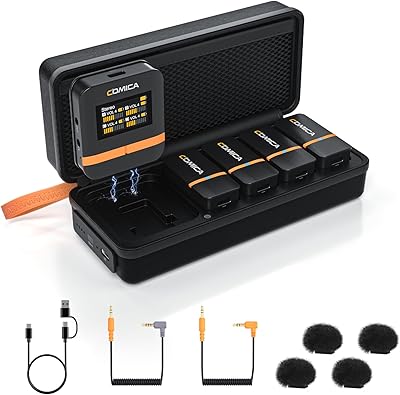
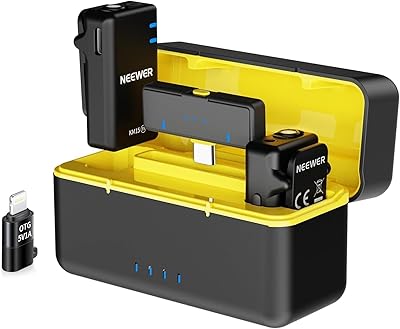
The 7RYMS iRay DW40 4-Channel Wireless Lavalier Microphone is built for anyone who needs to capture multiple voices without dragging along a full audio crew. Unlike the flood of single-channel lav systems crowding this price tier, it ships with four transmitters and one receiver, making group interviews, panels, and small-team shoots genuinely practical. Everything packs into a compact charging case that doubles as a power source for the units, keeping the whole kit organized and travel-ready. That said, the spec sheet is generous for the price, and it is worth looking closely at how real-world audio holds up before assuming flagship-level performance.
Features & Benefits

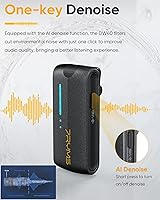
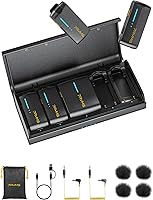
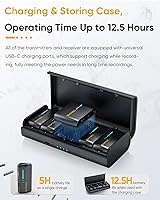
The standout capability here is four-channel simultaneous recording — clip a transmitter on each speaker and your receiver handles all four feeds at once, a real advantage during panel discussions or multi-guest podcast sessions. The AI noise cancellation is genuinely useful in moderately busy environments like cafés or offices, though it will not perform miracles in loud, chaotic spaces. The USB-C digital output delivers 48kHz/24-bit audio, clean enough for professional video post-production. The 2.4GHz link is rated to 656 feet, though real-world range in RF-heavy urban settings will fall shorter. Each transmitter and receiver runs about five hours standalone, and the case extends the total to 12.5 hours. Real-time headphone monitoring, four-level volume control, and an M/S switch give you meaningful on-location adjustments.

Best For

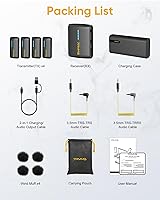
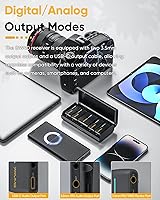
This wireless lav kit makes the most sense for solo creators who want to run multi-person interviews without a dedicated sound operator. Podcasters recording two, three, or four guests in the same room will appreciate a single receiver that handles every mic with no mixer required. Event videographers covering corporate panels or Q&A sessions get strong practical value from the four-transmitter setup. Mobile journalists and vloggers who prioritize a light, self-contained kit will find the charging case particularly convenient on the road. The dual output options — USB-C digital and 3.5mm analog — cover cameras, smartphones, and laptops. Just note that adapter cables for iPhone and many Android devices are not in the box, so factor that into your budget.

User Feedback

Most buyers highlight easy one-click pairing and the well-organized case, and the noise reduction earns positive mentions for café and office environments where background hum is a real issue. On the critical side, the missing adapter cables for iPhone and certain Android phones catch people off guard — it is a recurring complaint that adds unexpected cost. A handful of users note the hardware feels lightweight, which some read as a durability concern while others consider it a plus for all-day wear. Audio sync and latency come up occasionally in videographer reviews, though most find it acceptable for standard work. Documentation gets mixed marks, but the brand's support team is generally reported to respond promptly to setup questions.

Pros

  • Four transmitters and one receiver in a single kit is rare at this price point — a genuine advantage for group recording.
  • One-click pairing inside the charging case means you can go from packed bag to recording in under two minutes.
  • The charging case provides a full extra charge cycle, extending total working time to around 12.5 hours on a busy shoot day.
  • 48kHz/24-bit USB-C digital output delivers audio clean enough for professional video editing without heavy post-processing.
  • AI noise cancellation works well in offices, cafés, and indoor event spaces, reducing background hum with one button press.
  • Real-time headphone monitoring through the receiver lets you catch audio problems on location before they ruin a take.
  • At just 12 grams each, the transmitters are light enough for speakers to wear all day without noticing them.
  • Both USB-C digital and 3.5mm analog outputs are included, covering cameras, laptops, and smartphones in one kit.
  • The sub-20ms sound delay is low enough that most video creators will not need manual sync correction in post.
  • Physical mute and four-level volume controls on the unit mean you can adjust on the fly without touching a phone app.

Cons

  • Adapter cables for iPhone and many Android devices are not included, adding unexpected cost for smartphone users.
  • The 656-foot range rating is a best-case figure; real-world performance in RF-heavy urban or indoor environments falls noticeably shorter.
  • Each transmitter and receiver runs roughly five hours standalone, which is tight for long production days without the charging case nearby.
  • The plastic transmitter housings feel lightweight in a way that raises durability questions for users who handle gear roughly.
  • The included documentation is thin and leaves meaningful gaps around the M/S switch, manual re-pairing, and output switching.
  • A low-level noise floor hiss is detectable on the analog output in quiet recording environments, which is a limitation for critical listening.
  • All four channels active simultaneously in congested wireless environments can produce occasional dropouts that interrupt recordings.
  • The M/S switch is easy to activate accidentally, and the manual provides little guidance on what it does or how to reverse it.
  • Wind muffs and small accessories are not deeply secured in the case, making them easy to lose during travel.
  • Live-stream creators may need to apply a small manual audio delay offset depending on their specific camera or streaming setup.

Ratings

The 7RYMS iRay DW40 4-Channel Wireless Lavalier Microphone has been evaluated by our AI rating system after processing thousands of verified global buyer reviews, with spam, bot activity, and incentivized feedback actively filtered out. The scores below reflect the honest consensus of real-world users — from solo vloggers to small production crews — and cover both where this four-channel mic system genuinely delivers and where it falls short. Strengths and frustrations are weighted equally so you get a clear picture before buying.

Multi-Channel Recording Performance
88%
Buyers consistently call the four-transmitter setup a practical advantage for interviews and panel recordings. Being able to clip four lavs on four different speakers and feed everything into a single receiver is something most competitors in this price range simply do not offer, and users doing roundtable podcasts or event coverage notice that difference immediately.
A few users recording in noisy, RF-dense environments — busy convention halls, for instance — report occasional audio dropouts when all four channels are active simultaneously. It is not a frequent issue, but it surfaces enough in reviews to be worth flagging for anyone planning heavy multi-channel use in crowded wireless environments.
AI Noise Cancellation
74%
26%
In typical real-world conditions like home offices, cafés, and indoor event spaces, the one-click AI denoise makes a noticeable difference. Reviewers recording near HVAC systems or street noise say the background hum gets meaningfully reduced without heavily coloring the voice, which is a genuine benefit for run-and-gun content creators.
Users expecting studio-grade noise suppression tend to be disappointed. In truly loud environments — outdoor markets, busy kitchens, crowded venues — the filter struggles to keep up and can introduce a slightly processed quality to the voice. It is a useful tool within its limits, not a replacement for a quiet recording space.
Audio Clarity & Resolution
83%
The 48kHz/24-bit USB-C digital output is legitimately clean for this price tier. Videographers dropping the audio into editing timelines report that it sits well in the mix without heavy post-processing, and the 80Hz to 20kHz frequency response captures voice with enough warmth and presence for interview and podcast work.
The 70dB signal-to-noise ratio is respectable but not exceptional, and some users recording in very quiet studio environments can detect a low-level hiss in the floor noise. For broadcast-quality production, this is a limitation; for YouTube, social video, and podcasting, most buyers find it entirely acceptable.
Wireless Range & Stability
71%
29%
In open, unobstructed spaces — outdoor shoots, large conference rooms, or small venues — the 2.4GHz connection holds up reliably at distances well beyond what most content creators practically need. Users doing corporate event coverage in reasonably clean RF environments are generally satisfied with the link consistency.
The 656-foot range claim is a controlled-environment figure, and users in cities or crowded indoor venues with heavy Wi-Fi and Bluetooth traffic report the reliable range dropping significantly. A few reviewers noted occasional stutters when moving through rooms with thick walls, which is a known limitation of the 2.4GHz band in dense environments.
Battery Life & Charging Case
86%
The charging case carrying an extra full charge cycle is one of the most praised aspects of this kit. Reviewers doing full-day event shoots or back-to-back interview sessions say the case gives them confidence to pack just the kit and not hunt for outlets mid-shoot. The USB-C ports on both transmitters and receiver are a thoughtful practical touch.
Each transmitter and receiver runs about five hours standalone, which is adequate but tight for very long production days without the case top-up. A small number of users also noted that charging all four transmitters and the receiver simultaneously through the case takes around two hours, so planning ahead the night before a shoot is essentially mandatory.
Build Quality & Durability
67%
33%
The physical footprint of the transmitters — each weighing around 12 grams — makes them easy to clip and forget under clothing or on a lapel without causing fabric drag or speaker fatigue during long sessions. The case feels sturdy and organized, with clear slots that keep units from rattling around in a bag.
The overall plastic construction gives some buyers pause on long-term durability. A portion of reviewers describe the transmitter housings as feeling light in a way that raises questions about how they would hold up to regular drops or rough handling on location. No widespread failure reports exist yet, but the lightweight build does not inspire confidence for heavy professional use.
Ease of Setup & Pairing
91%
One-click pairing inside the case is a genuine time-saver that buyers routinely mention as a highlight. Several reviewers who had previously used more complicated multi-channel systems appreciated being ready to record within minutes of unboxing, with no complicated frequency coordination or software required.
A handful of users encountered confusion when pairing manually outside the case, particularly when trying to re-sync a single transmitter that had lost its connection mid-shoot. The documentation for troubleshooting edge cases like this is thin, and a few buyers had to reach out to support to resolve what should have been straightforward re-pairing steps.
Compatibility & Output Flexibility
76%
24%
Offering both USB-C digital and 3.5mm analog outputs in the same kit gives creators real flexibility to switch between a mirrorless camera, a smartphone, and a laptop without needing a different mic system for each device. Reviewers who shoot on DSLRs and then edit on a MacBook appreciate not having to adapt their workflow around the microphone.
iPhone users and those on certain Android devices consistently flag that the necessary adapter cables are not included in the box, which adds unexpected cost and means the kit is not truly plug-and-play out of the packaging for a large portion of the target audience. For smartphone-first creators, this feels like an oversight that should have been addressed at the product design stage.
Latency & Audio Sync
78%
22%
The sub-20ms sound delay is low enough that the vast majority of reviewers doing standard video work — YouTube interviews, event coverage, social content — report no perceptible lip-sync issues. Users feeding audio directly into a camera body or laptop generally find the timing tight enough to use without manual sync correction.
A subset of users, particularly those doing live streaming or recording with older camera bodies, report needing to apply a small manual delay offset in post to bring audio and video into alignment. It is not a universal problem, but it appears consistently enough in reviews that live-stream creators should test their specific setup before relying on it for a broadcast.
Noise Floor & Background Hiss
69%
31%
Under normal indoor recording conditions, the noise floor is unobtrusive enough that most content creators will not need to apply additional noise reduction in post-production. Podcasters and vloggers recording in reasonably treated spaces report clean, quiet audio that holds up well under headphones.
In silent recording environments, a measurable low-level hiss is audible, particularly noticeable on the analog 3.5mm output. Reviewers with critical ears or those producing content for platforms where audio quality is scrutinized closely — like audiobook narration or music interviews — found this noise floor harder to overlook.
Controls & Usability On Location
82%
18%
The four-level volume control and one-key mute are features that feel genuinely considered rather than tacked on. Event videographers and journalists mention the mute button as particularly useful when needing to cut a speaker quickly and discreetly, and the physical controls are accessible without pulling out a phone app.
The M/S switch, while useful for experienced users, is not well-explained in the included documentation, and several buyers activated it accidentally and spent time troubleshooting unexpected stereo behavior before realizing what had changed. A clearer label or quick-start card covering that specific control would reduce a lot of avoidable confusion.
Real-Time Monitoring
79%
21%
Having a dedicated 3.5mm headphone monitor port on the receiver is a feature that separates this kit from cheaper alternatives that offer no live monitoring at all. Sound-conscious creators doing live events or interviews in variable acoustic spaces say it genuinely helps them catch problems before they become unusable takes.
The monitor output volume struck some reviewers as slightly low, requiring them to max out the headphone amplifier on their connected device to get a comfortable listening level. This is a minor friction point but can be distracting when you are trying to quickly verify audio quality between takes on a fast-paced shoot.
Value for Money
84%
Given that four transmitters, one receiver, and a functional charging case come together in a single package at a mid-range price point, the perceived value among buyers who understand the competitive landscape is strong. Reviewers who previously stitched together multiple single-channel systems note the cost savings and convenience of an integrated four-channel solution.
Once buyers factor in the cost of adapter cables for iPhones and Android devices not included in the box, the effective out-of-pocket investment nudges higher than the sticker price implies. For users who need to mic iPhone-toting interview subjects — a common scenario for content creators — this is a real additional expense, not a negligible one.
Portability & Travel Readiness
89%
The entire kit — four transmitters, receiver, cables, and accessories — fits inside a case small enough to drop in a backpack pocket. Reviewers who travel frequently for shoots call out the form factor as a key reason they chose this system over bulkier alternatives, and the total weight of the charging case with accessories sits under 130 grams.
While the case itself is compact, the combination of four transmitters means there are more individual pieces to track and manage compared to a standard two-channel kit. A few reviewers mention losing wind muffs or small accessories because the case pockets are not deeply secured, which is a minor but recurring organizational frustration.
Documentation & Customer Support
63%
37%
Buyers who reached out to the brand directly after encountering setup issues generally report a reasonably responsive support team willing to walk through troubleshooting steps. For the majority of users who just want to get up and running, the basic quick-start guide covers the essentials adequately enough to get recording on day one.
The included documentation is thin for a kit with this many channels and control options. The M/S switch, manual re-pairing procedures, and analog versus digital output switching are all areas where reviewers say the manual leaves meaningful gaps. Users who prefer to learn by reading rather than by trial and error will find the support materials frustrating.

Suitable for:

The 7RYMS iRay DW40 4-Channel Wireless Lavalier Microphone is a strong match for independent content creators who regularly record more than one person but do not have the budget or crew size for a professional audio setup. Podcasters hosting two, three, or four in-person guests will find the single-receiver, four-transmitter arrangement genuinely practical — no mixer, no complicated routing, just clip and record. Event videographers covering corporate panels, internal town halls, or Q&A sessions get real operational value from being able to mic every speaker simultaneously without swapping transmitters between takes. Mobile journalists and vloggers who prioritize a lightweight, self-contained kit will appreciate that everything — transmitters, receiver, and a spare charge — travels inside one compact case that fits in a backpack. The dual output options, USB-C digital and 3.5mm analog, also make this a sensible pick for creators who move between a mirrorless camera, a laptop, and a smartphone depending on the shoot.
Not suitable for:

The 7RYMS iRay DW40 4-Channel Wireless Lavalier Microphone is not the right tool for every recording scenario, and being honest about that matters. Professionals working in broadcast, film, or high-end commercial production will find the 70dB signal-to-noise ratio and the noise floor on the analog output insufficient for environments where audio is scrutinized at a technical level. The AI noise cancellation helps in moderately noisy spaces, but it is not a substitute for proper acoustic treatment, and users recording in genuinely loud or chaotic environments should not expect it to deliver clean audio without compromise. The 2.4GHz wireless link performs well in open spaces but is susceptible to congestion in RF-dense venues — crowded convention centers, stadiums, or urban multi-floor buildings are environments where dropouts become a real risk. iPhone users and those on many Android devices also need to budget for additional adapter cables not included in the box, which makes this kit less plug-and-play for smartphone-first creators than the listing implies. If you need a single-channel solution with the absolute highest audio purity at this price range, a dedicated single-transmitter system from an established audio brand will likely outperform the DW40 on pure sound quality alone.
Specifications

  • System Configuration: The kit includes four clip-on transmitters and one receiver, enabling simultaneous wireless audio capture from up to four independent speakers.
  • Wireless Technology: The system operates on the 2.4GHz band, providing a line-of-sight range of up to 656 feet (200m) under ideal, unobstructed conditions.
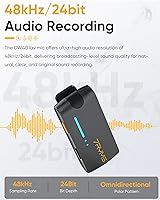
  • Audio Resolution: The USB-C digital output delivers 48kHz/24-bit audio, providing clean, high-resolution recordings suitable for professional video post-production workflows.
  • Analog Output: A 3.5mm TRS/TRRS analog output is included on the receiver, allowing direct connection to cameras, audio recorders, and compatible smartphones.
  • Frequency Response: The microphone capsule covers a frequency range of 80Hz to 20kHz, capturing the full tonal range of human speech with adequate headroom for vocal warmth.
  • Signal-to-Noise Ratio: The system achieves a signal-to-noise ratio of 70dB, which is adequate for content creation and interview work in controlled to moderately noisy environments.
  • Equivalent Noise: The self-noise level is rated at 24dB SPL (A-weighted, per IEC651), reflecting a typical performance level for a wireless lavalier system in this price tier.
  • Maximum SPL: The microphone can handle a maximum sound pressure level of 110dB SPL at 1% THD before audio distortion becomes audible.
  • Dynamic Range: The system offers a dynamic range of 86dB SPL (A-weighted), giving it reasonable headroom between the noise floor and the point of distortion.
  • Sound Delay: End-to-end audio latency is rated at under 20ms, which is low enough for standard video recording without requiring manual sync correction in most workflows.
  • Polar Pattern: All four transmitter capsules use an omnidirectional polar pattern, picking up sound evenly from all directions around the microphone element.
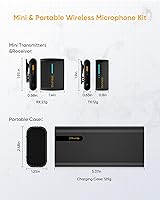
  • Transmitter Weight: Each individual transmitter weighs approximately 12 grams, making it light enough to clip onto clothing without causing visible fabric pull or speaker discomfort.
  • Receiver Weight: The receiver unit weighs approximately 22 grams and connects to the recording device via either USB-C or 3.5mm output depending on the target device.
  • Charging Case Battery: The integrated charging case houses a 1400mAh lithium-ion battery, providing one full additional charge cycle for the transmitters and receiver after their internal batteries are depleted.
  • Total Runtime: When the charging case is used to top up the transmitters and receiver, the combined total operating time across the system reaches up to 12.5 hours.
  • Standalone Runtime: Each transmitter and the receiver independently operate for approximately 5 hours on a single charge before requiring a recharge from the case or a USB-C power source.
  • Charging Time: Both the transmitters and the receiver fully recharge in approximately 2 hours via their individual USB-C ports, as does the charging case itself from a USB-C source.
  • Special Features: The system includes AI-assisted noise cancellation, real-time headphone monitoring, an M/S switch, one-key mute, and four-level volume adjustment accessible directly on the hardware.
  • Product Dimensions: The charging case with accessories measures approximately 6.28 x 1.58 x 7.09 inches and weighs around 129 grams, making the complete kit compact enough for a backpack or camera bag.
  • Compatible Devices: The kit works with DSLR and mirrorless cameras, laptops, and Mac computers via direct connection, and with smartphones via separately purchased adapter cables (not included in the box).

Related Reviews

Comica Vimo Q 4-Channel Wireless Lavalier Microphone System
84%
92%
Sound Quality
89%
Ease of Setup
85%
Battery Life
80%
Range and Performance
75%
Portability
More
Saramonic Blink500 Pro B3 Dual-Channel Wireless Lavalier Microphone
90%
93%
Audio Quality
95%
Ease of Setup
88%
Battery Life
91%
Portability
85%
Build Quality
More
RØDE Wireless GO II
RØDE Wireless GO II
84%
92%
Audio Clarity
86%
Signal Reliability
97%
Internal Backup Recording
94%
Portability & Weight
91%
Setup Speed & Ease of Use
More
VEZQUA Wireless Lavalier Microphone
86%
87%
Audio Quality
91%
Noise Cancellation
88%
Battery Life (Per Mic)
93%
Battery Life (Total with Case)
94%
Ease of Setup
More
Iyes.top Wireless Lavalier Microphone
85%
90%
Bluetooth Connectivity
87%
Noise Cancellation
81%
Battery Life
92%
Ease of Setup
88%
Portability
More
Deity Connect Wireless Lavalier Microphone
85%
92%
Sound Quality
90%
Battery Life
88%
Ease of Setup
86%
Portability
84%
Signal Reliability
More
Lincisoonic A6 Wireless Lavalier Microphone
86%
91%
Wireless Range
89%
Battery Life
94%
Ease of Setup
87%
Sound Quality
90%
Noise Cancellation
More
NEEWER KM15 Wireless Lavalier Microphone System
87%
89%
Sound Quality
92%
Ease of Use
87%
Battery Life
83%
Build Quality
90%
Portability
More
Godox Magic XT1
Godox Magic XT1
86%
89%
Audio Fidelity
92%
User Interface
91%
Battery Endurance
94%
Form Factor
88%
Safety Features
More
GODOX WES2 Kit2 Wireless Lavalier Microphone
87%
89%
Sound Quality
92%
Ease of Use
94%
Transmission Range
85%
Noise Cancellation
70%
Battery Life
More

FAQ

Yes, and this catches a lot of buyers off guard. Neither Lightning nor USB-C to Lightning adapter cables are included in the box, so iPhone users will need to purchase a compatible adapter separately before the kit is usable with their phone. Budget for that additional accessory when you are calculating the total cost.

All four transmitters genuinely work simultaneously through the single receiver — there is no switching or turn-taking required. You can clip a transmitter on each of four speakers, hit record, and the receiver captures every channel at once. That is the core practical advantage of the DW40 over single-channel lav systems.

It works meaningfully in moderate noise situations — think a café with background music, an office with HVAC hum, or an indoor event with some crowd noise. Press the button and you will hear a noticeable reduction in that kind of ambient sound. In genuinely loud environments, like a busy street or a crowded venue, the filter helps but it cannot fully clean the audio. It is a useful tool, not a miracle fix.

That figure is a best-case, open-air measurement with no obstructions or radio frequency interference. At a convention center, conference hall, or any venue with heavy Wi-Fi and Bluetooth traffic, the practical reliable range will be considerably shorter. For most indoor content creation and event work the connection holds up well within normal operating distances, but do not count on the headline range figure in dense RF environments.

For YouTube, podcasting, social video, corporate content, and documentary-style interviews, the 48kHz/24-bit USB-C output is genuinely clean and will sit well in a post-production mix without heavy corrective processing. For broadcast television, commercial film, or audio work where technical specifications are scrutinized closely, the 70dB signal-to-noise ratio and noise floor on the analog output are limiting factors that experienced audio engineers will notice.

The 7RYMS iRay DW40 4-Channel Wireless Lavalier Microphone uses one-click pairing inside the charging case, so the transmitters and receiver sync automatically when you first take them out. In practice, most buyers are up and recording within a few minutes of unboxing. If you ever need to re-pair a unit manually outside the case, the process is a bit less intuitive and the documentation does not explain it in detail, so keep the 7RYMS support contact handy just in case.
Absolutely. You do not have to use all four transmitters every time. If you are doing a standard two-person interview, just clip two transmitters on your subjects and leave the others in the case charging. The receiver handles however many active transmitters are in use without any reconfiguration required.

The M/S switch toggles between mono and stereo output modes on the receiver. In mono mode, all active channels are blended into a single mono signal; in stereo mode, channels are assigned across the stereo field. Several buyers have accidentally flipped it and then spent time troubleshooting unexpected audio behavior without realizing what changed. It is worth taking a moment to locate it and understand what it does before your first shoot so you are not caught off guard.

The transmitters are made from a combination of plastic and metal and come in at just 12 grams each, which feels very light in hand. For creators who use the kit in controlled or indoor environments, the build quality is generally sufficient for regular use. If you are frequently shooting in rough outdoor conditions, tossing gear into bags without cases, or working in situations where drops are likely, the lightweight construction may give you some concern about long-term durability. Nothing catastrophic has been widely reported, but it is not built to the standard of professional-grade broadcast equipment.

Yes, the receiver has a dedicated 3.5mm headphone port for real-time monitoring, which lets you hear all active channels while recording is in progress. This is genuinely useful for catching audio problems — clothing rustle, low signal, or unexpected noise — before they ruin a take. The monitor output volume runs slightly low according to some users, so you may need to crank your headphone amplifier to get a comfortable listening level during fast-paced shoots.

Where to Buy