Overview

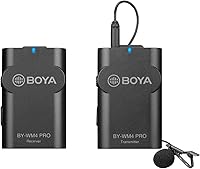
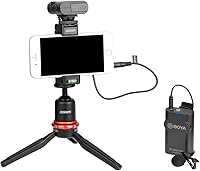
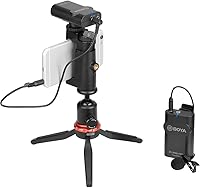
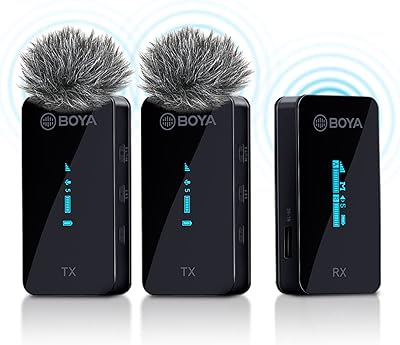
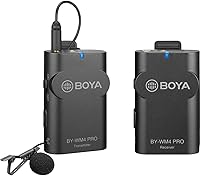
The BOYA BY-WM4 Pro K2 Wireless Lavalier Microphone is a dual-transmitter wireless kit built for video creators who want to go cable-free without spending a fortune. The package includes two transmitter units and a single receiver, which means you can mic up two subjects at once — a real advantage for interview-style shoots. Everything connects through a standard 3.5mm jack, so it works with DSLRs, smartphones, and camcorders right out of the box with no special adapters needed. The build is notably compact and lightweight, making it easy to toss in a bag and pull out on location. It holds a top-400 ranking in Professional Video Microphones on Amazon, which is respectable given its price tier, though the mixed review scores are worth paying attention to.
Features & Benefits

The wireless system operates on the 2.4GHz band, using GFSK modulation to maintain a stable connection. In ideal, open-air conditions you can push up to 50 meters of range — but indoors, with Wi-Fi routers and other wireless devices competing for the same spectrum, that number drops noticeably, so plan accordingly. The omnidirectional microphone capsule picks up sound from all directions, which gives you some forgiveness if a subject shifts position mid-interview. Audio is captured across a 35Hz–14kHz frequency range with an 84dB signal-to-noise ratio — adequate for spoken word and dialogue. The receiver also has a headphone monitoring port, so you can catch problems before they ruin a take. One practical upside: the units run on standard AAA batteries rather than a proprietary charging system — though none are included in the box, which catches some buyers off guard.

Best For

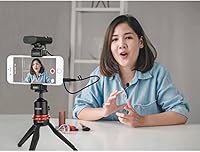
This wireless lav kit is most at home in the hands of hobbyists and early-career creators who are just stepping up from built-in camera audio. Think YouTubers doing interviews, educators filming course content on a DSLR, or smartphone creators who want a wireless audio solution without a tangled cable running across the frame. It also fits well in event videography situations where the shoot is short, informal, and doesn't demand broadcast-grade quality. What it is not suited for is professional or semi-professional production work. If you're shooting commercial clients or anything where audio quality is a deliverable expectation, this budget lavalier setup will likely leave you wanting — both in terms of build confidence and raw audio performance.

User Feedback

With a 3.6-star average across 172 ratings, the reception for the BOYA dual-transmitter system is genuinely split. Buyers who come in with realistic expectations tend to be satisfied — the pairing process is fast, the form factor is convenient, and for casual YouTube content, it gets the job done. The criticism, though, is hard to ignore. Indoor interference is a recurring complaint, with dropouts reported when other 2.4GHz devices are nearby. Several users found the included lavalier capsule underwhelming — noting that a decent wired mic in the same price range can outperform it on raw audio quality. On the positive side, BOYA's customer support and warranty handling earned genuine praise, which counts for something at this price tier.

Pros

  • Comes with two transmitters and one receiver in a single kit, ready for two-person interviews out of the box.
  • Pairs quickly with no complicated setup — power on, connect, and you are recording within minutes.
  • The 3.5mm jack connection works natively with most DSLRs, camcorders, and smartphones without extra adapters.
  • Compact enough to slip into a jacket pocket or small camera bag without adding noticeable bulk.
  • Omnidirectional pickup is forgiving of mic placement, reducing the need for precise positioning on subjects.
  • Real-time headphone monitoring on the receiver lets you catch audio issues before they ruin a take.
  • Standard AAA batteries keep things simple — easy to source and replace anywhere in the world.
  • BOYA’s customer support and warranty handling have earned genuine praise from buyers who needed assistance.
  • Two-channel simultaneous recording gives you independent audio tracks for cleaner editing flexibility.

Cons

  • Indoor wireless range drops significantly due to interference from Wi-Fi routers and other 2.4GHz devices.
  • The included lavalier capsule produces noticeable background hiss, especially in quieter recording environments.
  • AAA batteries are not included in the box, which is an annoying and commonly overlooked omission.
  • Build quality feels plasticky and fragile — the units do not inspire confidence for frequent or rough use.
  • A 3.6-star average across 172 ratings suggests reliability issues that go beyond isolated bad experiences.
  • Audio dropouts have been reported by multiple users even at moderate distances indoors.
  • The capsule underperforms compared to decent wired lavalier options available at a similar price point.
  • No USB-C or Lightning adapter is included, limiting direct plug-in compatibility with newer smartphones.
  • Two-channel recording requires the connected device and app to actually support dual-channel input, which not all do.

Ratings

The scores below reflect an AI-driven analysis of verified global user reviews for the BOYA BY-WM4 Pro K2 Wireless Lavalier Microphone, with spam, bot-generated, and incentivized feedback actively filtered out to ensure accuracy. This wireless lav kit sits in a competitive and scrutinized category, and our scoring does not shy away from the real-world frustrations buyers have reported alongside the genuine strengths. Both sides of the experience are represented transparently so you can make an informed call before purchasing.

Audio Quality
58%
42%
For casual YouTube uploads, social media clips, or online course recordings, the audio this budget lavalier setup captures is generally intelligible and usable without heavy post-processing. Buyers filming in quiet, treated spaces report acceptable vocal clarity for the price point.
A consistent noise floor and audible background hiss are the most frequent complaints — issues that become glaring when footage is edited in a quiet timeline. The included lavalier capsule simply cannot match the cleanness of wired alternatives at a comparable price, which frustrates buyers who prioritized audio fidelity.
Wireless Stability
54%
46%
In open outdoor environments — parks, rooftops, or quiet streets — the 2.4GHz connection holds up reasonably well for short-to-medium distances, and buyers filming outdoor content report fewer dropout complaints than those working indoors.
Indoor performance is where this system struggles most. Dense Wi-Fi environments, offices, and event venues generate enough 2.4GHz interference to cause noticeable dropouts, sometimes at frustratingly short distances. This is one of the most commonly cited dealbreakers in negative reviews and cannot be fixed with firmware or settings.
Ease of Setup
83%
The auto-pairing process is one of the clearest strengths of the BOYA dual-transmitter system — power on the receiver, switch on the transmitters, and they link up within seconds. Buyers consistently praise how quickly they can go from unboxing to recording, especially compared to competing systems that require app-based configuration.
A handful of users report that the pairing occasionally fails to hold after battery swaps or power cycles, requiring a re-pair. The lack of any on-screen pairing confirmation beyond LED indicators can also leave first-time users uncertain whether the connection is actually live before they start rolling.
Value for Money
67%
33%
Getting two transmitters and a receiver in a single kit at this price tier is genuinely hard to beat on paper, and buyers who treat this as a stepping stone into wireless audio tend to feel the purchase was worthwhile. For hobbyists and students on a tight gear budget, the cost-per-feature ratio is reasonable.
The value perception erodes quickly once buyers compare the audio output against wired lavalier mics in the same price bracket, which often sound noticeably cleaner. Those who expected near-professional results based on the spec sheet frequently feel the real-world performance does not justify even the modest asking price.
Build Quality
51%
49%
The compact plastic housing keeps the units light enough to clip discreetly onto a belt or camera rig without adding noticeable weight. For occasional and careful use, the build holds together adequately and shows no immediate signs of failure.
The units feel noticeably hollow and fragile — buyers who use this kit regularly report concern about the durability of the belt clip, the 3.5mm jack connections, and the overall chassis under repeated use. This is not a system built to survive the wear of professional-frequency deployment, and several users note visible wear after just a few months.
Compatibility
78%
22%
The 3.5mm jack connection means this kit plugs directly into the vast majority of DSLRs, mirrorless cameras, camcorders, and older smartphones without any adapters, which buyers consistently find convenient. It also works with audio recorders and laptops that have a 3.5mm input port.
Modern smartphones that have dropped the headphone jack — including recent iPhones and many flagship Android devices — require an additional adapter that is not included, which catches some buyers off guard. Compatibility with certain camera models that use TRS rather than TRRS pinouts can also require a specific adapter for proper mono or stereo routing.
Wireless Range
49%
51%
In genuinely open environments with no competing wireless signals, the system can sustain a stable connection over a useful distance, which works reasonably well for outdoor solo vlogging or small-scale presentations in open spaces.
The advertised 50-meter figure bears almost no resemblance to what buyers experience in real shooting conditions. Most indoor users report reliable performance cutting out well before 20 meters, and some encounter issues at distances as short as 5 to 10 meters in signal-dense environments. This gap between marketing claims and real-world performance is a recurring source of frustration.
Battery Practicality
62%
38%
Running on standard AAA batteries is a genuinely practical design choice for location shooting — you can grab replacements at any convenience store anywhere in the world, and there is no downtime waiting for a proprietary battery to recharge between shoots.
The fact that batteries are not included in the box is a frequently mentioned annoyance, particularly for buyers who expected to shoot immediately after unboxing. Battery life per set has not been widely praised either, and users running long shooting days report needing to carry spares to avoid running dry mid-session.
Latency
71%
29%
For video recording purposes, the audio-to-video sync is generally acceptable to most buyers using this kit with a DSLR or smartphone. The 2.4GHz digital transmission keeps latency low enough that it does not create obvious lip-sync issues in typical recording scenarios.
A small subset of users report needing to apply a minor audio offset in post-production to correct subtle sync drift, particularly when recording at higher video frame rates. While not a widespread problem, it is worth monitoring on your specific camera and app combination before a critical shoot.
Monitoring Experience
66%
34%
Having a dedicated headphone output on the receiver is a meaningful feature at this price point, letting shooters catch connection issues, clothing rustle, or mic placement problems in real time rather than discovering them during editing.
The headphone output level has been described by some users as underpowered, requiring headphones to be turned up to uncomfortably high volumes on certain devices to hear the monitored signal clearly. The monitoring also reflects any existing noise floor in the signal, which can make quality assessment during a shoot less reliable.
Portability
84%
At just 47g per unit and with a footprint smaller than a matchbox, the entire TX+TX+RX kit fits into a jacket pocket or small accessory pouch with ease. Buyers who shoot on the go — street interviews, travel vlogs, corporate events — consistently highlight how little space and weight this system adds to their kit.
The belt clip design works adequately for waistbands and thick fabric but struggles to grip securely on thinner materials like dress shirts or lightweight athletic wear, occasionally leading to the transmitter shifting or falling during longer takes.
Two-Person Interview Use
72%
28%
The dual-transmitter configuration is the standout practical advantage of this kit, giving creators a ready-made two-person wireless audio solution without purchasing separate units. YouTubers and podcast-style video creators specifically call this out as the main reason they chose this system over single-transmitter alternatives.
Whether you actually get two distinct audio tracks depends entirely on your camera or recording app — not all devices split the dual-channel input into separate tracks automatically. Buyers who discovered this limitation after purchase found it significantly reduced the editing flexibility they had anticipated.
Customer Support
74%
26%
BOYA’s post-purchase support stands out positively in user feedback relative to other budget audio brands. Multiple reviewers mention that warranty claims were handled without excessive friction and that support responses were timely and helpful, which is genuinely notable in this product category.
Experiences are not universally positive — some buyers report slow follow-up or difficulty reaching support depending on region and purchase channel. The 12-month warranty window is also fairly standard and does not offer the extended coverage that would give buyers additional long-term confidence.
Noise Handling
46%
54%
The omnidirectional capsule does a reasonable job of keeping vocal pickup consistent when a subject moves slightly, reducing the need for precise mic placement that a directional capsule would demand. This is helpful for spontaneous or less controlled shooting situations.
The same omnidirectional pickup that aids placement flexibility also means the mic captures ambient noise, clothing rustle, and handling noise with equal enthusiasm. In anything other than a quiet, controlled environment, background noise bleeds into recordings noticeably, and the system offers no onboard noise gate or attenuation to compensate.
Indicator & Feedback Clarity
61%
39%
The LED indicators on both transmitters and the receiver give a basic visual signal of power and connection status, which is sufficient for quickly confirming the system is live before a take begins. Most buyers find the indicators easy to read at a glance even in bright outdoor light.
The indicator system is minimal — there is no battery level display, no signal strength readout, and no clear differentiation between a weak connection and a strong one beyond a basic on or off status. Several users report being caught off guard by dead batteries or drifting connections because the LEDs gave no early warning.

Suitable for:

The BOYA BY-WM4 Pro K2 Wireless Lavalier Microphone is a strong fit for beginner and hobbyist video creators who want to cut the cable without cutting deep into their budget. YouTubers who regularly film interview-style content will appreciate having two transmitters in one kit, since it removes the need to buy separate units for a two-person setup. Student filmmakers and educators recording instructional videos on a DSLR or smartphone will find the plug-and-play 3.5mm connection refreshingly straightforward — no drivers, no complex menus, no adapters required for most common devices. It also works well for event videographers who shoot short, informal segments where pristine audio quality is less critical than speed and convenience. If your primary concern is getting usable wireless audio into your camera or phone without a steep learning curve, this wireless lav kit delivers on that specific promise.
Not suitable for:

Anyone producing content where audio quality is genuinely scrutinized should look elsewhere before committing to the BOYA dual-transmitter system. Semi-professional and professional videographers will likely find the included lavalier capsule underwhelming — background hiss and limited dynamic range become apparent when you push the audio in post-production. The 2.4GHz band it operates on is also heavily congested in indoor environments, meaning dropouts and interference are a real operational risk on busy shoot locations like offices, conference halls, or anywhere with dense Wi-Fi coverage. The build quality, while acceptable for casual use, does not inspire confidence for heavy-duty or frequent professional deployment. Put simply, this budget lavalier setup is a starting point, not a long-term investment — creators who are serious about growing their production quality will almost certainly outgrow it within a year.

Specifications

  • Wireless Frequency: The system operates on the 2.4GHz band (2405–2478MHz) using GFSK (Gauss Frequency Shift Keying) modulation for its wireless transmission.
  • Operation Range: Maximum range is rated at 50m (164ft) in open, unobstructed environments; real-world indoor range will be shorter due to interference and physical barriers.
  • Frequency Response: The microphone capsule covers a frequency range of 35Hz–14kHz with a ±3dB tolerance, making it suitable for capturing spoken dialogue and vocal content.
  • Signal-to-Noise Ratio: The system achieves a signal-to-noise ratio of 84dB or greater, which provides adequate clarity for voice recording in controlled environments.
  • Polar Pattern: The lavalier capsule uses an omnidirectional polar pattern, picking up sound evenly from all directions around the microphone element.
  • Audio Connector: Both transmitter input and receiver output use a standard 3.5mm mini jack, enabling direct connection to most cameras, smartphones, and recording devices.
  • Kit Configuration: The K2 kit includes two transmitter units (TX) and one receiver unit (RX), supporting simultaneous two-person wireless audio capture on two independent channels.
  • Monitoring Output: The receiver unit includes a dedicated headphone output rated at 65mW into a 32-ohm load, allowing real-time audio monitoring during recording.
  • Distortion: Total harmonic distortion is rated at 0.05% or less at 1kHz with a 65mW output into 32 ohms, indicating clean signal reproduction at normal operating levels.
  • Reception Sensitivity: Receiver sensitivity is rated at -90dB ±3dB (referenced to 0dB = 1V/Pa at 1kHz), reflecting the system’s ability to detect and process the wireless signal reliably.
  • Unit Dimensions: Each transmitter and receiver unit measures 4.5 x 7 x 3.5cm (approximately 1.8 x 2.8 x 1.4 inches), making the units pocket-sized and easy to conceal on a subject.
  • Unit Weight: Each transmitter and receiver weighs 47g (approximately 1.7oz) without batteries installed, keeping the overall system lightweight for on-location use.
  • Power Source: Each unit is powered by 2 AAA batteries (not included in the box); there is no built-in rechargeable battery or USB charging on any unit in this kit.
  • Transmitter Output: The RF output level from the transmitter is rated at 3mW, which is within standard low-power wireless audio transmission ranges.
  • Compatible Devices: The system is compatible with DSLR and mirrorless cameras, consumer camcorders, smartphones (via 3.5mm jack), audio recorders, and PCs with a 3.5mm input.
  • Microphone Form Factor: The included microphone is a clip-on lavalier style, designed to attach to clothing near the speaker’s chest for hands-free voice capture.
  • Warranty: BOYA provides a 12-month product warranty covering manufacturing defects, backed by post-sales customer support through their official channels.

Related Reviews
Neewer CM28 Pro Wireless Lavalier Microphone System
79%
88%
Audio Clarity
91%
Standalone Recording
67%
Wireless Range & Stability
86%
Battery Life
83%
Charging Case Design
More
Saramonic Blink500 Pro B3 Wireless Lavalier Microphone
69%
83%
Ease of Setup
67%
Audio Quality
41%
Device Compatibility
44%
App Compatibility
81%
Battery Life
More
BOYA BY-M1 Lavalier Microphone
69%
73%
Audio Quality
88%
Value for Money
82%
Ease of Setup
69%
Device Compatibility
58%
Build Quality
More
VEZQUA USB-C Wireless Lavalier Microphone
75%
93%
Ease of Setup
81%
Audio Clarity
74%
Noise Cancellation
72%
Battery Life
83%
Wireless Stability
More
Lincisoonic A6 Wireless Lavalier Microphone
82%
88%
Audio Clarity
94%
Ease of Setup
83%
Noise Cancellation
91%
Battery & Charging Case
71%
Wind Noise Rejection
More
iyes.top YE0-002 Wireless Lavalier Microphone
75%
91%
Ease of Setup
74%
Audio Clarity
68%
Wireless Range
59%
Build Quality
83%
Battery Life
More
Deity Connect Dual-Channel Wireless Lavalier Microphone
79%
88%
Audio Quality
76%
Signal Stability
89%
Dual-Channel Performance
67%
Ease of Use
78%
Value for Money
More
Godox Magic XT1
Godox Magic XT1
86%
89%
Audio Fidelity
92%
User Interface
91%
Battery Endurance
94%
Form Factor
88%
Safety Features
More
Saramonic UwMIC9 UHF Wireless Lavalier Microphone System
78%
78%
Audio Quality
74%
Signal Stability
84%
Build Quality
86%
Ease of Setup
88%
Value for Money
More
NEEWER KM15 Wireless Lavalier Microphone System
87%
89%
Sound Quality
92%
Ease of Use
87%
Battery Life
83%
Build Quality
90%
Portability
More

FAQ

It depends on your phone. If your device has a 3.5mm headphone jack, you can plug the receiver directly in and it should work. For newer iPhones or Android phones that have dropped the headphone jack, you will need a Lightning-to-3.5mm or USB-C-to-3.5mm adapter, which is not included in the box. Worth picking one up before your first shoot.

Yes, both transmitters can operate simultaneously and feed into the single receiver, which handles both channels. That said, whether your recording device captures them as two separate audio tracks depends on the camera or app you are using — not all devices split dual-channel input cleanly.

Treat it as an outdoor, line-of-sight figure. In a typical indoor environment — an office, a living room, a conference space — you will likely get reliable performance in the 10 to 20 meter range before dropouts start becoming a concern. Wi-Fi routers, Bluetooth devices, and walls all chip away at that rated maximum quickly.

No, batteries are not included, and this trips up a fair number of buyers. Each unit requires 2 AAA batteries, so you will need 4 AAA batteries in total to power both transmitters and the receiver before your first use. Grab a pack before the kit arrives.

Pairing is straightforward — power on the receiver first, then turn on each transmitter and they should link up automatically. There is no PIN entry or complex menu navigation involved. Most users report being up and running within a minute or two of unboxing.

Unfortunately, yes — background hiss is one of the more consistent criticisms from real users of the BOYA BY-WM4 Pro K2 Wireless Lavalier Microphone. The 84dB signal-to-noise ratio is adequate but not exceptional, and the included lavalier capsule itself contributes some noise floor. In loud or busy environments it is less noticeable, but in quiet recording situations it can be audible. Running a light noise reduction pass in post-production helps.

Yes, as long as your camera has a 3.5mm external microphone input — which most DSLRs and mirrorless cameras do — you simply plug the receiver into that port and set the camera to record from the external mic. No special settings or firmware are required on the camera side.

Absolutely. You are not required to use both transmitters at once. If you are filming a solo presenter or doing a one-person vlog, just power up one transmitter and the receiver and leave the second transmitter off. The system works fine in a single-transmitter configuration.

Honest answer: it feels budget-grade. The plastic housing is lightweight, which is nice for portability, but it does not feel particularly rugged. For casual or occasional shooting it holds up fine, but if you are using this kit multiple times a week in demanding conditions, the longevity is uncertain. Treat it carefully and it should serve you well enough for hobby use.

BOYA offers a 12-month warranty, and customer service responsiveness has actually been a bright spot in user feedback. A number of buyers who ran into issues reported that BOYA’s support team followed up and resolved their problems. That does not guarantee a perfect experience, but it is reassuring compared to brands that go silent after the sale.