Overview

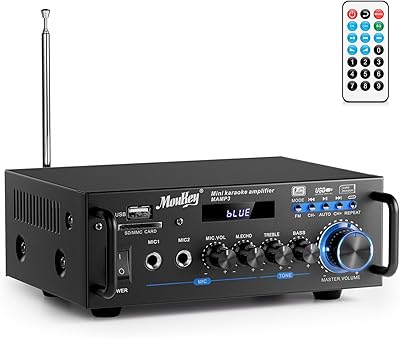
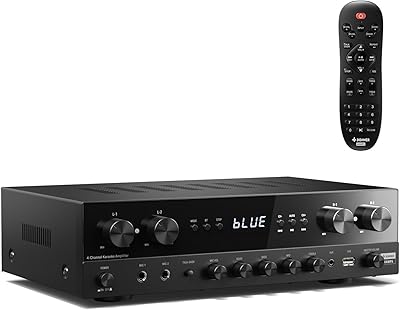
The Moukey MAMP1 Stereo Receiver Amplifier sits in an interesting spot — compact enough for a desk or shelf, but loaded with enough inputs and controls to handle a real home audio setup. Before anything else, address the power spec: the 400W figure is peak power under ideal conditions. The actual output is 25W per channel RMS, which is what matters day-to-day. That's honest mid-tier power for bookshelf speakers in smaller rooms. The plastic housing is lightweight and functional without pretending to be anything premium. Still, the front-panel LED display and bundled remote give it a more polished look than most budget amps manage at this price point.
Features & Benefits

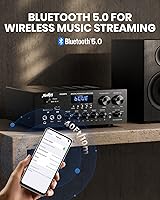
What sets this compact receiver apart from simpler Bluetooth amps is the sheer range of ways to connect to it. You get seven input options — dual RCA pairs, a 3.5mm AUX jack, USB and SD card slots, FM radio, and Bluetooth 5.0 for wireless streaming. The two 6.35mm microphone inputs with dedicated echo and volume knobs are the real differentiator here; that's a feature set you'd normally spend considerably more to find. Bass, treble, and balance knobs sit right on the front panel, so tuning is hands-on and immediate. Bluetooth range indoors realistically lands around 25–30 feet, though it stays stable and stutter-free within that distance.

Best For

This stereo amplifier makes the most sense for people building a home karaoke setup on a budget — the dual mic inputs with echo control genuinely change what's possible at this price. It also works well in small living rooms or bedrooms where you're driving a pair of bookshelf speakers and want more than a portable speaker can deliver. Students furnishing a dorm room will appreciate having one box handle Bluetooth, FM radio, USB playback, and wired sources all at once. If you already own a proper AV receiver, skip it — but as a first real amplifier or a karaoke-focused second system, it covers the bases well.

User Feedback

With close to 5,000 ratings and a 4.3-star average, the Moukey amp clearly connects with its intended audience. Buyers consistently praise how straightforward Bluetooth pairing is, and karaoke users tend to be genuinely satisfied — the mic echo functionality works as advertised. On the downside, some reviewers flag that FM reception varies noticeably depending on antenna placement, which can be fiddly in certain rooms. A few users mention the remote's limited functionality, since it only controls volume in specific modes. The RMS output is also a recurring conversation, with some buyers wishing they had matched it to more efficient speakers from the start.

Pros

  • Dual microphone inputs with echo control make home karaoke genuinely practical at this budget.
  • Seven input sources let you consolidate multiple devices into one compact receiver without a separate switcher.
  • Bluetooth 5.0 pairs quickly with phones, tablets, and laptops and stays stable in small rooms.
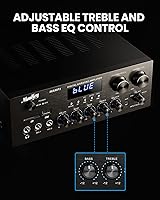
  • Physical bass, treble, and balance knobs let you tune sound on the fly without any app or software.
  • Banana plug speaker terminals keep wiring clean and make swapping speakers fast and hassle-free.
  • The front-panel LED display clearly shows active input and volume at a glance from across the room.
  • USB and SD card playback means you can listen to a local music library without streaming or Wi-Fi.
  • A bundled remote control and FM antenna with auto-scan add genuine convenience right out of the box.
  • At its price point, the Moukey MAMP1 Stereo Receiver Amplifier offers a feature set that costs considerably more from established audio brands.
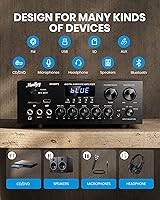
  • The included headphone jack lets you switch to private listening across any input without rewiring.

Cons

  • The 400W peak power figure is misleading — real-world output is 25W RMS per channel, which surprises some buyers.
  • FM reception is inconsistent and highly dependent on antenna placement, especially in suburban or rural areas.
  • The remote only controls volume in select modes and cannot switch input sources from across the room.
  • USB storage is capped at 64GB and SD cards at 32GB, which limits large local music libraries.
  • Background hiss becomes noticeable at higher volumes when using sensitive speakers or headphones.
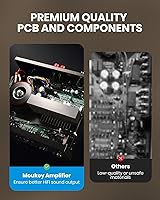
  • Plastic chassis construction raises questions about long-term durability with regular daily use.
  • The two-band EQ offers limited tonal correction — there is no mid-frequency control or graphic equalizer.
  • Headphone output is not well-matched for low-impedance earbuds, making volume control finicky at low levels.
  • The user manual is sparse and leaves USB navigation and FM preset saving poorly explained.
  • No speaker wire or RCA cables are included, so first-time buyers will need additional purchases before setup is complete.

Ratings

The Moukey MAMP1 Stereo Receiver Amplifier has been scored by our AI system after analyzing thousands of verified global purchase reviews, with spam, bot-generated, and incentivized submissions actively filtered out. The result is an honest breakdown that reflects both where this compact amp genuinely delivers and where real buyers have run into friction. Strengths and limitations are weighted equally so you can make a fully informed decision.
Value for Money
88%
For buyers coming from basic Bluetooth speakers or entry-level desktop amps, the feature-to-price ratio here is hard to argue with. Getting dual mic inputs, multiple RCA connections, USB and SD playback, and Bluetooth 5.0 in a single compact unit would cost significantly more from any recognizable audio brand.
A small segment of buyers felt misled by the 400W peak power headline, expecting considerably more volume than the 25W RMS per channel actually delivers. Once expectations are calibrated correctly, satisfaction goes up — but the marketing framing does create some early disappointment.
Karaoke Performance
91%
This is where the Moukey amp genuinely stands out among budget receivers. The two dedicated 6.35mm microphone inputs with individual echo and volume control work reliably for casual home karaoke nights, and users consistently report that the echo effect adds a satisfying depth without sounding cheap or distorted at moderate volumes.
Heavy echo at higher mic volumes can bleed into speaker output and muddy the overall mix, which more experienced karaoke users find limiting. There is no separate reverb control, so fine-tuning the mic sound beyond basic echo is not possible without an external processor.
Connectivity & Input Range
89%
Seven input sources on a receiver this size is genuinely unusual. Buyers who own a CD player, a turntable with a preamp, a TV, and a phone can route all of them through this single box without juggling cables or buying a separate switcher — that convenience factor comes up repeatedly in positive reviews.
The USB port tops out at 64GB and the SD slot at 32GB, which feels restrictive for users with large local music libraries. Additionally, there is no optical or digital coaxial input, so connecting a modern soundbar source or gaming console digitally is not an option.
Bluetooth Reliability
83%
Pairing is consistently described as fast and intuitive across Android and iOS devices. Within a typical small room or apartment, the connection holds steady without dropout, and Bluetooth 5.0 handles the handoff between devices reasonably well compared to older amp firmware.
Real-world indoor range falls noticeably short of the 40-foot spec once walls or furniture enter the picture. Users in larger open-plan spaces or those trying to stream from an adjacent room report intermittent dropout, which is a common real-world limitation the spec sheet does not convey.
Sound Quality
74%
26%
For bookshelf speakers in a bedroom or small living room, the audio output is clean and well-balanced at moderate listening volumes. The onboard bass, treble, and balance controls are responsive and let users shape the sound to their preference without needing any companion app or software.
At higher volume levels, some buyers notice a thinning in the midrange and a slight harshness in the highs, which is typical of amplifiers in this power class. The 80dB signal-to-noise ratio is acceptable but not exceptional — background hiss becomes audible during quiet passages when using sensitive speakers.
Build Quality
62%
38%
The unit feels solid enough on a shelf and the front-panel knobs have a satisfying resistance that does not feel flimsy on first use. For the price tier, the fit and finish are acceptable and the LED display is clearly legible from across a room.
The chassis is predominantly plastic, and the overall construction does not inspire confidence for long-term durability. A few reviewers have mentioned knobs loosening after several months of regular use, and the lightweight body can shift on a surface if cables are tugged.
EQ & Tone Controls
78%
22%
Having physical bass, treble, and balance knobs rather than a software menu makes real-time adjustments quick and intuitive. Users who switch between music genres appreciate being able to dial in more bass for hip-hop and then back off for acoustic listening without pausing playback.
The EQ range is limited to a simple two-band tone control with no mid-frequency adjustment, which audiophiles and home theater enthusiasts will find frustrating. There is no graphic equalizer option, so correcting room acoustics or speaker coloration is largely done by ear with blunt tools.
FM Radio
66%
34%
Auto-scan works reliably in areas with strong broadcast signals and the included antenna is functional for basic indoor use. Buyers in urban areas with dense FM coverage generally report clean reception across most stations.
Reception quality is highly dependent on antenna positioning and local signal strength, and rural or semi-urban users find the included wire antenna inadequate without repositioning it repeatedly. The FM tuner is a convenience feature rather than a high-fidelity one, and it shows.
Remote Control
57%
43%
The bundled remote means you do not have to get up to adjust volume during Bluetooth or FM listening, which is a legitimate quality-of-life addition at this price point. The button layout is straightforward and legible.
The remote only controls volume in MP3, Bluetooth, and FM modes — it cannot switch input sources or adjust EQ remotely. Its effective range is also shorter than expected, with several reviewers noting it needs near line-of-sight to function reliably beyond about 15 feet.
Setup & Ease of Use
86%
Most buyers report being up and running within minutes of unboxing. Input switching via the front-panel knob is intuitive, and Bluetooth pairing requires no app or manual. The LED display clearly shows the active source and mode, which removes guesswork.
The user manual is thin and leaves some features, particularly USB folder navigation and FM preset saving, underdocumented. A handful of buyers had to search online to understand how to use the track and folder controls on the front panel.
Headphone Output
69%
31%
The 6.35mm headphone jack is a thoughtful inclusion that lets users switch to private listening without rewiring anything. It works across the same input sources as the speaker outputs, which keeps the experience consistent.
Headphone output volume and impedance matching is not ideal for low-impedance earbuds, which can sound overly loud with minimal knob movement. High-impedance headphones, on the other hand, may feel underpowered at higher listening volumes.
Speaker Output Compatibility
71%
29%
Banana plug terminals make connecting and swapping speakers clean and cable-management friendly. The amp handles 4-ohm to 8-ohm speaker loads without issue in everyday use, and most entry-level bookshelf speakers pair with it without problems.
At 25W RMS per channel, this stereo amplifier is not suitable for large floor-standing speakers or any driver with low sensitivity ratings. Users who push it hard with demanding speakers report audible distortion and thermal shutoff triggering at higher volumes.
LED Display & Interface
77%
23%
The front-panel LED screen is bright enough to read in a well-lit room and clearly displays the active input, volume level, and FM frequency. It adds a layer of usability that many competing budget amps simply skip.
The display is not visible at sharp angles, which can be a nuisance if the unit is positioned low or off to the side. Some buyers also note that the LED brightness is fixed and cannot be dimmed for late-night use in a dark room.
Package & Accessories
73%
27%
Moukey includes the remote control, FM antenna, and a power cable in the box, which covers the basics without requiring immediate additional purchases. Having the antenna included is a small but appreciated detail.
No speaker wire or RCA cables are included, meaning first-time buyers will need to source these separately before the unit is fully functional. The packaging is adequate but not particularly protective for shipping, and a few buyers have reported cosmetic damage on arrival.

Suitable for:

The Moukey MAMP1 Stereo Receiver Amplifier is a strong fit for anyone setting up a casual home karaoke system without wanting to spend serious money — the dual microphone inputs with echo control are a genuine rarity at this price point, and they work well enough for living room sing-alongs and small gatherings. Students furnishing a dorm room or studio apartment will appreciate having one compact box handle Bluetooth streaming, FM radio, USB and SD card playback, and wired sources all at once, eliminating the need for multiple devices. It also suits buyers who are upgrading from a portable Bluetooth speaker to a real amplifier for the first time and want to drive a pair of bookshelf speakers properly. If your listening space is a small-to-medium room and your speakers are reasonably sensitive, this compact receiver delivers a satisfying step up in audio control and flexibility. Anyone with a mix of older and newer devices — say, a CD player, a turntable with a preamp, and a smartphone — will find the broad input selection genuinely practical rather than just a spec-sheet talking point.
Not suitable for:

Buyers expecting serious amplifier power should look elsewhere — the Moukey MAMP1 Stereo Receiver Amplifier delivers 25W RMS per channel, and while that is workable for efficient bookshelf speakers in small rooms, it is not enough to drive large floor-standing speakers or fill a bigger open-plan living area with authority. Audiophiles or home theater enthusiasts who care about low noise floors, precise imaging, and high-fidelity signal paths will quickly find the limitations of a receiver in this price and build class. The plastic construction, while acceptable for casual use, does not hold up to the scrutiny of buyers who prioritize long-term durability or a premium tactile experience. Anyone needing optical, HDMI ARC, or digital coaxial inputs for a modern TV or gaming setup will find this stereo amplifier's connectivity options outdated for that specific use case. If you already own a mid-range or high-end AV receiver, there is nothing here that justifies a replacement — this unit is an entry point, not an upgrade path.
Specifications

  • RMS Power: Delivers 25W per channel into 2 channels (2.0 stereo), which is the continuous, real-world output figure buyers should use when matching speakers.
  • Peak Power: Rated at 400W peak, a momentary maximum under ideal lab conditions that does not reflect sustained listening performance.
  • Frequency Response: Covers the full audible range from 20Hz to 20kHz, meaning it reproduces both deep bass and high-frequency detail without hardware-imposed cutoffs.
  • Signal-to-Noise Ratio: Measured at 80dB SNR, which is acceptable for casual listening but may allow faint background hiss on highly sensitive speakers at low volumes.
  • Total Harmonic Distortion: THD is rated at under 1%, indicating the amplifier introduces minimal audible coloration or distortion at normal operating volumes.
  • Bluetooth Version: Equipped with Bluetooth 5.0, supporting stable wireless streaming from smartphones, tablets, and computers with a specified range of approximately 40 feet in open conditions.
  • Wired Inputs: Accepts signal from two pairs of RCA audio inputs, one 3.5mm AUX jack, one USB port (up to 64GB), and one SD card slot (up to 32GB).
  • Microphone Inputs: Features two 6.35mm (1/4-inch) microphone jacks, each with independent echo and volume control knobs on the front panel.
  • Speaker Output: Speaker connections use banana plug terminals, supporting standard 4-ohm to 8-ohm passive speakers via standard bare wire or banana plug cables.
  • Additional Outputs: Includes one RCA line output for connecting to an external amplifier or subwoofer, and one 6.35mm headphone jack for private listening.
  • FM Radio: Built-in FM tuner with auto-scan functionality; a wire FM antenna is included in the box for improved signal reception.
  • Display: Front-panel LED screen shows the active input source, volume level, and FM station frequency, readable under normal room lighting conditions.
  • Remote Control: An infrared remote control is included but is limited to volume adjustment in MP3, Bluetooth, and FM modes only; input switching is not supported remotely.
  • Tone Controls: Front-panel knobs provide independent adjustment of bass, treble, and stereo balance without requiring any software or companion application.
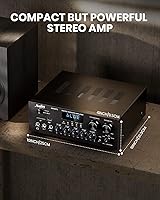
  • Dimensions: The unit measures 9.84″ deep by 9.76″ wide by 3.87″ tall, making it suitable for placement on a shelf, desk, or inside an open media cabinet.
  • Color & Finish: Available in black with a matte plastic exterior finish designed for a clean, unobtrusive look in home audio setups.
  • Channel Configuration: Operates as a 2.0 stereo amplifier with no surround sound processing or subwoofer channel output built in.
  • Compatibility: Works with smartphones, tablets, iPhones, iPads, laptops, and desktop computers via Bluetooth, as well as any passive speakers within the supported impedance range.

Related Reviews

Moukey MK0153 Karaoke Amplifier
73%
88%
Value for Money
91%
Ease of Setup
72%
Microphone Performance
78%
Bluetooth Connectivity
58%
Audio Output Power
More
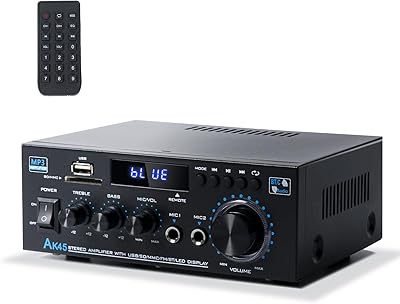
NEOHIPO AK45 Bluetooth Stereo Receiver Amplifier
73%
83%
Value for Money
91%
Ease of Setup
71%
Sound Quality
88%
Input Versatility
67%
Bluetooth Stability
More
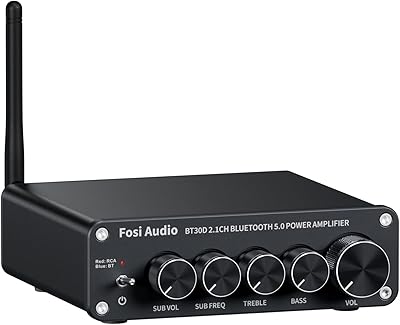
Fosi Audio BT30D
Fosi Audio BT30D
78%
83%
Sound Quality
88%
Subwoofer Performance
81%
Bluetooth Connectivity
91%
Value for Money
62%
Build Quality
More
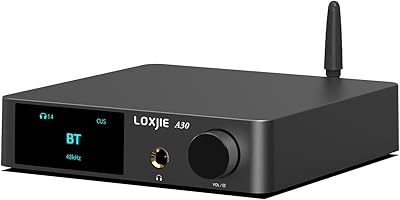
LOXJIE A30
LOXJIE A30
79%
86%
Sound Quality
82%
Build Quality
91%
Value for Money
89%
Input Versatility
63%
Bluetooth Performance
More
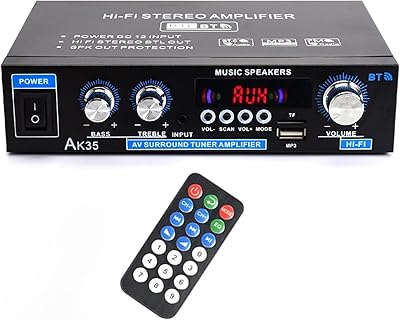
AK35 Stereo Mini Amplifier
71%
83%
Value for Money
67%
Sound Quality
71%
Bluetooth Performance
54%
Build Quality
89%
Setup & Ease of Use
More
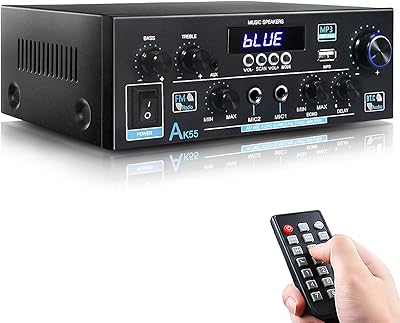
AK55 Stereo Amplifier
79%
88%
Value for Money
74%
Sound Quality
86%
Karaoke & Mic Performance
83%
Bluetooth Connectivity
91%
Input Variety
More
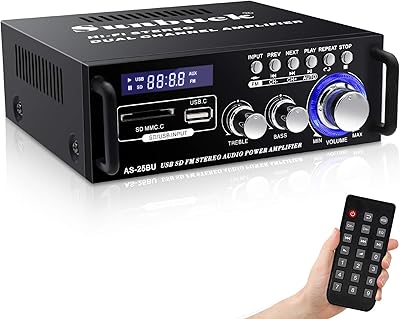
Sunbuck AS-25BU Stereo Amplifier
73%
88%
Value for Money
74%
Sound Quality
91%
Connectivity & Input Range
63%
Bluetooth Performance
51%
Power Output Accuracy
More
Donner MAMP5 Stereo Receiver
77%
88%
Value for Money
74%
Sound Quality
67%
Power & Amplification
91%
Connectivity & Inputs
82%
Bluetooth Performance
More
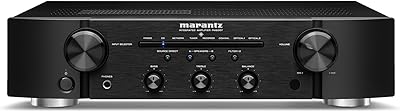
Marantz PM6007 Stereo Amplifier
84%
94%
Sound Quality & Clarity
90%
Build Quality & Durability
85%
Ease of Use & Setup
55%
Connectivity Options
88%
Power Output
More
Onkyo TX-8220 Stereo Receiver
79%
88%
Sound Quality
91%
Build Quality
63%
Bluetooth Performance
84%
Phono Stage Quality
86%
Input & Connectivity Options
More

FAQ

Not in the way most people assume. The 400W figure is the peak power rating, which describes a theoretical maximum under perfect lab conditions for a brief instant. The number that matters for real listening is the RMS rating: 25W per channel. That is the continuous, sustained output during normal use, and it is what you should match against your speaker's power handling specs.

Yes, the Moukey MAMP1 Stereo Receiver Amplifier has two independent 6.35mm microphone inputs, both active simultaneously. Each has its own echo and volume knob on the front panel, so two singers can use the system at once with individually adjusted levels. You will need standard 6.35mm dynamic microphones — the unit does not supply phantom power for condenser mics.
Most likely yes, provided your speakers are 4-ohm or 8-ohm passive speakers with a sensitivity rating of around 85dB or higher. At 25W RMS per channel, this compact receiver drives efficient bookshelf speakers well in small-to-medium rooms. If your speakers are large floor-standers or have low sensitivity, you may hit the amp's limits before reaching satisfying volume levels.

In practice, expect reliable performance within about 25 to 30 feet in a typical indoor environment. The 40-foot spec assumes an open, unobstructed space, which most homes are not. Through walls or around corners, range drops noticeably, so if your phone will often be in an adjacent room, keep that limitation in mind.

Only if your turntable has a built-in phono preamp, which many modern entry-level turntables do. This stereo amplifier does not have a dedicated phono input with the RIAA equalization stage that a raw turntable signal requires. If your turntable outputs a standard line-level signal, connect it to one of the RCA inputs and you will be fine.

Unfortunately not. The included remote only adjusts volume, and only when the unit is set to MP3, Bluetooth, or FM mode. Switching between input sources — say, from AUX to USB — has to be done manually using the front-panel knob. It is a notable limitation if you were hoping for full remote operation from the couch.

Yes, there is an RCA line output on the back that you can run to a powered subwoofer with its own built-in amplifier. The unit does not have a dedicated subwoofer channel or crossover control, so you would rely on the subwoofer's own settings to blend it with your main speakers.

It varies quite a bit depending on your location and how you position the included wire antenna. In cities and suburban areas with strong broadcast signals, reception is generally clean once you find a good antenna position. In less populated areas or in buildings with a lot of interference, the basic wire antenna can struggle, and repositioning it often becomes a trial-and-error process.

It is functional and covers the basics — you can plug in headphones and listen to any connected source without disturbing anyone nearby. That said, it is not optimized for audiophile headphone use. Low-impedance earbuds can feel overly sensitive to small volume knob movements, and very high-impedance headphones may not get loud enough. For casual listening it works; for critical headphone sessions you would want a dedicated headphone amp.

It is honest budget construction, which means a mostly plastic chassis that is lightweight and functional but not built to withstand years of rough handling. The knobs feel reasonably solid initially, though some users have reported loosening after extended use. If you treat it as a stationary shelf unit and do not move it around frequently, it should hold up for everyday casual use without major issues.