Overview

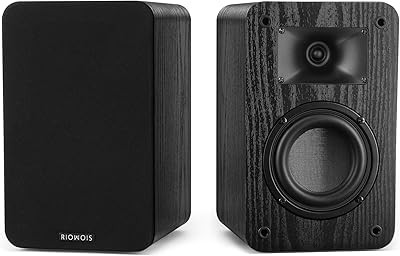
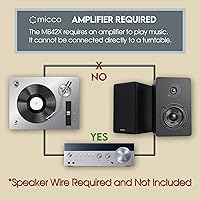
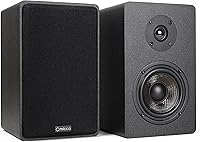
The Micca MB42X Bookshelf Speakers are a refined step up from Micca's original compact design, carrying forward everything that made the first version popular while addressing its most notable shortcoming — the crossover. Built for stereo listening, home theater surround duties, or near-field desktop use, these bookshelf speakers punch well above their price class. One thing buyers sometimes overlook before purchasing: these are passive speakers, meaning you'll need a separate amplifier or receiver to drive them. That's not a knock — just worth knowing upfront. For entry-level audiophiles looking to build a real system without breaking the bank, the MB42X pair is a genuinely compelling starting point.

Features & Benefits

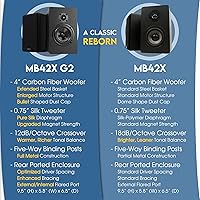
At the heart of these bookshelf speakers is a 4-inch carbon fiber woofer that delivers noticeably tighter, more defined bass than the flimsy paper-cone drivers you typically find at this price. Paired with a 0.75-inch silk dome tweeter, the high end stays smooth without becoming harsh or sibilant on vocals. What really sets the MB42X pair apart, though, is the advanced 18dB crossover — complete with Zobel network and baffle step compensation — which balances the two drivers in a way that cheaper speakers simply don't bother with. The rear-ported enclosure pushes low-frequency response down to 60Hz, and the 5-way binding posts give you real flexibility when connecting to an amp.

Best For

These bookshelf speakers are a natural fit for anyone building their first real audio setup on a reasonable budget — whether that means a stereo living room system, desktop near-field listening at a computer, or filling out the surround channels in a home theater. They work especially well in small to medium-sized rooms where a large tower speaker would be overkill. If you already have a stereo receiver or integrated amp collecting dust, the MB42X pair is an easy, low-risk upgrade to whatever you're currently using. They're equally at home in a bedroom or office where you just want honest, clear sound without the clutter of a bulky setup.

User Feedback

With thousands of ratings accumulated over more than a decade, Micca's compact speakers have earned a reputation that's hard to dismiss. Most buyers are genuinely surprised by how open and balanced these sound straight out of the box — though a handful note the sound improves after break-in. The matte black finish draws consistent praise for looking more expensive than it is. On the flip side, the 85dB sensitivity rating means they won't perform well with an underpowered amp — pair them with something weak and you'll notice immediately. Bass depth is also a recurring topic: most listeners find it satisfying for the cabinet size, but anyone wanting real low-end weight should plan on adding a dedicated subwoofer.

Pros

  • The Micca MB42X Bookshelf Speakers consistently outperform expectations for their price class in real-world listening tests.
  • The carbon fiber woofer delivers noticeably tighter and more controlled bass than paper-cone drivers common at this price.
  • The silk dome tweeter keeps high frequencies smooth and fatigue-free even during extended listening sessions.
  • The advanced 18dB crossover is the standout engineering achievement here — it produces a coherent, balanced sound most budget speakers can't match.
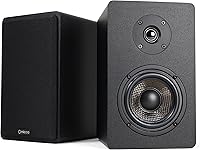
  • The matte black finish looks far more refined than the price tag suggests, fitting naturally into modern home setups.
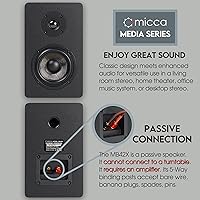
  • Full 5-way binding posts allow flexible wiring options, including banana plugs, spade connectors, and bare wire.
  • The magnetic front grille attaches and detaches cleanly, leaving a tidy front baffle with no visible mounting holes.
  • Long-term owners report consistent performance over years of use, suggesting solid manufacturing reliability.
  • Their compact footprint makes them genuinely easy to place on a desk, shelf, or stand in almost any room.
  • A large and long-standing base of verified buyer reviews makes it easy to set realistic expectations before purchasing.

Cons

  • A separate amplifier or receiver is required — first-time buyers often underestimate this added cost and complexity.
  • The 85dB sensitivity rating means underpowered amps will leave these bookshelf speakers sounding flat and dynamically lifeless.
  • Bass extension below 60Hz is essentially nonexistent, making a subwoofer a practical necessity for bass-heavy music or movies.
  • Some buyers report a noticeable break-in period before the drivers loosen up and the sound fully opens up.
  • The rear-ported design punishes placement in tight spaces or flush against walls, limiting flexibility in small rooms.
  • Channel-matching consistency can occasionally vary between units, which is a concern for listeners sensitive to stereo balance.
  • The vinyl cabinet wrap, while attractive, scuffs and marks with regular handling more readily than a painted or lacquered finish.
  • Low-sensitivity performance with weaker amplifiers often gets misattributed as a speaker flaw, causing undeserved returns.
  • Only available in black, which limits options for buyers with lighter or wood-toned interior aesthetics.

Ratings

The Micca MB42X Bookshelf Speakers have been put through rigorous analysis using thousands of verified buyer reviews sourced globally — with spam, incentivized submissions, and bot activity actively filtered out before scoring. What you see below reflects an honest, unvarnished picture of how these compact speakers perform across real-world listening environments, from desktop setups to home theater configurations. Both the standout strengths and the legitimate frustrations are reflected transparently in every score.

Sound Quality
88%
For the price class, the overall sound signature genuinely impresses. Buyers consistently describe the presentation as open and balanced, with vocals sitting naturally in the mix and instruments retaining decent separation. Many listeners used these as a reference point when upgrading from low-quality computer speakers or cheap all-in-one systems.
The sound can feel slightly thin in larger rooms where the small cabinet simply runs out of air to move. Listeners accustomed to larger floorstanders or powered studio monitors occasionally find the overall scale of the soundstage a bit modest, particularly on orchestral or bass-heavy tracks.
Bass Performance
71%
29%
For a 4-inch driver in a compact ported cabinet, the low-end response is genuinely punchy and controlled. Rock, pop, and vocal-focused genres come through with satisfying weight, and the rear port adds enough extension to keep music from sounding thin during casual listening sessions.
Deep bass below 60Hz simply isn't there — physics limits what a cabinet this size can do. Users who listen to electronic music, hip-hop, or cinematic soundtracks frequently note that a subwoofer is essentially required to fill the low-end gap, which adds cost and complexity to the setup.
Treble Clarity
86%
The silk dome tweeter earns its place at this price point, delivering a smooth and non-fatiguing high end that holds up well over long listening sessions. Cymbals, acoustic guitar strings, and breathy vocals all come through with enough detail to satisfy casual audiophiles without edginess or harshness.
A small number of listeners find the treble slightly recessed compared to more forward-sounding budget alternatives, which can make the presentation feel a touch laid-back depending on the amp pairing. Source quality matters here — poor-quality streaming or low-bitrate audio tends to expose a subtle lack of air in the upper registers.
Midrange Accuracy
84%
Midrange reproduction is one of the stronger suits of Micca's compact speakers, particularly for vocals and acoustic instruments. The carbon fiber woofer and the well-engineered crossover work together to keep the midrange clean and uncolored, which is rare at this price and makes a real difference when listening to singer-songwriter recordings or podcasts.
At higher volumes, some buyers report a mild congestion in the upper midrange — particularly with dense mixes where multiple instruments compete for the same frequency space. It's subtle, but listeners who push the speakers hard in a medium-sized room may notice a slight compression in that region.
Crossover Engineering
91%
The 18dB-per-octave crossover with Zobel network and baffle step compensation is genuinely the headline upgrade over the original MB42, and informed buyers notice it immediately. The transition between the woofer and tweeter is smooth and coherent, contributing directly to that open, balanced sound that gets praised so consistently in user reviews.
The engineering here is excellent for the category, but it's also not adjustable — you get one voicing and that's it. Listeners who prefer a brighter or bassier tuning have no way to tailor the response beyond what their amplifier's tone controls can provide, which is a minor but real limitation for those with specific sonic preferences.
Amplifier Compatibility
67%
33%
The 5-way binding posts make connecting to virtually any amp straightforward — banana plugs, spade connectors, or bare wire all work cleanly. For users who already own a capable integrated amp or AV receiver with decent current delivery, the MB42X pair responds well and scales up nicely with better source equipment.
The 85dB sensitivity rating is the most common buyer frustration in this product's review history. Paired with a low-powered amp or a budget receiver running multiple zones, these speakers can sound lifeless and dynamically compressed. Users with underpowered setups sometimes mistake the amp limitation for a flaw in the speakers themselves, leading to undeserved disappointment.
Build Quality
82%
18%
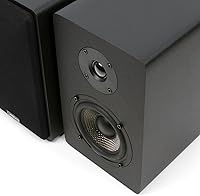
The matte black vinyl wrap looks noticeably more refined than competing speakers in this bracket, and the cabinet feels solid without any obvious flex or hollow resonance when tapped. The magnetic grille system is a thoughtful touch that works reliably — it attaches flush and removes cleanly without the ugly peg holes that most budget speakers leave exposed.
The vinyl finish, while attractive, is susceptible to scuffs and fingerprints with regular handling. A few buyers also note that the cabinet material is MDF wrapped in vinyl rather than a genuine wood finish, which is perfectly standard at this price but worth setting expectations for buyers expecting premium cabinetry.
Value for Money
93%
Across thousands of reviews spanning over a decade, value for money is the single most consistently praised attribute of the MB42X pair. Buyers upgrading from soundbars, desktop computer speakers, or budget shelf systems almost universally describe the jump in audio quality as dramatic relative to the cost of entry.
The total cost of ownership is higher than the speaker price alone implies — a capable amplifier or receiver is required and adds significant expense for buyers starting from scratch. First-time buyers who don't factor in the amp cost can feel caught off guard, which tempers the pure value proposition for complete beginners.
Design & Aesthetics
83%
The clean, minimal front baffle with no visible grill holes when the magnetic cover is removed gives these bookshelf speakers a far more intentional look than their price suggests. They blend naturally into a bookshelf, desk setup, or entertainment unit without demanding visual attention or clashing with modern home decor.
Color options are limited to black, which suits most environments but gives buyers with lighter or wood-toned interiors little choice. The rectangular cabinet profile is functional but unremarkable — those drawn to more distinctive or retro-styled speaker designs won't find much personality in the external form.
Setup & Ease of Use
79%
21%
Physical setup is genuinely simple — unbox, connect speaker wire to the binding posts, and you're done. The speakers can be placed on a desk, shelf, or stand without special mounting hardware, and their compact footprint means they fit comfortably in spaces where larger speakers simply wouldn't work.
The passive design adds a layer of complexity that trips up first-time buyers unfamiliar with home audio. Choosing the right amplifier, running speaker wire, and understanding impedance matching are all tasks that don't come with instructions in the box, and the learning curve for total beginners can be genuinely frustrating.
Break-In Period
66%
34%
A meaningful portion of buyers report that these bookshelf speakers noticeably open up after 20 to 40 hours of use, with the bass becoming more controlled and the midrange gaining a bit more ease and fluidity. For buyers who are patient, the out-of-box experience is not necessarily the final word on how they sound.
The fact that break-in is frequently mentioned at all suggests the speakers don't always make a strong first impression straight out of the box. Buyers who judge them immediately on unboxing and return them may be missing a legitimate improvement window — but requiring a break-in period to reach full performance is a reasonable buyer concern at any price.
Low Volume Listening
74%
26%
At moderate and low volumes, the balanced crossover tuning keeps music coherent and natural-sounding without the tonal thinning that plagues many budget speakers when played quietly. This makes the MB42X pair a good choice for late-night listening or office use where keeping volume low is a priority.
The sensitivity limitation becomes most noticeable at very low listening levels when paired with a weaker amp, where the speakers can struggle to produce satisfying dynamics. Buyers using low-gain amplifiers in near-field setups may find themselves pushing the volume knob higher than expected just to get adequate loudness.
Placement Flexibility
77%
23%
Their compact dimensions — roughly 9.5 inches tall — mean these speakers genuinely fit on a standard bookshelf, computer desk, or TV stand without the awkward overhang issues that plague slightly larger models. The rear port works best with a few inches of clearance from the back wall, which is easy to achieve in most setups.
The rear-ported design does impose some placement constraints — pushing them flush against a wall or into a tight shelf cavity tends to muddy the bass and reduce overall clarity. Buyers with very limited depth on their shelves or who need wall-mount placement may find the port positioning inconvenient.
Longevity & Reliability
87%
A product that has maintained consistent ratings across thousands of reviews over more than a decade is saying something meaningful about manufacturing consistency. Long-term owners regularly report that their units sound just as good years after purchase, with no driver degradation or enclosure issues emerging over time.
There are occasional reports of unit-to-unit variance, most commonly a subtle channel imbalance or a driver that sounds slightly different from its pair. These cases appear to be statistically rare given the volume of reviews, but they are worth noting for buyers who are particularly sensitive to matching consistency between left and right channels.

Suitable for:

The Micca MB42X Bookshelf Speakers are an ideal match for anyone stepping into real home audio for the first time without wanting to spend serious money before they know what they're doing. If you already own a stereo receiver or AV receiver with decent power output, plugging these in is one of the most cost-effective upgrades you can make to your listening setup. They work particularly well as near-field desktop speakers for a home office or study, where their compact footprint and balanced sound signature shine at moderate volumes without overwhelming a small space. Secondary room setups — a bedroom system, a kitchen shelf, or background music in an office — are also a natural fit, since the MB42X pair delivers genuinely satisfying audio quality in contexts where big, expensive speakers would simply be overkill. Home theater enthusiasts building a surround system on a budget will find these bookshelf speakers a sensible choice for rear or side channels, especially when paired with a capable AV receiver. First-time listeners coming from soundbars, Bluetooth speakers, or cheap all-in-one systems will likely find the jump in clarity and stereo separation immediately noticeable and rewarding.

Not suitable for:

The Micca MB42X Bookshelf Speakers are not the right call if you're expecting a plug-and-play experience — these are passive speakers that require a separate amplifier or receiver, and buyers who don't already own one will need to budget additional money and time to get a working system. If you listen primarily to genres with heavy low-frequency content — electronic music, hip-hop, or film soundtracks with deep bass effects — the physical limitations of a small 4-inch driver in a compact cabinet mean you will almost certainly want a subwoofer, which adds further cost. Listeners planning to fill a large living room with sound should also look elsewhere; these bookshelf speakers are optimized for smaller spaces and near-field distances, and their relatively modest sensitivity of 85dB means they can run out of headroom when asked to perform in a big room at high volumes. Seasoned audiophiles with high-resolution listening habits and more discerning ears may find the overall resolution and soundstage scale underwhelming compared to larger, more expensive speakers. Anyone hoping to place them flush against a wall or in a very tight enclosed shelf should also be aware that the rear-ported design genuinely needs a few inches of clearance to breathe properly.

Specifications

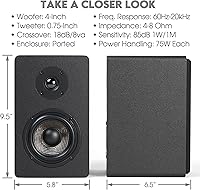
  • Woofer: A 4-inch woven carbon fiber cone with rubber surround handles mid and low frequencies with tighter transient response than conventional paper-cone drivers.
  • Tweeter: A 0.75-inch silk dome tweeter reproduces high frequencies smoothly, reducing listening fatigue during extended sessions.
  • Crossover: An 18dB-per-octave crossover network with Zobel impedance compensation and baffle step correction ensures a cohesive, balanced handoff between the woofer and tweeter.
  • Enclosure Type: The cabinet is rear-ported to extend low-frequency output and reduce port turbulence noise at moderate listening volumes.
  • Frequency Response: These speakers reproduce audio across a range of 60Hz to 20kHz, covering the full audible spectrum with the exception of deep sub-bass content.
  • Impedance: Nominal impedance is rated at 4 to 8 ohms, making these speakers compatible with most standard home stereo receivers and AV amplifiers.
  • Sensitivity: Sensitivity is rated at 85dB at 1 watt measured at 1 meter, which is on the lower end and requires a capable amplifier to achieve satisfying loudness levels.
  • Power Handling: Each speaker handles up to 75 watts of continuous power, providing adequate headroom for most home listening environments.
  • Dimensions: Each cabinet measures 9.5″ in height, 5.8″ in width, and 6.5″ in depth, making them genuinely compact for bookshelf or desktop placement.
  • Weight: The pair weighs approximately 8 pounds combined, making positioning and repositioning straightforward without requiring additional equipment.
  • Binding Posts: Full-size 5-way binding posts are installed on the rear panel, accepting banana plugs, spade connectors, pin connectors, and bare wire up to a standard gauge.
  • Grille System: A magnetic front grille attaches and detaches without pins or clips, leaving the front baffle completely clean when removed.
  • Cabinet Finish: The enclosure is wrapped in matte black vinyl over an MDF cabinet shell, giving it a clean, modern appearance that resists visible seams at normal viewing distances.
  • Signal Type: These are fully passive speakers with no internal amplification, DSP processing, or wireless connectivity of any kind.
  • Connectivity: Speaker wire connection is the sole input method, with no Bluetooth, optical, RCA, or USB inputs present on the unit.
  • Placement: Designed for indoor use only, these speakers are suited for shelf, desk, or stand placement, and are not rated for outdoor or moisture-prone environments.
  • Quantity: The product is sold as a stereo pair, including two identical speaker cabinets with no additional accessories included in the box.
  • Warranty: Micca provides a limited manufacturer warranty covering defects in materials and workmanship, with specific terms available through Micca's official support channels.

Related Reviews
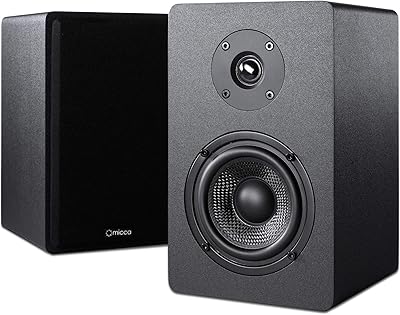
Micca PB42X Powered Bookshelf Speakers
83%
87%
Sound Quality
91%
Value for Money
76%
Bass Performance
89%
Ease of Setup
85%
Build Quality
More
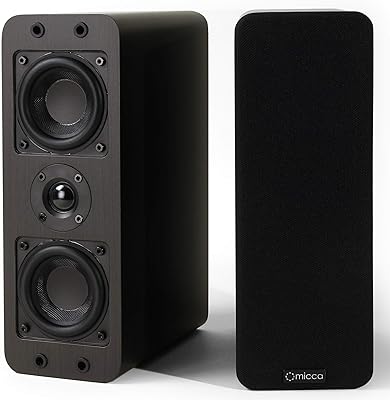
Micca OoO Passive Bookshelf Speakers
79%
86%
Sound Clarity
61%
Bass Performance
83%
Build Quality
89%
Design & Aesthetics
88%
Placement Versatility
More
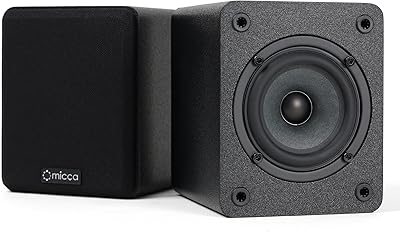
Micca COVO-S Bookshelf Speakers
76%
83%
Sound Quality
54%
Bass Performance
79%
Build Quality
91%
Value for Money
88%
Midrange Clarity
More
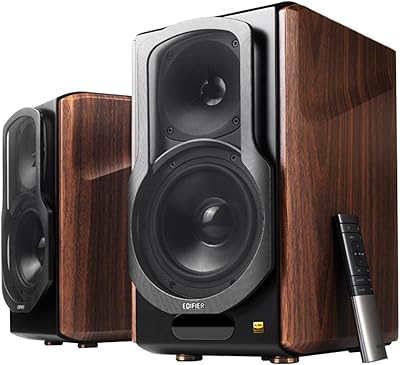
Edifier S2000MKIII Bookshelf Speakers
86%
92%
Sound Quality
89%
Bluetooth Performance
88%
Build Quality
85%
Ease of Use
91%
Connectivity Options
More
MEVOSTO DS19 Bookshelf Speakers
80%
83%
Sound Quality
79%
Bass Performance
91%
Connectivity & Input Options
86%
Bluetooth Performance
88%
USB Digital Audio
More
Probox BT16 Bookshelf Speakers
75%
78%
Sound Clarity
54%
Bass Performance
84%
Bluetooth Stability
82%
USB DAC Quality
63%
Build Quality
More
KEF Q150 Bookshelf Speakers
77%
93%
Sound Staging
91%
Vocal & Midrange Clarity
62%
Bass Performance
67%
Amplifier Compatibility
84%
Treble Smoothness
More
Sanyun SW208 3″ Bookshelf Speakers
86%
88%
Build Quality
84%
High-Frequency Clarity
91%
Mid-Range Warmth
78%
Bass Performance
93%
Control Ergonomics
More
Sanyun SW205
Sanyun SW205
78%
83%
Sound Quality
61%
Bass Performance
87%
Soundstage & Imaging
89%
Connectivity & Inputs
84%
Bluetooth Performance
More
Fluance XL8SW Bookshelf Speakers
87%
90%
Sound Quality
84%
Bass Response
91%
Clarity of Midrange
87%
Ease of Installation
88%
Design & Build Quality
More

FAQ

You will need a separate amplifier or stereo receiver to use them — these are passive speakers with no built-in amplification. If you already own an AV receiver or a stereo amp with speaker outputs, you are ready to go. First-time buyers who don't own amplification equipment should factor that additional cost into their budget before purchasing.

Because the sensitivity is rated at 85dB, you want an amp that can deliver at least 20 to 50 watts per channel at 4 to 8 ohms without clipping. A modest stereo integrated amp or an AV receiver with a decent power section works well. Avoid pairing them with very low-powered amps or budget mini-amplifiers that run out of headroom quickly — the speakers will sound flat and compressed as a result.

Not directly, no. Computers, TVs, and phones output line-level or digital audio signals, not the amplified speaker-level signal these require. You would need an amplifier or DAC-amp combination in between. There are compact stereo amplifiers purpose-built for desktop use that work well for exactly this kind of setup.

They handle bass reasonably well for their size, but they physically cannot reach below about 60Hz, so genres like electronic music, hip-hop, or cinematic soundtracks with deep sub-bass will feel incomplete without a subwoofer. For voice-forward content, acoustic music, or casual background listening, most people find the bass punchy enough without one. Adding a subwoofer later is always an option and genuinely transforms the low end.

Ideally, leave at least 3 to 4 inches of clearance between the rear of the cabinet and the wall behind it. Placing them flush against a wall can cause the port to over-pressurize the low end, producing a boomy, muddy bass character. On an open desk or a shelf with some depth, most users find placement easy without much fuss.

A portion of buyers do report the sound loosening up and becoming more open after 20 to 40 hours of regular use. It's a real phenomenon with new drivers, particularly the woofer surround. That said, if the speakers sound significantly wrong out of the box — thin, harsh, or distorted — that's more likely a setup or amp pairing issue worth investigating rather than a break-in problem.

Yes, and they're actually a popular choice for exactly that application. Their compact size makes them easy to position on rear shelves or side stands, and their balanced sound signature means they blend reasonably well with a front soundstage when the AV receiver handles channel calibration. They work best in setups where the front speakers are similarly sized rather than large floorstanders.

They're genuinely well-suited for near-field desktop use. At a typical desk listening distance of 3 to 5 feet, the imaging and midrange clarity are among the strongest attributes of Micca's compact speakers. The compact footprint fits comfortably on most desks without dominating the workspace, and the sound at moderate office volumes is natural and non-fatiguing.

Based on years of user feedback, these bookshelf speakers hold up well over time under normal indoor use. Long-term owners regularly report that their units continue to perform consistently years after purchase. The vinyl cabinet finish can scuff with rough handling, but the drivers themselves appear to be reliably built for the price category.

They don't include built-in wall mount hardware or keyhole slots on the cabinet, so dedicated wall mounting would require a universal speaker wall bracket purchased separately. For most users, a desk, shelf, or speaker stand is the practical choice. If wall placement is important to you, verify that any bracket you buy can accommodate the cabinet depth and weight before purchasing.

Where to Buy