Overview

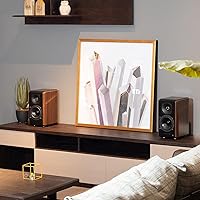
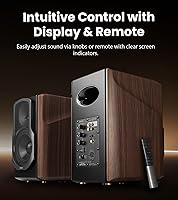
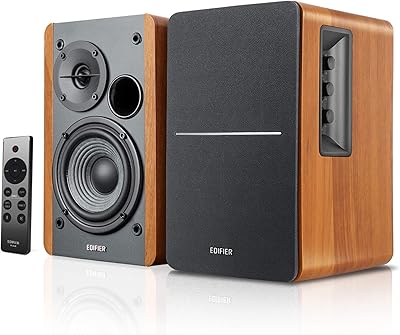
The Edifier S2000MKIII Active Bookshelf Speakers occupy a genuinely interesting space — premium enough to satisfy serious listeners, yet approachable enough to live on a home desk rather than a recording studio shelf. Upgrading from the MKII, the headline change is a new planar magnetic tweeter paired with a tri-amplified design that gives each driver its own dedicated amplifier channel. The walnut wood enclosure sets this active speaker pair apart immediately; where competitors at this price tier ship plasticky cabinets, these feel like furniture worth keeping. One practical note: they are substantial. Plan for real desk space or dedicated stands — these speakers need room to breathe.
Features & Benefits

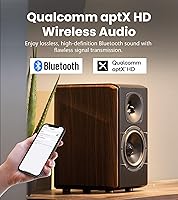
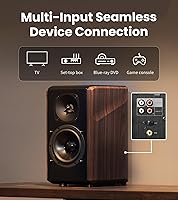
The planar magnetic tweeter is the engineering story worth telling here. Unlike dome tweeters, which push air with a rounded cap, a planar driver uses a thin membrane that moves uniformly — the result is high-frequency detail that stays clean and airy rather than edgy at volume. The 5.5-inch aluminum woofer handles the low end with real authority for a bookshelf design, though buyers expecting true sub-bass should manage expectations; this is a 2.0 system. Bluetooth with aptX HD means wireless streaming doesn't feel like a compromise. The input lineup — optical, coaxial, dual RCA — lets you keep a TV, turntable, and PC connected simultaneously, and the wireless remote handles switching between them without leaving your chair.

Best For

These Edifier bookshelf speakers are an especially strong fit for anyone building a serious desktop setup — the kind where you're streaming from a laptop, spinning records from a turntable, and occasionally feeding audio from a TV, all without wanting to swap cables. Work-from-home users get a lot of value here too, since the S2000MKIII handles calls and background music equally well from the same desk footprint. People ready to move past budget PC speakers will find this a meaningful long-term upgrade. That said, small-to-medium rooms are where these shine; in a large open space, two 5.5-inch drivers will reach their limits before you do.

User Feedback

Across a wide range of buyer reviews, two things come up repeatedly: the soundstage and treble clarity consistently outperform what buyers expected at this price point, and the walnut finish looks considerably better in person than product photos suggest. On the downside, a notable subset of users reports a faint background hiss at low volumes — particularly noticeable late at night or in quiet rooms. It doesn't appear to affect everyone, but it's worth knowing before buying. The included remote does the job, but those expecting app-based control or EQ adjustments will find it basic. Pairing the S2000MKIII with a turntable and PC simultaneously is a recurring highlight in reviews.

Pros

  • Planar magnetic tweeter delivers airy, detailed highs that most bookshelf speakers at this price simply cannot match.
  • Tri-amplified design keeps each driver running clean — distortion stays low even when you push the volume.
  • Bluetooth 5.0 with aptX HD brings wireless audio noticeably closer to wired quality than standard Bluetooth codecs do.
  • Multiple wired inputs — optical, coaxial, and RCA — let you keep several sources connected without swapping cables constantly.
  • The walnut wood enclosure looks and feels premium; build quality routinely surprises buyers who expected less.
  • Soundstage width consistently earns praise from owners, with instruments sitting in well-defined positions across the stereo field.
  • At 130 watts across three dedicated channels, there is plenty of headroom for dynamic passages without audible strain.
  • The wireless remote works reliably for input switching and volume adjustment without requiring you to leave your chair.

Cons

  • Some owners report a faint but persistent background hiss at low volumes, especially noticeable in quiet environments.
  • No subwoofer output and limited deep bass extension — this is a 2.0 system with real low-end boundaries.
  • The included remote lacks EQ control, app integration, or any display feedback — it is purely functional.
  • At roughly 37 pounds for the pair, repositioning or experimenting with speaker placement is more effort than expected.
  • Larger rooms or sustained high-volume listening can expose the limits of 5.5-inch woofers without subwoofer reinforcement.
  • No headphone output or USB audio input, which narrows connectivity options for some desktop-focused users.
  • Bluetooth real-world range through walls can fall noticeably short of the rated specification.
  • Buyers coming from budget speakers may need to upgrade their source components to fully hear what this active speaker pair can do.

Ratings

Our rating scores for the Edifier S2000MKIII Active Bookshelf Speakers are generated by AI after analyzing thousands of verified buyer reviews from global markets, with automated filters applied to remove spam, bot activity, and incentivized submissions. Each score reflects the honest weight of real user experiences rather than manufacturer claims, so both the standout strengths and the genuine pain points are transparently captured in every number. The categories below were selected specifically for this product type and weighted to reflect what actually matters to buyers of premium powered bookshelf speakers.
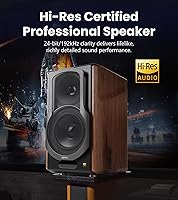
Sound Quality
89%
The planar magnetic tweeter gives these speakers a high-frequency clarity that stands out noticeably in the bookshelf category. Listeners consistently report that vocals feel present and textured, and acoustic instruments carry a sense of space that budget alternatives simply cannot replicate. For everyday listening and casual audiophile use, the overall sound signature is polished and rewarding.
At very low volumes, the experience can be undermined by the background hiss that some units exhibit — a real problem for late-night listening in quiet rooms. The low-end extension, while punchy, falls short of what a dedicated subwoofer would add, leaving bass-heavy genres like EDM or hip-hop feeling slightly lean.
Treble & Detail
91%
The planar magnetic diaphragm is the most discussed technical highlight among buyers, and the real-world results support the enthusiasm. String instruments, hi-hats, and upper vocal harmonics reproduce with an airiness and separation that dome-tweeter speakers at this price range rarely match. Users repeatedly describe the treble as detailed without ever tipping into harshness.
A small number of listeners with particularly treble-sensitive hearing find the high-end occasionally bright on certain recordings, particularly older or heavily compressed digital files. This is less a flaw and more a characteristic of planar transducers — they reveal exactly what is in the source material, including its imperfections.
Build Quality
88%
The walnut wood enclosure makes an immediate impression that product photos do not fully communicate — it looks and feels like a genuinely considered design rather than a box with veneer applied as an afterthought. Buyers coming from plasticky desktop speakers frequently cite material quality as one of the biggest and most welcome surprises.
The walnut finish, while attractive, shows fingerprints and light dust more readily than matte plastic alternatives and requires occasional wiping down. A few buyers have noted that the grille attachment feels slightly less refined than the cabinet itself, though this registers as a minor cosmetic observation rather than any structural concern.
Connectivity
87%
Having optical, coaxial, and dual RCA inputs simultaneously available — without any need to swap cables — is one of the most practically useful features of this active speaker pair. Users with a turntable, desktop PC, and television all connected at the same time consistently highlight this as a major convenience during their daily workflow.
There is no USB audio input, which means PC users wanting the simplest one-cable digital connection may need an external DAC. The absence of a headphone jack is also noted by a handful of buyers who expected one given the product's clear desktop positioning.
Value for Money
76%
24%
Within the active powered bookshelf category, the combination of planar magnetic tweeters, tri-amplification, aptX HD Bluetooth, and a solid wood enclosure is genuinely competitive at this price tier. Buyers who researched the market before purchasing consistently report feeling the hardware justifies the investment, particularly those upgrading from budget desktop speakers.
At this price point, buyers arrive with elevated expectations across every dimension, and a few shortcomings — particularly the basic remote and the hiss issue on some units — feel disproportionately frustrating given the cost. Competitors in the same tier are beginning to offer app-based control and room correction that the S2000MKIII currently does not.
Bass & Low-End
71%
29%
For a 2.0 system without a dedicated subwoofer, the 5.5-inch aluminum woofers deliver a satisfying and punchy mid-bass that works well with rock, jazz, and acoustic music. Users in smaller rooms frequently report that the low end feels full and present without overwhelming the space or cluttering the mix.
Sub-bass below around 50 Hz thins out noticeably, and in genres that depend on deep low-end weight — electronic, hip-hop, cinematic scores — the absence of a subwoofer output becomes a meaningful gap. Buyers upgrading from a 2.1 system should factor this trade-off carefully into their decision.
Bluetooth Performance
83%
Bluetooth 5.0 with aptX HD is a meaningful step above the standard codecs most wireless speakers rely on. When paired with an aptX HD-compatible source device, the wireless listening experience is noticeably cleaner and more resolved. Many users run these speakers wirelessly for casual daily listening without feeling they are shortchanging the hardware.
Real-world Bluetooth range through walls and floors falls noticeably short of the rated specification, which is a common limitation rather than a product defect. Source compatibility is also a factor — Apple device users do not benefit from aptX HD decoding, since iOS defaults to the AAC codec instead.
Soundstage & Imaging
86%
Soundstage width is one of the most consistently praised aspects across buyer reviews — listeners regularly describe a sensation that sound extends well beyond the physical speaker boundaries. Instrument separation and stereo imaging are precise enough that complex orchestral and jazz recordings feel spatially coherent and clearly defined.
Optimal imaging requires thoughtful speaker placement, including distance from rear walls and some toe-in adjustment. Buyers who position these directly against a bookshelf or wall report a noticeably muddier stereo image — a common bookshelf speaker characteristic, but a real concern for anyone working within a constrained desk setup.
Noise Floor
63%
37%
During normal listening levels, background noise is effectively inaudible and the 90 dB signal-to-noise ratio keeps program material sounding clean and uncolored. Users who run these speakers at moderate to higher volumes for music, movies, or work calls do not typically report any noise concerns during everyday use.
The background hiss audible on some units at very low volumes in quiet environments is one of the more consistently flagged concerns in buyer feedback and cannot be easily dismissed. It appears to affect a meaningful minority of units, making it a genuine pre-purchase consideration for anyone who listens in near-silence or late at night.
Amplifier Performance
92%
The tri-amplified design keeps each driver operating independently in its intended frequency range, which pays real dividends during demanding musical passages. At higher volumes, the speakers handle orchestral crescendos and rhythmically complex tracks without the compression artifacts that commonly appear in single-amplifier bookshelf designs.
The internal amplification is fixed and non-adjustable, so buyers cannot tune gain, crossover behavior, or output levels to suit their room or listening preferences. Those accustomed to working with external amplifiers that offer tone controls or adjustable crossover points may find this constraint more limiting than expected.
Remote & Controls
58%
42%
The wireless remote handles volume control and input switching reliably from across the room without requiring direct line-of-sight in most setups. For users running a straightforward single-source desk arrangement, it covers the day-to-day control needs without any real friction.
Relative to the speakers' price, the remote feels underpowered in a way buyers consistently call out. There is no companion app, no onboard EQ, no current-input display, and no way to configure a startup volume preference. In a market where app-based audio control is increasingly common, this gap is difficult to overlook.
Ease of Setup
84%
Getting these speakers up and running is genuinely straightforward — connect the inter-speaker cable, plug a source into one of the inputs, power on, and play. Most buyers report being fully set up within 15 minutes, and Bluetooth pairing requires only a single button press on the remote.
The speaker interconnect cable has a fixed length, which can restrict how far apart the two cabinets can be positioned if your setup needs more separation than a standard desktop arrangement allows. A few buyers were also initially uncertain which cabinet is the active unit, as the rear-panel labeling is easy to overlook on first inspection.
Room Suitability
79%
21%
In a small to medium-sized room — a home office, bedroom, or compact living room — these Edifier bookshelf speakers fill the space convincingly without requiring a subwoofer. Users frequently report being surprised by how much low-end authority the 5.5-inch woofers generate when room boundaries contribute naturally to the listening experience.
In larger or acoustically open spaces, the output ceiling becomes apparent at higher volumes, with bass presence thinning and overall impact diminishing before the dial reaches its upper range. Open-plan rooms with high ceilings are simply not the natural operating environment for a 2.0 bookshelf design at this driver size.
Wireless Range
77%
23%
In a typical home office or open apartment layout, the Bluetooth connection is stable and dropout-free at distances most users would realistically traverse during daily use. Switching from a wired input to Bluetooth via the remote is quick, and the connection locks in reliably once the pairing is established.
The rated 100-meter range assumes an open, obstacle-free environment that most homes cannot replicate, and through walls or across floors the practical range drops considerably. Buyers expecting to move freely between rooms while maintaining a solid connection may find the real-world performance meaningfully more limited than the specification implies.

Suitable for:

The Edifier S2000MKIII Active Bookshelf Speakers are built for listeners who want meaningful audio quality without assembling a full separates system. They work especially well for work-from-home setups where the same pair of speakers handles a morning playlist, video calls, and an evening vinyl session — all from the same desk, without touching a cable. Hi-fi enthusiasts with a source-rich setup will appreciate the ability to keep a turntable, PC, and TV connected simultaneously via the optical, coaxial, and RCA inputs. Anyone who has been nursing a pair of budget PC speakers and is ready to invest in something that will genuinely last will find this a rewarding step up. Small-to-medium rooms — a home office, a bedroom listening nook, a studio apartment living room — are where these speakers deliver their best performance, filling the space with a wide, well-defined soundstage without needing a subwoofer.
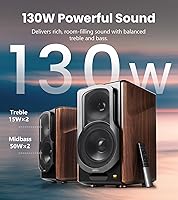
Not suitable for:

The Edifier S2000MKIII Active Bookshelf Speakers are not the right pick for everyone, and being honest about that matters. If you have a large open-plan living room or need to fill a big space with serious volume, two 5.5-inch drivers working without a subwoofer will eventually show their limits — these are not room-filling floor-standers in disguise. Buyers who expect smart-home integration, a companion app, or digital EQ controls will be disappointed; the control story here begins and ends with the included physical remote. If a low noise floor is non-negotiable — say, you work in complete silence or record in a treated space — the background hiss some users have reported at low volumes is a real concern worth weighing carefully. Anyone on a tight budget who is hoping to stretch toward this tier would likely be better served waiting and saving, rather than compromising on placement or pairing with inferior source components.

Specifications

  • Output Power: Total amplified output is 130W, distributed across three dedicated amplifier channels in a tri-amped configuration.
  • Amplifier Design: Three independent amplifier channels power the tweeter, mid-range, and woofer separately, a design known as tri-amplification that reduces inter-driver interference and distortion.
  • Tweeter Type: The tweeter uses a planar magnetic diaphragm, which moves a thin, flat membrane uniformly across its surface for cleaner high-frequency reproduction compared to conventional dome designs.
  • Woofer Size: Each cabinet houses a 5.5-inch aluminum diaphragm woofer responsible for mid-range and low-frequency output.
  • Bluetooth Version: Bluetooth 5.0 is supported with aptX HD decoding, enabling high-resolution wireless audio streaming with reduced latency compared to standard Bluetooth codecs.
  • Wired Inputs: Wired connectivity includes optical (TosLink), coaxial (S/PDIF), and dual RCA line-in inputs, allowing multiple sources to remain connected simultaneously.
  • Frequency Response: Frequency response extends up to 40 kHz, covering the full audible range and reaching into the ultrasonic spectrum.
  • SNR Rating: Signal-to-noise ratio is rated at 90 dB, reflecting a relatively clean output signal with low background noise relative to program material.
  • Bluetooth Range: Bluetooth wireless range is rated at up to 100 meters in open, unobstructed conditions.
  • Enclosure Material: Speaker cabinets are constructed from wood with a walnut finish, providing both acoustic damping and a premium aesthetic.
  • Dimensions: Each speaker cabinet measures 7.8″ deep, 10.87″ wide, and 9.53″ tall.
  • Pair Weight: The combined weight of the speaker pair is approximately 37.7 pounds (17.14 kg), reflecting the solid wood construction and internal amplifier hardware.
  • Configuration: The system is a stereo 2.0 configuration with no dedicated subwoofer channel or subwoofer output connection.
  • Remote Control: An included wireless remote handles volume adjustment and input source switching without requiring physical access to the speaker.
  • Power Source: The speakers operate on AC mains power via a standard power cable; no batteries or USB power delivery are involved.

Related Reviews
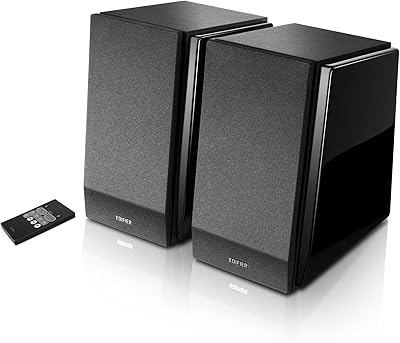
Edifier R1850DB
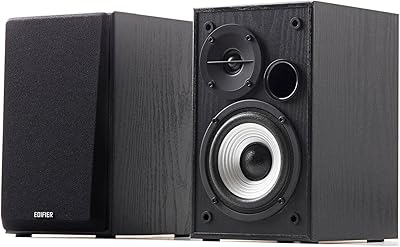
Edifier R1850DB
79%
83%
Sound Quality
93%
Connectivity & Inputs
86%
Build Quality
67%
Bluetooth Performance
81%
Value for Money
More
Edifier S1000MKII
Edifier S1000MKII
81%
91%
Sound Quality
68%
Bass Performance
88%
Build Quality
74%
Bluetooth Performance
93%
Connectivity & Inputs
More
Edifier R980T 4″ Active Bookshelf Speakers
85%
87%
Sound Quality
72%
Bass Performance
91%
Build Quality
93%
Ease of Setup
85%
Connectivity Options
More
Edifier S3000Pro Active Bookshelf Speakers
79%
93%
Sound Quality
91%
Treble Clarity
77%
Bass Performance
88%
Wireless Connectivity
84%
Value for Money
More
Majority D40 Powered Bookshelf Speakers
78%
78%
Sound Quality
86%
Value for Money
74%
Build Quality
91%
Connectivity
71%
Bluetooth Performance
More
Edifier R2000DB Bookshelf Speakers
80%
88%
Sound Quality
79%
Bass Performance
93%
Connectivity & Inputs
67%
Bluetooth Performance
86%
Build Quality
More
Edifier R1700BTs Bluetooth Bookshelf Speakers
82%
86%
Sound Quality
83%
Bass Response
71%
Bluetooth Performance
89%
Build Quality
88%
Value for Money
More
Edifier P12
Edifier P12
78%
83%
Sound Clarity
61%
Bass Performance
79%
Treble Quality
86%
Build Quality
91%
Wall-Mount Bracket
More
BESTISAN SR16 Bookshelf Speakers
78%
74%
Sound Quality
81%
Build Quality
92%
Ease of Setup
88%
LED Input Indicator
71%
Bluetooth Performance
More
Edifier R1280DBs
Edifier R1280DBs
77%
83%
Sound Quality
67%
Bass Performance
79%
Build Quality
91%
Connectivity & Input Options
72%
Bluetooth Performance
More

FAQ

These are fully active speakers with all amplification built in, so no external amp or receiver is needed. You connect your source — a computer, TV, phone, or turntable — directly to the speakers, plug into the wall, and you are ready to listen. The only setup step most people miss is running the speaker cable between the primary and secondary cabinet, which is included in the box.

It depends on your turntable. If it has a built-in phono preamp (many modern decks do, and it is usually noted on the specs or the back panel), you can connect it straight to the RCA line-in. If your turntable outputs a raw phono-level signal, you will need an inexpensive external phono preamp between the two. When in doubt, check your turntable's manual — it will tell you whether the output is line-level or phono-level.

The most meaningful change in the MKIII is the switch from a dome tweeter to a planar magnetic tweeter, which brings a noticeably airier and more detailed top end. Bluetooth 5.0 and aptX HD support are also new additions. If you are already satisfied with the MKII's sound signature, the upgrade is real but not urgent. If treble refinement and better wireless audio quality are priorities, the MKIII is a worthwhile step forward.

With aptX HD support, the wireless performance on the S2000MKIII is genuinely solid — noticeably better than standard Bluetooth. If your source device also supports aptX HD, the gap between wired and wireless listening narrows considerably for most content. For critical listening, a wired connection is still technically superior, but day-to-day wireless use from a phone or laptop is not a compromise most listeners will find frustrating.

It is worth being upfront about this. A portion of owners do report a faint hiss audible at very low volumes, most noticeable in quiet rooms when no audio is playing. It does not appear to affect every unit, and at normal listening levels it is typically masked entirely by the program material. If you routinely listen at very low volumes in near-silence — late at night, for example — this is a legitimate factor to weigh before buying.

Yes — this is one of the more practical strengths of this active speaker pair. You can leave a TV on the optical input, a PC on the coaxial input, and a turntable on the RCA input simultaneously, then switch between them using the wireless remote without unplugging anything. For anyone running a multi-source desk setup, that alone removes a lot of daily friction.

These Edifier bookshelf speakers are well-suited to small and medium-sized spaces — a typical home office, bedroom, or modestly proportioned living room. In a large, open-plan area, the 5.5-inch woofers will reach their comfortable output limits before filling the room convincingly. They are not intended to compete with floor-standing speakers in expansive spaces, but within their intended context they deliver more than enough volume and presence.

There is no companion app and no built-in EQ or room correction. All control runs through the physical wireless remote, which covers volume and input switching only. If EQ flexibility is important to your workflow, you would need to introduce an external DAC or hardware EQ unit into the signal chain, or rely on software EQ from your playback application.

A sturdy desk works fine, and many users run them that way without issue. Given the size and weight of each cabinet, a solid, stable surface is important — anything flimsy will resonate. Adding isolation pads or foam decouplers underneath each speaker on a desk noticeably improves imaging and reduces vibration transfer to the work surface. If you plan to place them away from a desk, stands rated for at least 20 pounds each are the right choice given the pair's combined weight.

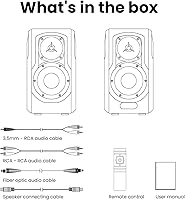
The box includes the speaker pair, the speaker interconnect cable that links the two cabinets, the wireless remote, a power cable, and a basic RCA cable for connecting an analog source. For optical or coaxial connections you will need to supply your own cable, as those are not typically included. If you are connecting via Bluetooth exclusively, you can be up and running with just the included contents.