
Overview

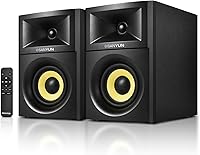
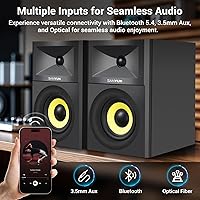
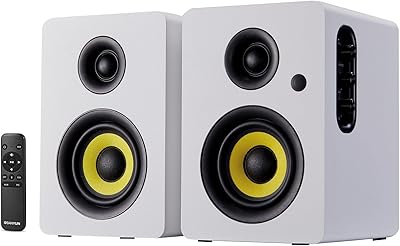
The Sanyun SW205 is a compact, active bookshelf speaker system aimed at listeners who want genuine HiFi quality without the cost or complexity of a full stereo setup. What separates these bookshelf speakers from the crowd isn't just the dual-driver configuration — a glass fiber woofer paired with a silk dome tweeter — but the fact that they pack an onboard DAC and DSP processor directly into the cabinet. That's hardware you'd normally find in a separate amplifier. The geometric diffusion cabinet draws on instrument acoustics to distribute sound more evenly, and the package includes everything needed to get started: optical cable, aux cable, power cable, and a 2.4GHz wireless remote.

Features & Benefits

The onboard DAC chip is the most meaningful spec here — when you run audio through the optical input, the conversion happens inside the speaker rather than relying on whatever's built into your TV or soundcard. In practice, that tends to produce a quieter noise floor and more resolving mid-range detail. The glass fiber woofer handles mid-bass with decent control, keeping kick drums and bass lines from turning into a blurry mess. The silk dome tweeter is genuinely smooth at higher volumes, which is rarer than it should be at this price point. Bluetooth 5.4 holds a connection reliably, and the physical EQ knobs let you adjust the tone without diving into any app.

Best For

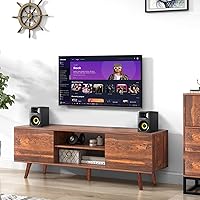
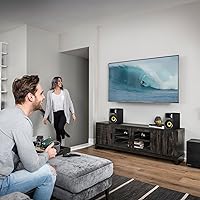
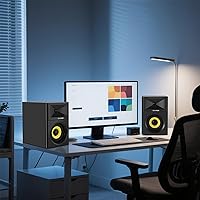
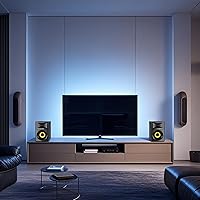
This compact HiFi pair makes most sense on a desk or a small entertainment shelf — not in a large living room where its 4-inch drivers would run out of headroom. Desktop listeners upgrading from cheap computer speakers will notice a real difference, especially through the optical input connected to a monitor or TV. It also suits apartment setups where floor-standing speakers would be overkill and a separate receiver feels like too much commitment. Frequent source switchers will appreciate having Bluetooth, optical, and AUX all in one box. For first-time buyers dipping into HiFi audio, it's a reasonable starting point that doesn't demand any additional hardware to get running.

User Feedback

Buyers tend to praise the soundstage width disproportionate to the cabinet size — several mention being genuinely surprised by how open the stereo image feels for such a small pair of speakers. Build quality gets positive marks too, with the MDF cabinet feeling solid rather than cheap. On the critical side, low-bass extension is expectably limited; listeners who want real sub-bass presence will likely need a subwoofer. The virtual surround DSP divides opinion — some find it adds welcome depth for movies, while others switch it off entirely for music. A few buyers noted the included manual is thin on detail, and the remote requires a battery that isn't in the box.

Pros

  • Built-in DAC delivers audibly cleaner audio through the optical input compared to relying on a TV or laptop output.
  • Soundstage feels impressively wide for speakers this size, especially in near-field desktop setups.
  • Bluetooth 5.4 holds a stable connection with low enough latency for casual video watching and light gaming.
  • Physical bass and treble knobs make quick tonal adjustments without any app or menu navigation.
  • The 2.4GHz wireless remote works from anywhere in the room, including behind furniture and around corners.
  • MDF cabinet feels solid and well-damped — noticeably more substantial than most speakers at this price.
  • Ships with both an optical and AUX cable, covering the most common connection scenarios right out of the box.
  • All-in-one active design eliminates the need to purchase a separate amplifier or DAC, saving real money.
  • Silk dome tweeter stays smooth at higher volumes, avoiding the harshness typical of budget speaker tweeters.

Cons

  • Sub-bass extension is limited — bass-heavy music genres feel thin without an external subwoofer.
  • Remote battery is not included, which is a minor but consistently annoying first-use friction.
  • The sparse manual makes toggling DSP modes and input priority non-obvious for less technical users.
  • Virtual surround DSP smears stereo imaging on music and is best left off for critical listening.
  • No USB audio input, which rules out a cleaner direct digital connection from a desktop computer.
  • Input switching is manual with no auto-detection when a new source becomes active.
  • The power cable is shorter than ideal, limiting placement flexibility relative to the nearest outlet.
  • Only available in one color, which limits compatibility with lighter or more neutral room aesthetics.

Ratings

The scores below were generated by AI after analyzing verified buyer reviews worldwide, with spam, bot-submitted, and incentivized feedback actively filtered out. Our model evaluated the Sanyun SW205 across every major purchase consideration — from daily listening performance to long-term reliability — and the ratings reflect both what real users celebrate and where they consistently run into frustration.

Sound Quality
83%
Most buyers describe the overall sound as surprisingly refined for the cabinet size, with vocals sitting clearly in the mix and instrumental separation that holds up well on jazz, acoustic, and pop recordings. The silk dome tweeter keeps the top end from becoming fatiguing during longer listening sessions, which is a genuine differentiator at this tier.
Listeners accustomed to larger drivers or dedicated audiophile setups will find the low-end lacks body, particularly on bass-heavy genres like electronic or hip-hop. The sound signature can feel slightly thin when the DSP is switched off and room acoustics aren't ideal.
Bass Performance
61%
39%
For a 4-inch driver, the woofer delivers reasonably controlled mid-bass — kick drums and bass guitar lines come through with decent punch rather than muddiness. Users playing indie rock or acoustic music report satisfying results without needing a subwoofer.
Sub-bass simply doesn't extend far enough to satisfy listeners who want physical impact from bass drops or cinematic low-end rumble. Several reviewers explicitly recommend pairing these with a subwoofer if bass-heavy content is a priority, which adds cost and complexity.
Soundstage & Imaging
87%
This is consistently the most praised aspect across buyer reviews. Many users note the stereo image feels wider than the physical speaker placement would suggest, making these a strong choice for desktop setups where speakers sit close together. Instrument placement feels coherent and three-dimensional on well-recorded material.
The virtual surround DSP, while helpful for movies and TV, introduces a slight smearing of imaging on precise stereo recordings. Purists tend to disable it for critical music listening, meaning the enhanced soundstage is partly dependent on a software effect rather than purely acoustic design.
Connectivity & Inputs
89%
Having optical, AUX, and Bluetooth 5.4 in one compact active speaker is genuinely practical — users switching between a TV, laptop, and phone throughout the day don't need a separate switch box or receiver. The optical input in particular is well-regarded for improving audio quality from TVs with poor built-in DACs.
There is no USB audio input, which some desktop users consider a more direct digital connection than AUX. A small number of reviewers also noted that input switching requires cycling through options manually rather than auto-detecting the active source.
Bluetooth Performance
84%
Bluetooth 5.4 holds a stable connection in real-world home environments, and users report fast, reliable pairing with phones and tablets. Latency is low enough for casual video watching and light gaming, which covers most wireless use cases these speakers are bought for.
Audiophiles streaming high-resolution audio wirelessly will note that Bluetooth compression remains a ceiling regardless of the protocol version. A few buyers also flagged occasional reconnection delays after the speakers wake from standby.
DAC & DSP Engine
82%
18%
The built-in DAC meaningfully improves the listening experience when using the optical input, producing a noticeably quieter noise floor compared to relying on a TV or budget soundcard's onboard conversion. Users upgrading from passive speakers with a cheap amplifier often comment that the integrated approach simplifies their setup without sacrificing clarity.
The DSP virtual surround effect is polarizing — it works well for movie dialogue and ambient soundscapes but is too diffuse for critical stereo music listening. There is no app or remote-accessible way to fine-tune the DSP beyond a simple on/off toggle.
Build Quality
78%
22%
The MDF cabinet feels solid and well-damped when handled, and the finish is clean enough to sit in a living room without looking out of place. Most buyers mention the speakers feel more substantial than they expected given the price point.
The grille attachment and some of the input port tolerances feel less precise than the cabinet itself, giving a slightly inconsistent impression of overall fit and finish. The front baffle material shows fingerprints easily on the black finish.
Remote Control
76%
24%
The 2.4GHz wireless remote is a genuine step up from infrared — it works from behind furniture, around corners, and from across the room without needing line of sight. Volume adjustment and input switching feel responsive in everyday use.
The battery is not included, which is a minor but consistently mentioned frustration in reviews. The remote's physical build feels lightweight and plasticky relative to the speakers themselves, and the button layout takes a few days to learn by feel in a dim room.
EQ & Customization
74%
26%
Physical bass and treble knobs on the speaker body are a practical touch — dialing in more warmth for late-night listening or boosting treble for spoken-word podcasts takes seconds without any app involvement. The dedicated bass boost button on the remote is convenient for quickly switching listening modes.
The EQ range is limited to two parameters, and there are no preset sound profiles or a companion app for more granular control. Users who want to notch out a resonance frequency or shape a custom curve will find the onboard options insufficient.
Setup & Ease of Use
81%
19%
The included cable kit covers the most common connection scenarios out of the box, and the speakers power on and pair quickly without a confusing initialization process. Most buyers report being up and running within a few minutes of unboxing.
The included manual is sparse, and figuring out how to toggle the DSP mode or navigate input priority isn't immediately obvious. A few buyers with less technical experience mentioned consulting online resources to complete their setup.
Value for Money
86%
Considering the active amplification, onboard DAC, and multi-input flexibility, the SW205 offers a strong feature-to-price ratio that passive bookshelf speakers at the same price simply cannot match. For first-time HiFi buyers, it removes the need to separately budget for an amplifier or DAC.
Buyers who already own a capable amplifier may find they are paying for processing hardware they don't need. In pure acoustic terms — driver quality alone — there are passive alternatives at a lower price that some experienced listeners would prefer.
Design & Aesthetics
72%
28%
The geometric cabinet shape is distinctive enough to stand out from the generic rectangular box that defines most budget speakers. The clean black finish suits both desk environments and media console setups without drawing unwanted attention.
The curved baffle design, while acoustically motivated, makes placement on some stands or shelves slightly awkward due to the non-flat front face. There is currently only one color option, which limits compatibility with lighter-toned room decor.
Volume & Room Coverage
68%
32%
For a desk or a small to medium bedroom, the output is more than sufficient — buyers report clean, undistorted sound at volumes well above normal listening levels in compact spaces. The wide dispersion from the curved baffle means off-axis listening remains balanced.
In larger living rooms or open-plan spaces, the SW205 runs out of headroom before filling the room convincingly. Users expecting to cover a party or a large lounge with these speakers will be disappointed, as the drivers simply aren't sized for that task.
Packaging & Accessories
71%
29%
The inclusion of both an optical cable and an AUX cable means most users won't need to make an additional purchase before their first listening session. The packaging is secure and the speakers arrive well-protected.
The missing remote battery is a recurring minor complaint that creates an unnecessary extra errand before first use. Some buyers also noted the power cable length is shorter than ideal for setups where the outlet isn't conveniently located near the listening position.

Suitable for:

The Sanyun SW205 is a strong match for anyone who wants a real audio upgrade without committing to a full stereo receiver and separate component chain. Desktop listeners in particular get a lot of value here — the built-in DAC means connecting a monitor or TV via optical delivers noticeably cleaner audio than a headphone jack or cheap onboard soundcard would. Apartment dwellers and small-room listeners will find the output more than adequate for the space, and the compact cabinet won't dominate a desk or shelf. If you regularly switch between a phone, a laptop, and a TV throughout the day, having Bluetooth, AUX, and optical all in one box removes a real point of friction. First-time HiFi buyers are also well served — this compact HiFi pair removes the guesswork of matching an amplifier to passive speakers, making it a practical, low-barrier entry into higher-quality sound.

Not suitable for:

Buyers who prioritize deep, physical bass should look elsewhere or budget for a subwoofer alongside the Sanyun SW205, because 4-inch drivers have a physical ceiling on low-frequency extension that no amount of DSP processing can fully overcome. Experienced audiophiles with an existing amplifier setup will likely find the integrated electronics redundant and may get more acoustic value from passive alternatives at a comparable price. Anyone trying to fill a large living room or open-plan space will be disappointed — these speakers are sized and tuned for near-field and small-room listening, not whole-room coverage. The virtual surround DSP, while useful for movie watching, is a software approximation and won't satisfy critical listeners who want precise, uncolored stereo imaging for serious music listening. Finally, if you need USB audio input for a direct digital connection from a computer, the input selection here won't cover that use case.

Specifications

  • Driver Config: Each cabinet houses a 4-inch glass fiber woofer and a 20mm silk dome tweeter working together to cover the full audible frequency range.
  • Output Power: The integrated amplifier delivers up to 80W total, providing ample headroom for small to medium room listening at high volumes without audible clipping.
  • Frequency Response: The system is rated to reproduce audio from 20 Hz to 20 kHz, covering the full range of human hearing across music, dialogue, and effects.
  • Impedance: The speakers present a 4-ohm load, which is relevant only if connecting to an external amplifier — the built-in amp is already matched to drive them correctly.
  • Signal-to-Noise Ratio: An 80 dB SNR rating indicates a clean noise floor for a powered speaker at this price tier, meaning background hiss during quiet passages is minimal.
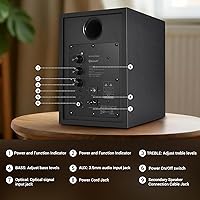
  • Connectivity: Three inputs are available: Bluetooth 5.4 for wireless devices, optical TOSLINK for TVs and consoles, and a 3.5mm AUX jack for any wired analog source.
  • Audio Engine: An onboard dual-core DAC and DSP processor handles digital-to-analog conversion and virtual surround sound processing without requiring any external hardware.
  • Cabinet Material: The enclosure is constructed from MDF (medium-density fiberboard) and features a curved geometric diffusion shape designed to reduce internal resonance and widen sound dispersion.
  • Remote Type: The included remote uses 2.4GHz wireless technology, allowing omnidirectional control from anywhere in the room without requiring a direct line of sight to the speakers.
  • EQ Controls: Physical bass and treble rotary knobs are located on the speaker body, and a dedicated one-touch bass adjustment button is also available on the wireless remote.
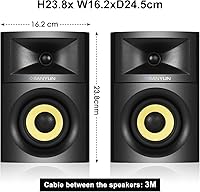
  • Dimensions: Each speaker measures 9.65″ deep by 6.38″ wide by 9.37″ tall, making them compact enough for most desks, shelves, and media console setups.
  • Weight: The pair weighs 12.23 lbs combined, indicating a solid MDF build that should remain stable on a shelf or desktop without additional securing.
  • Power Source: The speakers are corded electric, rated for 100V input, and require a standard wall outlet — there is no battery or passive operation mode.
  • Included Accessories: The box includes one optical TOSLINK cable, one 3.5mm AUX cable, one power cable, and one 2.4GHz wireless remote control (battery for the remote not included).
  • Bluetooth Version: Bluetooth 5.4 provides a more stable connection, faster initial pairing, and lower audio latency compared to older Bluetooth versions commonly found in budget speakers.
  • Surround Sound: The DSP engine offers a virtual surround sound mode that processes stereo signals to simulate a wider, multi-dimensional soundstage — this is a software effect, not a physical multi-speaker configuration.
  • Color Options: The SW205 is currently offered in a single black finish with a classic rectangular cabinet profile suited to most desk and home theater environments.
  • Warranty: The product carries a limited warranty as stated by the manufacturer; buyers should confirm the specific duration and coverage terms directly with the seller at time of purchase.

Related Reviews
Sanyun SW206
Sanyun SW206
81%
83%
Sound Quality
78%
Dual Sound Modes
93%
Connectivity & Inputs
71%
Bluetooth Performance
86%
Build Quality & Cabinet
More
Sanyun SW203
Sanyun SW203
80%
86%
Sound Clarity
63%
Bass Response
82%
Soundstage & Imaging
91%
Connectivity & Input Options
78%
Bluetooth Stability
More
Sanyun SW102 Computer Speakers
79%
74%
Sound Quality
71%
Bass Performance
78%
Build Quality
66%
Cable & Controls
93%
Setup & Ease of Use
More
Sanyun SW209
Sanyun SW209
79%
83%
Sound Clarity
61%
Bass Performance
86%
USB DAC Quality
78%
Bluetooth Stability
72%
EQ Modes Usefulness
More
Sanyun SW208 3″ Bookshelf Speakers
86%
88%
Build Quality
84%
High-Frequency Clarity
91%
Mid-Range Warmth
78%
Bass Performance
93%
Control Ergonomics
More

FAQ

No — the SW205 is an active speaker system with amplification built directly into the cabinet. You just plug them into the wall, connect your source via Bluetooth, optical, or AUX, and they are ready to go. No receiver or external amp required.

Yes, and that is actually one of the best ways to use them. Most modern TVs have a TOSLINK optical output, and an optical cable is already included in the box. This connection routes audio through the speakers' onboard DAC rather than your TV's internal one, which typically results in cleaner, more detailed sound.

In everyday use, the Bluetooth 5.4 connection has low enough latency that video watching on a phone or laptop is not a problem for most users. That said, if you are extremely sensitive to audio sync or doing precision work in a DAW, a wired connection via AUX or optical will always be tighter.

It depends heavily on what you are listening to. For movies and TV shows, many users find it genuinely adds a sense of spaciousness that works well in a small room. For music — especially anything where you want precise stereo imaging — most experienced listeners prefer to leave it off, as it can soften the focus of the soundstage.

Honestly, they are not the best fit for genres where deep sub-bass impact is central to the experience. The 4-inch woofer manages mid-bass reasonably well, but the physical low-frequency extension of a driver this size has real limits. If bass is a priority for you, pairing these with a compact subwoofer would make a meaningful difference.

The remote takes a standard AAA or similar small battery — you will need to check the remote's battery compartment for the exact size when yours arrives. It is a minor but common frustration that it is not bundled in the box, so having a spare battery on hand before you unbox the speakers will save you a trip to the store.

Yes, they work well for gaming on a desktop setup. The Bluetooth 5.4 connection is stable enough for casual gaming without distracting sync issues, and the optical or AUX inputs give you a wired option if you need tighter latency. The soundstage is wide enough to give games reasonable directional cues in a near-field setup.

One speaker handles the amplification and processing and connects to the wall power, while the other connects to the primary speaker via a speaker cable. Both need to be connected — neither operates completely on its own, but only one requires the main power connection.

Not directly — the speakers have a line-level AUX input, and most turntables output a phono-level signal that requires a preamplifier to boost and equalize before it reaches a line-level input. If your turntable already has a built-in phono preamp (many modern entry-level tables do), you can connect it via the 3.5mm AUX input without any issues.

These bookshelf speakers actually perform quite well at low volumes — the silk dome tweeter and the onboard DSP processing help maintain tonal balance even when you dial things down. You won't experience the muddy or hollow sound that some budget speakers suffer from at low listening levels, which makes them a reasonable choice for quiet evening or night-time listening.